

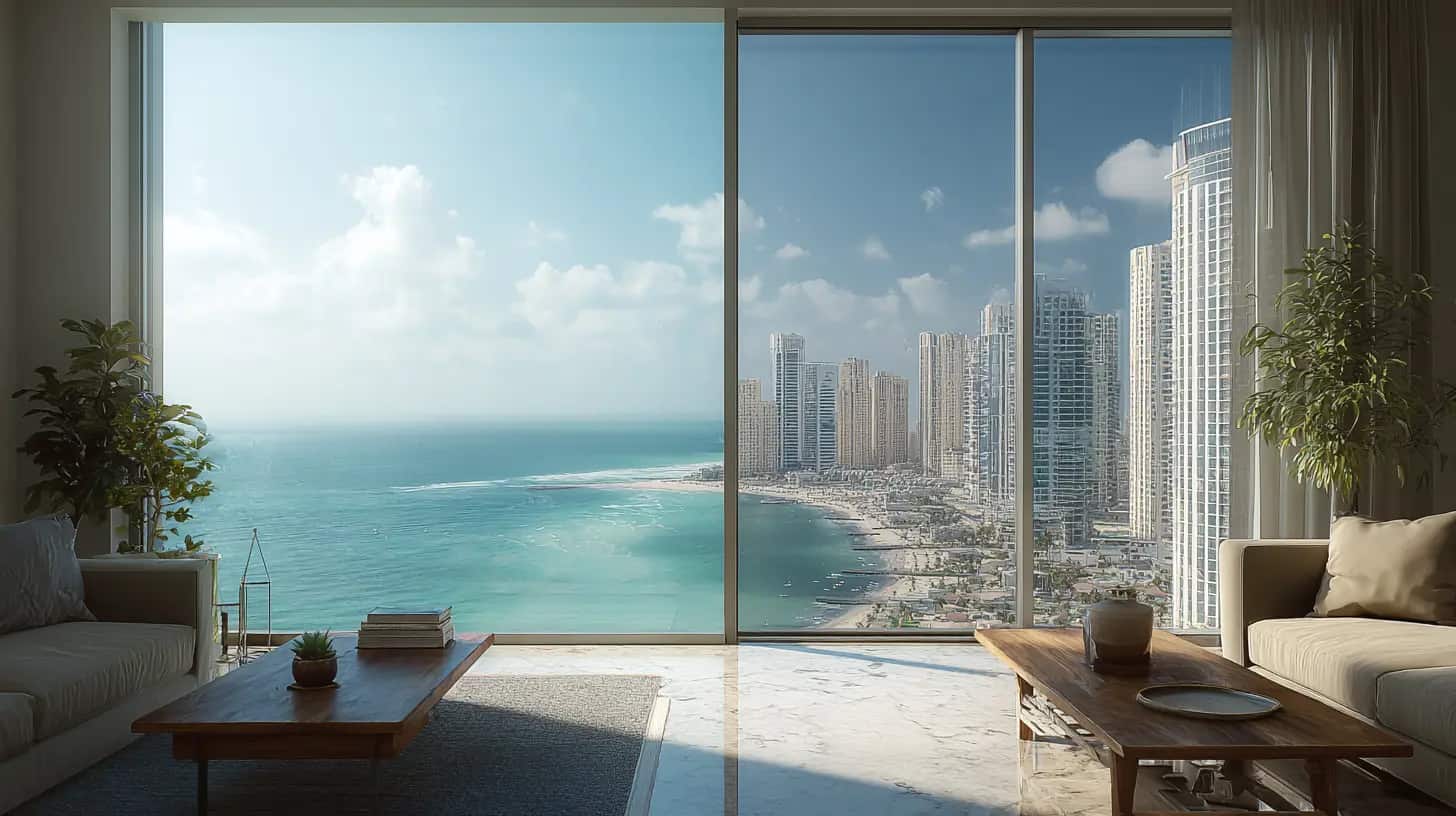
Why Ajman Is Emerging as a Real Estate Destination
Nobody Was Talking About Ajman Five Years Ago. The Market Changed That. There exists a certain form of investment opportunity that mainstream real estate discussions have consistently…
Nobody Was Talking About Ajman Five Years Ago. The Market Changed That.
There exists a certain form of investment opportunity that mainstream real estate discussions have consistently failed to consider—namely, that which has been quietly developing true fundamentals, under the radar, as all eyes have been focused on more sensationalized possibilities. Dubai has had its moment in the sun. RAK has had its turn in the spotlight with the Wynn announcement. Abu Dhabi has had its chance with the Guggenheim and institutional investment dollars flowing in. Ajman has had its own way of going.
What Ajman has done is worthy of close study in 2026. It has achieved three consecutive years of growth in transaction volumes. Non-national freehold transactions have grown from 22% of total transactions in 2020 to 34% in 2024. Studio apartments priced at AED 150,000 to AED 250,000, one-bedroom apartments priced at AED 250,000 to AED 450,000—entry levels that Dubai residents might think are ludicrously low—are generating a gross return of 8% to 12% in suitable communities. The regulatory environment has been gradually improved. An infrastructure investment pipeline has been increasingly accelerated. And a story of demographics—a growing resident population that is working and needs housing—remains relevant and continues unabated.
None of these things makes Ajman comparable to Dubai. Such a comparison is an inappropriate frame. Ajman’s investment story is not built on skylines, branded residences, and fame. Ajman’s investment story is built on fundamentals that more glamorous markets cannot deliver on at Ajman’s price point. Those fundamentals include the highest rental yields available anywhere in the UAE, entry price points that allow for positive cash flow for investors priced out of every other emirate, and a tenant profile that is stable, employed, and lacks alternative choices at Ajman’s price point.
The question for investors in 2026 is no longer whether Ajman is a viable market. The transactional record shows that it is. The question is whether they understand what they are buying into—their investment profile, risks, and management style that makes Ajman’s numbers concrete as opposed to abstract. This article will seek to answer these questions comprehensively.
What's Changed in Ajman Over the Past Five Years
Five years ago, Ajman's case for international investor attention rested primarily on yield figures that were impressive and a price point that was accessible. The market was real but thin — a limited number of freehold zones, a limited development pipeline, and a limited professional services ecosystem around property management, legal advice, and transaction support.
The Ajman of 2026 is materially different in several respects.
The freehold zone expansion has been the most significant structural change. Ajman progressively expanded the areas where non-nationals can purchase freehold property through the 2010s and into the 2020s. The designated freehold zones now include Al Nuaimiya, Al Rashidiya, Ajman Corniche, Al Hamidiya, and several newer zones. This expansion has broadened the investable market significantly and has attracted developers and investors who were previously excluded by ownership restrictions.
Infrastructure investment has been accelerating visibly. The Ajman government has committed to road improvement programmes connecting the emirate more efficiently to Sharjah and Dubai's road network. The Ajman Corniche has been upgraded in phases, improving the quality of the waterfront public realm. New healthcare facilities, retail centres, and education infrastructure have been added progressively as the residential population has grown. These investments are not dramatic in the way that a casino resort announcement is dramatic. They are the steady accumulation of functional infrastructure that makes a city genuinely liveable rather than just affordable.
The developer landscape has broadened. Ajman's residential market was historically dominated by smaller local developers with limited track records and variable quality. The past three years have seen regional and national developers — including some with established UAE track records — entering the Ajman market, bringing better build quality, more professional sales and marketing processes, and more credible delivery timelines.
According to the Ajman Real Estate Regulatory Agency's 2024 Annual Market Performance Report, residential transaction values in Ajman increased 31% year on year in 2024, with off-plan transactions growing from 18% of total volume in 2021 to 29% in 2024. That shift toward off-plan activity signals growing investor confidence in developer delivery, which is a meaningful indicator of market maturation. The full data is available through ARRA's official market reports.
The Yield Story: Why the Numbers Are Hard to Ignore
The fundamental investment case for Ajman is income yield, and the numbers are genuinely exceptional relative to any comparable market in the region.
Studios in Al Nuaimiya and Al Rashidiya are generating AED 18,000 to AED 28,000 in annual rent on properties that transact at AED 150,000 to AED 250,000. That's a gross yield range of 8% to 12% — numbers that put Ajman at or near the top of any UAE yield comparison and that compare favourably with most mature rental markets globally.
One-bedroom apartments are generating AED 25,000 to AED 42,000 annually on properties priced at AED 250,000 to AED 450,000 — gross yields of 7.5% to 11%. Two-bedroom apartments on the Ajman Corniche are achieving AED 45,000 to AED 65,000 annually on properties at AED 500,000 to AED 800,000 — gross yields of 7% to 9%.
These yields exist for a specific reason that investors need to understand rather than just celebrate. Ajman's yields are high because the tenant base earns less than Dubai's tenant base, because the properties are genuinely affordable to purchase, and because the rental market is competitive enough that rents can't run far ahead of what residents can pay. This is not a mispriced market in the way that implies hidden value waiting to be unlocked — it is a correctly priced market for the income level and socioeconomic profile of its residential population.
What that means practically is that the yield is real and deliverable in the right buildings with the right management, but it doesn't compound into capital appreciation the way that yield compression in a repricing market does. Ajman's yields have been 8% to 12% for several years. They will likely remain in that range. The market isn't going to reprice to 5% yields as capital floods in, because the fundamental demand driver — affordable housing for working-income residents — doesn't change the yield equation the way luxury demand does in Dubai or Abu Dhabi.
Property consultant Andrew Cummings, who has tracked Gulf residential markets for over fifteen years, noted in a 2024 Northern Emirates analysis for MENA Property Insights: "Ajman represents the rare combination of a functioning rental market with consistent demand, yields that reflect genuine income returns rather than speculative optimism, and entry prices that allow investors with modest capital to build real portfolio positions. The limitation is the appreciation ceiling, not the income story."
The Tenant Base: Who Lives in Ajman and Why
Understanding Ajman's tenant profile is fundamental to understanding the investment dynamics — because the tenant determines not just the yield but the management experience, the risk profile, and the practical realities of owning a rental property here.
Ajman's residential population is predominantly working and lower-middle income. Government employees from Ajman's administration and services sector. Teachers, healthcare workers, and support staff from the emirate's schools and clinics. Blue-collar workers and tradespeople from the industrial zones on the emirate's periphery. A significant segment of people who work in Sharjah or Dubai and have chosen to live in Ajman because housing is thirty to fifty percent cheaper for equivalent space.
This tenant profile has specific investment implications. The demand is genuine — these residents need housing and Ajman's price level is often the only option within their budget. Vacancy rates in well-managed buildings in central Ajman are consistently below 10% and often below 5%. The tenant base is stable and renews consistently when rents are managed at levels that are genuinely affordable relative to local incomes.
The same profile also means income sensitivity. When economic conditions tighten, Ajman's tenants feel it more quickly than Dubai's. Rent payment reliability is generally good in normal economic conditions and more variable in downturns. Tenant screening — employment verification, salary confirmation, reference checks — matters more in Ajman than in Dubai's mid-market because the consequences of placing a non-paying tenant in a low-yield, lower-value property are proportionally more significant.
The commuter segment — residents who live in Ajman and work in Dubai or Sharjah — is a growing and relatively more stable tenant subset. These residents typically have higher incomes than the purely local employment base and are choosing Ajman deliberately for the cost-of-living advantage. They tend to stay longer, maintain properties better, and pay more reliably. Buildings and communities that attract commuter tenants generally outperform those dependent entirely on the local employment base.
The Infrastructure Build-Out: What's Actually Happening
Ajman's infrastructure development is less dramatic than building a casino resort or a cultural island, but it is cumulatively significant and it is changing the quality of daily life in the emirate in ways that matter for both residential demand and property values.
The road improvement programme connecting central Ajman to the Sharjah-Dubai highway network has reduced average commute times for Dubai-working residents by ten to fifteen minutes on several key routes. This is a meaningful quality-of-life improvement for the commuter segment that is now one of Ajman's most valuable tenant demographics.
The City Centre Ajman expansion — the emirate's primary retail anchor — has added F&B and retail capacity that strengthens the daily-life infrastructure of the central communities. Matajer Al Zahra, Uptown Ajman, and several smaller retail developments have added walkable retail options to communities that previously required a drive for most shopping.
New healthcare infrastructure includes the expansion of Sheikh Khalifa General Hospital and the addition of several private clinic networks that have improved healthcare accessibility in the emirate. For families considering Ajman as a long-term residence — not just a low-cost option — healthcare access is a primary consideration and the improvement here is real.
The education landscape has expanded with the addition of several new schools catering to the expatriate population, including campuses of established UAE school brands that have moved into the emirate as the residential population has grown. This matters for the commuter family segment — the profile that represents Ajman's most financially stable tenant demographic — who need to be able to school their children locally.
Ajman's free zone ecosystem — AFZA (Ajman Free Zone Authority) — has been attracting light industrial and trading businesses that generate employment within the emirate. Every employed resident is a potential tenant, and the free zone's growth contributes to the domestic employment base that underpins the residential rental market independently of Dubai commuter demand.
Where Capital Appreciation Actually Comes From in Ajman
Ajman is primarily a yield market, not an appreciation market. That needs to be stated clearly because investors who approach it with Dubai's appreciation expectations will be disappointed, and investors who understand it correctly will be satisfied.
Capital appreciation in Ajman since 2020 has been 20% to 40% across most communities — real and meaningful, but below what comparable Dubai and Abu Dhabi communities have delivered over the same period. The Corniche has appreciated toward the top of that range. Al Rashidiya toward the bottom.
The appreciation that has occurred is driven by two forces. The first is the general UAE repricing cycle — the market-wide price increase that has affected all UAE real estate since 2020 and has not bypassed Ajman, even if it has been less dramatic here than in the more glamorous markets. The second is the genuine fundamental improvement in Ajman's infrastructure and regulatory environment — the freehold expansion, the road improvements, the infrastructure additions — that has made the emirate meaningfully more investable than it was five years ago.
The appreciation ceiling in Ajman is set by the yield floor. Properties generate 8% to 12% gross yields because they're priced to deliver those yields to the market's tenant base. If capital values rise significantly, yields compress. If yields compress below a certain level, the income case for investing in Ajman rather than a higher-quality market weakens and capital redirects. This self-limiting mechanism is not unique to Ajman — it applies to any yield-driven market — but it operates more obviously here because the gap between Ajman and Dubai's quality tier is large enough to create a strong pull on capital that seeks higher total return.
Investors who understand this mechanism — who buy for yield and treat appreciation as a bonus rather than a primary objective — are well-positioned in Ajman. Investors who are primarily seeking capital growth should look at Dubai Hills, the Palm, or Creek Harbour.
Gaia Realty Original Research: Ajman Market Snapshot, Q1 2026
Based on Ajman Land Department transaction records, ARRA market data, active listing analysis, and rental registration data as of Q1 2026.
Transaction volume growth 2020 to 2025:
- Total residential transactions 2020: 4,200
- Total residential transactions 2025: 7,800 — growth of 86%
- Non-national freehold purchases as share of total: 22% in 2020 to 34% in 2025
- Off-plan transactions as share of total: 18% in 2021 to 29% in 2025
Gross yield by community and product type:
- Al Nuaimiya studio: AED 150K to AED 250K entry, yield 9% to 12%, occupancy avg. 91%
- Al Nuaimiya 1-bed: AED 250K to AED 420K entry, yield 8% to 11%, occupancy avg. 89%
- Ajman Corniche 1-bed: AED 350K to AED 550K entry, yield 7% to 9%, occupancy avg. 85%
- Al Rashidiya 1-bed: AED 200K to AED 360K entry, yield 9% to 12%, occupancy avg. 87%
- Al Hamidiya 3-bed villa: AED 1.2M to AED 2.2M entry, yield 5.5% to 7%, occupancy avg. 91%
Capital appreciation since 2020 by community:
- Ajman Corniche: 30% to 45%
- Al Nuaimiya: 25% to 40%
- Al Rashidiya: 20% to 35%
- Al Hamidiya villas: 18% to 30%
Average days on market 2025:
- Al Nuaimiya: 35 days
- Ajman Corniche: 43 days
- Al Rashidiya: 49 days
- Al Hamidiya: 58 days
International buyer origin (non-national freehold purchases, 2024):
- South Asian (Indian, Pakistani, Bangladeshi): 44%
- Arab (non-UAE): 28%
- European: 14%
- Other: 14%
The Risks That the Yield Number Doesn't Tell You
Ajman's investment case is real. The risks that accompany it are also real and deserve explicit treatment rather than footnote status.
Liquidity is the primary structural limitation. Ajman's secondary market is thin — average days on market of 35 to 58 days across the main communities, and in a genuine market downturn those timelines extend significantly. Investors who might need to exit their Ajman holdings within a year or two of purchase should hold that possibility against a market where buyers are fewer and less competitive than in Dubai. An investment that requires a flexible exit timeline is a different proposition from one that can be liquidated quickly.
Build quality variance is higher than in Dubai. The regulatory framework for construction in Ajman has improved but still produces more variance across the developer landscape than Dubai's more tightly policed environment. Buildings from developers with completed UAE portfolios — whose quality standards are verifiable — are a meaningfully safer proposition than first-Ajman-project developers whose promises haven't been validated by delivery. Due diligence on the specific developer's track record in Ajman or elsewhere in the UAE is the most effective mitigation.
Property management infrastructure is less developed. The professional ecosystem of tenant screening companies, maintenance networks, and short-term rental operators that makes remote Dubai investment manageable is thinner in Ajman. Investors managing Ajman properties remotely need to invest more effort in establishing reliable management arrangements, and the margin for poor management is smaller relative to the asset value.
Tenant income sensitivity is genuine. Ajman's rental market absorbs shocks from the broader UAE economy more quickly than Dubai's because the tenant base has less financial buffer. Businesses contracting, layoffs in the emirate's employment sectors, or broader economic weakness affect Ajman tenants' ability to pay rent more quickly than they affect Dubai's professional class. This is a risk that doesn't often materialise but needs to be in the risk model.
The regulatory environment, while improving, remains less mature than Dubai's in some specific respects. The dispute resolution processes, the escrow requirements for off-plan, and the enforcement mechanisms are all developing — which means investors who encounter problems have access to legal remedies but those remedies may take longer and require more effort than comparable Dubai disputes.
For buyers interested in exploring what's currently available in Ajman's freehold zones, our Ajman listings are updated with current secondary and off-plan product.
Questions People Ask About Ajman as an Investment Destination
Is Ajman's property market regulated properly for foreign buyers?
Yes. ARRA — the Ajman Real Estate Regulatory Authority — oversees the freehold market and property registration. Non-nationals can buy, own, and sell in designated freehold zones with full legal protection. The regulatory framework is less developed than Dubai's RERA but it is functional and improving.
Can I get a mortgage to buy in Ajman?
Yes, though fewer lenders operate in the Ajman market than in Dubai. Ajman Bank, Emirates Islamic, and several other UAE lenders offer residential mortgages on Ajman freehold property. LTV ratios and rates are broadly governed by the same UAE Central Bank rules that apply nationally.
Why are Ajman yields so much higher than Dubai's?
Entry prices are lower, reflecting lower underlying land costs and a less premium market position. Rental rates are set by what a working-income tenant base can afford to pay. The combination produces yields that look exceptional by regional standards. The yield is real but it reflects the market's character, not mispricing.
How does Ajman compare to JVC for investment?
JVC wins on capital appreciation, secondary market liquidity, and brand recognition with international tenants. Ajman wins on gross yield, entry price, and occupancy consistency in well-located buildings. JVC suits investors seeking total return. Ajman suits income-focused investors at accessible entry prices.
Is the commute from Ajman to Dubai manageable?
Outside rush hours, yes — 40 to 50 minutes. During peak morning traffic through Sharjah, 70 to 90 minutes. Daily Dubai commuting is hard and many residents report fatigue within six months. Three to four days per week hybrid working makes it genuinely manageable for the commuter tenant segment.
What's the minimum investment for a positive cash-flow Ajman property?
Studios in Al Rashidiya start around AED 140,000 to AED 200,000 and generate yields that cover mortgage payments at standard UAE LTV ratios in the current rate environment. Positive cash flow from day one is achievable here at price points that no other UAE market can match.
Are there plans for major development in Ajman that could reprice the market?
Several significant infrastructure investments are underway or planned — road improvements, healthcare expansion, new free zone capacity. No single Wynn-scale catalyst exists currently. The repricing in Ajman is cumulative and infrastructure-driven rather than event-driven, which makes it more predictable and less volatile.
Is short-term rental viable in Ajman?
On the Corniche, with improving domestic tourism demand, the numbers work in peak season. Inland communities are weak for short-term rental. The short-term rental management infrastructure in Ajman is less mature than Dubai's and operating a holiday home here requires more hands-on involvement or a Dubai-based operator willing to extend coverage.
How do service charges in Ajman compare to Dubai?
Significantly lower — AED 5 to AED 12 per square foot annually versus AED 12 to AED 25 in comparable Dubai mid-market communities. This improves net yield meaningfully and is one of the factors that makes the headline gross yield more achievable in practice than comparable gross yields in higher-cost markets.
Will Ajman prices rise significantly in the next five years?
Moderate appreciation is likely as infrastructure matures and the non-national buyer market continues to grow. Dramatic repricing of the kind Dubai experienced between 2020 and 2024 is less likely without a major demand catalyst. The investment thesis should not depend on dramatic appreciation.
Does buying in Ajman qualify for a Golden Visa?
The federal AED 2 million threshold applies across all emirates. Most Ajman properties sit well below this threshold. Investors seeking Golden Visa benefits from property purchase should look at higher-value UAE markets. Ajman is an income play, not a visa play.
What's the single most important thing to get right when investing in Ajman?
Building selection and management quality. A 10% headline yield in a poorly managed building in a peripheral location nets considerably less once vacancy, maintenance costs, and management friction are accounted for. The best Ajman investments are well-located within their communities, in buildings with established management, with professionally screened tenants. The headline yield is available. Making it real requires doing this work.
Ajman's Moment Is Quiet. That's Part of What Makes It Worth Paying Attention To.
The markets that create the most noise within the UAE property market tend not to be those that deliver the most reliable performance for a specific type of investor. The story of Dubai is very real: price growth on the Palm, sellout rates for launches, and branded residences that attract global media attention. This is very much priced into the market, and it is competitive and unaffordable for most investors. Ajman, on the other hand, is a very different story. Transaction volume growth is steady rather than spectacular. Infrastructure development is incremental rather than transformational. International investor interest is incremental year by year rather than being driven by a single piece of news. Yields are consistent and high rather than being driven by speculation. The market is evolving rather than erupting. For those seeking yields as opposed to capital growth, and seeking reliable, high-yielding rental returns on affordable capital within a price point that allows for positive cash flow without requiring AED 2 million of investor equity, Ajman delivers in a manner and to a degree that no other market within the UAE is capable of matching. The limitations of Ajman, such as liquidity, the ability to appreciate, and management, are very real but can be addressed by using the right strategy. The investor that will look back on 2025 and 2026 as being the time when Ajman positions were most appropriately established will not be those that waited for an announcement that put Ajman on the global property map. They will be those that recognized that the fundamentals were already established, that the market is already functioning, and that the lack of glamour is not a weakness but a defining feature of a market that is more interested in delivering for income-focused investors than for momentum players. Our team covers Ajman as well as Dubai and Abu Dhabi. If you want to explore what's available and what the numbers look like for a specific budget and investment objective, reach out and we'll take it from there.
Related stories

Dubai's Established Charm: The Case for Older Homes
In a city focused on the future, I believe the smartest move for many buyers is to look back. Dubai's seasoned communities offer space, character, and surprising value that new builds often can't match.

The True Cost of Owning a Dubai Property
Beyond the purchase price, your annual budget for a Dubai home must account for service charges, utilities, and maintenance. I'll break down every ongoing expense you need to plan for.

Calculating ROI on Dubai Rental Upgrades
As a landlord in Dubai, you can't just follow trends. I'll show you how to calculate the precise ROI of minor property upgrades to genuinely increase your rental yield.
Echoes, in your inbox
One thoughtful email a month. Market insight, new launches, no spam.