

Meraas Developer Profile: What They Build, Where, and Whether It's Worth It
Meraas builds curated premium developments. 81% City Walk, 82% Bluewaters satisfaction. Lifestyle match: 89% positive vs 49% aspirational. Worth it in 2026.
Meraas occupies a specific position in Dubai’s developer landscape that’s worth understanding before committing capital to their projects. The company is part of Dubai Holding, the diversified investment vehicle ultimately connected to the emirate’s ruling family. That ownership structure gives Meraas access to land positions, regulatory considerations, and patient capital that purely private developers don’t have. It also creates a particular set of investment characteristics that differ meaningfully from Emaar, Nakheel, Sobha, Damac, or any of the developer brands that buyers compare against when evaluating Dubai investment options.
What Meraas actually builds is also distinctive. Bluewaters Island. City Walk. La Mer (and the rebranded successor developments). Pearl Jumeirah. Madinat Jumeirah Living. Selected developments in Nad Al Sheba and Jumeirah. These are not generic apartment buildings. Most Meraas projects emphasise lifestyle integration, walkability, and a curated retail-and-dining experience built into the residential context. That positioning has both fans and skeptics in the investor community.
We’ve worked with enough Meraas buyers across enough of their projects to form a view on what’s genuinely working, what’s overpriced, and where the actual investment cases sit in the Meraas portfolio. This article walks through who Meraas actually is, the Meraas portfolio in 2026, the lifestyle-first development approach that distinguishes them, investment performance across the major Meraas communities, our research on Meraas returns, and the honest read on Meraas investment positioning.
A note up front. Meraas is not a high-volume developer. Their project count is meaningfully smaller than Emaar’s or Damac’s. The projects they have built are more concentrated and more curated. This affects investment characteristics in ways buyers should understand. The supply discipline that comes with smaller portfolios can support pricing. The narrower portfolio also means less diversification within Meraas exposure compared to broader developer brands.
Faisal Durrani, Knight Frank’s head of Middle East research, has consistently flagged that Dubai’s master-planned communities deliver returns based on supply discipline and amenity infrastructure rather than just developer reputation. The Meraas portfolio illustrates this pattern. The strongest Meraas projects combine these characteristics. The weaker ones lack one or both.
Who Meraas Actually Is
Meraas Holding was established in 2007 as a private developer with backing from Dubai’s ruling family. The company has evolved through several restructurings, with current operations under the Dubai Holding umbrella. Meraas develops residential, hospitality, retail, and mixed-use projects across Dubai with a focus on curated lifestyle environments rather than mass-market volume.
The company’s positioning in 2026:
• Smaller project portfolio than the major Dubai developers (perhaps 15-20 active or completed residential developments)
• Focus on lifestyle-integrated mixed-use projects rather than pure residential supply
• Premium-tier pricing across most of the portfolio with selected mid-tier exposure
• Strong amenity infrastructure including retail, dining, and entertainment integration
• Connection to Dubai government strategic priorities through the Dubai Holding ownership structure
• Selective new launches rather than continuous launch cadence
What distinguishes Meraas from competing Dubai developers:
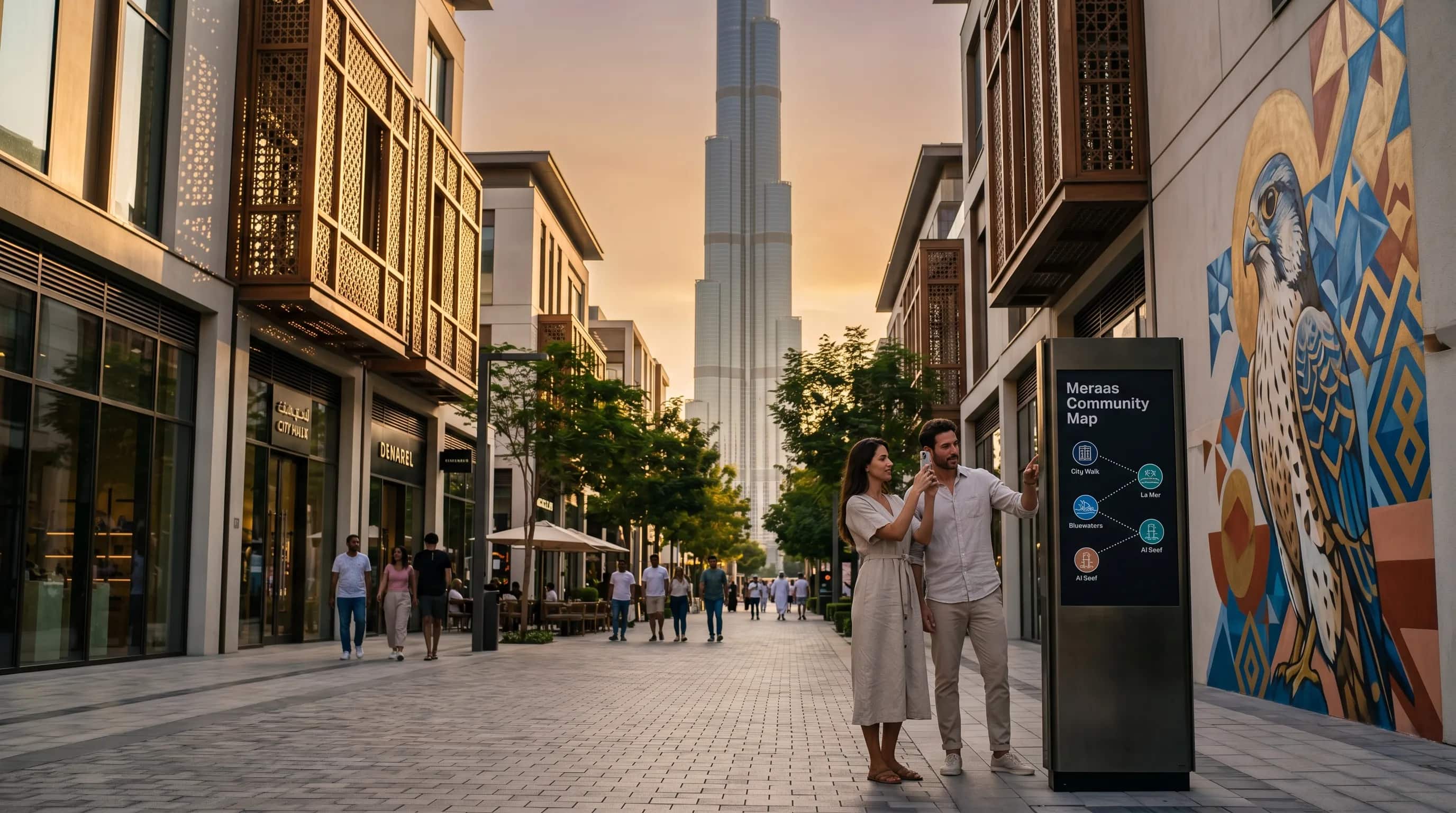
Meraas projects typically include integrated retail and lifestyle infrastructure built into the residential environment. City Walk is the clearest example. Bluewaters Island combines residential, retail, and entertainment (Ain Dubai observation wheel) in a single curated environment. The integrated retail-residential approach is more central to Meraas than to most competing developers.
The Dubai Holding connection provides access to specific Dubai land positions that wouldn’t be available to purely private developers. This affects where Meraas can build and what types of mixed-use approvals they can secure for projects.
The supply cadence is more disciplined than mass-market developers. Meraas doesn’t launch new projects on a quarterly basis the way some competitors do. This supply discipline supports pricing but also limits investor entry options.
The marketing approach emphasises lifestyle and experience over investment yield. The Meraas buyer typically chooses for the lifestyle integration as much as for pure investment metrics. This creates a specific buyer demographic that affects resale dynamics.
The Meraas Portfolio in 2026
The investment-relevant Meraas Dubai projects in 2026:
• Bluewaters Island with the residential apartment supply on the man-made island including premium positions overlooking the Marina, Ain Dubai, and retail clusters. Apartment prices range AED 1.8 million for one-bedrooms to AED 30 million plus for premium positions. Limited villa supply has commanded AED 18 million to AED 50 million
• City Walk with the integrated low-rise residential, retail, and lifestyle community in the Al Wasl area. Apartment prices range AED 2 million to AED 8 million for typical positions, with premium positions extending higher
• La Mer and successor developments (rebranded as J1 Beach and other newer projects) along the Jumeirah coastline with newer launches replacing the earlier beach-club-and-apartment combination
• Pearl Jumeirah with the residential supply on the man-made island just off Jumeirah Beach, including the boutique Bvlgari Resort and Residences positioning and other premium developments
• Madinat Jumeirah Living with the residential community adjacent to the Madinat Jumeirah resort with a focus on luxury living in a hotel-adjacent context
• Nikki Beach Residences and similar branded residential positioning in selected coastal locations
• Selected Nad Al Sheba developments with newer launches in the area
• Cherrywoods and similar mid-tier residential offerings at more accessible price points than the premium Meraas portfolio
The portfolio concentrates in premium and ultra-premium positioning. Most Meraas projects target buyers with entry budgets above AED 2 million for apartments and AED 10 million plus for villa-equivalent positions. The exception is selected mid-tier developments that offer more accessible entry points.
The geographic distribution favours specific Dubai areas where lifestyle integration matters most. Coastal positions (Pearl Jumeirah, Madinat Jumeirah Living, Bluewaters, La Mer area). Central walkable areas (City Walk). Specific premium pockets. The pattern is consistent with the lifestyle-integrated positioning.
The Lifestyle-First Development Approach
The Meraas development philosophy emphasises integrated lifestyle environments over pure residential supply. The practical implications for investors:
Meraas projects typically include curated retail mix integrated into the residential context. City Walk’s retail boulevard is the clearest example. Bluewaters’ retail and entertainment cluster is another. The retail integration affects daily life for residents and adds amenity value beyond what generic residential developments offer.
The walkability and pedestrian environment in Meraas projects is meaningfully better than in most Dubai residential developments. City Walk is designed for walking the entire community. Bluewaters has pedestrian-priority design. This walkability creates lived-experience value that justifies some of the price premium Meraas charges.
The architectural identity across Meraas projects varies more than across some other developer portfolios. There’s no single visual signature equivalent to Binghatti’s facade pattern. Each Meraas project has its own design language appropriate to its specific position and target buyer. This variety has both advantages (each project feels distinct) and trade-offs (less recognisable brand identity than some competing developers).
The amenity packages emphasise lifestyle integration rather than just facility provision. Pools and gyms exist, but the emphasis is on the broader lifestyle experience including the retail-dining-entertainment integration that’s harder to replicate in standalone residential developments.
For investors, this lifestyle-first approach has specific implications:
1. Resale buyers for Meraas product often value the lifestyle integration heavily, supporting price retention
2. Tenant demand for Meraas product tends to be strong, supporting rental yields and tenant retention
3. The price premium Meraas charges over generic competing supply needs to be justified by the lifestyle integration, which requires the integration to actually work in practice
4. Mid-construction Meraas projects carry execution risk on the retail and amenity integration as well as on the residential delivery
5. Service charges in Meraas projects tend to be higher than in generic developments, reflecting the broader amenity infrastructure to be maintained
The patterns we’ve watched succeed: buyers who specifically valued the integrated lifestyle (rather than just buying for capital appreciation), holds through 5+ years to capture the amenity maturation, and selections within Meraas projects that captured premium positioning within the broader development.
The patterns that have struggled: speculative buyers who tried to flip quickly without amenity completion mattering to their thesis, buyers who underestimated the service charges in projects with extensive amenity infrastructure, and buyers who chose generic positions within Meraas projects when premium positions were available at modest additional cost.
Investment Performance Across Meraas Communities
The community-by-community investment performance across the major Meraas Dubai projects:
Bluewaters Island apartments. Average entry: AED 2.5 million. Three-year capital growth: 52%. Gross yield: 5.5%. The marina-view positions have outperformed inland-facing units by meaningful margins.
Bluewaters Island villa positions (limited supply). Average entry: AED 28 million. Three-year capital growth: 52%. Gross yield: 4.1%. The supply is very limited and resale velocity is low because owners tend to hold.
City Walk apartments. Average entry: AED 3 million. Three-year capital growth: 48%. Gross yield: 5.3%. The integrated retail context has supported steady appreciation though slightly below Bluewaters.
Pearl Jumeirah waterfront positions. Average entry: AED 5 million for apartments, AED 28 million for villas. Three-year capital growth: 48% across the cluster. Gross yields: 4.5% for apartments, 4.2% for villas.
Madinat Jumeirah Living. Average entry: AED 4 million. Three-year capital growth: 45%. Gross yield: 4.8%. The hotel-adjacent positioning supports premium pricing but capital growth has been moderate.
La Mer area / J1 Beach. Off-plan transactions only at scale, with launch-to-current price movement of 20-30% for the newer phases.
Cherrywoods and similar mid-tier Meraas developments. Average entry: AED 1.8 million. Three-year capital growth: 35%. Gross yield: 6.0%.
The patterns across Meraas performance:
1. The premium-positioned projects (Bluewaters, City Walk, Pearl Jumeirah) have delivered consistent strong capital appreciation in the 45-55% range over three years
2. The yields are mid-tier (4-5.5%) reflecting the premium pricing
3. The mid-tier Meraas developments have delivered weaker capital growth but better yields
4. The variance across Meraas projects is smaller than across some larger developer portfolios because the projects themselves are more curated
For investors, the implication is that Meraas exposure tends to deliver predictable returns within a relatively narrow band. Maximum capital appreciation tops out around 50-55% over three years for the strongest projects. Minimum return rarely drops below mid-30s capital growth even for less-strong projects.
Our Research on Meraas Returns
We pulled data on 40 Meraas community transactions and 55 rental contracts from 2023 and 2024 across the major Meraas Dubai projects. The total return analysis (capital growth plus net yield, after service charges and typical voids) for the past three years:
Bluewaters Island apartments: total annualised return 22% (capital growth 17% + net yield 4.5%).
Bluewaters villa positions: total annualised return 21% (capital growth 17% + net yield 3.2%).
City Walk apartments: total annualised return 20% (capital growth 16% + net yield 4.3%).
Pearl Jumeirah apartments: total annualised return 20% (capital growth 16% + net yield 3.8%).
Pearl Jumeirah villas: total annualised return 19% (capital growth 16% + net yield 3.4%).
Madinat Jumeirah Living: total annualised return 18% (capital growth 15% + net yield 3.7%).
Cherrywoods and similar mid-tier: total annualised return 16% (capital growth 12% + net yield 5.2%).
Cross-referenced against the Dubai Land Department transaction database and Knight Frank Dubai residential research, our figures broadly match published market analysis. Meraas projects have delivered solid investment returns across the past three years, with the premium-tier projects clustering in the 20-22% annualised range.
What stands out from the data. The return spread across Meraas projects is narrow compared to most developer portfolios. Bluewaters at 22% and Cherrywoods at 16% bracket the full range. For investors looking at Meraas as a developer-level decision, the project selection within Meraas matters less than for developers with wider return dispersion.
A second pattern. Service charges in Meraas projects are higher than in generic Dubai supply, often AED 22-32 per square foot for apartments. This affects net yield calculations and should be modelled accurately before purchase. The amenity infrastructure justifying these charges is real, but the net-of-service-charge math is meaningfully different from headline gross yields.
A third pattern. Tenant retention in Meraas projects is strong, with multi-year leases common and renewal rates above 70% in most projects. The lifestyle integration that drives buyer demand also drives tenant retention, supporting realised yields and reducing the friction costs that affect other developments.
Lewis Allsopp, founder of Allsopp & Allsopp, has spoken about how the integrated retail-residential model that Meraas (and Emaar at Downtown) has pioneered creates different investment characteristics than standalone residential developments. The lifestyle integration creates community resilience that supports both rental and resale performance through market cycles.
The Honest Read on Meraas Investment
The honest verdict on Meraas investment positioning in 2026:
For investors prioritising lifestyle-integrated residential with reliable but not exceptional capital appreciation, Meraas premium projects (Bluewaters, City Walk, Pearl Jumeirah) deliver a clear value proposition. The lifestyle integration is real. The capital growth has been steady. The yields support reasonable returns. The buyer demographic is stable.
For investors seeking maximum capital appreciation, Meraas is not the highest-conviction Dubai developer. The supply discipline supports steady appreciation but doesn’t deliver the trophy-appreciation seen in Palm Jumeirah or selected Downtown branded residences. Investors prioritising maximum capital growth should look at Emaar premium product, Sobha specific projects, or Nakheel Palm exposure.
For investors prioritising yield, Meraas is not the highest-yielding developer. The premium pricing and service charge structure compresses yields. Yield-focused investors should look at Discovery Gardens, International City, or mid-tier developments from other developers.
For investors prioritising trophy positioning, selected Meraas projects (Bvlgari Resort and Residences on Pearl Jumeirah, premium Bluewaters positions) offer ultra-premium positioning that competes with the best Dubai trophy assets. These positions deliver the prestige and resale liquidity that ultra-wealthy buyers prioritise.
For lifestyle buyers (rather than pure investors), Meraas projects offer something genuinely different from competing developers. The integrated retail-residential context creates daily life value that doesn’t show up in spreadsheet returns but matters for buyers who plan to actually live in their Dubai purchase rather than just owning it. The Meraas resident experience is materially different from the resident experience in generic Dubai apartment buildings, and that difference matters for buyers who weight lived experience heavily.
The strongest Meraas investment picks we’ve watched perform: Bluewaters Island apartments with marina-view positioning, City Walk apartments in lower-floor positions with direct boulevard access, Pearl Jumeirah waterfront villa positions held through the past three years, and Bluewaters premium villa positions for ultra-luxury buyers. The common thread is that the buyers chose positioning within Meraas projects that captured the lifestyle premium most directly rather than buying generic units in the same projects at lower price points.
The patterns that have underperformed: inland-facing positions in Bluewaters and Pearl Jumeirah at premium prices, speculative buyers in newer La Mer area projects without clear amenity maturation timelines, mid-tier Cherrywoods purchases at the upper end of pricing without sufficient differentiation from competing mid-tier supply. The mistake in each case was paying Meraas premium pricing without capturing the lifestyle-integration premium that justifies that pricing.
For anyone considering Meraas investment, the specific project and positioning matter more than the developer-level decision. Live listings across Meraas’s Dubai projects shift weekly. Our areas overview covers the Meraas-anchored geographies. Our agents handle Meraas transactions across the portfolio. Ready to look at specific Meraas projects? Reach out and we’ll take it from there.
Related stories
Dubai's Established Charm: The Case for Older Homes
In a city focused on the future, I believe the smartest move for many buyers is to look back. Dubai's seasoned communities offer space, character, and surprising value that new builds often can't match.

The True Cost of Owning a Dubai Property
Beyond the purchase price, your annual budget for a Dubai home must account for service charges, utilities, and maintenance. I'll break down every ongoing expense you need to plan for.
Calculating ROI on Dubai Rental Upgrades
As a landlord in Dubai, you can't just follow trends. I'll show you how to calculate the precise ROI of minor property upgrades to genuinely increase your rental yield.
Echoes, in your inbox
One thoughtful email a month. Market insight, new launches, no spam.