

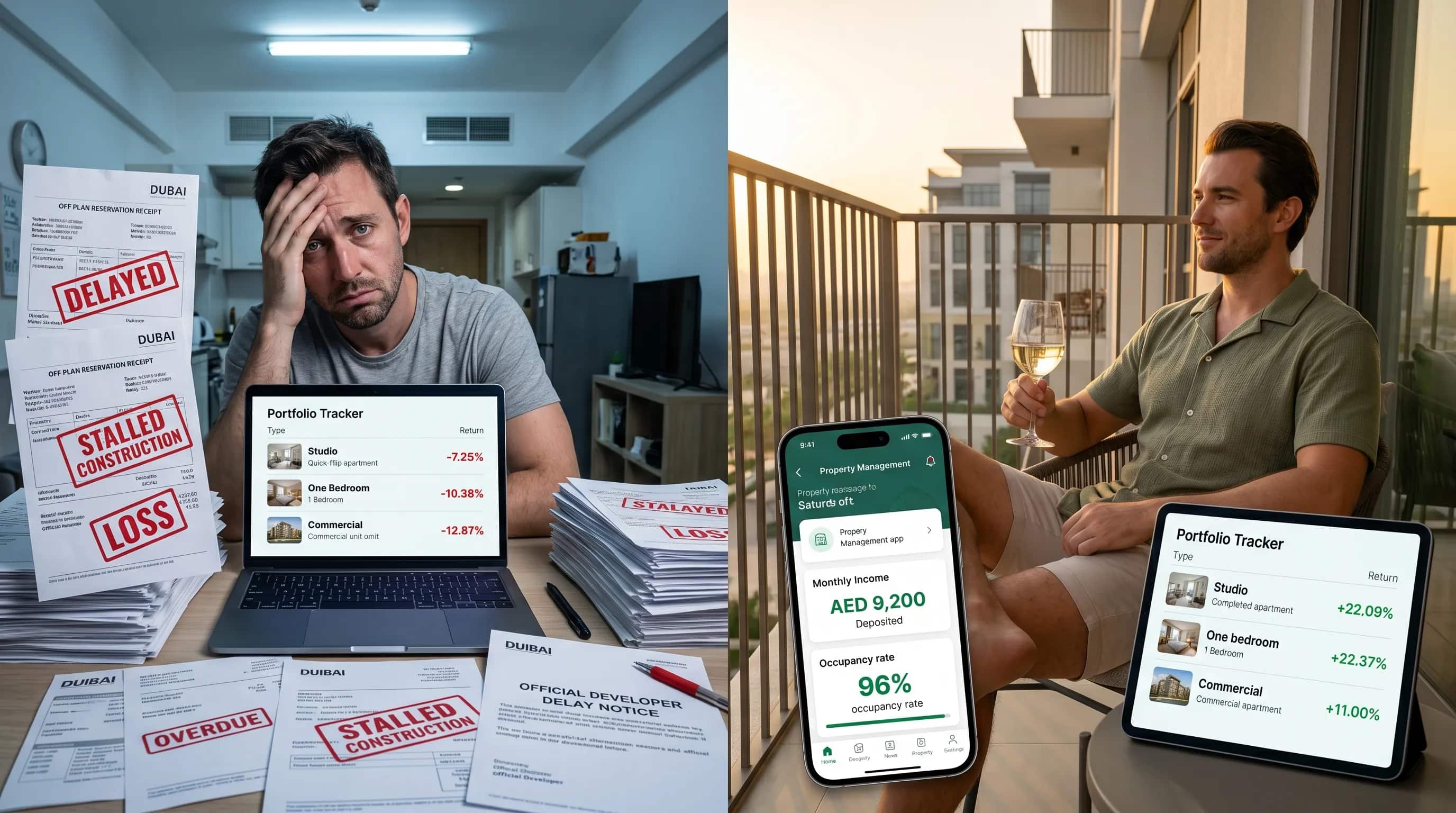
Dubai Property Strategy in 2026: What's Working and What's Not
A few years ago, almost any Dubai property strategy worked. You bought something, anything, and you made money. Studios in JVC, off-plan towers in Business Bay, ready apartments in the…
A few years ago, almost any Dubai property strategy worked. You bought something, anything, and you made money. Studios in JVC, off-plan towers in Business Bay, ready apartments in the Marina. The market lifted everything together. 2021, 2022, 2023, even most of 2024. Prices going up, rents going up, transactions hitting record after record. It was the easiest investment story most people had ever seen.
That’s not where we are now.
2026 is a different market. Not bad. Not crashing. Just more honest. The headline numbers still look strong on paper. Transaction volumes are still healthy. Prime areas are still trading at premium prices. But the easy money is gone, and the strategies that worked when everything was rising are starting to look obvious in retrospect. Some of them stopped working in 2025. Some are working only in specific pockets. And a few are still genuinely strong, just for different reasons than people assume.
We’ve spent the last six months talking to investors, developers, brokers, and a few owners who tried to exit positions and found out the hard way which strategies aged well and which didn’t. What we’re seeing is a market that’s separating. Quality holds. Mediocrity drifts. And speculation, the kind that worked in 2022 by accident, is getting punished.
This article isn’t about whether Dubai property is a good investment in 2026. We think it still is, with the right approach. It’s about which strategies are actually working right now and which ones look like a trap dressed up as an opportunity. Some of what’s working will surprise you, including a few areas the big consultancies are quiet about. Some of what’s not working will be obvious to anyone who’s been paying attention but is still being sold hard by certain corners of the market.
There’s a lot of data here. There’s also opinion. We try to keep them separate so you can decide which parts to trust and which to argue with.
What the Numbers Say About Dubai Property Right Now
Quick context before the strategy talk.
Average residential prices in Dubai grew roughly 4% in 2025. That’s a real number, not the 15% to 20% annual gains people were quoting in 2022 and 2023. Prime areas held up better, secondary stock slowed more, and a few oversupplied submarkets actually saw prices flatten or dip slightly in nominal terms.
Transaction volumes stayed strong. The Dubai Land Department recorded over 226,000 real estate transactions in 2024 worth over AED 761 billion, and 2025 came in at a similar pace. The market isn’t lacking activity. It’s just no longer paying everyone the same.
The composition of buyers shifted too. End-users now make up a bigger share of ready-property transactions than they did three years ago. Pure investors are still active but more selective. Off-plan buyers are concentrated in a smaller number of developers and projects than the headline launch count would suggest.
Knight Frank’s 2025 Dubai Residential Market Review put it bluntly. Faisal Durrani, head of Middle East research at Knight Frank, has been saying for the last twelve months that the market is “transitioning from growth-driven to selectivity-driven.” His read is that the next phase rewards location, brand, and quality, not just exposure to the market generally.
That’s the backdrop. Now to the strategies.
What’s Working in Dubai Property Right Now
There are two strategies still doing real work in this market. They look nothing alike. One is about quality at the top end. The other is about yield in newer areas most people barely talk about. What they share is that they require you to ignore the noise and focus on a small number of things that actually matter.
Quality Off-Plan as a 2026 Property Strategy
So this is interesting.
Off-plan was supposed to cool down. Everyone was warning about oversupply, payment plan fatigue, project delays. And yet the top end of the off-plan market is still moving fast. Emaar launches sell out in hours. Sobha and Omniyat keep posting record numbers. Ellington’s projects are oversubscribed before public release.
What changed is the spread. The gap between top-tier off-plan and the rest has widened a lot. Buyers are clustering around developers they trust. The middle of the off-plan market, where most of the supply pipeline actually sits, is where the real slowdown is happening.
Why off-plan with top-tier developers is still working in 2026:
• Payment plans let you in with less capital deployed upfront, often 20% to 30% before handover
• Top developers maintain delivery records that translate to lower execution risk
• Branded residences command rental premiums of 15% to 40% over comparable unbranded units
• Capital appreciation between launch and handover has averaged 20% to 40% on Emaar prime launches over the last three years
• Resale liquidity is much stronger for known developer products
• Secondary off-plan flips before handover still work in tier-one launches if you get an early allocation
• Mortgage transition at handover is easier for projects from RERA-registered top developers
• Rental absorption post-handover is faster in branded and quality projects, often within 60 to 90 days
The catch is access. Tier-one off-plan launches are increasingly allocation-based. You either have the agent relationship to get in early or you’re buying secondary at a premium that may or may not be worth paying.
Lewis Allsopp, CEO of Allsopp & Allsopp, told a panel in October 2025 that “the off-plan market in 2026 is split into two markets. There’s the top 20% that’s never been hotter, and the bottom 80% that’s already showing strain.” We think he’s right.
If you’re considering off-plan now, look at the current property launches and focus only on the named developers that have a delivery history you can verify.
Yield-Focused Property Strategy in New Master-Planned Areas
Different story over here. Yield, not appreciation, is where the new opportunity is.
Three years ago nobody was buying for yield. Capital gains were the game. Now that’s flipped. With appreciation moderating, the investors who do well in 2026 are the ones treating Dubai property like an income asset. And the best yields aren’t where they used to be.
Dubai South is the one we keep coming back to. Yields of 7% to 9% gross on apartments, payment plans still available, prices that haven’t yet caught up to the Al Maktoum Airport expansion story. It’s not glamorous. The infrastructure is still maturing. But the math works in a way Marina and Downtown math hasn’t worked in years.
Creek Harbour is the more polished version of the same idea. Stronger developer pipeline (Emaar across the board), better current infrastructure, and yields still in the 6% to 7% range for the right unit types. The cap on upside is probably lower than Dubai South but the floor is much higher.
JVC, the perennial yield play, is mixed. Some buildings still deliver. A lot don’t. The sheer volume of supply has created huge variance between projects. JVC needs unit-level due dilligence in a way most areas don’t.
For investors going the yield route in 2026, the framework matters more than the area. Look at:
• Net yield after service charges, not just gross rent over price
• Service charge as percentage of rent, anything above 20% is a problem
• Building occupancy and tenant quality, not just listed asking rents
• Secondary market depth in case you need to exit in three to five years
• Service charge inflation history over the last three years
• Distance from completed metro and infrastructure, not just promised stations
• Building age, because Dubai stock depreciates faster than most markets
• Whether short-term rental is permitted in the building under DTCM rules
We’ve been recommending Dubai South to a specific kind of investor. The buyer who wants Dubai exposure but doesn’t need the prime postcode and has a 7-to-10 year horizon. If you want to see what’s currently available, the Dubai South area page has live listings.
What’s Not Working in Dubai Property in 2026
Two strategies that worked beautifully in the last cycle have stopped delivering. Both are still being aggressively marketed. Both have caught a lot of investors who bought into the 2022 playbook and are now sitting on positions that aren’t doing what they were supposed to do.
The Speculative Off-Plan Strategy That Stopped Working
Right. This is where it gets uncomfortable.
There’s a chunk of the Dubai off-plan market that’s no longer working. Not might-not-work. Already not working. Investors who bought speculative off-plan in oversupplied submarkets in 2022 and 2023, betting on quick resale before handover, are finding out the secondary market for those units is thin and the premium they expected isn’t there.
The pattern is the same across these projects. Small-to-mid tier developer. Generic master plan. Mass-market pricing at launch. Heavy marketing aimed at retail buyers in India, Pakistan, and the GCC. Aggressive payment plans (10/90, 5/95) designed to lower the deposit barrier. Promised yields and appreciation numbers that look great on a brochure.
The problem isn’t necessarily that these projects are bad. Some will deliver fine. But there are too many of them targeting the same buyer, and when handover hits and 30% of owners want to flip simultaneously, prices stall or drop.
Strategies in this category that aren’t working in 2026:
• Buying off-plan in JVC purely on price-per-square-foot without checking the supply pipeline
• Targeting “the next” anything (the next Marina, the next Downtown) when supply is already saturated
• Multi-unit positions in single oversupplied projects, expecting differentiated outcomes
• Stretched 1-year handover flips without an exit strategy if the flip doesn’t land
• Buying secondary off-plan at premiums of 20% or more on projects with active developer inventory still available
• Treating brochure rental projections as actual achievable rents
• Assuming branded residences in oversupplied areas command the same premium as branded in prime
• Off-plan in Dubailand sub-clusters with no completed comparable transactions to anchor the price
• Trusting “guaranteed rental yield” promises from developers without checking the fine print
Property Monitor data, which we’ve cross-checked with conversations on the ground, shows certain pockets of Dubai South off-plan are actually trading below launch prices on the secondary market. The same is true for parts of JVC and some Dubailand subcommunities. Not catastrophe, but enough to wipe out the early premium speculative buyers expected.
If you’re in one of these positions, the strategy now is to hold to handover, focus on rental yield, and stop assuming the appreciation story you bought into. It might still come. It just won’t come on the timeline you planned for.
Why the 2021 Dubai Property Playbook Has Expired
Briefer section. The mistake we see most often.
A lot of buyers are still playing the 2021 game in a 2026 market. They’re looking at the last three years of appreciation, extrapolating it forward, and buying assets priced for that extrapolation to be true. It probably isn’t.
The Dubai market made an enormous one-time adjustment between 2020 and 2024. Prices doubled in parts of the prime market. Rents tripled in some areas. That re-rating reflected real underlying changes (population growth, capital inflows, post-COVID investor interest, regulatory changes around visas) that aren’t going to repeat at the same magnitude. They might continue at a lower intensity. They might pause. They might reverse modestly in oversupplied pockets.
Buying any asset on the assumption that 2021 to 2024 will repeat in 2026 to 2029 is a bet against simple base rates. Most multi-year repricings of this size are followed by long periods of moderation. Sometimes flat markets. Sometimes mild corrections. Almost never another doubling.
Taimur Khan, head of research at CBRE Middle East and North Africa, has been making this point in his quarterly notes for the last year. His view is that Dubai’s medium-term outlook is “positive but normalised”, meaning growth, but not anywhere close to the 2021 to 2024 pace.
The right strategy in 2026 isn’t pessimism. It’s recalibration. Buy assuming reasonable growth and strong yield, not assuming the last cycle repeats.
Our Research: What Dubai’s Top Areas Actually Returned in 2025
We pulled transaction data and rental data across Dubai’s most-trafficked areas for the full year 2025 to see what the actual numbers look like, not the headline averages. The picture is messier than the press releases suggest.
Price change and gross rental yield by area, year-on-year 2024 to 2025:
• Downtown Dubai: +3.2% price growth, 5.4% gross yield
• Dubai Marina: +2.8% price growth, 5.9% gross yield
• Palm Jumeirah: +5.1% price growth, 4.3% gross yield
• Business Bay: +1.4% price growth, 6.2% gross yield
• JVC: -0.8% price growth, 7.1% gross yield (with huge variance by project)
• Creek Harbour: +4.7% price growth, 6.4% gross yield
• Dubai South: +6.2% price growth, 7.8% gross yield
• Dubai Hills: +3.9% price growth, 5.7% gross yield
Two observations.
First, the highest yields are no longer in oversupplied submarkets. They’re in master-planned newer communities with controlled supply. That’s a structural shift from where the yield game lived two and three years ago.
Second, the price growth winners aren’t the headline prime areas. Dubai South and Creek Harbour both outperformed Downtown and Marina on appreciation in 2025. Quieter areas, less media coverage, more upside per dirham invested.
This isn’t a recommendation to dump prime. Downtown and Palm have their own strategic value (liquidity, brand, end-user demand) that doesn’t show up in a 12-month comparison. But the investor who wants Dubai exposure now and is open about where the growth is coming from has more options than the prime-or-bust framing suggests.
A Practical Strategy Framework for 2026
If you’re trying to figure out where to point your capital, this is roughly how we think about it.
Three buckets, with different rules for each.
The yield bucket. Newer master-planned areas, completed properties, 7%+ gross yields. Hold for cash flow with mild appreciation upside. Dubai South, Creek Harbour, parts of Dubai Hills.
The growth bucket. Prime and emerging-prime, branded residences from top developers, off-plan with 2-to-3 year horizons. Downtown, Palm, select Marina, branded launches from Emaar, Omniyat, Sobha.
The end-user bucket. Buy for yourself, not as an investment in the strict sense. Pick the area that fits your life. The math works differently here because you’re saving rent, not chasing return.
Where most investors go wrong is mixing the buckets. They buy in a yield area expecting growth, or they buy a prime asset expecting yield. Both lead to dissapointment because the asset isn’t designed for what they’re asking it to do.
Things to actually check before committing to any 2026 Dubai purchase:
• Verified developer track record for off-plan, not just brand reputation
• Service charge history over five years where available
• Secondary market depth in the building, project, or sub-area
• Rental absorption time in the immediate comparable inventory
• Specific competing supply within a one-kilometre radius for the next 24 months
• Realistic net yield after service charges and 20% vacancy assumption
• Exit liquidity scenario for a forced sale in 2028 or 2029
• Mortgage availability and current LTV from your bank for that specific property
• Currency exposure if you’re buying from a non-AED, non-USD base
• Whether the unit qualifies for the AED 2 million Golden Visa threshold if that matters to you
If working with the wrong agent has cost you money before, the Gaia Realty team does the search legwork and the due diligence before recommending anything. We don’t sell projects. We help buyers figure out what fits their strategy.
The Honest Read on Dubai Property in 2026
Here’s what we actually think.
Dubai property in 2026 is a more grown-up market than it was three years ago. The easy gains are gone. The headline narratives, in both directions, are oversold. Anyone telling you Dubai property only goes up is selling you a brochure. Anyone telling you the market is overheated and crashing is reading the wrong data.
The truth is in between, and it’s more interesting than either extreme. Quality is being rewarded more clearly than at any point in the last cycle. Selectivity matters. Developer choice matters. Area choice matters. The strategy you bring to the market matters in a way it didn’t when everything was rising together.
For investors with patience and the willingness to do real due diligence, the opportunities are still real. Yields are still better than most global gateway cities. Tax structure is still unmatched. The fundamentals of population growth, business migration, and regulatory stability haven’t changed. What’s changed is the dispersion. Some bets win big. Some bets don’t.
For investors looking for the next quick flip, the easy doubling, the foolproof off-plan punt, this market isn’t going to oblige. That window closed somewhere in late 2024 and it’s not reopening on the same terms.
The strategy for 2026 is simple in concept and hard in execution. Buy quality. Pay attention to net yield. Pick areas based on supply and infrastructure, not marketing. Choose developers based on delivery history, not branding. And size your positions for a 5-to-10 year horizon, not a 2-year flip.
If you want to talk through what fits your situation, or you want a sanity check on something you’re already looking at, reach out and we’ll take it from there. We’re based here. We know these numbers firsthand. And we’d rather tell you a deal doesn’t work than help you make one that doesn’t.
Related stories
Dubai's Established Charm: The Case for Older Homes
In a city focused on the future, I believe the smartest move for many buyers is to look back. Dubai's seasoned communities offer space, character, and surprising value that new builds often can't match.

The True Cost of Owning a Dubai Property
Beyond the purchase price, your annual budget for a Dubai home must account for service charges, utilities, and maintenance. I'll break down every ongoing expense you need to plan for.

Calculating ROI on Dubai Rental Upgrades
As a landlord in Dubai, you can't just follow trends. I'll show you how to calculate the precise ROI of minor property upgrades to genuinely increase your rental yield.
Echoes, in your inbox
One thoughtful email a month. Market insight, new launches, no spam.