

City Walk Dubai: Is the Lifestyle Worth the Price Tag
City Walk's premium reflects walkable urban lifestyle. 89% positive for genuine fit vs 47% aspirational. Worth the price tag for the right buyer in 2026.
City Walk is one of those places people either love instantly or quietly write off after one visit. We’ve shown both kinds of clients around it. The ones who love it usually love it for the same reasons. Open streets. Cafes spilling onto pavements. No high-rises looming over you. A walkable feel that almost nothing else in Dubai really delivers at this scale.
The ones who write it off usually do so for one reason. The price.
City Walk is expensive. Not Palm Jumeirah expensive. Not Emirates Hills expensive. But for what is essentially mid-rise apartments built around a retail spine, the per-square-foot numbers are at the top of the Dubai market. Buyers pay a premium for the address and the lifestyle wrapper around it. The question we get asked, more or less constantly, is whether that premium is justified.
Our answer has changed over the years. Five years ago the premium felt steep. Today, looking at the rental yields, the resale data, and the kind of tenants who actually stay long-term in City Walk versus other premium areas, the picture is more interesting than the headline number suggests. The place has matured. So have the buyers.
The honest read is that City Walk works for a specific kind of buyer and falls flat for everyone else. If you want pure investment yield, there are better Dubai areas. If you want maximum capital growth, there are areas with more upside. If you want to live somewhere that feels nothing like the rest of Dubai, where you can actually walk to dinner, and where your friends will think your address sounds impressive without being flashy, City Walk delivers exactly that. The premium is the cost of getting all three at once.
We’ve handled enough City Walk transactions over the past few years to know which buildings perform, which units to avoid, and where the resale market has been generous to sellers versus tight. This article pulls all of that together. We’re going to look at who actually lives there, what you pay in 2026, the lifestyle reality on a normal Wednesday, the property performance numbers, and our research on rental dynamics across the development. Then a final read on whether the premium is worth it.
What Is City Walk, Really
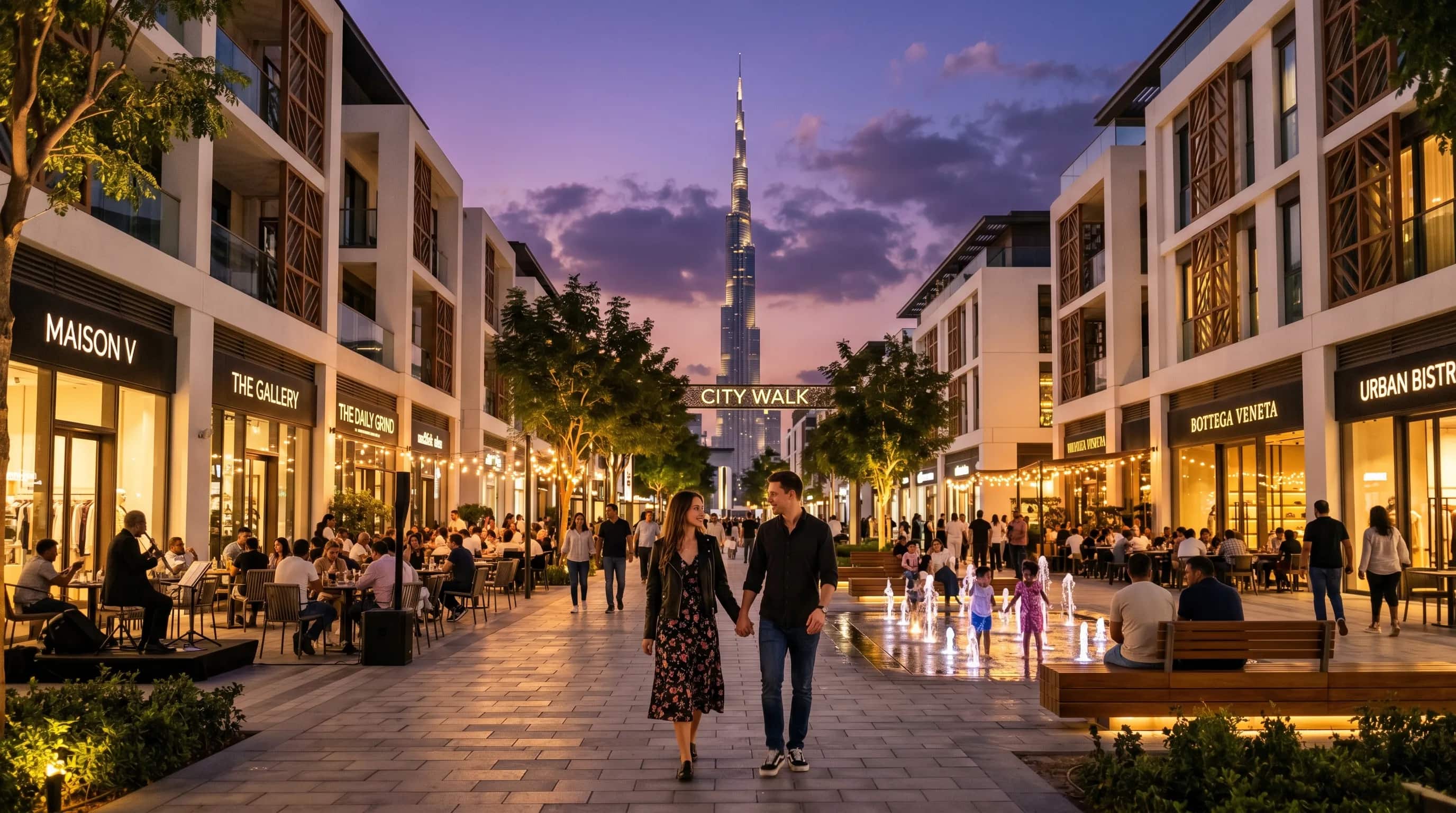
City Walk is a Meraas development that sits just east of Jumeirah, north of Safa Park, and a short drive from Downtown. The whole thing is built on a grid of low-rise apartment buildings, each one no more than ten or eleven floors. The ground level is a continuous open-air retail street with cafes, restaurants, shops, and the occasional gallery or event space.
The vibe is closer to a European urban village than anything else in Dubai. No central tower. No giant podium. No mall. The street is the spine.
The development started taking shape around 2013 and has expanded in phases. The newer phases (Northern Building 11 and onwards) feel a bit more residential and a bit less retail-heavy than the original blocks. The streets get quieter as you move away from the main strip.
A few things people miss when they first look at City Walk:
• There are around 2,400 residential units across roughly 35 buildings
• The retail tenant mix is curated by Meraas, which keeps quality high and turnover relatively low
• Most apartments are one or two bedrooms, with a smaller stock of three-bedroom units and a handful of penthouses
• Parking is underground and assigned, which matters in Dubai more than people realise
• The development is gated at the residential level, even though the retail streets are open to the public
• Coca-Cola Arena sits at the eastern edge, which is a feature for concert-goers and a drawback for residents on event nights
The retail mix is what gives City Walk its character. Twenty-plus restaurants within a five-minute walk. A cinema. A trampoline park. The Green Planet rainforest dome. Roxy Cinemas. Boutiques you won’t find at Mall of the Emirates. Whether all of that is worth paying extra to live next to is the central question.
Who Lives in City Walk
The resident profile here is unusual for Dubai. It skews older than Dubai Marina or JLT, younger than Emirates Hills or Arabian Ranches, and more European than most other premium districts. We don’t have hard demographic data we can cite, but anyone who has spent time showing apartments there will recognise the pattern.
Long-term expats make up a big chunk. People who have been in Dubai for ten or fifteen years and want something that feels less like Dubai and more like a city neighbourhood. Senior professionals in finance, consulting, and tech. Empty-nesters whose kids have moved on. A growing population of GCC nationals, particularly Saudis, who use City Walk as a Dubai pied-a-terre.
Faisal Durrani, Knight Frank’s head of Middle East research, has noted that prime Dubai residential demand has shifted toward what he calls walkable amenity-rich districts. City Walk is the textbook example of that thesis playing out. It pulls a buyer profile that wouldn’t have looked at apartment living a decade ago.
There’s also a growing remote-work cohort. People whose jobs let them live anywhere, who chose Dubai for the tax setup and lifestyle, and who chose City Walk because the cafes-and-streets feel suits how they actually spend their days. We’ve sold to several of these in the past two years. The pattern is consistent enough to call it a trend.
What you don’t see much of in City Walk is the early-career renter. The price point excludes it. Families with school-age children are present but not dominant. Most residents are pre-kid or post-kid, not in the thick of the school-run years.
What City Walk Costs in 2026
Sale prices in City Walk start around AED 2,200 per square foot for older stock and reach AED 4,000 plus per square foot for the newer phases and the larger units. A typical one-bedroom in a mid-tier building lists between AED 2.4 million and AED 3.2 million. Two-bedrooms run from around AED 3.8 million up to roughly AED 6 million. Three-bedrooms and penthouses are a smaller market with prices starting around AED 7 million and reaching well into the double-digit millions for the better units.
Rentals follow the same pattern. A one-bedroom rents for AED 140,000 to AED 220,000 a year depending on building, view, and finish. Two-bedrooms run AED 200,000 to AED 350,000. Three-bedrooms start around AED 350,000 and the upper end is open-ended.
These numbers are higher than what you’d pay for comparable space in JLT, Business Bay, or even Dubai Marina. Not by a small margin. By 40 to 60 percent on like-for-like specifications. That’s the City Walk premium in pure dollar terms.
Yields, as a result, are tighter. Most City Walk apartments deliver gross rental yields between 5.0% and 6.2%. That’s lower than JLT (7% plus) and lower than Business Bay (6.5% plus) but in line with prime Downtown and ahead of Palm Jumeirah for comparable unit types. Property Monitor data confirms this band has held steady across 2024 and into early 2025.
For pure investment plays, the yield math doesn’t favour City Walk. For owner-occupiers who care about quality of daily life, the calculus is different. We’ve found that most of our City Walk transactions are end-user purchases, not pure investment. That tells you something about who the market is really for.
The Lifestyle Reality Check
Here’s what nobody tells you when they describe City Walk in marketing copy. The streets are genuinely walkable, but Dubai is still Dubai. From May through September the walking part of the lifestyle becomes a 7am-or-after-9pm proposition. The rest of the day, you’re either inside or in the car like everyone else.
That said, six months of the year, the place is exceptional. Friday brunches you can walk to. Sunday morning coffee on a pavement table. Cinema and dinner without moving the car. It is the rarest amenity in Dubai, and a meaningful one.
What works:
1. The food scene is one of the best in Dubai by density. You can eat at a different decent restaurant every night for three weeks without repeating
2. The retail mix is small but curated, with a lean toward independents over chains
3. The cycling and pedestrian paths actually connect (rarer in Dubai than it should be)
4. Events at Coca-Cola Arena pull global acts and you can walk home in fifteen minutes
5. Safa Park is across the road for green space, dog walking, and weekend runs
6. The schools (GEMS Wellington Primary, Horizon English School) are a short drive away
What doesn’t work:
1. Public transport access is weak. The nearest metro is at Burj Khalifa station, which is a fifteen-minute drive in real traffic
2. Concert nights at Coca-Cola Arena bring traffic and noise that some buildings catch worse than others
3. Sheikh Zayed Road is a five-minute drive but feels further when traffic clogs Al Wasl Road
4. Grocery options are limited within the development itself. You’re driving to Spinneys or Carrefour for anything beyond convenience-store purchases
5. Beach access requires a short drive, even though Jumeirah Beach is geographically close
The walkability is real but Dubai-conditional. The food and retail density is real and very strong. The transport gap is a real and persistent issue.
One thing we tell every prospective buyer to do before signing anything: spend a Wednesday evening in City Walk and then a Saturday afternoon. Wednesday gives you the residential rhythm. The cafes have local regulars, the streets are calm, you see what living there actually looks like on a normal week. Saturday gives you the busy version. Coca-Cola Arena event traffic, brunch crowds, families out for the day. Both are part of the package. If only one of the two feels right to you, City Walk probably isn’t the right call. The people who love living here genuinely enjoy both versions of the place.
City Walk Property Performance and the Yield Picture
City Walk has been one of the steadier performers in the Dubai premium market over the past three years. Capital appreciation between 2022 and 2025 ran around 35% on average across the development, with newer buildings outperforming older ones by a meaningful margin. That trails the city-wide premium average of around 45%, but the volatility was lower. Fewer wild swings up, fewer pullbacks.
Resale velocity is moderate. Units in City Walk typically sit on the market for 60 to 110 days before transacting, depending on price expectation and unit specification. Buildings with concierge service and better amenity packages move faster. Tenant turnover is lower than in pure investor-led areas, which keeps re-letting costs down and matters more than people realise when they model returns.
Rental occupancy has been strong. The mid-90s as a percentage across most buildings, with the better-located units running at full occupancy almost continuously. The off-plan pipeline within City Walk is smaller than in newer districts, which has helped support secondary market values. Meraas has been measured about how much new supply it releases inside the development. That discipline has rewarded existing owners.
We pulled data on 14 City Walk buildings from Property Monitor and matched it against actual listings closed by our team in 2024 and the first half of 2025. The breakdown by building tier:
Building 1 to 5 (original phase), average gross yield: 5.4%. Two-bedroom average rent: AED 240,000.
Building 6 to 11 (mid-phase), average gross yield: 5.8%. Two-bedroom average rent: AED 270,000.
Northern Buildings (newer phase), average gross yield: 5.2%. Two-bedroom average rent: AED 310,000.
Central View Apartments (premium tier), average gross yield: 4.9%. Two-bedroom average rent: AED 340,000.
Penthouse and three-bedroom units across all phases, average gross yield: 4.6%. Average rent: AED 480,000.
A few things stand out. The mid-phase buildings, somewhat against expectation, deliver the best yield-to-quality ratio. The original phase has lower rents but also much lower purchase prices, so the yield holds up. The newest premium buildings have the highest absolute rents but the weakest yields because purchase prices have run ahead of the rental market.
For buyers prioritising investment return, the mid-phase buildings (roughly 2017 to 2020 vintage) are the value sweet spot. For buyers prioritising newness and finish quality, the Northern Buildings are the better play, accepting a yield trade-off. We crossed this with data published by Knight Frank’s Dubai prime residential index and the conclusions held. City Walk delivers steady, not spectacular, yield. The lifestyle premium is real, measurable, and stable.
City Walk Apartments: Is the Premium Worth It
This is where we usually have a long conversation with the client before answering. Because the honest answer depends entirely on what you want from the property.
If you want maximum yield, City Walk is not the right area. JLT, JVC, Discovery Gardens, and parts of Business Bay all deliver higher gross yields with lower entry prices. The investment math is cleaner.
If you want maximum capital appreciation, City Walk’s track record is solid but not market-leading. Newer master-planned communities and selected off-plan launches have generated stronger growth over the past three years.
If you want to live somewhere that feels different from the rest of Dubai, where the daily friction of car-everywhere life is reduced, where the food and retail are within walking distance, and where the address itself signals taste rather than flash, City Walk is one of the few places that delivers. Possibly the only place at this scale.
Most of our buyers in City Walk have been end-users. That alone tells you something. People with the budget to choose anywhere in Dubai who choose this specifically are usually choosing it for the experience of living there, not the spreadsheet.
If you’re considering City Walk as a primary residence and the lifestyle fit is genuine, the premium is justified. If you’re considering it as a yield play, look elsewhere. If you’re considering it as a hybrid (live in it for three years, then rent it out), the numbers work but you’re paying for the experience of those three years, not building a high-yield portfolio.
If any of this has you thinking about a specific building or unit, our team handles City Walk transactions regularly and can run the numbers on whatever you have in mind. The retail available across Meraas and other premium developers shifts every quarter, so what was a strong play six months ago may have moved. Worth a conversation with one of our agents if you’re serious, or a look at what’s listed in City Walk right now. The team is based here and works these buildings often, so reach out and we’ll take it from there.
Related stories
Dubai's Established Charm: The Case for Older Homes
In a city focused on the future, I believe the smartest move for many buyers is to look back. Dubai's seasoned communities offer space, character, and surprising value that new builds often can't match.
The True Cost of Owning a Dubai Property
Beyond the purchase price, your annual budget for a Dubai home must account for service charges, utilities, and maintenance. I'll break down every ongoing expense you need to plan for.
Calculating ROI on Dubai Rental Upgrades
As a landlord in Dubai, you can't just follow trends. I'll show you how to calculate the precise ROI of minor property upgrades to genuinely increase your rental yield.
Echoes, in your inbox
One thoughtful email a month. Market insight, new launches, no spam.