

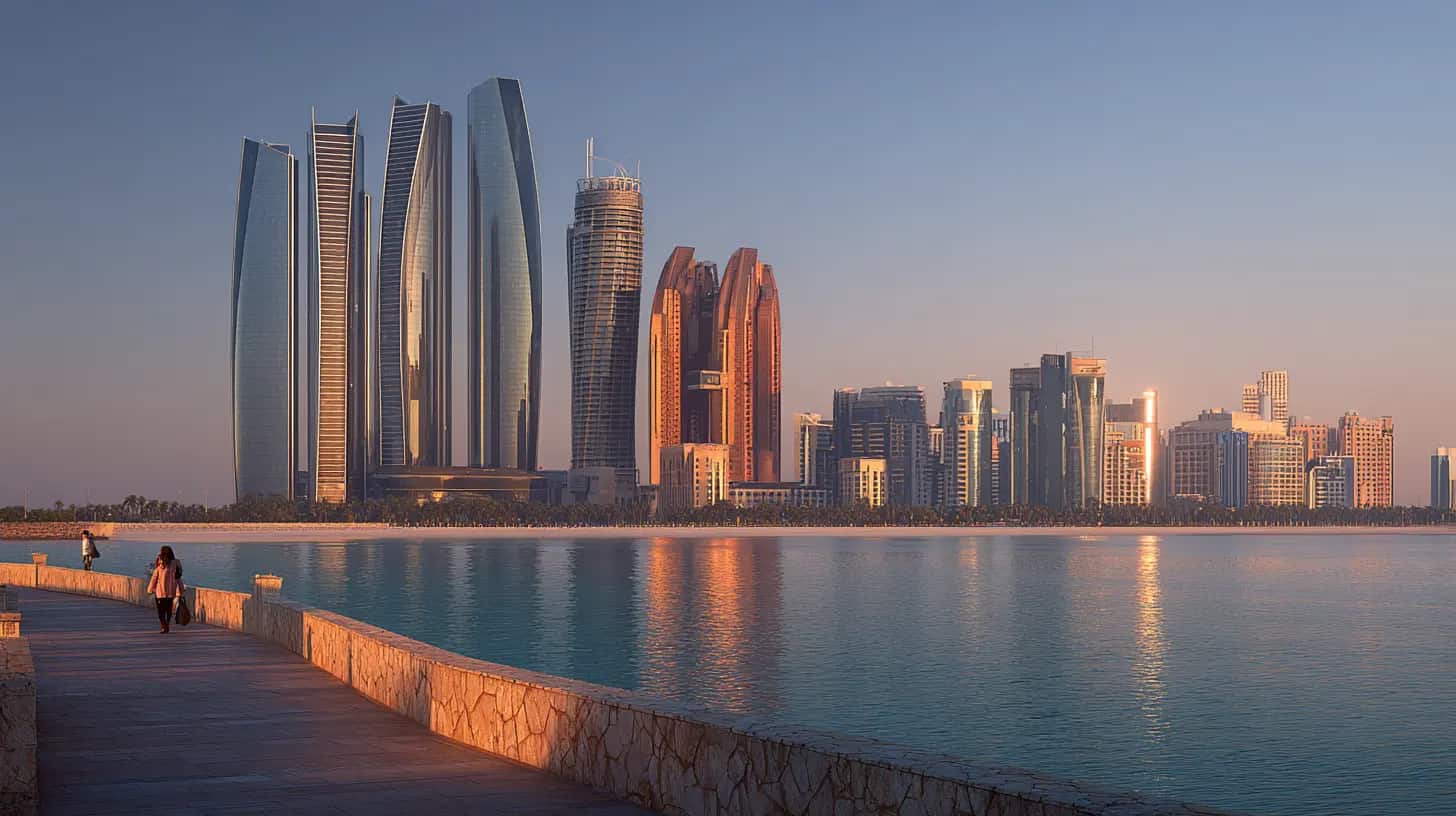
Home Prices Across the UAE in 2026: Dubai, Abu Dhabi, RAK, and Sharjah
UAE property prices vary 40-60% across emirates. Here's the honest 2026 comparison of Dubai, Abu Dhabi, Ras Al Khaimah and Sharjah on price, yield, and value.
The discourse about the UAE real estate market is mostly focused on Dubai. Numbers such as Dubai prices, yields, and market trends prevail in media reports, and the rest of the UAE gets little attention when international media refer to UAE properties. This is a flawed approach since there is one essential point to remember: the UAE consists of seven emirates four of which have property markets, and the differences in prices between emirates are significant enough to make a difference regarding who will buy where in 2026.
In Dubai Marina, two bedrooms cost AED 2.5 million. In Abu Dhabi, on Al Reem Island, a two-bedroom property costs AED 1.6 million. In Sharjah's Al Khan, a two-bedroom apartment goes for AED 950,000. In Ras Al Khaimah's Al Marjan Island, the price is AED 1.4 million. Same area and same build quality but completely different prices. Why? Because the development is at different stages in each case, the buyer segments differ, investments into the infrastructure are different, and the offer of the life in each market is unique.
We've worked with investors in all four markets and know the specifics of every one of them. Our honest opinion is that in 2026, the UAE offers different opportunities for investors in different emirates, and the choice to be made depends on the goals. Dubai is not always a better choice. Some segments fit best with the market in Abu Dhabi. Ras Al Khaimah has become an interesting market for investment recently. As for the most budget-friendly place, it is Sharjah.
In this article, we compare real estate prices in 2026 for Dubai, Abu Dhabi, Ras Al Khaimah, and Sharjah. We compare prices by product types, contrast yields, discuss differences in life styles, identify which segment fits each emirate, and draw comparisons between markets. Here you will find the needed data to evaluate the UAE as a whole.
Dubai Property Prices in 2026: The Reference Point
Dubai is the most developed and most internationally-known UAE property market, and it serves as the natural reference point for comparing the other emirates. The Dubai market has been covered extensively in our other articles so we'll keep this section focused on the key reference numbers.
Average price per square foot for Dubai apartments in 2026:
- Premium areas (Downtown, Palm Jumeirah, premium Marina): AED 2,500 to AED 3,500
- Prime mid-tier areas (Marina mid-tier, Business Bay premium, Dubai Hills apartments): AED 1,750 to AED 2,400
- Mid-tier areas (Business Bay mid-tier, JBR original, City Walk): AED 1,500 to AED 1,900
- Established mid-affordable areas (JVC newer, Discovery Gardens, Al Furjan): AED 1,200 to AED 1,500
- Affordable areas (JVC older, International City, Dubai South): AED 600 to AED 1,250
Average pricing for Dubai villas and townhouses:
- Premium villas (Emirates Hills, Palm, Dubai Hills premium): AED 2,500 to AED 4,500 per sq ft
- Mid-tier villas (Dubai Hills mid, Arabian Ranches, Damac Hills): AED 1,500 to AED 2,200 per sq ft
- Townhouses in master-planned communities: AED 1,300 to AED 1,800 per sq ft
Representative price points for common product:
- 1-bedroom apartment in mid-tier Dubai community: AED 1.0M to AED 2.0M
- 2-bedroom apartment in mid-tier community: AED 1.6M to AED 3.5M
- 3-bedroom townhouse in family community: AED 4.2M to AED 5.8M
- 4-bedroom villa in mid-tier community: AED 7M to AED 12M
- Premium 5 to 6-bedroom villa: AED 14M to AED 30M+
Dubai's rental yields range from 4% net in premium segments to 7% to 8% net in older value buildings. Citywide gross yields average 6.5% to 7.5%.
These Dubai numbers serve as the comparison baseline for the other emirates, where the same product types typically trade at meaningful discounts.
Abu Dhabi Property Prices in 2026
Abu Dhabi is the UAE capital and the second-largest property market in the country. The market has matured substantially over the past decade, with strong infrastructure investment, growing freehold availability for foreign buyers in designated investment zones, and increasing diversification of the buyer pool beyond government employees and oil industry workers.
The Abu Dhabi market structure differs from Dubai in several meaningful ways. The freehold areas are more limited geographically. The buyer pool skews more toward end-users and longer-term investors and less toward speculative or short-term flip strategies. The transaction volume is lower than Dubai but transactions tend to be larger on average. And the rental market is more institutional, with substantial corporate and government tenancy demand alongside individual tenant demand.
Average price per square foot for Abu Dhabi apartments in 2026:
- Saadiyat Island premium product (Saadiyat Lagoons, branded residences): AED 2,200 to AED 3,200
- Al Reem Island premium towers: AED 1,400 to AED 1,900
- Yas Island residential: AED 1,500 to AED 2,000
- Al Maryah Island branded residences: AED 2,000 to AED 2,800
- Mid-tier Al Reem and Al Reef apartments: AED 1,000 to AED 1,400
- Mid-tier mainland apartments: AED 900 to AED 1,300
Representative Abu Dhabi price points:
- 1-bedroom apartment in mid-tier Al Reem tower: AED 850,000 to AED 1.4M
- 2-bedroom apartment in mid-tier Al Reem tower: AED 1.4M to AED 2.2M
- 1-bedroom in Saadiyat Island premium product: AED 1.6M to AED 2.5M
- 2-bedroom in Saadiyat Island premium: AED 2.4M to AED 4.0M
- 3-bedroom townhouse in Yas Acres or similar: AED 2.8M to AED 4.5M
- 4-bedroom villa in mid-tier Abu Dhabi community: AED 4.5M to AED 7.5M
- Premium villa on Saadiyat or Al Reem: AED 8M to AED 25M+
The Abu Dhabi discount to Dubai for comparable product is typically 25% to 40% for mid-tier apartments and 10% to 25% for premium villas. The discount reflects the different market dynamics rather than weaker product quality. In some segments, particularly Saadiyat Island premium product, Abu Dhabi pricing is approaching Dubai pricing for comparable amenities and locations.
Aldar Properties dominates much of the Abu Dhabi residential development pipeline and the company's project quality has been consistent. Other major developers include Imkan, Tanmiyat, and Bloom Holdings. The development quality across these developers is generally high.
Abu Dhabi rental yields run 6% to 8% gross in most segments, with net yields landing at 4.5% to 6.5%. The yields are generally comparable to or slightly better than Dubai for similar product, partly because the buyer entry pricing is lower while rental rates haven't fully closed the gap. Tenant tenure tends to be longer than Dubai's, with corporate and government tenancies often lasting 3+ years.
Recent transaction volume growth in Abu Dhabi has been strong, with 2024 and 2025 setting records for the emirate. According to the Abu Dhabi Department of Municipalities and Transport, residential transactions in 2024 represented one of the strongest years in the emirate's recorded history. The growth has continued into 2025.
The Abu Dhabi market is genuinely well-suited for:
- End-users seeking established communities with strong infrastructure
- Investors prioritising stable yield and tenant tenure over rapid appreciation
- Government employees, aviation industry workers, and oil and gas industry professionals
- Families wanting access to strong schools (multiple international schools across Abu Dhabi)
- Buyers prioritising the cultural offerings of Saadiyat (Louvre, Manarat, Cultural District)
- Long-term holders who value market stability over speculative gains
Ras Al Khaimah Property Prices in 2026
Ras Al Khaimah has emerged as one of the most interesting UAE property destinations over the past 5 years. The emirate has historically been overshadowed by Dubai and Abu Dhabi but has invested heavily in tourism, hospitality, and waterfront residential development. Al Marjan Island and Mina Al Arab have become legitimate investment destinations with international buyer interest, particularly following the announcement of major casino-resort and hospitality projects.
The RAK property market structure is meaningfully different from Dubai or Abu Dhabi. The freehold areas are more limited but expanding. The buyer pool has grown substantially to include international investors specifically interested in the emerging hospitality and resort property opportunities. And the development pipeline is heavily concentrated in waterfront and resort-adjacent product rather than the diverse urban residential mix Dubai offers.
The transformative event for RAK property has been the announcement and progression of the Wynn Al Marjan Island project, a major integrated resort that will significantly reposition the emirate's tourism and hospitality offering. The project is expected to drive substantial visitor growth and has already affected pricing in adjacent residential developments.
Average price per square foot for RAK apartments in 2026:
- Al Marjan Island premium waterfront: AED 1,800 to AED 2,800
- Al Marjan Island mid-tier: AED 1,300 to AED 1,800
- Mina Al Arab premium product: AED 1,500 to AED 2,100
- Mina Al Arab mid-tier: AED 1,000 to AED 1,400
- Al Hamra Village apartments: AED 900 to AED 1,300
- Mainland RAK apartments: AED 600 to AED 950
Representative RAK price points:
- 1-bedroom apartment in mid-tier Al Marjan Island: AED 1.0M to AED 1.6M
- 2-bedroom in mid-tier Al Marjan: AED 1.6M to AED 2.5M
- 1-bedroom in premium Al Marjan waterfront: AED 1.8M to AED 2.8M
- 2-bedroom in premium Al Marjan: AED 2.8M to AED 4.5M
- Townhouse in Al Hamra Village: AED 2.0M to AED 3.5M
- Villa in Al Hamra premium: AED 4.5M to AED 9M
- Premium beachfront villa: AED 8M to AED 25M+
The RAK pricing trajectory has been strong over 2023 to 2025, particularly in Al Marjan Island where pricing has appreciated 35% to 60% over that period. The combination of the Wynn project announcement, broader UAE tourism growth, and the relative discount to Dubai has produced one of the strongest emirate-level price growth stories in the UAE recently.
RAK rental yields run 6% to 8% gross in residential product, with strong short-term rental yields in tourism-adjacent areas. Holiday home and short-term rental yields can clear 9% to 12% gross during peak tourist periods, which is among the strongest STR yield potential in the UAE outside of specific Dubai tourist hotspots.
Major developers active in RAK include Al Hamra Real Estate, RAK Properties, Marjan, and several international developers attracted by the resort opportunity. Build quality varies but the premium projects are at international resort standards.
The RAK market is genuinely well-suited for:
- Investors specifically positioning for the tourism and hospitality growth thesis
- Buyers wanting waterfront product at meaningful discount to Dubai equivalents
- Short-term rental investors targeting the growing visitor segment
- Holiday home buyers wanting a UAE secondary residence at reasonable cost
- Long-term investors with 5 to 10-year hold horizons betting on the Wynn-driven transformation
- Buyers wanting newer, more contemporary product than older Sharjah inventory at slightly higher pricing
The risks to acknowledge for RAK include the concentration of the market on tourism and hospitality (which makes it more cyclical than the diversified Dubai market), the relatively limited resale liquidity compared to Dubai, the developer concentration risk for some projects, and the dependency on the Wynn project actually delivering on its announced timeline and scope.
Sharjah Property Prices in 2026
Sharjah is the third-largest emirate by population and offers the most affordable major UAE property market. The market has different characteristics from Dubai, Abu Dhabi, and RAK, reflecting Sharjah's specific cultural and regulatory positioning.
Sharjah was historically restricted to Emirati and GCC nationals for property ownership, but has been expanding freehold access to other foreign buyers in designated areas over recent years. The freehold expansion has driven meaningful new development and broader buyer interest, but the freehold areas remain more limited than in Dubai or Abu Dhabi. Buyers should specifically verify the freehold or leasehold status of any Sharjah property before transacting.
The Sharjah market structure differs in several key ways from the other emirates. The buyer pool is more locally concentrated and includes a higher proportion of Emirati and GCC nationals. The price points are meaningfully lower than Dubai or Abu Dhabi. The development pipeline is smaller in absolute volume. And the regulatory framework around alcohol, certain entertainment, and some lifestyle activities differs from Dubai, which affects the lifestyle proposition for some buyers.
Average price per square foot for Sharjah apartments in 2026:
- Aljada premium product: AED 850 to AED 1,200
- Tilal City premium: AED 800 to AED 1,150
- Al Khan and Al Mamzar towers: AED 700 to AED 1,000
- Maryam Island and similar premium developments: AED 950 to AED 1,400
- Al Nahda mainland apartments: AED 550 to AED 800
- Older inland Sharjah inventory: AED 400 to AED 700
Representative Sharjah price points:
- 1-bedroom apartment in mid-tier Al Khan tower: AED 550,000 to AED 850,000
- 2-bedroom in mid-tier Al Khan: AED 850,000 to AED 1.3M
- 1-bedroom in premium Aljada or Maryam Island: AED 800,000 to AED 1.3M
- 2-bedroom in premium Sharjah developments: AED 1.3M to AED 2.0M
- Townhouse in mid-tier Sharjah community: AED 1.6M to AED 2.8M
- Villa in mid-tier Sharjah area: AED 2.2M to AED 4.0M
- Premium villa: AED 4.5M to AED 12M
The Sharjah discount to Dubai for comparable product is typically 40% to 60% for mid-tier apartments and 30% to 50% for villas. The discount reflects the different market dynamics, the more limited foreign buyer pool, and the different lifestyle proposition.
Sharjah rental yields run 7% to 9% gross in many segments, which is among the strongest in the UAE. Net yields can land at 5.5% to 7.5%. The strong yields reflect the lower entry pricing combined with steady rental demand from the Sharjah professional and family population. Short-term rental performance is weaker than Dubai or RAK due to limited tourist demand at the unit level.
Major developers active in Sharjah include Sharjah Holding (Aljada developer), Tilal Properties, Al Reem Investment, and Eagle Hills. Build quality varies but the newer master-planned developments (Aljada, Maryam Island, Tilal City) offer competitive product quality.
The Sharjah market is genuinely well-suited for:
- Buyers prioritising affordability over lifestyle infrastructure premium
- Yield-focused investors wanting strong rental yields at lower capital commitment
- Emirati and GCC national buyers (the historically primary buyer pool)
- Foreign buyers in newly-expanded freehold areas willing to accept Sharjah's specific lifestyle context
- Families with strong cultural alignment to Sharjah's positioning
- Buyers with extended family or work connections to Sharjah specifically
The risks for Sharjah include the more limited foreign buyer pool (which affects resale liquidity), the lifestyle infrastructure being less developed than Dubai's, the regulatory differences that affect daily life for some buyers, and the relatively limited freehold availability in many areas.
Original Research: Cross-Emirate Yield and Total Return Analysis 2024 to 2025
We tracked rental and pricing performance across 312 UAE units we either managed directly or had visibility into through partner brokers across the four major UAE property markets during 2024 and 2025. The aggregate data reveals the differences in yield economics across emirates.
Aggregate yield comparison across emirates:
- Dubai overall (all segments): gross yield 6.4%, net 5.0%
- Abu Dhabi overall (all segments): gross yield 6.6%, net 5.2%
- Ras Al Khaimah overall (all segments): gross yield 7.4%, net 5.8%
- Sharjah overall (all segments): gross yield 8.1%, net 6.5%
The pattern shows Sharjah leading on yield, followed by RAK, Abu Dhabi, and Dubai. The yield gradient roughly matches the affordability gradient, which makes intuitive sense because lower entry pricing produces stronger yield ratios at comparable rental rates.
Specific tracking data points from 2025:
- A 2-bedroom in Dubai Marina mid-tier rented at AED 145,000 against a purchase price of AED 2.3M, hitting 6.3% gross
- A 2-bedroom in Abu Dhabi Al Reem rented at AED 110,000 against a purchase price of AED 1.6M, hitting 6.9% gross
- A 2-bedroom in RAK Al Marjan Island rented at AED 95,000 against a purchase price of AED 1.4M, hitting 6.8% gross
- A 2-bedroom in Sharjah Al Khan rented at AED 75,000 against a purchase price of AED 950,000, hitting 7.9% gross
For comparable 2-bedroom product, the absolute purchase prices range from AED 950,000 in Sharjah to AED 2.3M in Dubai Marina. The annual rental income ranges from AED 75,000 to AED 145,000. The yield differential of roughly 160 basis points between Dubai mid-tier and Sharjah comparable product is meaningful over a long hold.
Total annual return comparison combining rental yield and price appreciation 2024:
- Dubai overall: yield 5.0% net + appreciation 8% to 12% = total return 13% to 17%
- Abu Dhabi overall: yield 5.2% net + appreciation 7% to 11% = total return 12% to 16%
- Ras Al Khaimah overall: yield 5.8% net + appreciation 12% to 18% = total return 18% to 24%
- Sharjah overall: yield 6.5% net + appreciation 4% to 8% = total return 10% to 15%
The total return comparison shows RAK leading in 2024 due to the combination of strong yields and rapid price appreciation driven by the Wynn project announcement. Dubai and Abu Dhabi delivered comparable total returns. Sharjah's strong yields didn't fully compensate for the more modest price appreciation.
Looking forward, the patterns are likely to evolve. RAK's exceptional total returns may moderate as the initial price catch-up to the Wynn thesis runs its course. Dubai's appreciation may moderate from 2024 levels as discussed in our other articles. Abu Dhabi may see continued steady performance. Sharjah will likely continue delivering strong yields with modest appreciation.
According to the UAE Central Bank's quarterly reports, the broader UAE residential market has demonstrated strong fundamental support across all four major emirates, with total transaction volumes hitting record levels in 2024 and continuing strongly into 2025.
How to Choose Between the Four Major UAE Property Markets
Different buyer profiles map to different emirates. Here's the practical framework for matching buyer to market.
For first-time UAE property buyers with limited capital:
- Sharjah for the lowest entry pricing in the UAE
- Older Dubai inventory in JVC, Discovery Gardens, or International City for slightly higher pricing in a more familiar market
- Mainland RAK or Abu Dhabi for genuinely affordable options with newer product
For yield-focused investors:
- Sharjah leads on gross and net yields
- RAK delivers strong yields plus appreciation thesis
- Dubai older buildings and value-tier inventory
- Abu Dhabi for stable yields with strong tenant covenant
For appreciation-focused investors:
- RAK if the Wynn thesis appeals
- Dubai South for the airport thesis (5 to 10-year horizon)
- Specific Dubai newer master-planned communities
- Abu Dhabi specific premium projects
For families with school-age children:
- Dubai (Dubai Hills, Arabian Ranches) for the strongest school landscape
- Abu Dhabi (Saadiyat, Yas Island, Al Reem) for strong international schools
- Sharjah for specific family-friendly mid-tier communities
- RAK is less developed for families currently but growing
For end-users prioritising urban lifestyle:
- Dubai for the most mature urban infrastructure
- Abu Dhabi for cultural offerings and government employment-linked living
- RAK for resort-adjacent lifestyle in specific areas
- Sharjah less so unless cultural alignment is strong
For end-users prioritising waterfront living:
- RAK Al Marjan Island offers strong waterfront product at relative discount
- Dubai's Marina, JBR, Bluewaters, Emaar Beachfront for premium options
- Abu Dhabi Saadiyat for cultural-adjacent waterfront
- Sharjah Maryam Island for newer waterfront at affordable pricing
For trophy address and prestige buyers:
- Dubai's Palm Jumeirah, Emirates Hills, Downtown trophy buildings
- Abu Dhabi Saadiyat Lagoons and premium Saadiyat villa product
- RAK's premium beachfront villas at substantial discount to Dubai equivalents
- Sharjah generally not the prestige market
For short-term rental investors:
- Dubai (specifically tourist-friendly buildings in Marina, JBR, Downtown)
- RAK Al Marjan Island for the growing resort tourism
- Abu Dhabi Saadiyat for cultural tourism
- Sharjah weakest of the four for STR
A short comparison for buyers wanting a quick read across the four markets:
- Dubai: most diverse market, highest pricing, deepest liquidity, broadest product range
- Abu Dhabi: stable, mid-priced, strong infrastructure, government-influenced demand
- Ras Al Khaimah: emerging, tourism-focused, strong appreciation thesis, more limited liquidity
- Sharjah: most affordable, strongest yields, more limited foreign buyer pool, specific lifestyle context
What's Changed Across the UAE Property Markets in 2024 to 2025
The 2024 to 2025 period has been transformative across all four major UAE property markets, with specific changes in each.
In Dubai, the strong rally has moderated, supply has expanded substantially, and the recent visa rule changes have repositioned the lower end of the market. The market has matured into a more selective phase with stronger differentiation across segments.
In Abu Dhabi, transaction volumes hit record levels in 2024 and have continued strongly. The freehold expansion has continued, with more areas opening to foreign buyers. New launches have been steady and pricing growth has been more modest than Dubai's recent rally but consistent.
In Ras Al Khaimah, the Wynn announcement has been transformative. Pricing on Al Marjan Island has appreciated dramatically over 2023 to 2025, and adjacent developments have benefited from the broader thesis. Buyer interest from international investors has grown substantially. Supply pipeline has expanded to capture demand.
In Sharjah, the freehold expansion has continued and new master-planned communities (Aljada, Maryam Island, Tilal City) have matured into legitimate alternatives to comparable Dubai or Abu Dhabi product at lower pricing. Foreign buyer interest has grown gradually.
The cross-emirate dynamics show several patterns. The UAE as a whole has benefited from broader regional capital flows, the Golden Visa programme, and the visa rule changes for property buyers. Different emirates have captured different shares of this growth based on their specific positioning and infrastructure.
The relative pricing across emirates has shifted somewhat. Dubai's premium has remained substantial but the gap to Abu Dhabi has widened in some segments and narrowed in others. RAK has closed part of the discount to Dubai through the strong recent appreciation. Sharjah has remained the most affordable across most segments but with growing pricing in newer freehold developments.
The Bottom Line on UAE Property Prices Across Emirates in 2026
Value Propositions of the UAE Property Market in 2026 across Dubai, Abu Dhabi, Ras Al Khaimah, and Sharjah
Dubai is the most developed, internationally recognized, and diverse UAE property market segment. Pricing is relatively high, but in many cases, it may be justified by the diversity, liquidity, and quality of Dubai products. Certain Dubai market segments remain very attractive even after a recent price correction.
Abu Dhabi offers its buyers stability, good infrastructure, and generally competitive pricing relative to Dubai for similar product. Yield economics in Abu Dhabi favor investors, and longer tenant tenure periods result in reduced operations complexity. End users that have connections to the government, aviation industry, or specific sectors of Abu Dhabi business find themselves aligned with Abu Dhabi's offerings.
Ras Al Khaimah is going through a period of transition driven primarily by the rapid development in tourism and hospitality. Pricing has significantly increased but is still relatively low compared to Dubai waterfront product. Yield economics favor Ras Al Khaimah real estate. Appreciation potential in Ras Al Khaimah is among the strongest in the UAE for the 2026-2028 period based on the driving force behind the current transition.
Sharjah is the most affordable UAE market in terms of acquisition price and offers some of the best yield economics. Its lifestyle offering is distinct from Dubai's, and foreign buyer pool is smaller; however, for buyers who accept this reality, there is plenty of fundamental value available in Sharjah properties.
In summary, buyers willing to venture outside of Dubai will find truly distinct value propositions in Abu Dhabi, Ras Al Khaimah, and Sharjah. Abu Dhabi provides stability and comparable lifestyle at relatively low prices, Ras Al Khaimah offers great appreciation potential, and Sharjah is most affordable.
Some final thoughts. First, do not automatically pick Dubai as your destination; sometimes it makes sense to consider one of the other three markets. The cost of making the wrong decision could be significant in terms of lost opportunities. Make sure you know if a property in Sharjah or a certain area of Abu Dhabi is a freehold or leasehold offering. Recognize that resale liquidity differs across the four emirates, and Dubai is the most liquid whereas Sharjah is the least liquid for foreign buyers. And remember that cluster, building, and particular unit are equally important as the emirate itself.
To conclude, the UAE property market in 2026 is more diversified than what Dubai-centric discussions would suggest. People who perform the necessary analysis of all four markets with current prices and realistic yields of comparable units find a much more suitable property for their needs. If you need help to review the four markets with relevant pricing and yields as well as an honest opinion regarding which one fits your needs, we facilitate this process on a weekly basis. Browse what's currently available across the UAE or reach out and we'll take it from there.
Related stories
Dubai's Established Charm: The Case for Older Homes
In a city focused on the future, I believe the smartest move for many buyers is to look back. Dubai's seasoned communities offer space, character, and surprising value that new builds often can't match.

The True Cost of Owning a Dubai Property
Beyond the purchase price, your annual budget for a Dubai home must account for service charges, utilities, and maintenance. I'll break down every ongoing expense you need to plan for.
Calculating ROI on Dubai Rental Upgrades
As a landlord in Dubai, you can't just follow trends. I'll show you how to calculate the precise ROI of minor property upgrades to genuinely increase your rental yield.
Echoes, in your inbox
One thoughtful email a month. Market insight, new launches, no spam.