

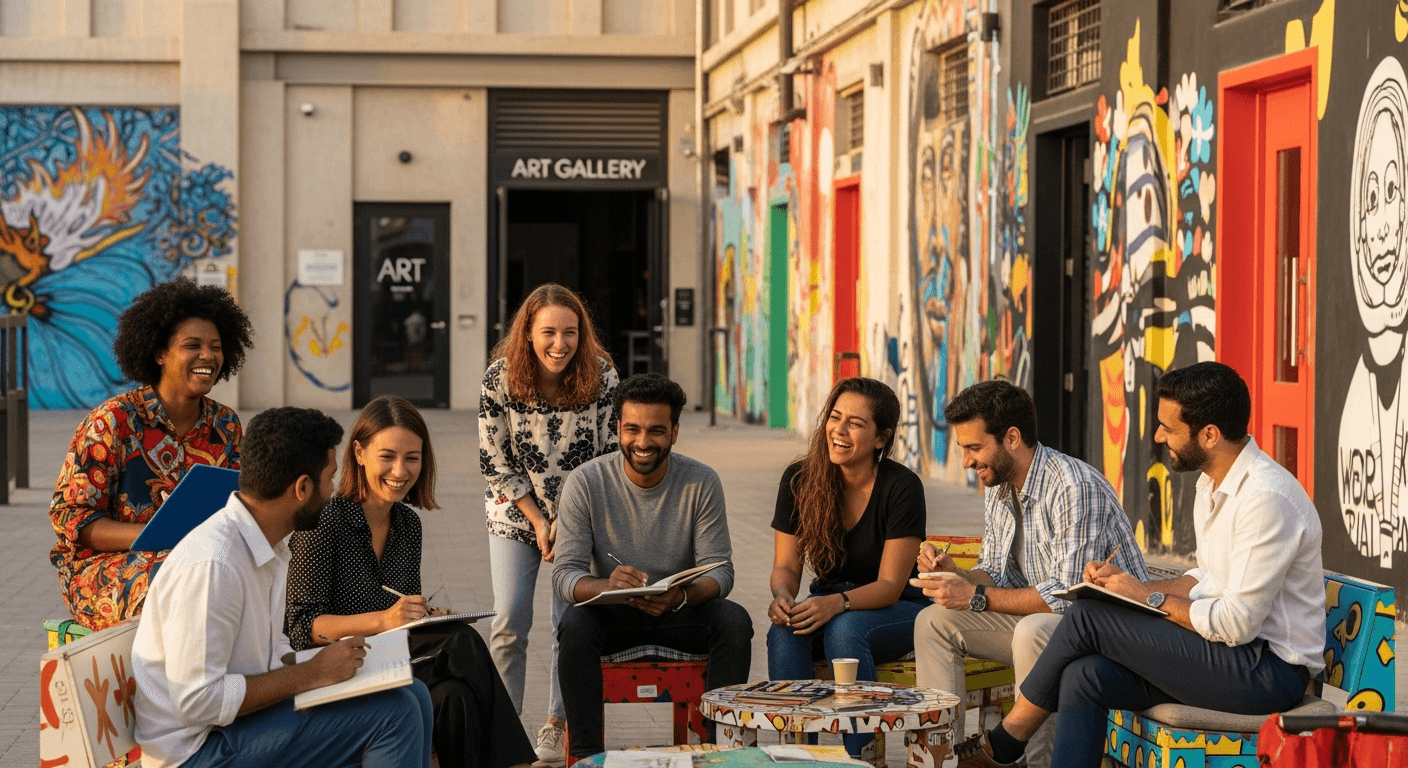
Dubai's True Art & Culture Hubs
Move beyond the museum visit. I explore the Dubai neighbourhoods where art and culture are woven into the fabric of daily life, and what it costs to live there.

For many, the idea of a 'cultural lifestyle' in Dubai is a ticket to the opera, a weekend trip to the Louvre Abu Dhabi, or a stroll through a gallery. These are wonderful experiences, but they are appointments with culture. They aren't the same as living it. As someone who lives and breathes this city’s neighbourhoods, I’m far more interested in the places where art and creativity are part of the daily rhythm — the texture of the streets, the nature of your neighbours, the view from your window.
Here’s what we'll explore:
- Redefining a 'cultural neighbourhood' beyond tourist spots.
- Al Quoz & Alserkal Avenue: From industrial zone to creative heart.
- DIFC: Where finance meets fine art.
- Downtown Dubai: Culture on a grand, accessible scale.
- Dubai Design District (d3): A hub for fashion and design professionals.
- The waterfront contenders: Culture at Creek Harbour and Jaddaf.
- The financial reality: A cost breakdown of buying into these zones.
- My verdict: Which neighbourhood offers the most authentic creative lifestyle?
Beyond the White Cube: What Makes a Real Cultural Neighbourhood?
When we at Gaia Living talk to clients seeking a home connected to the arts, the conversation often begins with proximity to a museum. It's a logical starting point, but it misses the soul of the matter. A true cultural neighbourhood isn't defined by a single landmark. It's an ecosystem. It’s about the unplanned encounters with creativity, the presence of makers and not just consumers, and the kind of urban design that encourages you to walk and discover. It’s the difference between a city having a great library and a neighbourhood having a dozen little bookshops you can stumble into after dinner.
In my view, the most authentic Dubai art communities are those that possess a certain creative friction. They are not always the most polished or perfectly master-planned. Sometimes, they are born from the city's own evolution, where industrial spaces are repurposed by artists, or where a concentration of galleries organically creates a gravitational pull. This is the story of areas like Al Quoz. Then you have the alternative: the meticulously planned districts where culture is a core pillar of the value proposition from day one. Developers like Emaar Properties in Downtown or Meraas in d3 have become patrons and placemakers, using art and design to craft a specific identity and command a premium. Both approaches create fascinating, yet vastly different, living experiences.
A genuine creative lifestyle property Dubai offers more than just a nice apartment. It offers a context. It’s about being able to walk from your home to an independent cinema, a design studio, or a gallery opening without getting in a car. It's about a community where your neighbours might be architects, gallerists, or musicians. This requires a mix of residential, commercial, and cultural spaces that are porous and interconnected. The best cultural neighbourhoods Dubai facilitate this blend, creating a vibrant street life that extends beyond office hours. They have what I call a 'linger factor' — you want to spend time there even when you have no specific destination.
As we explore the contenders, I want you to consider this distinction. Are you looking for culture as a premium, polished amenity, like having a five-star gym in your building? Or are you looking for culture as a living, breathing, slightly messy part of your environment? Your answer will point you toward very different parts of the city and very different types of property. Dubai, more than ever before, offers a sophisticated choice between the two.
The Original: Al Quoz & Alserkal Avenue
 Featured project
There is no better place to start this conversation than Al Quoz. For years, this sprawling industrial zone was known for its warehouses, labour accommodations, and car repair shops. It was the city's engine room, not its art gallery. But within that gritty, functional landscape, something incredible happened. The low rents and large, open spaces that made it perfect for storing materials also made it perfect for artists' studios and workshops. This organic shift laid the groundwork for what would become the heart of Dubai's contemporary art scene.
The catalyst for this transformation was Alserkal Avenue. What started as a small cluster of warehouses developed by the Alserkal family has evolved into a world-class arts district. Walking through its lanes today, you are surrounded by a dynamic energy that feels completely distinct from the rest of Dubai. You have leading contemporary galleries like The Third Line and Leila Heller Gallery, the architectural marvel of 'Concrete' (a multi-disciplinary space designed by Rem Koolhaas's OMA), the city's only independent arthouse cinema, Cinema Akil, and a host of design studios, concept stores, and artisanal cafes. It’s raw, it’s real, and it’s a hub for creation, not just exhibition.
So, what does Alserkal Avenue living actually mean? This is where it gets interesting. For a long time, it meant not living there at all. The residential options within Al Quoz itself were sparse and not aimed at the premium market. The experience was about visiting, not residing. This is changing, but the primary model for living near Alserkal is still to choose a home in a nearby residential community. This creates a fascinating dynamic where you can have a quiet, family-friendly home life and tap into the raw creative energy of Al Quoz with a five-to-ten-minute drive. Communities like The Greens, Barsha Heights (formerly Tecom), and even the newer phases of Meydan offer excellent proximity. A one-bedroom apartment in The Greens, for instance, offers a mature, leafy environment and might rent for AED 90,000 to AED 110,000 annually, with purchase prices around AED 1.1 million to 1.4 million. For those seeking more space, the villas and townhouses in District One or Meydan provide a luxury option just across Al Khail Road.
The future of Al Quoz is even more compelling. The government's 'Al Quoz Creative Zone' initiative is a formal recognition of the area's cultural capital. The master plan aims to cement its status as a global creative hub by improving infrastructure, providing pathways for creatives, and, crucially, integrating residential options. This will eventually create a fully-fledged live-work-create ecosystem. For now, investing in a property with easy access to Alserkal is a smart way to buy into this authentic, evolving lifestyle. It's a choice for those who value the grassroots energy of the art world and prefer a scene with a little bit of edge.
The Polished Alternative: DIFC, The Art & Finance Nexus
If Al Quoz is the city's creative soul, then the Dubai International Financial Centre (DIFC) is its impeccably dressed, highly articulate cultural mind. This is where the worlds of high finance and high art collide, creating a lifestyle that is smooth, sophisticated, and unapologetically premium. The district's evolution into a major art hub wasn't an accident; it was a strategic move to enrich the environment for the global talent living and working there. The result is one of the most concentrated and valuable collections of art galleries in the entire region, all within a few minutes' walk of each other.
The heart of the DIFC art scene is Gate Village. This cluster of limestone-clad buildings, connected by pedestrian-friendly walkways and courtyards, feels more like a European capital than a Middle Eastern financial district. Here, you'll find the Dubai outposts of global auction houses like Christie's and Sotheby's alongside powerhouse international galleries such as Perrotin, Opera Gallery, and Ayyam Gallery. The experience of living here means that world-class art is not something you plan a visit to see; it's something you walk past on your way to pick up coffee. The regular 'Art Nights' see the district's courtyards transform into bustling open-air exhibitions, further embedding culture into the fabric of daily life.
This makes the concept of DIFC art district homes a powerful reality. The residential towers within DIFC — such as the iconic Index Tower, the elegant Limestone House, and the well-appointed Central Park Towers and The Residences at Gate Avenue, offer a turnkey luxury lifestyle. You can leave your apartment and be at a gallery opening, a Michelin-starred restaurant, or a chic cafe in under five minutes, all without ever needing your car keys. This level of integrated, walkable urban living is a rare commodity in Dubai, and it commands a significant premium. A two-bedroom apartment in a prime tower like Index Tower or Burj Daman can easily range from AED 3.5 million to over AED 5 million, depending on the view and floor. Rentals for a one-bedroom unit typically fall between AED 150,000 and AED 200,000 per year.
The contrast with Al Quoz is stark and speaks to the diversity of Dubai's cultural offerings. Alserkal is about discovery and a certain industrial chic; DIFC is about curation and polished prestige. One is for the artist, the other for the collector. The person who thrives in DIFC is someone who values efficiency, quality, and access above all else. They want the best of the world at their fingertips, and in this concentrated, 110-hectare free zone, that is exactly what they get. It's a powerful proposition for a global citizen who wants their home to be as culturally rich as it is professionally convenient.
“Living in DIFC means your local walk isn't just to a cafe, it's a stroll past a Picasso, a Rodin, and three Michelin-starred restaurants. It's culture as a polished amenity.”
The Mainstream Stage: Downtown Dubai
While DIFC offers a curated art experience and Al Quoz provides a grassroots one, Downtown Dubai presents culture as a grand spectacle. This is the city’s cultural living room, designed by master developer Emaar to be impressive, accessible, and constantly engaging. The lifestyle here is less about the intimate, artist-led scene and more about being front-and-centre for some of the world's most impressive cultural showcases. It’s a neighbourhood built around iconic landmarks, and its cultural heartbeat is inextricably linked to them.
The anchor of the entire district is, of course, the Dubai Opera. This stunning dhow-shaped building is a masterpiece of contemporary architecture and hosts a world-class calendar of events, from classical ballet and opera to Broadway shows and international music acts. For residents of towers like Opera Grand, The Address Fountain Views, or Burj Vista, this isn't a destination; it's their local theatre. The ability to decide on a whim to see a show and simply walk across the street is a luxury that defines the Downtown experience. The culture here is programmed, professional, and always on.
Beyond the opera house, art is woven into the public realm. The Sheikh Mohammed bin Rashid Boulevard is dotted with significant public art installations, from Fernando Botero's 'Horse' to the giant 'Wings of Mexico' that has become a famous photo spot. The very design of the area, with its wide, pedestrian-friendly boulevards, the Dubai Fountain, and the light shows on the Burj Khalifa, creates a sense of living within a perpetual arts festival. It's an immersive environment that is designed to be experienced on foot. This makes it one of the most desirable places for those who want a vibrant, walkable urban life.
Living in Downtown Dubai means paying for that front-row seat. It is one of the most expensive real estate markets in the city. A two-bedroom apartment with a coveted view of the Burj Khalifa and The Dubai Fountain can trade for anywhere between AED 3.5 million and AED 7 million, and sometimes more for trophy units in premium buildings. The rental market is equally robust, with similar apartments commanding rents of AED 250,000 to AED 350,000 per year. It's important to also factor in the higher service charges, which can range from AED 25 to AED 35 per square foot annually, reflecting the immense upkeep required for the district's pristine common areas, pools, and amenities. For the premium, however, you get an unparalleled lifestyle of convenience and spectacle — a home where the city's greatest cultural moments unfold right outside your window.
For the Makers: Dubai Design District (d3)
If Alserkal Avenue is for the fine artist, then the Dubai Design District, universally known as d3, is for the designer, the architect, and the fashion creator. This is a purpose-built 'creative ecosystem' that functions as both a commercial free zone and a cultural destination. It’s a place conceived from the ground up to foster collaboration and innovation within the design industries. For a certain type of creative professional, living here isn't just convenient; it's essential for being at the centre of their professional world.
D3's cultural rhythm is dictated by the industry calendar. Its main event is Dubai Design Week, an annual festival that transforms the entire district into a sprawling showcase of regional and international design, with installations, exhibitions, and talks. But the creative energy is present year-round. The district is home to the headquarters of global fashion brands, architecture firms, and design studios, alongside a growing number of homegrown labels. It's also the location of the Dubai Institute of Design and Innovation (DIDI), the region's first multi-disciplinary design university, which injects a youthful, academic energy into the area. The lifestyle in d3 is about immersion. Your neighbours are your collaborators, your local cafe is a networking hub, and inspiration is quite literally all around you.
The residential component of d3 is a more recent, and very exciting, development. The d3 Residences, a project by Meraas, are the first residential offerings directly within the district. These are being designed specifically for the creative class they aim to attract, with a focus on flexible spaces and community-oriented amenities. Buying or renting here means adopting a true live-work lifestyle, with a commute that can be measured in footsteps. It eliminates the friction between professional and personal life that many creatives experience. Given their novelty, these properties represent a new frontier for creative lifestyle property Dubai.
Here are some of the key advantages of living in d3:
- Unmatched Proximity: You are physically located at the epicentre of Dubai's design industry, perfect for networking and collaboration.
- Purpose-Built Environment: The entire district is designed to inspire, from the architecture to the public art and retail mix.
- Community of Peers: You are surrounded by like-minded individuals, fostering a strong sense of community and creative exchange.
- Future Growth: As a developing area, especially with its new residential component, there is significant potential for growth in both lifestyle and property value.
While it’s still early days for the residential market here, we expect off-plan sales for a one-bedroom apartment to launch in the region of AED 1.8 million to AED 2.2 million. This is for those who are not just art lovers, but art and design makers. It’s a bet on a community where your home address is also your creative and professional identity.
The Waterfront Contenders: Culture on the Creek
Beyond the established hubs, a new wave of cultural neighbourhoods Dubai is rising along the city's historic waterway, the Dubai Creek. These communities are weaving art and culture into their master plans from the outset, promising a waterfront lifestyle enriched by creative experiences. The two most prominent examples are Creek Harbour and the Jaddaf Waterfront, each offering a distinct vision for the future of cultural living in Dubai.
Dubai Creek Harbour, another ambitious project by Emaar Properties, is envisioned as a city of the future with culture at its core. While still under development, the scale of the ambition is breathtaking. The master plan includes promenades filled with public art, spectacular viewing decks, and dedicated cultural venues, all set against the backdrop of the Ras Al Khor Wildlife Sanctuary. Living in one of the sleek residential towers — like those in Creek Island or The Cove, is about buying into a future where grand-scale cultural infrastructure is part of the package. It's a lifestyle that promises the vibrancy of Downtown with the tranquillity of a waterfront setting. It attracts buyers who are pioneers, willing to invest in a vision that will unfold over the next decade.
Just across the water lies the Jaddaf Waterfront, an area that offers a more immediate and institution-led cultural experience. The star attraction here is the Jameel Arts Centre, a stunning, privately funded institution dedicated to contemporary art from the Middle East and beyond. With its serene sculpture park and world-class exhibition program, it has single-handedly put Jaddaf on the cultural map. The area is also home to the grand Palazzo Versace hotel, which contributes its own brand of neoclassical luxury. The residential landscape in Jaddaf is a mix of established buildings and new developments like D-One. It offers a quieter, more understated alternative to the city's bustling centres, with the significant advantage of having a major art institution as a neighbour. For those seeking value, Jaddaf presents a compelling case, as it's not yet as established — or as expensive, as Downtown or DIFC.
The choice between these two waterfront contenders comes down to your appetite for the new. Creek Harbour is a long-term play on a fully integrated, master-planned city. It promises a smooth lifestyle where every element, including culture, is part of a grand design. Jaddaf offers a more eclectic, evolving neighbourhood feel, anchored by a truly exceptional arts centre. Both demonstrate a clear trend in Dubai's development: culture is no longer an afterthought but a fundamental pillar of creating desirable places to live.
The Financial Reality: Budgeting for a Creative Lifestyle
Choosing a home in one of these vibrant districts is an exciting prospect, but it's crucial to ground that dream in financial reality. The sticker price of a property is only the beginning. Understanding the full, upfront costs and the recurring annual expenses is essential for making a sound investment. Let's break down the real costs of buying a property in one of these premium cultural neighbourhoods, using a hypothetical two-bedroom apartment in DIFC as our example.
First, the upfront costs. In the UAE, the buyer bears the majority of the transaction fees. The largest of these is the Dubai Land Department (DLD) transfer fee, which is a non-negotiable 4% of the property's purchase price. For our example, we'll use a purchase price that is realistic for a good quality two-bedroom unit in the area.
Sample Upfront Cost Breakdown for a DIFC Apartment:
- Property Purchase Price: AED 3,500,000
- Down Payment (for residents taking a mortgage, 20% minimum): AED 700,000
- Dubai Land Department (DLD) Fee (4% of purchase price): AED 140,000
- DLD Registration Fee (for property > AED 500k): AED 4,200
- Real Estate Agency Fee (2% of purchase price + 5% VAT): AED 73,500
- Mortgage Registration Fee (0.25% of loan amount of AED 2.8M): AED 7,000
- Bank Mortgage Fees (valuation, processing): Approximately AED 8,000
- Trustee Office Fee (for processing the transfer): Approximately AED 4,200
- Total Upfront Cash Required: AED 936,900
As you can see, the total cash needed to complete the transaction is significantly more than just the down payment — in this case, over 26% of the purchase price. It is critical that buyers budget for these ancillary costs. At Gaia Living, this is a conversation we have with every client at the very beginning of their search to ensure there are no surprises.
Beyond the purchase, you must account for annual running costs. The most significant of these are the service charges, which cover the maintenance of the building's common areas, security, swimming pools, and other amenities. In premium districts like DIFC and Downtown Dubai, these charges are higher due to the quality of the facilities. For a 1,500 sq. Ft. apartment, you can expect charges to be between AED 28 and AED 38 per square foot. This translates to an annual bill of AED 42,000 to AED 57,000. On top of this, you will have your monthly mortgage payments and utility bills (DEWA for water and electricity, and often a separate bill for district cooling/chiller). Understanding this complete financial picture allows you to enjoy your new cultural lifestyle without financial stress.
My Verdict: Finding Your Authentic Cultural Fit
After walking through the city's most vibrant creative hubs, it's clear there is no single 'best' neighbourhood for an art and culture lover. The right choice is deeply personal and depends entirely on your definition of a creative life. At Gaia Living, our role is to help you decipher that definition and match it with a property and a place that feels like home. My personal verdict on these neighbourhoods is based on the unique type of resident each one serves best.
For the true creative — the maker, the artist, the musician who values authenticity and a bit of grit, the areas surrounding Alserkal Avenue remain unmatched. The lifestyle isn't about having a gallery in your lobby; it's about being a short drive from your studio, from an experimental performance, from a community of fellow creators. It requires a slight trade-off in direct proximity for a huge gain in authenticity and connection to the grassroots scene. It's the choice for someone who wants to be part of the art world, not just a spectator.
For the collector and the global executive, DIFC is, in my opinion, the pinnacle of sophisticated cultural living. It offers a smooth, turnkey lifestyle where world-class art is an integrated amenity, like a state-of-the-art gym or concierge service. The premium you pay is for unparalleled convenience, prestige, and the ability to live and work in an environment that is both intellectually stimulating and incredibly efficient. It’s for those who collect art and appreciate having that world at their doorstep.
For those who love spectacle and want to be at the centre of the action, Downtown Dubai is the undisputed champion. It's a life lived on a grand stage, with the Dubai Opera and the city's most iconic landmarks as your backdrop. This is the ideal choice for families and individuals who thrive on energy and want world-class entertainment and dining to be a walkable part of their daily lives. It is culture as a blockbuster event, and you have a front-row seat.
Finally, for the pioneers — the designers, the architects, and the forward-thinking investors, the emerging districts of d3, Creek Harbour, and Jaddaf offer the most excitement. D3 is for the professional who wants to live and breathe their industry. Creek Harbour is for the visionary who wants a waterfront lifestyle within a future-focused city. And Jaddaf is for the astute buyer who recognizes the immense value of living next to a world-class institution like the Jameel Arts Centre before the rest of the market catches on. These are choices for people who want to be part of shaping the city's next cultural chapter.
A true creative lifestyle in Dubai isn't about owning a property with a gallery in the lobby. It's about choosing a neighbourhood whose rhythm, community, and access to creative spaces — whether polished or industrial, matches your personal definition of culture.
## Sources - Dubai Land Department (DLD): https://dubailand.gov.ae - Central Bank of the UAE: https://www.centralbank.ae - The Official Portal of the UAE Government: https://u.ae
Questions, answered
- Which area in Dubai is best for artists to live?
- For artists and makers, living near Al Quoz and Alserkal Avenue offers the most authentic connection to studios and a grassroots creative scene. While direct residential options are limited, nearby areas like The Greens, Meydan, or even JVC provide practical living solutions with a short commute to this vibrant hub.
- Is DIFC a good place to live for art lovers?
- Yes, DIFC is excellent for art collectors and enthusiasts who appreciate a polished, high-end experience. The area is home to world-class galleries like Christie's and Sotheby's, integrated into a walkable district with fine dining, making it one of Dubai's premier destinations for living with art.
- What is the difference between the art scene in Al Quoz and DIFC?
- Al Quoz, centered around Alserkal Avenue, has an industrial, grassroots, and experimental art scene focused on local and regional talent. In contrast, the DIFC art district is a curated, blue-chip environment featuring major international galleries, auction houses, and a clientele that merges the worlds of finance and fine art.
- Are there affordable cultural neighbourhoods in Dubai?
- Affordability is relative, but emerging cultural zones like Jaddaf Waterfront offer better value than established hubs like DIFC or Downtown. Proximity to the Jameel Arts Centre and new developments make it an area with significant cultural potential without the premium price tag of more central districts.
- What are the typical service charges in Dubai's cultural districts?
- Service charges vary by building and location. In premium areas like DIFC and Downtown Dubai, expect to pay between AED 25 to AED 40 per square foot annually. In newer or less central areas, charges might be lower, typically ranging from AED 18 to AED 25 per square foot.
- Can I buy property in areas like Al Quoz or d3?
- Yes, freehold residential property is becoming available. Dubai Design District (d3) has its own branded residences, and the Al Quoz Creative Zone master plan includes future residential projects. These areas are specifically designed to attract a creative class of residents.

Yusuf writes about how Dubai actually lives — waterfront mornings, community dining, walkability, and the lifestyle premium built into an address.
Related stories
Dubai's Big Squeeze: Smaller Plots, Denser Living
Dubai real estate is undergoing a fundamental shift towards smaller plot sizes and higher density. We analyse the economic drivers, the impact on property values, and what this new era of compact urban living means for both homebuyers and investors.
Resort Living as Your Dubai Reality
Explore how to trade temporary staycations for a permanent home with five-star amenities in Dubai. I'll break down the real costs, best communities, and lifestyle trade-offs of embracing high-end resort living every day.
Finding Your Tribe in Dubai's Villa Communities
I explore which of Dubai's renowned villa communities attract specific expat nationalities and lifestyle groups, offering insights to help you find a place that feels like home.
Echoes, in your inbox
One thoughtful email a month. Market insight, new launches, no spam.