

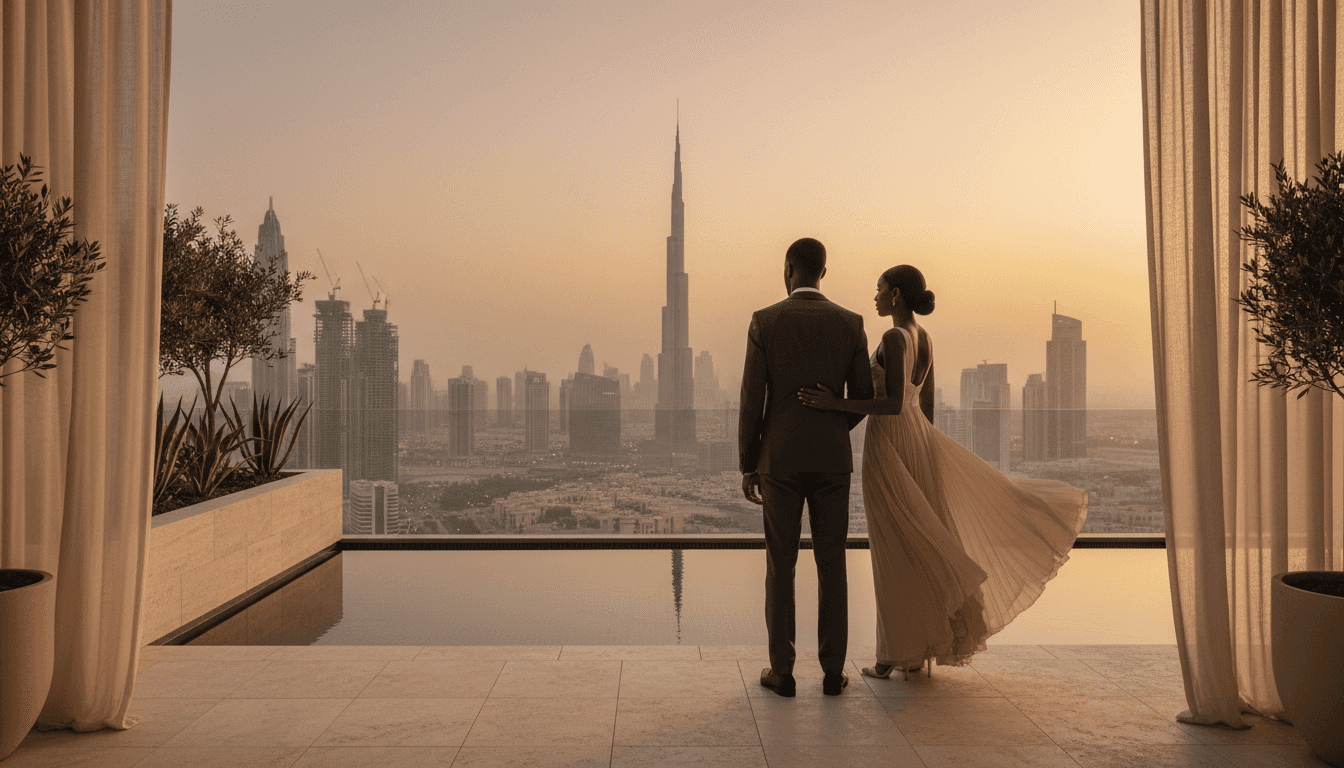
Dubai's Big Squeeze: Smaller Plots, Denser Living
Dubai real estate is undergoing a fundamental shift towards smaller plot sizes and higher density. We analyse the economic drivers, the impact on property values, and what this new era of compact urban living means for both homebuyers and investors.

For decades, the Dubai dream was defined by space: sprawling villas on generous plots of land, separated from neighbours by manicured lawns. That dream is being redrawn. A quiet but powerful transformation is underway across the city, driven by simple economics and ambitious urban planning, recalibrating our expectations of what a family home in Dubai looks like.
Here’s what we’ll cover in this deep dive:
- The fundamental drivers behind Dubai's pivot from sprawl to density, including the Dubai 2040 Urban Master Plan.
- How developer economics and land costs are shaping the homes being built today.
- Real-world examples of communities where this trend is playing out, from affordable to luxury.
- The crucial distinction between plot size, BUA, and perceived value for a homebuyer.
- A line-by-line breakdown of the real costs involved in buying a modern townhouse.
- The investment implications of this shift, analysing both rental yields and capital appreciation potential.
- My final verdict on whether this move towards compact living is a net positive for the market.
The End of Sprawl: Why Dubai is Building Up, Not Out
The most obvious driver for this shift is a finite resource: land. While Dubai gives the impression of endless desert, the reality is that prime, developable land connected to existing infrastructure is scarce and expensive. The low-hanging fruit has been picked. The cost to developers of acquiring large, well-located parcels has soared, making the old model of low-density, sprawling communities economically challenging. Developers must either move further into the desert, incurring massive infrastructure costs, or use the land they have more efficiently. Most are choosing the latter.
This market-driven trend is being codified and accelerated by official policy. The Dubai 2040 Urban Master Plan is the government's strategic blueprint for a more sustainable and liveable city, and density is at its core. The plan explicitly calls for concentrating development in existing urban centres, boosting the population around mass transit stations, and improving efficiency. The goal is to create a '20-minute city', where residents can access 80% of their daily needs and destinations within 20 minutes by foot or bicycle. This vision is simply incompatible with endless, low-density sprawl. It requires a more compact urban form, with integrated residential, commercial, and leisure spaces.
We’re seeing this philosophy translate directly into planning approvals. Municipal authorities are favouring, and in some cases mandating, development plans that demonstrate efficient land use. This isn't just about building more apartment towers; it's about rethinking the suburban model itself. The result is the rise of the modern townhouse community and the 'cluster villa' concept, where homes are built on much smaller plots, often with zero-lot-lines, private but compact gardens, and a greater reliance on shared community amenities like parks, pools, and sports facilities. This approach allows developers to deliver the privacy of a standalone or semi-detached home at a price point that is far more accessible to a broader segment of the population.
Finally, there's a demographic shift. Dubai's population continues to grow and diversify. While the demand for large, luxury villas remains strong from high-net-worth individuals, a larger and growing segment of the market consists of young professionals and families seeking the privacy and space of a house, but without the cost and maintenance burden of a half-acre plot. The market is responding to them. This pragmatic approach to housing supply is a sign of a maturing city, one that is grappling with the same challenges of affordability and sustainability as other global hubs. The era of limitless suburban expansion is over; the age of thoughtful, planned density has begun.
Decoding the Developer's Playbook: The Economics of Density
 Featured project
To understand why your new townhouse has a smaller garden than one built 15 years ago, you have to think like a developer. For them, land is the single biggest input cost, and their primary goal is to maximise the return on that investment. The core of the `developer land use strategy` revolves around a metric called Gross Floor Area (GFA) — the total sellable area they can build. By reducing individual plot sizes, they can fit more units onto the same parcel of land, thereby increasing the total GFA and overall revenue.
Consider a hypothetical 1 million square foot parcel of land. Using an old model from the early 2000s, a developer like Emaar Properties might have allocated 10,000 sq. Ft. plots for each villa, allowing them to build 100 villas. In today's market, that same developer might use an average plot size of 2,500 sq. Ft. for a townhouse. This allows them to build 400 units on the same land. While the price per unit is lower than for a large villa, the total revenue from 400 townhouses will vastly exceed that from 100 villas. This is the simple, powerful arithmetic driving `high-density living Dubai`.
This strategy also has benefits beyond pure unit count. It significantly lowers the per-unit infrastructure cost. The cost of laying roads, power lines, water pipes, and sewerage for 400 homes in a compact layout is far less, on a per-home basis, than for 100 homes spread across a vast area. This efficiency is passed on to the buyer in the form of a more accessible entry price. A developer can deliver a brand new three-bedroom home for AED 2.5 million, a price point impossible to achieve with a 10,000 sq. Ft. plot. This opens up the market to a much wider pool of buyers who were previously priced out of the villa/townhouse segment.
We see this playbook being executed by virtually every major developer. Nshama pioneered this high-volume, high-density model with incredible success in Town Square. Emaar has applied it to its newer communities like Arabian Ranches III and Valley. Even in premium locations like Dubai Hills Estate, you see a mix of product types, with clusters of townhouses and smaller-plot villas balancing out the larger mansions. Newer, aggressive players like Binghatti are applying this logic to the apartment space, focusing on maximising the number of units in prime locations. It's a fundamental shift in the financial model of property development in Dubai, moving from high-margin, low-volume projects to lower-margin, high-volume ones that cater to the city's growing middle class.
Case Studies in Compact Living
To see this trend in action, you only need to look at the communities that have defined Dubai's growth over the past decade. Let's compare the old with the new.
Take The Meadows, one of Emaar's original flagship villa communities. Developed in the early 2000s, it's characterised by large, independent villas on plots that typically range from 6,000 sq. Ft. to over 10,000 sq. Ft. The roads are wide, the gardens are expansive, and the overall feeling is one of suburban tranquility. Now, compare that to a newer community like Maple or Sidra in Dubai Hills Estate, also by Emaar. Here, the three to five-bedroom villas and townhouses are built on plots averaging between 2,200 sq. Ft. and 4,000 sq. Ft. The homes are often linked or semi-detached, the private gardens are compact and designed for low maintenance, and much of the green space is communal.
This isn't a criticism; it's a different proposition. The Meadows offers private space. Maple offers access to a world-class community — the golf course, the mall, the parks, the hospital, at a more accessible price. The developer has traded large private plots for exceptional shared amenities. This is a recurring theme. Communities like Al Furjan, initially developed by Nakheel with larger plots, have seen newer phases by other developers introduce much tighter, more efficient townhouse layouts. Jumeirah Village Circle (JVC) is perhaps the ultimate example of this, a master community designed around a dense network of townhouse plots, a model which has allowed thousands of families to own a home with a private entrance and a small garden.
Even developers known for luxury are adapting. While areas like Al Barari are still a bastion of enormous plots and lush private landscaping, projects like Sobha Hartland II are introducing new townhouse and smaller villa products alongside their larger properties. They understand that even affluent buyers appreciate the 'lock-up-and-leave' convenience of a more compact home, provided the quality and community amenities are world-class. The rise of `compact living Dubai` is not just an affordable housing trend; it's becoming a mainstream lifestyle choice, embraced for its convenience and community-centric design.
Plot Size vs. Built-Up Area: What Matters More?
As buyers navigate this new landscape, it's crucial to understand the distinction between two key terms: plot size and Built-Up Area (BUA). Plot size is the total footprint of the land you own. BUA is the total interior floor space of your home, usually measured across all levels. Historically, these two figures were strongly correlated. A large BUA meant a large plot. Today, that is no longer the case. The most significant trend in `Dubai smaller plot developments` is the effort to maximise the BUA on a minimal plot.
I regularly see new townhouses with a BUA of 2,200 sq. Ft. built on a plot of just 1,800 sq. Ft. How is this possible? Developers achieve this through multi-storey design (G+1 or G+2), minimal setbacks from the property line, and efficient interior layouts. The result is a home that feels surprisingly spacious inside, even if the private outdoor space is limited to a small patio or terrace. For many buyers, particularly families with young children, the internal living space is more important than a large garden they may not have the time or budget to maintain.
So, which matters more for value and lifestyle? It depends entirely on your priorities. If you are a keen gardener, have large pets, or crave absolute privacy and space between you and your neighbours, then a larger plot size will be paramount. You might be better off looking at older properties in communities like Arabian Ranches or Jumeirah Islands. However, if you prioritise modern finishes, energy efficiency, a manageable home, and access to a vibrant, walkable community with shared amenities, then a new-build on a smaller plot with a large BUA could be the perfect fit. You're trading private outdoor space for better community facilities and often, a more modern and efficient home.
“The debate isn't about which is 'better' — a large plot or a large BUA. It's about a fundamental trade-off the modern Dubai market asks you to make: do you want to own private land, or do you want to buy into a shared lifestyle?”
From a `property appreciation density` perspective, the argument is nuanced. A large plot is a finite asset and will always hold intrinsic value. However, a property's value is also a function of demand. A modern, 4-bedroom townhouse with 3,000 sq. Ft. of BUA in a prime community like Dubai Hills might appreciate faster than an older, 4-bedroom villa with the same BUA on a much larger plot in a less desirable, aging community. The location, amenities, school proximity, and overall desirability of the master community are becoming more powerful drivers of value than plot size alone.
The True Cost of a Modern Townhouse
One of the main attractions of these denser developments is the headline price. A starting price of AED 2 million for a three-bedroom house sounds incredibly appealing. However, as with any property purchase in Dubai, buyers must understand the full, all-in cost. Let’s create a realistic, line-by-line cost breakdown for a hypothetical off-plan townhouse with a purchase price of AED 2,200,000.
This calculation assumes a purchase directly from a developer in the primary market. The fees can vary slightly, but this provides a solid estimate.
Upfront Costs for an Off-Plan Townhouse (AED 2,200,000):
- Purchase Price: AED 2,200,000
- Dubai Land Department (DLD) Fee: 4% of Purchase Price = AED 88,000. This is the standard property transfer tax.
- DLD Registration Fees: Approximately AED 4,200. This covers the administrative cost of registering the title deed (or Oqood for off-plan).
- Oqood Issuance Fee: Approximately AED 1,050. Oqood is the initial registration for an off-plan property that secures your name on the title before completion.
- Developer Admin Fees / NOC: This can vary, but let's budget between AED 5,000 to AED 10,000. Some developers waive this, others charge it.
- Agency Fee: Typically 2% of the Purchase Price + 5% VAT. At Gaia Living, we represent the buyer, but in many off-plan sales, this fee is paid by the developer. For the sake of a comprehensive budget, it's wise to be aware of it. In a secondary market transaction, this is a standard buyer cost. For this example, let's assume no agency fee for a direct developer purchase.
Total Upfront Cost (excluding mortgage down payment): AED 98,250
Now, let's consider the payment plan. A typical off-plan plan might be 10% on booking, 40% during construction, and 50% on handover. In this case:
- Booking Deposit: 10% of AED 2,200,000 = AED 220,000
So, your immediate cash outlay at the time of signing the contract would be the DLD fees plus the booking deposit: AED 98,250 + AED 220,000 = AED 318,250. The remaining payments would be due in instalments over the construction period and at handover, which could be financed via a mortgage if you qualify. It’s critical to remember that banks in the UAE typically require a minimum 20-25% down payment for mortgages on completed properties, and financing for off-plan can be more restrictive. This upfront accessibility is a key reason for the popularity of developer post-handover payment plans.
Investment Implications: Yield vs. Capital Growth
For investors, the shift to denser communities presents a compelling set of opportunities and trade-offs. The primary appeal lies in rental yields. Because the initial purchase price of a townhouse or small-plot villa is significantly lower than a traditional large villa, the potential for higher rental returns is strong.
Let's run the numbers. A large 4-bedroom villa in an older, established community might cost AED 6 million and rent for AED 240,000 per year. That represents a gross rental yield of 4.0%. Now consider a brand new 4-bedroom townhouse in a dense, amenity-rich community, purchased for AED 3.5 million. That same family tenant base might pay AED 210,000 per year to live there, attracted by the modern facilities and community vibe. This results in a gross rental yield of 6.0%. For an investor focused on cash flow, the choice is clear. The lower capital outlay and higher relative rent make the denser product a more efficient income-generating asset.
Of course, yield is only half of the total return equation. The other is capital appreciation. Here, the picture is more complex. Proponents of large plots argue that land is the only truly finite part of the equation, and therefore properties with more land will appreciate more in the long run. There is truth to this. However, `property appreciation density` is also influenced by demand dynamics. The pool of potential buyers and renters who can afford a property in the AED 2-4 million range is vastly larger than the pool for properties over AED 6 million.
This broad demand base creates a liquid and resilient market for smaller-plot homes. They are often the first to recover in a downturn and can experience rapid appreciation in an upswing due to the sheer volume of interested buyers. My observation is that while a trophy villa on a huge plot on Palm Jumeirah might see more dramatic percentage gains in a bull market, a well-located townhouse in a community like Town Square or Dubai Hills Estate provides more consistent, stable growth with lower volatility. It's a less spectacular but arguably more dependable long-term investment. The key, as always, is buying the best quality and location you can afford within that product type.
The Future Urban Fabric of Dubai
The move towards smaller plots and higher density is more than a real estate trend; it's a key element in the next chapter of Dubai's story. It represents a conscious decision to build a more sustainable, efficient, and interconnected city. By concentrating growth, the city can support world-class public transport, reduce reliance on private cars, and preserve the surrounding desert environment. This `urban planning Dubai real estate` strategy fosters a stronger sense of community, as residents are more likely to interact in shared parks, cafes, and walkways.
This shift also has profound implications for the city's social fabric. By enabling developers to build and sell homes at more accessible price points, it strengthens the city's middle class and allows more residents to transition from renting to owning. A higher rate of homeownership leads to more stable communities, as residents become long-term stakeholders in their neighbourhoods. It anchors families to the city, encouraging them to put down roots, a core objective of policies like the Golden Visa.
There are challenges, of course. Infrastructure must keep pace with densification. Schools, clinics, and road networks need to be planned and delivered in tandem with new housing, not as an afterthought. Developers have a responsibility to ensure that 'compact' does not mean 'cramped' and that quality of life is prioritised through thoughtful design, sufficient green space, and robust community management. Service charges must also be managed transparently to ensure these communities remain affordable to run in the long term. At Gaia Living, we always advise clients to scrutinise the service charge estimates for any new community, as this is a significant ongoing cost of ownership.
The shift towards smaller plots and denser communities is a sign of Dubai's maturation as a global city. It balances economic reality with a progressive vision for a more sustainable and liveable urban future. For buyers and investors, it requires a recalibration of expectations — moving away from the simple metric of plot size and towards a more holistic assessment of lifestyle, community, and long-term value.
This new model of urban living is not a compromise; it is an evolution. It offers a different, but in many ways richer, version of the Dubai dream. It's a dream based less on private, isolated space and more on shared experiences, convenience, and connection. As the city grows towards its 2040 goals, this trend is set to accelerate, shaping the homes, neighbourhoods, and investment opportunities of tomorrow.
Sources
- Dubai 2040 Urban Master Plan: UAE Government Portal
- Property Registration and Fees: Dubai Land Department
Questions, answered
- Why are new villas and townhouses in Dubai being built on smaller plots?
- Developers are using smaller plots to manage high land costs, increase the number of units they can build, and offer more accessible price points to buyers. This strategy aligns with the Dubai 2040 Urban Master Plan, which promotes higher density and more efficient land use.
- Does a smaller plot size mean lower property appreciation?
- Not necessarily. While a larger plot is a component of value, appreciation is driven by location, community amenities, quality, and overall demand. A well-designed home on a smaller plot in a prime, amenity-rich community can see stronger appreciation than a larger home in a less desirable area.
- Are smaller plot homes a good investment in Dubai?
- They can be a very effective investment. Their lower entry price often translates to higher rental yields compared to larger, more expensive villas. These properties are also in high demand from a large pool of tenants and end-users, potentially leading to strong, stable returns and good capital growth.
- What are some examples of communities in Dubai with smaller plot sizes?
- Many of Dubai's newer communities feature smaller, more efficient plot layouts. Examples include the townhouses in Nshama's Town Square, many clusters in Emaar's Dubai Hills Estate, the recent phases of Al Furjan, and communities like Arjan and Jumeirah Village Circle (JVC).
- How much does it cost to buy a townhouse on a smaller plot in Dubai?
- Prices vary significantly by location and developer. As of 2026, a three-bedroom townhouse in a developing community like Town Square or Damac Hills 2 might start from AED 1.8 million to AED 2.5 million. In more central communities like Dubai Hills Estate, similar properties would command prices upwards of AED 4 million.
- What is the difference between plot size and Built-Up Area (BUA)?
- Plot size is the total area of the land your property sits on, including gardens and outdoor space. Built-Up Area (BUA) is the total square footage of the actual house across all its floors. A key trend in Dubai is for developers to maximize the BUA on a smaller plot.
Omar tracks the announcements that move the market — new launches, regulation, mega-projects, and developer moves — and tells you what they actually mean for buyers.
Related stories
Resort Living as Your Dubai Reality
Explore how to trade temporary staycations for a permanent home with five-star amenities in Dubai. I'll break down the real costs, best communities, and lifestyle trade-offs of embracing high-end resort living every day.
Finding Your Tribe in Dubai's Villa Communities
I explore which of Dubai's renowned villa communities attract specific expat nationalities and lifestyle groups, offering insights to help you find a place that feels like home.
Post-Handover Quality: The Secret to Your Apartment's Value
Beyond the glossy brochures lies the real test of your property investment: how well a building ages. I'll break down why a developer's post-handover quality is the single most important factor for your apartment's long-term value.
Echoes, in your inbox
One thoughtful email a month. Market insight, new launches, no spam.