

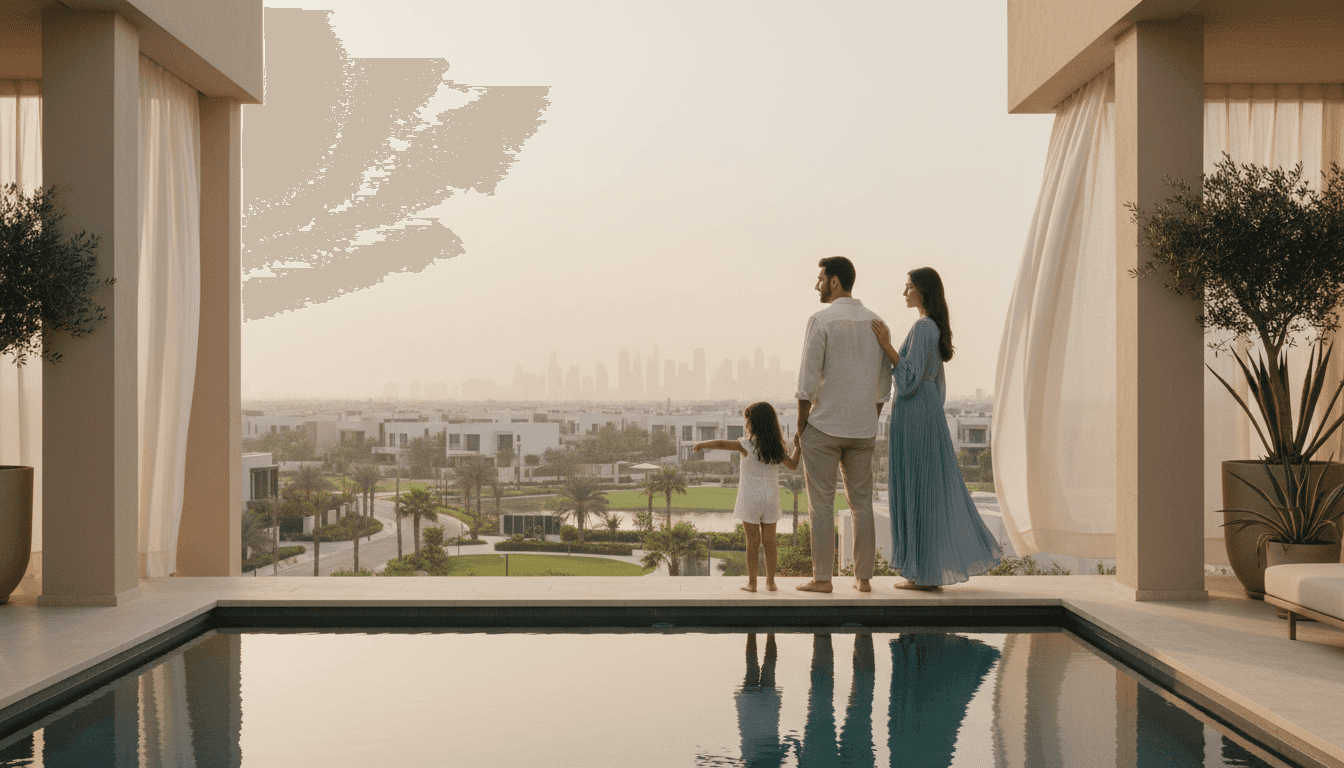
Finding Your Tribe in Dubai's Villa Communities
I explore which of Dubai's renowned villa communities attract specific expat nationalities and lifestyle groups, offering insights to help you find a place that feels like home.

One of the most common questions I hear from families relocating to Dubai is not about square footage or potential yield, but something far more personal: 'Where will we fit in?' Finding your home is one thing; finding your tribe is quite another.
Here’s what we'll explore in this guide:
- The concept of 'demographic gravity' in Dubai's master communities.
- A deep dive into the classic British enclave: Arabian Ranches.
- Why Sobha Hartland has become a hub for Indian families.
- The truly global appeal of Dubai Hills Estate.
- Newer communities and the diverse family communities in Dubai they are fostering.
- A practical breakdown of the costs associated with buying into these communities.
- My personal verdict on finding your perfect cultural and social fit.
The Gravity of Familiarity: Why Do Communities Cluster?
Before we look at specific neighbourhoods, it's important to understand *why* certain nationalities tend to gravitate towards the same areas. It’s rarely a conscious decision orchestrated by developers. Instead, it’s a beautifully organic process, a kind of social gravity. The first few families move in, perhaps drawn by a new school, a particular style of home, or proximity to their workplace. They tell their friends back home or in their existing social circles. Those friends join them. Soon, a small network becomes a community, complete with familiar cultural touchstones, informal support systems, and shared traditions.
This phenomenon is powerful. For someone moving thousands of miles from home, the comfort of hearing a familiar accent at the community pool, knowing your children’s friends share a cultural shorthand, or being able to borrow a specific cooking ingredient from a neighbour can make all the difference. It transforms a functional living space into a genuine home. It's about more than just finding a house; it's about building a life. These clusters create incredibly valuable social expatriate living Dubai is famous for, where friendships are forged over school runs and weekend barbecues.
Of course, Dubai is one of the most cosmopolitan cities on earth, and you’ll find a mix of people everywhere. No community is a monolith. Yet, these tendencies are real and observable. A community might gain a reputation for being 'very British' or 'popular with Indians' or 'a magnet for Europeans'. This isn't stereotyping; it's an acknowledgement of the social fabric that has been woven over years. For families, this can be a huge draw, offering a soft landing in a new country. It’s about finding a place where the unwritten rules of social engagement feel intuitive and where your kids can build a network of friends with shared experiences.
Arabian Ranches: The Quintessential British Suburb
 Featured project
If there is one community that has, for nearly two decades, epitomised the British expat dream in Dubai, it is Arabian Ranches. Developed by Emaar, it was one of the first freehold villa projects to deliver a true suburban lifestyle. When I first drive clients through its winding, tree-lined streets, the reaction is often one of surprise. The mature landscaping, the terracotta roofs, and the established, lived-in feel are a world away from the gleaming skyscrapers many associate with Dubai.
What created this distinctly British feel? It was a perfect storm of factors. The timing was key; it launched when the British expat population was surging. The villas themselves, with their gardens and community pools, mirrored the suburban ideal many were seeking. Most importantly, the amenities were tailored perfectly. The Arabian Ranches Golf Club became a social anchor, and Jumeirah English Speaking School (JESS), one of the city’s most sought-after not-for-profit schools, built a campus right inside the community. This created a powerful feedback loop: families moved to the Ranches for the school, which in turn reinforced the community's family-centric, British-leaning demographic.
Today, that legacy endures. While it's more diverse now, the prevailing culture is unmistakably influenced by its founding residents. You see it in the packed community centre on a Friday morning, the thriving 'Ranches Ladies' social club, and the annual community events that have a village fête-like quality. For many British families, moving to Arabian Ranches feels less like a step into the unknown and more like a sunnier, more spacious version of home. It remains one of the premier expat communities Dubai villas have to offer, especially for those seeking an established and stable environment. The community is now so large it's split into Arabian Ranches I, II, and III, each with a slightly different character but all sharing that same foundational DNA.
Sobha Hartland: A Beacon for Indian Families
For a long time, the narrative around high-end villa living was dominated by European tastes. But in the last decade, a major shift has occurred, and no community represents this better than Sobha Hartland and Sobha Hartland II. Located in Mohammed Bin Rashid City, just a stone's throw from Downtown Dubai, this area has rapidly become the address of choice for a huge number of affluent Indian families. I have worked with many clients for whom Sobha Hartland was not just an option, but the *only* option they were seriously considering.
The developer, Sobha Realty, is a key part of the story. Founded by Indian entrepreneur P.N.C. Menon, the brand carries immense weight and trust within the Indian community, both in India and abroad. They have a reputation for exceptional build quality and a meticulous, backwards-integrated construction process where they control almost every element, from design to concrete. This resonates deeply with buyers who prioritise quality and longevity. The promise of German engineering and uncompromising standards, delivered by a trusted Indian-led company, is a powerful combination.
Beyond the developer's reputation, the location and amenities are perfectly aligned. Hartland is home to two of Dubai's most prestigious international schools, North London Collegiate School and Hartland International School, which are both extremely popular. Beyond that, its proximity to the city's main business hubs like DIFC and Business Bay is a huge draw. The design of the community itself, with its focus on green space (the marketing famously promises 30% of the land is dedicated to parks and gardens) and modern, spacious villas, meets the aspirations of a new generation of successful Indian professionals and entrepreneurs. This has created a vibrant and dynamic cultural community Dubai villas here are now famous for, with Diwali and Holi celebrated with as much enthusiasm as any other festival.
I’ve watched this community grow from a collection of off-plan launches into a thriving, energetic neighbourhood. The sense of community is palpable. You see multi-generational families strolling along the canal, children playing in the parks after school, and a genuine neighbourhood feel. It's a sign of how a developer, by understanding the specific values and priorities of a demographic — in this case, quality construction, excellent education, and a modern family lifestyle, can create a powerful sense of place. It’s a masterclass in building not just homes, but a true community.
Dubai Hills Estate: The Global Village
While some communities develop a distinct national character, others thrive on their sheer diversity. Dubai Hills Estate, another flagship master community by Emaar, is perhaps the best example of this. In my experience, it's one of the most genuinely mixed, globally representative neighbourhoods in the entire city. When we at Gaia Living work with clients in Dubai Hills, their backgrounds are incredibly varied: European, Arab, Asian, African, North and South American. It’s a true melting pot.
What makes Dubai Hills so universally appealing? I believe it comes down to three things: centrality, variety, and modernity. Its location is almost unbeatable, set between Al Khail Road and Mohammed bin Zayed Road, offering easy access to almost every part of the city. For dual-income families where partners work in different areas — say, Jabal Ali and DIFC, it’s a perfect compromise. This logistical advantage cannot be overstated; it removes a major point of friction from daily life. This has cemented its reputation as one of the most sought-after diverse family communities in Dubai.
Second is the sheer variety of property on offer. Within Dubai Hills, you can find everything from one-bedroom apartments in the Collective (aimed at a younger, co-living demographic) to sprawling mansions in the 'Billionaire's Row' of Sector E. This huge range of price points and property types means the community attracts people at all stages of life and from all economic backgrounds. Unlike older communities that might have a more uniform housing stock, Dubai Hills offers a ladder. You can start in an apartment, move to a townhouse, and eventually upgrade to a villa, all without leaving the neighbourhood you love. This creates a stable, long-term population.
“For many buyers today, the new 'luxury' isn't exclusivity based on nationality; it's the richness of a globally diverse community where their children grow up with friends from all over the world.”
Finally, there's the modern, all-encompassing lifestyle. The amenities are world-class: the magnificent Dubai Hills Golf Club, the enormous Dubai Hills Mall, multiple schools (including GEMS International School and King's College Hospital), and acres upon acres of pristine parkland. It’s a self-contained city designed for the 21st century. This clean-slate, everything-is-new appeal attracts buyers who aren't looking for the 'olde-worlde' charm of a community like the Ranches, but rather the smooth convenience of modern master planning. The result is a vibrant, forward-looking community that truly reflects the global character of Dubai itself.
Emerging Hubs: Al Furjan, DAMAC Hills, and Beyond
While Arabian Ranches and Dubai Hills are established titans, the search for nationality friendly villa neighbourhoods in Dubai is constantly evolving. Newer communities are now developing their own unique demographic footprints. Al Furjan, a Nakheel development located towards the Jebel Ali end of the city, is a fascinating example. With its distinctive Quortaj (North African) and Dubai (traditional Emirati) architectural styles, and excellent connectivity via the Metro, it has become incredibly popular with a diverse mix of residents, including a significant number from the wider Middle East and South Asia.
The villas and townhouses in Al Furjan, particularly in the ready secondary market, often represent better value per square foot compared to more central communities. This affordability, combined with its strong community infrastructure (two pavilions with shops, restaurants, and pools), has created a solid, family-oriented neighbourhood. It’s less about a single nationality and more about a shared life stage: young families putting down roots and looking for space and community without the premium price tag of the more established areas. The opening of the Al Furjan metro station on the Route 2020 line was a game-changer, making it a viable option for those who rely on public transport.
Then you have the sprawling communities of Damac Hills and Damac Hills II. These areas are known for their ambitious amenities — Trump International Golf Club in the first, and a water park and other attractions in the second. Their demographic mix is incredibly broad, largely driven by the developer's international marketing reach. I've found these communities are particularly popular with buyers from the CIS countries, the wider MENA region, and parts of Europe. The sheer scale of these projects and the variety of unit types, from apartments to large villas, naturally create a very mixed population. They offer a very modern, resort-style version of social expatriate living in Dubai, which appeals to those looking for a lifestyle packed with on-site activities.
It's also worth watching communities like Town Square by Nshama, which has attracted a younger, millennial demographic with its contemporary townhouses and apartments centered around a vibrant town park. The price point is a major factor here, making it one of the most accessible entry points into property ownership for young professionals and families. As these newer communities mature, their social and cultural identities will continue to solidify, creating even more choice for buyers looking to find their tribe.
The Practicalities: Understanding the Costs
Choosing a community is about feel and fit, but it must be grounded in financial reality. The costs of buying a villa go far beyond the sticker price. It's crucial to have a clear picture of the total upfront and ongoing expenses. When we at Gaia Living sit down with a buyer, we map this out in detail. Let's take a hypothetical example of buying a ready villa in a community like Arabian Ranches or Dubai Hills for AED 6,000,000.
Here’s a realistic breakdown of the upfront costs you would need to prepare for, assuming you are a resident taking a mortgage with a 20% down payment, as per the Central Bank of the UAE regulations for a first property valued over AED 5 million.
- Down Payment (20%): AED 1,200,000
- Dubai Land Department (DLD) Transfer Fee (4% of property price): AED 240,000
- DLD Admin Fee: Approx. AED 4,200
- Real Estate Agency Fee (2% of property price + 5% VAT): AED 126,000
- Mortgage Registration Fee (0.25% of loan amount): AED 12,000 (on a loan of AED 4.8M)
- Bank Mortgage Processing & Valuation Fee: Approx. AED 8,000 - AED 10,000
- Trustee Office Fee (for property transfer): Approx. AED 4,200
- No Objection Certificate (NOC) from Developer: AED 500 - AED 5,000 (variable)
- Total Upfront Cash Required: Approx. AED 1,595,600
This is a significant sum over and above the down payment, and it often catches first-time buyers by surprise. The 4% DLD fee, mandated by the Dubai Land Department (DLD), is the largest component and is non-negotiable. It's essential to factor this into your budget from day one.
Beyond the purchase, you have the annual running costs. The most significant of these is the community service charge. This fee covers the maintenance of all common areas: landscaping, security, swimming pools, parks, and street lighting. It is billed annually and calculated in AED per square foot of your property's built-up area (BUA). In premium villa communities like Dubai Hills or Arabian Ranches, you can expect service charges to range from AED 3.50 to AED 6.00 per sq. Ft. So, for a 4,000 sq. Ft. villa, you could be looking at an annual bill of AED 14,000 to AED 24,000. This is a legally binding charge, and failure to pay can lead to restrictions on your access to community amenities. It’s a crucial number to verify before you sign any contract.
My Verdict: Balancing Heart and Head
So, how do you choose? How do you find that perfect intersection of community, culture, and cost? After years of walking families through this exact decision, my advice is to approach it in two stages: analysis and feeling.
First, the analysis. Be pragmatic. Define your non-negotiables. What is your absolute maximum commute time to work and school? What is your total budget, including all the fees we just discussed? What are your must-have amenities? A golf course? A specific school curriculum? Proximity to the Metro? Make a list. Use this to filter your options down from the dozens of Dubai communities to a manageable shortlist of three or four. This is the 'head' part of the decision. At Gaia Living, this is where we excel, providing the data, cost breakdowns, and logistical insights to help you build that rational framework.
Then comes the 'heart' part. Once you have your shortlist, you need to go and experience these places. Don't just do a quick drive-by. Visit at different times of day. Go to the local community centre café on a Friday morning. Take your kids to the main park on a Saturday afternoon. Walk around the lake or green spaces in the evening. See who is out and about. Do you feel a connection? Can you picture your family living here? This is where the intangible element of 'tribe' comes into play. You'll get a sense of the community's energy, its demographic, and its overall vibe that no brochure or spreadsheet can ever convey.
Ultimately, the best choice is often a balance. Don't choose a community purely because it's popular with your nationality if it means a miserable daily commute. Conversely, don't pick a place that's logistically perfect if it feels socially isolating. The magic happens when you find a place that works on paper *and* feels right in your gut. For some, that will be the established, leafy lanes of Arabian Ranches. For others, the modern, high-quality finish of Sobha Hartland, and for many more, the vibrant, global mix of Dubai Hills Estate. The perfect cultural community Dubai villas are waiting for you in; the key is to know what you're truly looking for.
Sources
- Dubai Land Department (DLD) - dubailand.gov.ae
- Central Bank of the UAE - centralbank.ae
- UAE Government Portal - u.ae
Questions, answered
- Which Dubai villa community is most popular with British expats?
- Arabian Ranches has long been a firm favourite with British families due to its established feel, mature greenery, excellent schools, and community amenities like the Arabian Ranches Golf Club.
- What is a good villa community in Dubai for Indian families?
- Sobha Hartland and the newer Sobha Hartland II are exceptionally popular with Indian families. This is due to the developer's reputation, proximity to top-tier Indian curriculum schools, and high-quality construction.
- Are there truly diverse and international villa communities in Dubai?
- Yes, communities like Dubai Hills Estate are known for their incredible diversity. Its modern amenities, central location, and wide range of property types attract a global mix of residents from Europe, Asia, the Middle East, and beyond.
- What are the typical costs of buying a villa in one of these communities?
- Beyond the purchase price, budget for a 4% Dubai Land Department transfer fee, a 2% real estate agency fee, a mortgage registration fee of 0.25% of the loan amount, and around AED 5,000 in miscellaneous admin fees. Annual service charges typically range from AED 3 to AED 6 per square foot of built-up area.
- How important is a shared culture when choosing a community?
- For many families, having neighbours who share a cultural background can ease the transition to a new country, offering a familiar social network and support system. However, many also seek out diverse communities for a more global experience.
- Can I find social expatriate living outside of traditional villa communities?
- Absolutely. While villas offer a certain lifestyle, many apartment communities like those in Dubai Marina or JVC also foster strong social networks, often centered around shared pools, gyms, and local cafes, appealing to younger expats and couples.

Sophia profiles Dubai's villa communities — schools, commute times, green space, and the intangible feel of a neighbourhood. She writes for families putting down roots.
Related stories
Dubai's Big Squeeze: Smaller Plots, Denser Living
Dubai real estate is undergoing a fundamental shift towards smaller plot sizes and higher density. We analyse the economic drivers, the impact on property values, and what this new era of compact urban living means for both homebuyers and investors.
Resort Living as Your Dubai Reality
Explore how to trade temporary staycations for a permanent home with five-star amenities in Dubai. I'll break down the real costs, best communities, and lifestyle trade-offs of embracing high-end resort living every day.
Post-Handover Quality: The Secret to Your Apartment's Value
Beyond the glossy brochures lies the real test of your property investment: how well a building ages. I'll break down why a developer's post-handover quality is the single most important factor for your apartment's long-term value.
Echoes, in your inbox
One thoughtful email a month. Market insight, new launches, no spam.