

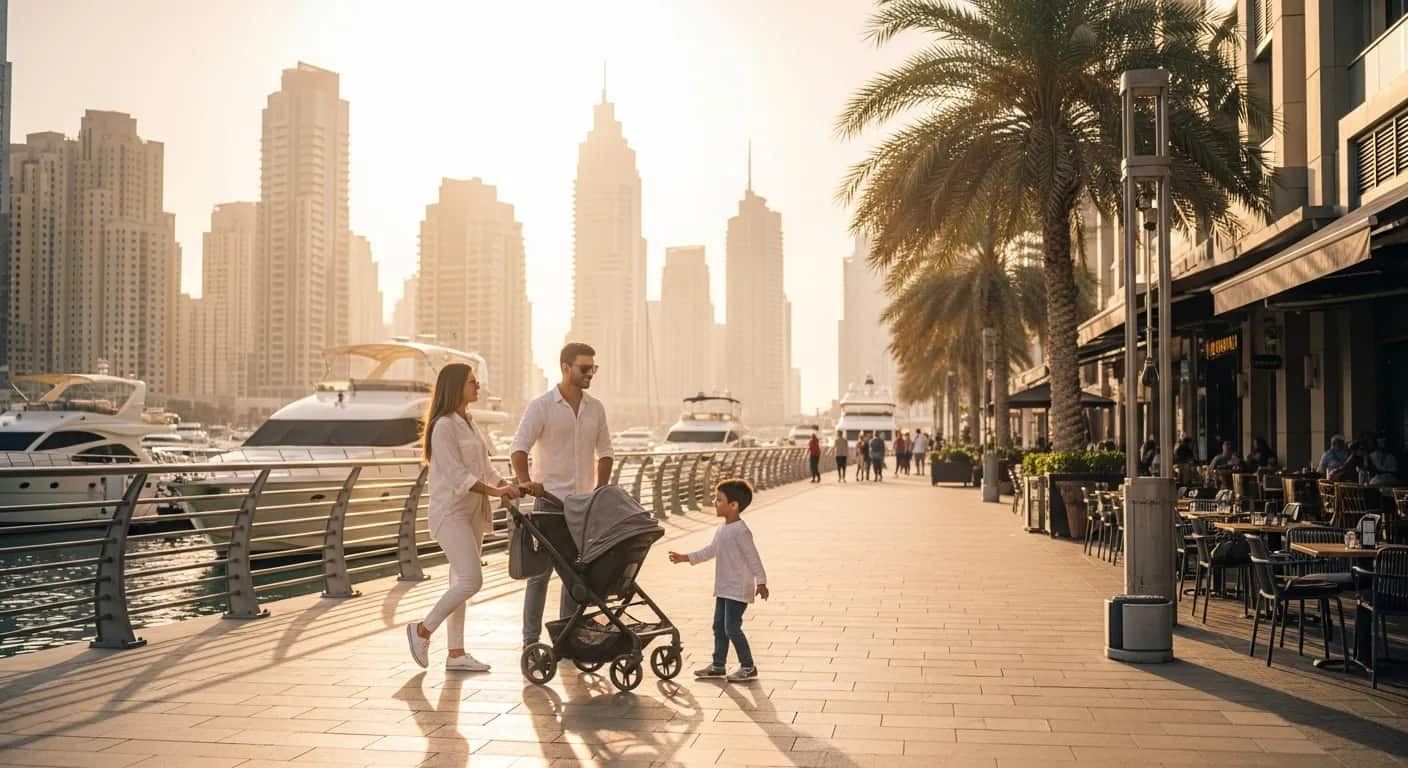
Dubai's Most Walkable Neighbourhoods
Explore Dubai's premier walkable neighbourhoods where convenience and community command a premium. We analyse the lifestyle and investment case for car-free living in a city built for the automobile.

Dubai is a city of grand ambitions, often expressed through the arteries of its superhighways. Yet, for all its automotive focus, a powerful counter-narrative has taken root: the rise of the human-scale, walkable neighbourhood.
- The Walkability Premium: Unpacking the value proposition of a car-lite lifestyle.
- Downtown Dubai: Analysing the quintessential urban core and its property dynamics.
- Dubai Marina & JBR: A look at waterfront promenades and vertical living.
- City Walk & Bluewaters Island: Exploring master-planned pedestrian havens.
- Emerging Contenders: Spotting the next generation of walkable communities like Creek Harbour.
- The Financials of Foot Traffic: A breakdown of service charges, yields, and capital appreciation.
The Myth of the Unwalkable City
As someone who has tracked the pulse of this city’s lifestyle for years, I’ve had a front-row seat to its transformation. The long-standing caricature of Dubai as a place where you drive from one air-conditioned box to another is becoming increasingly outdated. While the car remains king on a macro level, a quiet revolution has been unfolding in meticulously planned pockets across the emirate. This isn't about simply adding sidewalks. True walkability, in the Dubai context, is an intricate ecosystem woven by visionary master developers. It's the seamless integration of high-end retail, world-class dining, shaded pathways, lush green spaces, cultural venues, and efficient public transport links like the Metro and Tram. It is, in essence, the creation of a '15-minute city' on a neighbourhood scale.
This shift is not a happy accident; it is a multi-billion dirham strategic decision. Developers like Emaar Properties and Meraas understood early on that in a maturing global city, lifestyle is the ultimate luxury. The ability to leave your apartment, stroll to a cafe for a morning coffee, walk your children to a park, and meet friends for dinner without ever touching a car key is a powerful value proposition. This curated convenience creates a profound sense of place and community, qualities often elusive in sprawling suburban villa developments. It fosters spontaneous interactions and a neighbourhood vibrancy that cannot be replicated in a car-dependent environment.
However, this lifestyle comes at a price. These pedestrian-centric enclaves are among the most sought-after and expensive real estate in the city. The central thesis of this article is to explore whether that premium is justified. We will dissect the very concept of walkability as a tangible asset, examining what it costs, who it’s for, and how it performs as an investment. For a discerning buyer, understanding the mechanics behind this trend is crucial. It’s a choice that goes beyond square footage and views; it's a fundamental decision about how you wish to engage with one of the world's most dynamic cities.
Deconstructing the Walkability Premium
 Featured project
So, why are people willing to pay substantially more to live in a place where they can walk? The 'walkability premium' isn't just a catchy phrase; it's a quantifiable market reality reflected in sales prices and rental rates. To understand it, we must break it down into its core components, moving beyond the simple convenience of having a supermarket downstairs. The first and most obvious element is the reclamation of time. In a city where commutes can easily consume hours each week, the ability to conduct a significant portion of your life on foot is the ultimate luxury. It translates to more time with family, more time for personal pursuits, and less time spent in traffic. This time-saving aspect alone has a tangible economic and wellness value that sophisticated buyers are increasingly pricing into their decisions.
Beyond pure convenience, there's a powerful lifestyle and wellness dimension. Living in a walkable area naturally encourages a more active existence. It's the evening stroll along the Marina promenade, the weekend walk through the park in Dubai Hills Estate, or the simple act of choosing the stairs over the elevator because the journey outside is pleasant. This constant, low-impact activity has proven benefits for both physical and mental health. Moreover, these neighbourhoods are designed to be aesthetically pleasing. The investment in high-quality public realms—from the art installations in DIFC to the meticulously manicured gardens in Al Barari—creates an environment that reduces stress and enhances daily life. You are not just buying an apartment; you are buying into a beautifully maintained, resort-like setting.
Perhaps the most compelling, yet least tangible, component is the sense of community. In traditional villa compounds, your interaction with neighbours might be limited to a wave from a car window. In a walkable community, the 'third spaces'—the plazas, cafes, and promenades—become extensions of your living room. You bump into neighbours, your children play with their friends in the communal park, and a genuine social fabric begins to form. This creates a stickiness, a reason for residents to put down roots, which in turn leads to a more stable resident base and consistent rental demand. For an investor, this translates directly into lower vacancy rates and a more resilient asset. The premium, therefore, is not just for concrete and steel, but for the carefully engineered social infrastructure that underpins these unique urban villages.
The Original Blueprint: Downtown Dubai
When we talk about purpose-built walkability in Dubai, the conversation must begin with Downtown Dubai. This is Emaar's magnum opus, the gold standard against which all other urban communities in the region are measured. It was conceived not just as a collection of towers, but as a fully integrated, living, breathing heart for the new Dubai. The genius of Downtown lies in its 'density of experience'. From your residence, you are within a short, and often spectacular, walk of the world's largest mall, the world's tallest building, the stunning Dubai Opera, and a seemingly infinite array of cafes, restaurants, and hotels. The Sheikh Mohammed Bin Rashid Boulevard is the community's central artery, a vibrant loop of life that connects everything, encouraging residents and visitors alike to explore on foot.
Living here is an immersive urban experience. I often advise clients to spend an evening just walking the area before making a decision. Start at the base of the Burj Khalifa as the fountains begin their dance, stroll through the green expanse of Burj Park, cross one of the elegant bridges to the Souk Al Bahar for a traditional aesthetic, and finish with dinner on the Boulevard. The entire journey is a masterclass in urban planning. The pedestrian pathways are wide and shaded, the landscaping is immaculate, and the ambient energy is palpable. The seamless connection to the Dubai Metro is a critical piece of the puzzle, linking residents to the rest of the city without a car. This is not just convenience; it's a statement about a new way of urban living in the Middle East.
Of course, this unparalleled lifestyle carries a price tag to match. Properties here, from the branded residences in the Address hotels to the iconic apartments in the Burj Khalifa itself, represent some of the most premium real estate in the city. A project like Opera Grand exemplifies the offering: prime location with world-class amenities and direct access to the cultural heart of the district. But the cost isn't just the purchase price. Prospective buyers must be prepared for some of the highest service charges in Dubai. These fees, regulated by RERA, are essential for maintaining the pristine public realm, 24/7 security, and five-star amenities that define the Downtown experience. For many, this is a worthwhile trade-off—paying for a hassle-free, five-star lifestyle where every detail is managed. For others, it's a significant ongoing cost that must be carefully factored into the total cost of ownership.
Waterfront Walkability: Dubai Marina & JBR
If Downtown is the city's formal, urban heart, then Dubai Marina and its vibrant neighbour, Jumeirah Beach Residence, represent its relaxed, cosmopolitan soul. This is a different flavour of walkability—less about iconic landmarks and more about a linear, waterfront lifestyle. The 7km Marina Walk promenade is the star of the show. On any given day, it’s a tapestry of residents jogging, families cycling, and friends catching up over coffee at one of the dozens of alfresco cafes, all set against the stunning backdrop of gleaming yachts and futuristic skyscrapers. It’s a dynamic, ever-changing scene that provides a constant source of energy and entertainment right on your doorstep.
The master plan here is brilliant in its connectivity. Pedestrian bridges stitch together both sides of the marina, while the Dubai Tram forms a seamless loop, linking residents to the Metro, The Palm Jumeirah, and the entire JBR strip. You can live, work (many towers have commercial space), and play within this ecosystem. A resident of an Emaar 'Original Six' tower, for example, can walk to the Marina Mall for groceries, take the tram to The Beach at JBR for a swim, and then enjoy dinner with a view of Ain Dubai, all within a 2km radius. This multi-modal approach, combining walking with the tram and even water taxis, makes the area remarkably self-sufficient.
“True walkability isn't just about sidewalks; it's about density of experience. It's the ability to live a full, rich life within a 15-minute radius of your front door, on foot.”
The real estate landscape is incredibly diverse. You'll find everything from the original, well-established towers to ultra-modern, super-luxury new launches from developers like Select Group. This diversity creates a more organic, less uniform community than some of the newer master plans. However, this walkability comes with a well-known trade-off: traffic. While life on foot within the Marina is idyllic, getting in and out by car, especially during peak hours, can be a significant challenge. This is a crucial consideration for anyone with a daily commute outside the immediate area. Financially, the investment case is strong but nuanced. JBR, with its direct beach access, is a powerhouse for short-term holiday lets, often commanding high rental yields. Properties in the Marina, like those in a classic tower such as Marina Heights, attract a mix of long-term tenants and end-users who value the lifestyle. Service charges can vary dramatically from tower to tower, depending on age, quality, and amenities, making due diligence on the specific building absolutely essential.
The Curated Experience: City Walk & Bluewaters
Moving beyond the high-rise density of the Marina and Downtown, we find the next evolution of pedestrian-friendly design in Dubai: the 'curated' neighbourhood. City Walk and Bluewaters Island, both masterfully executed by Meraas, represent a shift towards walkability as a branded, boutique experience. They feel less like parts of a sprawling city and more like self-contained, luxury destinations. City Walk, with its low-rise residential buildings, licensed dining, and boulevards reminiscent of European high streets, offers a distinctly chic and cosmopolitan atmosphere. The integration of street art, high-fashion boutiques, a cinema, and The Green Planet bio-dome creates a layered experience that encourages exploration on foot. It’s a masterclass in placemaking, designed for a sophisticated audience that values design and curated retail as much as convenience.
Bluewaters Island takes this concept of exclusivity a step further. It is, by its very nature, an enclave. The walk across the pedestrian bridge from JBR is a dramatic arrival, separating the island from the hustle of the mainland. Life here is serene and resort-like. The residential buildings are low to mid-rise, offering breathtaking views of the sea and the marina skyline. The retail and dining options are carefully selected, and the public spaces are immaculate. With the iconic Ain Dubai as its centerpiece and the presence of world-class hotels, Bluewaters feels like a permanent holiday. It is perhaps the most purely 'walkable' of all Dubai's neighbourhoods, as the limited road access and contained environment actively discourage car use within the island itself.
This level of curation comes at a premium. Properties in both City Walk and Bluewaters are firmly in the luxury segment. The investment proposition here is different from that of Downtown or the Marina. The target demographic is narrower, seeking privacy, exclusivity, and a turnkey lifestyle. These are not areas that cater to the masses; they are designed for a global elite. From a financial perspective, the limited supply, particularly on Bluewaters, acts as a strong pillar for value preservation and potential capital growth. Rental demand is robust but from a very specific, high-income tenant pool. When you buy here, you're not just buying an apartment; you are acquiring a piece of a meticulously crafted, highly desirable brand, a lifestyle product as much as a property.
Emerging Hubs: Where Walkability is the New Standard
The success of these established pedestrian zones has created a powerful blueprint, and today, walkability is no longer an afterthought but a core principle in Dubai's most ambitious new projects. For buyers and investors with a long-term perspective, identifying these emerging hubs is key to securing future value. The most significant of these is undoubtedly Dubai Creek Harbour. Positioned as Emaar’s answer to its own Downtown, this mega-project is being designed from the ground up with walkability at its heart. Plans include a sprawling central park, a marina, and an extensive waterfront promenade with retail and dining, all anchored by the future Dubai Creek Tower. Early residents are already enjoying the tranquil, pedestrian-focused lifestyle along the waterfront, and buying here, especially off-plan, is a vote of confidence in a vision that promises to be even grander and more refined than its predecessor.
Another fascinating case study is the evolution of communities that blend suburban scale with an urban core. Dubai Hills Estate, for instance, is widely known for its luxurious villas and golf course. However, the master plan includes a vibrant, walkable core centered around the Dubai Hills Mall and Dubai Hills Park. The boulevards connecting the apartment complexes in this central zone are lined with retail and F&B outlets, creating a self-contained urban village within the larger suburban landscape. This hybrid model is incredibly appealing to families who want the space and greenery of a villa community but also the convenience of being able to walk to a restaurant, a cinema, or one of the best parks in the city. It represents a 'best of both worlds' approach that is proving immensely popular.
This trend is also making its way to more accessible price points. Nshama's Town Square is a prime example. The entire community is oriented around a central square, brimming with shops, a cinema, and restaurants. The surrounding apartment buildings are all within easy walking distance of this central hub and numerous parks and recreation facilities. It has successfully democratized the walkable lifestyle, proving that good urban design is not exclusive to the ultra-luxury segment. When investing in these emerging areas, especially through off-plan purchases, it's vital to understand the process, including the Oqood registration with the Dubai Land Department, which secures your title. You are not just buying a property; you are buying into the developer's promise to deliver a complete, amenity-rich, and ultimately walkable community.
The Financials of Foot Traffic: A Deeper Analysis
Beyond the appealing lifestyle, a savvy buyer must scrutinize the numbers. The financial implications of choosing a walkable neighbourhood are significant and multifaceted. The most immediate and recurring cost is the service charge. It's a simple equation: the beautiful landscaping, pristine swimming pools, 24/7 security, chilled water features, and clean public spaces that define these communities cost a great deal to maintain. Consequently, service charges in Downtown, the Marina, or City Walk are typically higher than in a standalone tower or a less amenity-rich community. These fees, which are itemised and approved by RERA's Mollak system, are not optional extras; they are a fundamental cost of ownership that directly impacts your net rental yield and annual budget. Before signing a Sales and Purchase Agreement (SPA), you must demand a clear history of service charges for the specific building.
On the revenue side, the picture is generally positive. Prime walkable communities typically exhibit strong rental demand from a high-quality tenant pool. This translates into lower vacancy periods and more stable income streams for investors. A key consideration is the difference between gross and net yield. An apartment in a less walkable area might advertise a higher gross yield, but after factoring in longer void periods and potentially lower rental rates, the net yield could be inferior to a property in a high-demand area like the Marina. Furthermore, areas like JBR and Downtown excel in the lucrative short-term rental market, offering investors the flexibility to generate higher income during peak tourist seasons, though this requires more active management.
For most end-users and long-term investors, the ultimate goal is capital appreciation. Here, walkable master-planned communities have historically demonstrated impressive resilience. Their enduring appeal, coupled with the scarcity of such well-designed environments, creates a protective 'moat' around property values. They tend to hold their value better during market downturns and appreciate more steadily during growth cycles. When seeking financing, banks often view these prime properties favorably. However, the higher purchase prices mean buyers must be prepared for a larger down payment, as mandated by UAE Central Bank mortgage caps (for instance, a 20% minimum down payment for a first-time resident buyer on properties under AED 5 million, and higher percentages for more expensive properties or for non-residents). This underscores the need for robust financial planning when targeting these premium locations. Our buyer and investor guides offer more detailed insights into this process.
Investing in a walkable Dubai neighbourhood is a lifestyle-first decision with significant financial implications. The premium you pay is for convenience, community, and curated quality of life, which often translates into more resilient capital values and stronger rental demand, provided you budget for the higher service charges.
My Verdict: Is the Premium Justified?
After walking these streets, analysing the data, and speaking with countless residents and investors, my conclusion is clear: yes, the premium for walkability in Dubai is, for the right buyer, absolutely justified. It represents a conscious investment in quality of life. The ability to seamlessly blend living, leisure, and socialising without constant reliance on a car is a modern luxury that is in scarce supply and high demand. This is not a trend that will fade; as Dubai continues to mature and densify, the value placed on these human-scale, pedestrian-friendly oases will only increase. They are, in my view, among the most future-proof real estate assets in the city.
So, who is the right buyer? Firstly, it’s the young professional or couple who thrives on social energy and convenience. For them, living in Dubai Marina or JBR means their social life is on their doorstep. Secondly, it's the downsizer or 'empty nester' moving from a large, high-maintenance villa in a suburban community like Arabian Ranches. They seek a lock-and-leave lifestyle, security, and amenities without the burden of upkeep. Downtown Dubai and City Walk are perfect for this demographic. Thirdly, it's the discerning global investor who understands that prime, well-managed real estate in a world-class city is a secure store of value. They see the stable rental income and potential for capital growth as a cornerstone of a diversified portfolio.
However, this lifestyle is not for everyone. If your primary objective is to maximize square footage for your money, you will find better value in emerging suburban communities. The apartment-centric nature of most walkable hubs means those who crave a private garden and a garage for multiple cars should look elsewhere. Furthermore, if you value absolute peace and quiet above all else, the ambient buzz of a vibrant urban core might feel intrusive. These are not sleepy suburbs; they are dynamic, energetic environments. The choice, therefore, hinges on a deeply personal assessment of your priorities. Walkability in Dubai is more than a feature—it's a philosophy. It is a deliberate trade of horizontal sprawl for vertical convenience, of private isolation for public community. It's about deciding whether you want to live in the city, or simply next to its highways.
Questions, answered
- Are walkable neighbourhoods in Dubai more expensive?
- Yes, properties in prime walkable areas like Downtown Dubai or Dubai Marina typically command a significant price premium per square foot. This is due to high demand for the convenient, amenity-rich lifestyle. Investors should also factor in higher service charges for the maintenance of the extensive public realm.
- What are the best walkable areas for families in Dubai?
- While Downtown and the Marina are popular, communities like Dubai Hills Estate and Town Square are increasingly favoured by families. They offer a hybrid model with walkable town centres, parks, and schools, combined with larger living spaces than you'd find in the urban core.
- Can I get a mortgage for a property in a prime walkable area?
- Absolutely. Banks view properties in established, walkable communities favourably due to their strong market performance. However, be aware of UAE Central Bank mortgage caps, which require a minimum down payment, meaning a higher initial cash outlay for these premium-priced homes.
- What are service charges like in walkable communities?
- Service charges are generally higher in master-planned walkable neighbourhoods. These fees, regulated by RERA, cover the extensive maintenance of high-quality landscaping, swimming pools, security, cleaning, and public amenities that define the lifestyle. You are paying for the upkeep of the entire environment, not just your building.
- Is it a good investment to buy in an emerging walkable area?
- Investing in off-plan projects in emerging walkable zones like Dubai Creek Harbour can offer significant potential for capital appreciation as the community matures. However, it requires buying into a long-term vision and accepting the risks associated with construction timelines and the developer's ability to deliver the promised lifestyle.
- Do I still need a car if I live in a walkable Dubai neighbourhood?
- While you can manage daily life without a car, most residents still own one. Dubai is a large city, and travel between walkable hubs or to workplaces in other areas still largely requires a vehicle. The benefit is reduced daily dependency, not complete elimination.

Yusuf writes about how Dubai actually lives — waterfront mornings, community dining, walkability, and the lifestyle premium built into an address.
Related stories
Dubai's Big Squeeze: Smaller Plots, Denser Living
Dubai real estate is undergoing a fundamental shift towards smaller plot sizes and higher density. We analyse the economic drivers, the impact on property values, and what this new era of compact urban living means for both homebuyers and investors.
Resort Living as Your Dubai Reality
Explore how to trade temporary staycations for a permanent home with five-star amenities in Dubai. I'll break down the real costs, best communities, and lifestyle trade-offs of embracing high-end resort living every day.
Finding Your Tribe in Dubai's Villa Communities
I explore which of Dubai's renowned villa communities attract specific expat nationalities and lifestyle groups, offering insights to help you find a place that feels like home.
Echoes, in your inbox
One thoughtful email a month. Market insight, new launches, no spam.