

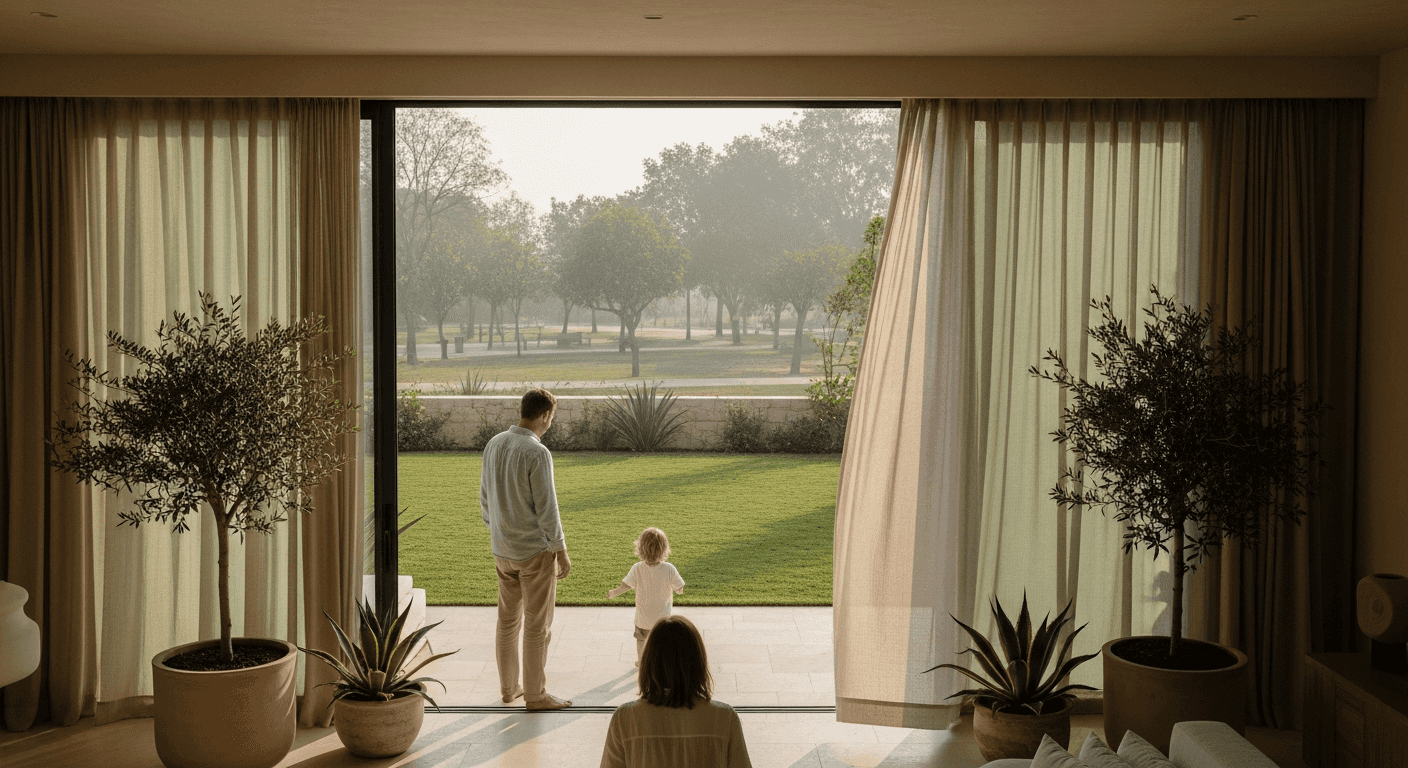
Dubai's Greenest Neighbourhoods
A deep dive into the communities where lush landscaping and serene parks define the lifestyle, moving beyond the city's iconic skyline. I'll show you where to find true tranquility and what it really costs to live there.

When clients first sit down with me to discuss their move to Dubai, they often arrive with a fixed image in mind: shimmering glass towers, six-lane highways, and the electric energy of a city built on ambition. And they are not wrong. But that’s only one frame in a much larger, more nuanced picture. My job — and my passion, is to show them the other side: the quiet, tree-lined streets, the sprawling parks where children’s laughter replaces the city’s hum, and the feeling of coming home to a place that truly lets you breathe. These are Dubai's greenest neighbourhoods, and they represent a profound shift in what luxury living means in our city.
Here’s what we will explore in this deep dive:
- What 'green living' really means in a desert city, beyond just landscaping.
- My personal review of the original green sanctuaries: Al Barari and Arabian Ranches.
- An analysis of the modern standard-bearer for green masterplans: Dubai Hills Estate.
- A complete breakdown of the 'green premium' and whether it's a price worth paying.
- Understanding the real-world impact of service charges in these lush environments.
- A look at other emerging green communities for different budgets and tastes.
- The future of `sustainable living dubai` and how it’s shaping the next generation of neighbourhoods.
- My final verdict on finding your own pocket of tranquility in the emirate.
Beyond the Glass Towers: Redefining 'Green' in Dubai
For years, the story of Dubai was one of vertical growth. We built the world’s tallest tower, the most luxurious hotels, the most ambitious man-made islands. It was a narrative of conquering the desert. But as the city has matured, so has our definition of a desirable lifestyle. The new narrative is not about conquering nature, but integrating it. True `serene dubai neighbourhoods` are not an accident; they are the result of meticulous, long-term master planning that prioritizes human well-being over sheer density. In my experience, the conversation with buyers has shifted. Ten years ago, the prime request was for a sea view from a penthouse. Today, a significant number of clients, particularly families, start the conversation by asking for a garden, a park, and a place where their children can safely ride a bicycle.
This shift is about more than just aesthetics. A truly 'green' community offers tangible benefits that we at Gaia Living see our clients value more and more. It's about improved air quality in a city that is still growing. It's about the mental health benefits of being surrounded by nature, a concept well-supported by science. It's about fostering a genuine sense of community, something that happens naturally when neighbours meet while walking their dogs in the park or watching their kids play. These are communities designed for living, not just for sleeping. They encourage a slower, more deliberate pace of life, a welcome counterpoint to the dynamic energy of Dubai's commercial hubs like DIFC or Business Bay.
The government itself is championing this evolution. The Dubai 2040 Urban Master Plan is a clear statement of intent, with a core objective to make Dubai the world’s best city for living. A key pillar of this plan is to increase the land area for public beaches, parks, and green corridors significantly. Developers have been quick to align with this vision. It's no longer enough to build a tower with a pool deck. The most successful new projects are `dubai green communities` that sell a holistic lifestyle, where the space between the buildings is just as important as the buildings themselves. This is the new benchmark for luxury, and it's a far more grounded and, in my opinion, a more fulfilling one.
The Original Oasis: Al Barari's Uncompromising Vision
If you want to understand the genesis of high-end green living in Dubai, you have to start with Al Barari. Long before it was a market trend, Al Barari was a bold, almost radical, statement. The developer, also named Al Barari, committed to a vision where over 60% of the entire development would be dedicated to green space, botanical gardens, and waterways. To visit Al Barari is to feel like you’ve left Dubai entirely. The air feels cooler, the soundscape is dominated by birdsong and the rustle of leaves, and the sheer density of mature, thriving flora is unlike anything else in the region. It’s a sign of a long-term, uncompromising vision that prioritized creating a unique environment above all else.
I’ve walked clients through its famous themed gardens — the Mediterranean, the Balinese, the Contemporary, and watched their reactions. There is a palpable sense of calm that settles over you. This is not a community with a park; the community *is* a park. The properties, which consist almost exclusively of large, architecturally distinct villas and a few select low-rise apartment projects like Seventh Heaven and Ashjar, are designed to blend into this landscape. Floor-to-ceiling windows don’t just look out onto a garden; they make the garden part of the living space. The name 'Al Barari' itself means 'the wilderness' in Arabic, and while it's a meticulously curated wilderness, it delivers on that promise of escapism.
Of course, this level of exclusivity comes at a price. Al Barari is firmly in the ultra-luxury segment. The residents are typically UHNW individuals and families who value privacy and a bespoke lifestyle above proximity to the city's core. A large villa here can command prices well north of AED 20 million, with rentals for substantial family homes often exceeding AED 1 million per year. It is not a market for everyone. But for those who can afford it, Al Barari offers something that money in Dubai can rarely buy: genuine seclusion and a deep connection to nature. The community has its own high-end wellness centre, The Farm restaurant which is a destination in itself, and a close-knit community feel. It’s a self-contained world for those who want to retreat from the city without truly leaving it.
The Suburban Dream, Perfected: Arabian Ranches
If Al Barari is the exclusive, botanical retreat, then Arabian Ranches is the perfected vision of the aspirational suburban dream. Developed by Emaar Properties, the master developer behind icons like Downtown Dubai, the Ranches demonstrates a deep understanding of what families truly want. It was one of the first large-scale communities to prove that you could create a thriving, green, and self-sufficient suburb in Dubai. It has since become the template for `family living with green spaces` across the region. When I take clients to Arabian Ranches for the first time, their focus immediately shifts from the individual house to the lifestyle of the entire area.
What Emaar got so right with Arabian Ranches is the ecosystem. It's not just villas and townhouses set around a golf course. It’s the community centres with supermarkets and clinics, the highly-regarded Jumeirah English Speaking School (JESS) right inside the community, the Arabian Ranches Golf Club, and the Dubai Polo & Equestrian Club. It’s the network of shaded walkways, community pools, and pocket parks that are always just a short stroll away. This holistic approach means residents rarely need to leave the community for their daily needs. The landscaping is mature, especially in the original Arabian Ranches 1, with tree-lined streets that provide shade and a sense of establishment you don’t find in newer areas.
The community has expanded over the years, and it's useful to understand the differences. Arabian Ranches 1 has the most character and the lushest, most mature greenery, with villas that feel more individual. Arabian Ranches 2 offers more modern layouts and larger homes, with its own dedicated souk and community facilities. The newest, Arabian Ranches 3, caters to a younger demographic with contemporary townhouses and a host of new amenities, including a large central park and even a lazy river. This variety means there's a Ranches property for different tastes and life stages. A three-bedroom townhouse in Ranches 3 might be found starting from AED 2.5 million, while a larger, upgraded five-bedroom villa on the golf course in Ranches 1 could easily be AED 10 million or more. It remains, in my view, one of the safest and most consistently desirable investments for family-oriented buyers and renters in Dubai.
The New Centre of Gravity: Dubai Hills Estate
For a long time, buyers faced a choice: the urban energy of areas like Dubai Marina or the suburban tranquility of communities like Arabian Ranches. Dubai Hills Estate is the community that shattered that compromise. A joint venture between two of Dubai's most respected developers, Emaar and Meraas, it represents the next generation of master-planned living. Its genius lies in its location and its scale. Situated just a short drive from Downtown Dubai and the coast, it offers unparalleled access to the city's core while enveloping residents in an ocean of green.
At the heart of the community lies its two defining features: the 18-hole championship golf course and the immense Dubai Hills Park. This park is a game-changer. Spanning over 180,000 square metres, it offers everything from a skate park and splash pad to sports courts and picnic lawns. This has created a huge demand for `park view homes dubai`, with apartment buildings in projects like Park Heights and Park Ridge directly overlooking this incredible amenity. For many of my clients, the ability to have a direct, protected view of green space from an apartment is the ultimate urban luxury. It combines the convenience of apartment living with the wellness benefits of a villa community.
The property mix in Dubai Hills is also far more diverse than in the older green communities. You can find everything from one-bedroom apartments perfect for young professionals to sprawling, ultra-exclusive mansions in the Hills Grove and Hills View sub-communities, which are often referred to as the new Emirates Hills. This diversity creates a more dynamic and vibrant community. A one-bedroom apartment might trade for around AED 1.5 million, a three-bedroom townhouse for AED 4-5 million, and the magnificent villas can run into the tens of millions. The presence of the Dubai Hills Mall, top-tier schools like GEMS International, and a business park all within the same masterplan makes it a true 'city within a city'. It's my belief that Dubai Hills Estate will set the benchmark for integrated community living for the next decade.
In a city that moves at lightning speed, the ultimate luxury isn't a high floor or a sea view — it's the simple, grounding act of stepping out your door onto soft grass.
The Price of Green: A Detailed Cost Breakdown
This idyllic lifestyle comes with a price tag, and it's essential for any serious buyer to understand the full financial picture. The 'green premium' is real. You are paying for the master planning, the lower density, the extensive landscaping, and the lifestyle amenities. To make this tangible, let's walk through the typical upfront costs for purchasing a property in one of these communities. It’s critical to budget for these ancillary costs, which can add up to 7-8% of the property’s value. These fees are regulated and transparent, and we at Gaia Living always ensure our clients have a clear picture before making any commitment.
Let’s use a hypothetical example of purchasing a four-bedroom townhouse in a community like Dubai Hills or Arabian Ranches on the secondary market. The principles apply to any resale property purchase in Dubai. The figures below are illustrative but reflect a realistic scenario in the current market.
Sample Cost Breakdown: AED 5,000,000 Townhouse Purchase
- Purchase Price: AED 5,000,000
- Down Payment (20% for residents): AED 1,000,000 (Note: The Central Bank of the UAE requires a minimum 20% down payment for a first property for residents, and 25% for non-residents on properties under AED 5M).
- Dubai Land Department (DLD) Transfer Fee (4% of purchase price): AED 200,000. This is the government tax on the property transfer, mandated by the Dubai Land Department (DLD).
- DLD Admin Fee: Approximately AED 4,200 (this is a fixed fee for properties over AED 500,000).
- Trustee Registration Fee: Approximately AED 4,200. This is paid to a DLD-approved registration trustee office to handle the transfer process.
- Real Estate Agency Fee (2% of purchase price + 5% VAT): AED 105,000 (AED 100,000 fee + AED 5,000 VAT).
- No Objection Certificate (NOC) Fee: Between AED 500
- AED 5,000, paid to the developer to issue the NOC for the sale.
- Mortgage Arrangement & Valuation Fees (if applicable): Typically 0.5%
- 1% of the loan amount for arrangement, plus a valuation fee of around AED 2,500
- AED 3,500.
Adding these up, the total upfront cash required, excluding mortgage-related fees, would be approximately AED 1,313,400. This is a substantial figure over and above the down payment, and it's why working with an experienced advisor is crucial to avoid any surprises. While the initial outlay is higher for properties in these premier green communities, the consistent demand and strong capital appreciation potential often seen in such well-managed masterplans can, over the long term, justify the initial investment.
The Green Premium: Unpacking Service Charges
Beyond the purchase price, the most significant ongoing cost of owning a property in a lush, green community is the service charge. This is a topic I spend a lot of time on with my clients because it directly impacts your annual expenses and the overall return on your investment. It’s simple: those beautiful parks, pristine swimming pools, manicured golf courses, and 24/7 security all cost money to maintain. That cost is passed on to the homeowners through annual service charges, managed via the RERA-regulated Mollak system, which ensures transparency and owner oversight.
These charges are calculated on a per-square-foot basis based on your property's total area as registered with the DLD. This means that for the same type of property, a larger unit will have a higher total service charge bill. In general, you can expect service charges in the greenest, most amenity-rich communities to be at the higher end of the market spectrum. For example, a villa community like Dubai Hills or Arabian Ranches might have service charges in the range of AED 4 to AED 8 per square foot per year. In contrast, an apartment in a high-amenity tower within those same communities could be higher, perhaps AED 15 to AED 22 per square foot, because the charge also covers maintenance of the building itself — elevators, facade cleaning, lobby, etc.
Let’s translate this into real numbers. Consider a 4,000 sq. Ft. villa in Arabian Ranches with a service charge of AED 5 per sq. Ft. Your annual bill would be AED 20,000. Now consider a 1,500 sq. Ft. apartment in Dubai Hills with a park view, where charges are AED 18 per sq. Ft. The annual bill would be AED 27,000. The ultra-premium, botanically dense environment of a place like Al Barari would command even higher fees to maintain its unique landscape. It is crucial to request the service charge history for any property you are considering buying. This 'green premium' on service charges is not a hidden fee; it is the direct cost of the lifestyle and environment you are buying into. In my view, if the facilities are well-maintained and heavily used by your family, it offers excellent value.
Beyond the Big Three: Emerging Green Havens
While Al Barari, Arabian Ranches, and Dubai Hills represent the gold standard, the demand for `family living with green spaces` has led to a wonderful diversification of options across different price points and locations. Dubai’s property market is mature enough to offer green living for a wider range of budgets, and some of these communities offer compelling value. One of my long-time favourites is Jumeirah Golf Estates. As the name implies, life here revolves around two Greg Norman-designed championship golf courses, 'Fire' and 'Earth'. The community is divided into distinct, Mediterranean-themed enclaves of villas, townhouses and apartments, each with its own character. The landscaping is superb, and the sense of being set within a world-class golf resort is ever-present. It has a slightly more secluded feel than Dubai Hills but offers a similar high-end, green-focused lifestyle.
For those looking for a similar vibe but perhaps with a different developer ethos, Damac Hills is a major player. Developed by Damac Properties, the first phase is built around the Trump International Golf Club Dubai. It offers a huge range of properties, from apartments to sprawling villas, and has created a vibrant community with parks, a skate park, and stables. DAMAC Hills 2, located further inland, doubles down on the amenity-rich concept with dedicated 'Water Town', 'Sports Town', and other zones, offering an almost resort-like living experience at a more accessible price point than the Ranches or Dubai Hills. It’s a bold and ambitious project that has attracted a lot of families.
Perhaps the most compelling story in the affordable green living space is Town Square by Nshama. I have a lot of respect for what they've achieved. They targeted a clear gap in the market: young families and professionals who wanted the green, walkable lifestyle of the premium communities but at a price they could afford. The entire development is built around Town Square Park, a massive central hub with a carousel, kids' play areas, a cinema, and countless retail and dining outlets. The emphasis is on community engagement and an active lifestyle. You can get a three-bedroom townhouse here for a price that might only get you a one-bedroom apartment in a more central location. It proves that thoughtful master planning can deliver a high-quality green lifestyle without the ultra-luxury price tag.
The Future is Green: Sustainability and Innovation
The conversation around `dubai green communities` is evolving, moving from purely aesthetic green spaces to genuinely `sustainable living dubai`. This is a shift driven by both consumer demand and government vision. The next generation of developments is being designed with a much deeper focus on environmental impact and long-term efficiency. The most prominent example of this is Expo City Dubai, the legacy site of the World Expo. It is being reimagined as a clean, green, human-centric city of the future. It's designed as a 15-minute city, where residents can access all their daily needs via pedestrian-friendly paths or on a bicycle, drastically reducing the reliance on cars. The buildings have high sustainability ratings, and the entire infrastructure is built on smart technology.
We are seeing this ethos trickle down to other new projects as well. Developers are increasingly highlighting features like the use of treated sewage effluent (TSE) water for irrigation — a critical practice in a desert climate. They are incorporating solar panels on villas and community buildings, designing projects to promote passive cooling and reduce air conditioning loads, and using sustainable, locally sourced materials where possible. This is no longer a niche concern; it’s becoming a key selling point. Buyers, especially those from Europe and other regions with strong environmental awareness, are asking these questions. They want to know that their home is not just in a green setting, but is also built and operates on green principles.
The Dubai 2040 Urban Master Plan is the strategic backbone for this movement. By mandating that nature reserves and rural natural areas will constitute 60% of the emirate’s total area, and significantly expanding green corridors to link residential districts, it ensures that this trend is not a fleeting one. It's a long-term structural change in how Dubai will grow. For us at Gaia Living, this is incredibly exciting. It means we will be able to offer our clients an even greater variety of communities that deliver not just a home, but a healthier, more responsible, and more connected way of life. It’s a future where the city’s iconic ambition is balanced by an equally strong commitment to livability.
My Verdict: Is a Green Neighbourhood Right for You?
After walking through countless parks and touring hundreds of homes from Al Barari to Town Square, my conviction is stronger than ever: for the right person, investing in a green community is one of the best lifestyle decisions you can make in Dubai. The premium in both purchase price and service charges is undeniable, but what you receive in return is not easily measured in square feet or monetary yield. You are buying cleaner air, more space, a safer environment for your children, and a daily sense of tranquility that is priceless in a bustling global hub. For many of our clients, particularly families who are putting down long-term roots, this trade-off is more than worth it.
However, it's not the right choice for everyone. If your life revolves around the fast-paced energy of DIFC and you value a 5-minute walk to work over a 30-minute drive, then a villa in Arabian Ranches may feel isolating. If your investment strategy is purely about maximizing rental yield, the higher purchase prices and service fees of a green community might not produce the highest percentage returns compared to a smaller, more central unit. The key is self-awareness. You must be honest about your priorities.
To help you decide, I often ask my clients to consider a few key questions. I've compiled them into a simple checklist:
- Your Daily Commute: How much time are you realistically willing to spend in the car each day? Map the drive from your potential new home to your office and your children's schools during peak hours.
- Your Budget Realities: Have you stress-tested your finances to comfortably afford not just the mortgage, but the significant upfront fees and the recurring annual service charges? Don't stretch yourself too thin.
- Your Lifestyle Priorities: What truly recharges you? Is it the buzz of a new restaurant opening in a trendy district, or is it a quiet weekend morning in your own garden? Be honest.
- Your Amenity Use: Will you actually use the golf course, the equestrian facilities, or the extensive park network? A key part of the value is in using what you're paying for.
- Your Space Needs: Does your vision of home involve a private garden for barbecues, or is a spacious balcony overlooking a vibrant park more your style? This will guide you between a villa, townhouse, or apartment.
Key takeaway: Ultimately, choosing a home in one of Dubai's green communities is an investment in your well-being. It is a conscious decision to prioritize space, nature, and a calmer pace of life. While the financial commitment is significant, the daily dividends of a grounded, healthier, and more connected family life are, in my professional and personal opinion, the most valuable returns of all. If this resonates with you, I encourage you to browse our curated properties for sale or get in touch with our team. We're here to help you find your perfect patch of green in this remarkable city.
## Sources
- Dubai Land Department (DLD): dubailand.gov.ae
- Central Bank of the UAE (CBUAE): centralbank.ae
- The UAE Government Portal (Dubai 2040 Urban Master Plan): u.ae
Questions, answered
- Are service charges always higher in Dubai's green communities?
- Yes, generally they are. The extensive maintenance required for parks, water features, and lush landscaping leads to higher annual service charges, which are calculated per square foot of your property's area and approved by RERA. This 'green premium' is a key cost to factor into your budget.
- What are the most established green neighbourhoods in Dubai?
- The most established green communities are Al Barari, known for its botanical gardens and ultra-luxury villas, and Arabian Ranches by Emaar, a long-standing favourite for family living with its mature parks and golf course. Both offer a tranquil, suburban lifestyle with well-developed amenities.
- Can I find affordable family homes in a green Dubai neighbourhood?
- Yes, while premium areas exist, communities like Town Square by Nshama and DAMAC Hills 2 offer more accessible price points for villas and townhouses. These newer developments are designed around central parks and green spaces, making them excellent choices for families seeking that lifestyle on a more moderate budget.
- Is it possible to find an apartment with a good park view in Dubai?
- Absolutely. Communities like Dubai Hills Estate are prime examples, offering modern apartments with direct views over the massive Dubai Hills Park. Similarly, Town Square and Creek Harbour feature apartment buildings specifically oriented to maximize views of their central green spaces.
- How is 'sustainability' being incorporated into new Dubai communities?
- Newer developments and master plans, like Expo City, are focusing on more than just aesthetics. Sustainable living in Dubai now involves using recycled water for irrigation, designing buildings for energy efficiency, incorporating solar power, and creating walkable, car-light districts to reduce reliance on vehicles.

Yusuf writes about how Dubai actually lives — waterfront mornings, community dining, walkability, and the lifestyle premium built into an address.
Related stories
Dubai's Big Squeeze: Smaller Plots, Denser Living
Dubai real estate is undergoing a fundamental shift towards smaller plot sizes and higher density. We analyse the economic drivers, the impact on property values, and what this new era of compact urban living means for both homebuyers and investors.
Resort Living as Your Dubai Reality
Explore how to trade temporary staycations for a permanent home with five-star amenities in Dubai. I'll break down the real costs, best communities, and lifestyle trade-offs of embracing high-end resort living every day.
Finding Your Tribe in Dubai's Villa Communities
I explore which of Dubai's renowned villa communities attract specific expat nationalities and lifestyle groups, offering insights to help you find a place that feels like home.
Echoes, in your inbox
One thoughtful email a month. Market insight, new launches, no spam.