

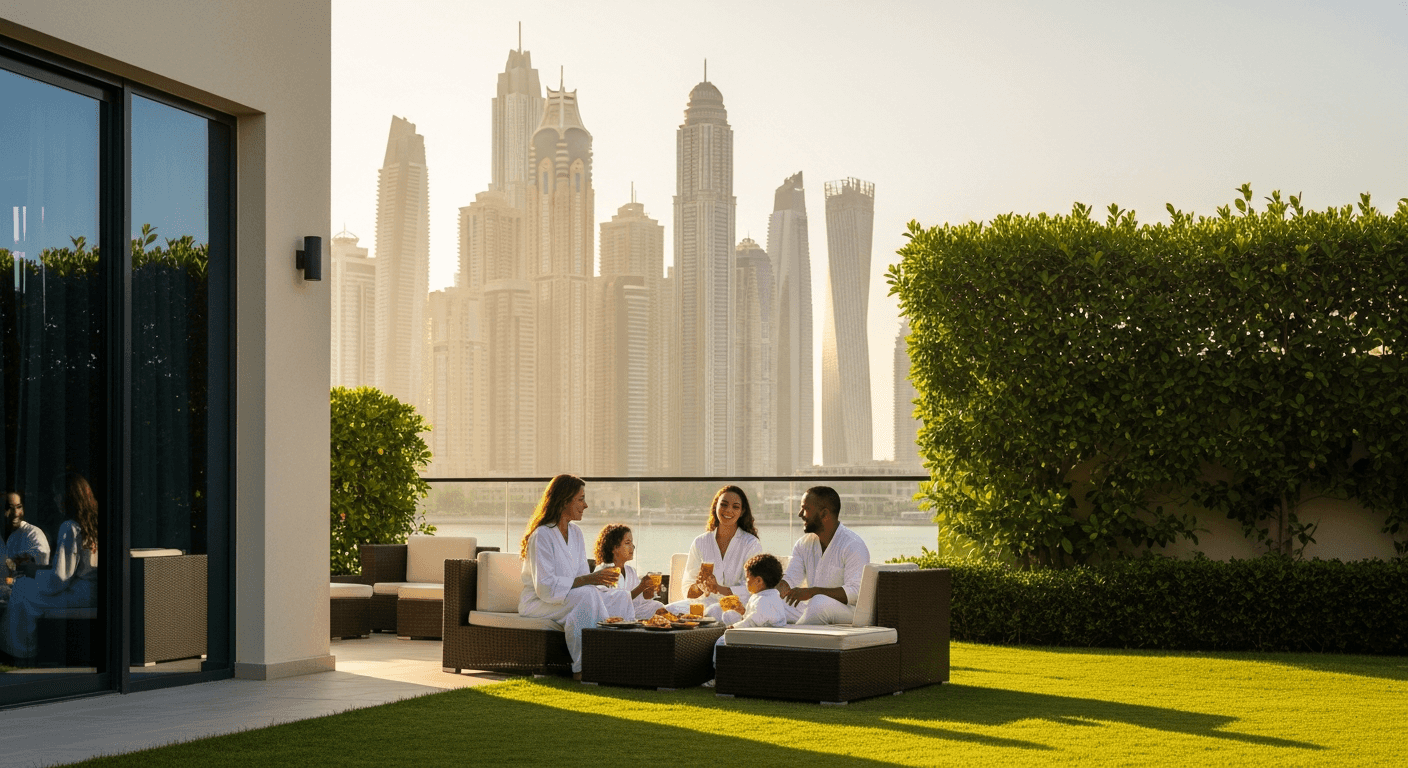
Dubai's Great Debate: High-Rise vs. Villa Living
It's the ultimate Dubai property question: a soaring apartment with skyline views or a spacious villa with a private garden? I'll break down the lifestyle, costs, and investment potential to help you choose.

It’s a conversation I have with clients almost weekly. It sits at the very heart of defining what a life in Dubai means to you. Do you see yourself waking up to a panoramic sunrise over the Arabian Gulf from the 50th floor, or do you picture coffee in your own quiet garden, the sound of birds replacing the city's hum? This is the essential choice: the soaring ambition of a high-rise home versus the grounded seclusion of a villa.
Here at Gaia Living, we see this isn't a simple question of budget or square footage. It's a profound lifestyle decision. To help you navigate it, I'll walk you through the real-world trade-offs and opportunities of each.
Here's what we'll explore:
- The fundamental lifestyle differences between vertical and horizontal living.
- The specific appeal and amenities of the modern Dubai high-rise.
- The unique privacy and space offered by gated villa communities.
- A detailed, line-by-line cost comparison for buying an apartment versus a villa.
- The truth about service charges and other ongoing ownership costs.
- An investor's analysis of yields, appreciation, and long-term value.
- The new hybrid properties that are blurring the lines between the two.
- My personal verdict on how to make the right choice for your life.
The Foundational Choice: Lifestyle Above All Else
Before we even touch on price per square foot or potential rental yields, we need to talk about you. The most common mistake I see buyers make is getting lost in the numbers before they’ve defined their personal ‘why’. The best property for you is the one that complements the life you want to lead. The choice between an apartment and a villa isn't just about real estate; it's about the very rhythm of your daily existence in this city. A spreadsheet can't tell you whether you'll be happier with a five-minute walk to a bustling promenade or the privacy of your own swimming pool.
Think about your daily routine. The Dubai high-rise lifestyle is one of immense convenience. It’s the ability to leave your apartment and be within minutes of a world-class restaurant, your office in DIFC, or the energy of a beachfront walk at JBR. It’s the ‘lock-up-and-go’ freedom that appeals to busy professionals, frequent travellers, and couples who want the city at their fingertips. The amenities are an extension of your home: a state-of-the-art gym, a rooftop infinity pool, a 24-hour concierge to handle deliveries. Your social life is often built-in, with neighbours from all over the world just an elevator ride away.
In contrast, villa living Dubai comparison highlights a different set of priorities. It’s about creating a private sanctuary. Life in a community like Arabian Ranches or Dubai Hills is deliberately paced. Mornings might involve a walk with the dog around the neighbourhood lake, weekends are for barbecues in your garden, and the soundscape is one of children playing in the street rather than the distant thrum of Sheikh Zayed Road. This lifestyle is a conscious choice for space, for privacy, and for putting down roots, especially for families. It demands a greater reliance on the car but rewards you with a sense of permanence and ownership that can be harder to find in a tower.
The View from Above: The Allure of the Dubai High-Rise Lifestyle
 Featured project
The appeal of luxury skyscraper homes Dubai is potent and deeply tied to the city's identity. Dubai built its modern reputation on architectural ambition, and living within one of these structures is a way of participating in that story. Waking up in a residence in Downtown Dubai, with the Burj Khalifa and the fountains performing for you each evening, is an experience that is hard to quantify but immensely powerful. The views are, without question, the headline act. Whether it’s the full marina and sea view from a tower by Emaar Properties in Emaar Beachfront or the glittering skyline from a penthouse in Business Bay, this perspective provides a daily reminder of the dynamic city you inhabit.
Beyond the view, the lifestyle is defined by effortless access to world-class amenities. This is a key part of the apartment vs villa Dubai value proposition. In a premium tower, you aren't just buying the space within your four walls; you're buying into a vertically integrated resort. This can include multiple pools (lap pools, family pools, temperature-controlled relaxation pools), extensive fitness centres that rival commercial gyms, residents' lounges, cinemas, and even direct, air-conditioned access to the Dubai Metro or a major mall. The concierge service in a building like The Address or a Select Group tower is more akin to a hotel front desk, capable of arranging everything from housekeeping to dinner reservations.
This concentration of services creates an incredibly efficient way of life. There's no garden to maintain, no pool to clean, no security system to manage. The building's management handles it all, funded by the collective service charges. This convenience is a huge draw for those with demanding careers or who travel often. However, it comes with trade-offs. You share walls, floors, and ceilings with your neighbours. You're subject to the rules of the Owners Association. And while many modern buildings have excellent soundproofing, you are inherently part of a much larger, denser community. For many, this is a positive — a chance to meet people and feel connected. For others, the constant low-level interaction can feel draining.
Grounded in Space: The Enduring Appeal of the Dubai Villa
If the high-rise is about ambition and convenience, the villa is about sanctuary and space. The moment you pass the security gate of a community like Jumeirah Golf Estates or the exceptionally lush Al Barari, the pace of life changes. The streets are wider, the greenery is abundant, and the scale is human. The primary allure here is control over your personal environment. You own the land your home sits on (within the freehold plot), and that translates to a level of privacy and freedom a tower resident can only dream of.
This is where gated community villas Dubai truly shine. It’s the ability to have a private swimming pool, to landscape your garden exactly as you wish, to have a dedicated, secure space for your children to play. It's about having a garage for your cars, a spare room for a home office or gym, and the simple luxury of not having to wait for an elevator. For families, these factors are often non-negotiable. The communities are designed around this life stage, often including international schools, community centres, supermarkets, and clinics within their boundaries. You can live a full and comfortable life without ever needing to venture onto a major highway.
Of course, this idyllic picture comes with its own set of responsibilities. That beautiful garden and sparkling pool? Their maintenance is your financial and logistical responsibility. If the air conditioning fails, you are the one calling the technician, not the building manager. This hands-on ownership is rewarding for many but can be a burden for others. Villas also generally necessitate a two-car household. While communities are becoming more self-contained, access to the city's main business and entertainment hubs requires driving. This trade-off — space and privacy in exchange for a longer commute, is a calculation every villa buyer must make. The value proposition here is less about dazzling views and more about the tangible, usable square footage, both inside and out.
“The choice isn't just about square feet versus a panoramic view; it's about the very rhythm of your daily life in Dubai.”
The Brass Tacks: An Honest Apartment vs. Villa Dubai Value Comparison
Let's move from lifestyle to the ledger. In my experience, sticker shock can go both ways. Clients are often surprised that a large villa in an established community can have a lower price per square foot than a two-bedroom apartment in a prime tower. The key metric is the total quantum — the final price you pay, which is almost always higher for a villa because the overall size is so much greater. But the value equation is more complex than that.
To make this concrete, let's walk through a realistic, hypothetical purchase scenario for two distinct properties. We will look at the upfront costs beyond just the purchase price, which are often overlooked by first-time buyers. These fees are mandated and non-negotiable, so they must be factored into your budget from day one. The 4% transfer fee, for instance, is a significant sum payable to the Dubai Land Department (DLD) to register the new title deed in your name.
Let’s compare a popular apartment choice with a sought-after villa type:
Scenario 1: 2-Bedroom Apartment in Dubai Marina * Property Type: 1,400 sq. Ft. apartment with a marina view. * Purchase Price: AED 3,000,000 * Upfront Costs Breakdown: * DLD Transfer Fee (4% of Purchase Price): AED 120,000 * Real Estate Agency Fee (2% of Purchase Price + 5% VAT): AED 63,000 * DLD Title Deed Registration / Trustee Fee: ~AED 4,200 * Mortgage Registration Fee (0.25% of loan amount, if applicable): ~AED 6,000 (on a typical 80% loan) * Total Upfront Costs (approx.): AED 193,200
Scenario 2: 3-Bedroom Villa in Arabian Ranches * Property Type: 3,200 sq. Ft. villa with a small garden. * Purchase Price: AED 4,500,000 * Upfront Costs Breakdown: * DLD Transfer Fee (4% of Purchase Price): AED 180,000 * Real Estate Agency Fee (2% of Purchase Price + 5% VAT): AED 94,500 * DLD Title Deed Registration / Trustee Fee: ~AED 4,200 * Mortgage Registration Fee (0.25% of loan amount, if applicable): ~AED 9,000 (on a typical 80% loan) * Total Upfront Costs (approx.): AED 287,700
As you can see, the absolute cash required upfront is significantly higher for the villa, driven by the higher purchase price. This is before your mortgage down payment, which for an expatriate resident on a first property under AED 5 million is 20%, rising to 30% for properties over that threshold. These numbers illustrate that while the villa might offer more 'space for your money' on a per-square-foot basis, the barrier to entry in terms of both down payment and fees is substantially higher. This is a critical factor in the apartment vs villa Dubai value debate.
Service Charges and Hidden Costs: What You Really Pay For
The purchase price is just the beginning of your financial commitment. Annual running costs, particularly service charges, can have a major impact on your budget and, for investors, your net rental yield. This is an area where there is a stark difference between apartments and villas, and understanding it is crucial. Service charges are fees collected by the Owners Association Management company to cover the cost of maintaining and operating the common areas of a project. They are approved by Dubai's Real Estate Regulatory Agency (RERA) and are calculated on a per-square-foot basis against the total area of your property on the title deed.
For an apartment, service charges cover a long list of items: the maintenance and staffing of the lobby, security personnel, cleaning of common areas, landscaping, pest control, and — most significantly, the operation of all amenities like the pool, gym, and lifts. In many towers, this also includes the cost of air conditioning (chiller fees), though in some buildings this is billed separately based on consumption. A realistic range for a quality apartment building in a prime area like Downtown Dubai or Dubai Marina is between AED 18 and AED 35 per square foot per year. For our 1,400 sq. Ft. apartment example, this means an annual bill of AED 25,200 to AED 49,000.
For a villa, the calculation is different. The service charge is levied on the plot area or built-up area (this varies by community) but is much lower on a per-square-foot basis, typically ranging from AED 2 to AED 6. This fee covers the maintenance of the community's infrastructure: roads, street lighting, security gates, community parks, and communal pools. For our 3,200 sq. Ft. villa, this might be an annual fee of AED 6,400 to AED 19,200. However, this does not cover any of the costs associated with your private property. The maintenance of your garden, the cleaning and servicing of your private pool, your individual pest control, and all exterior and interior repairs are your direct responsibility. These costs can easily add an extra AED 20,000 to AED 40,000 or more to your annual budget, depending on the size of your plot and pool. When you factor in these private maintenance costs, the total annual outlay for a villa can often meet or exceed that of a similarly valued apartment.
The Investor's Calculus: Yields, Appreciation, and Exit Strategy
When we shift our focus from end-user lifestyle to pure investment, the apartment-versus-villa calculus changes again. Here, the key metrics are gross and net rental yield, potential for capital appreciation, and liquidity (the ease of selling the asset). At Gaia Living, we advise our investor clients to be crystal clear on their primary goal: is it regular income, long-term growth, or a blend of both?
Generally speaking, apartments offer a stronger play for rental income. A one or two-bedroom apartment in a high-demand rental area like the Marina, JLT, or Business Bay can generate a gross rental yield of 6-8%, and sometimes higher. The tenant pool is vast, consisting of young professionals, couples, and new arrivals to Dubai who want convenience and amenities. The lower purchase price also means your capital is less concentrated in a single asset. The trade-off is that the market for standard apartments is very competitive, and capital appreciation can be slower compared to unique or larger properties. The churn of tenants can also be higher, leading to more frequent vacancy periods and agency fees for finding new renters.
The investment case for a villa is typically weighted more towards capital appreciation. While gross rental yields are lower, usually in the 3-5% range, well-located family villas in premium gated community villas Dubai have historically been a strong driver of wealth creation in Dubai. Demand for these properties from end-user families is robust, and supply is more constrained than for apartments. This dynamic can lead to significant price growth during market upswings. Tenants for villas are usually families who tend to sign longer leases, providing more stable and predictable income, even if the percentage yield is lower. The challenge for a villa investor is the higher entry cost and reduced liquidity. Selling a multi-million dirham villa is a more involved process and the buyer pool is smaller, meaning it can take longer to exit the investment compared to a one-bedroom apartment.
The New Wave: Hybrids and Emerging Trends
The classic dichotomy of a small apartment in a tower versus a sprawling villa in the suburbs is becoming less rigid. Developers, in their constant drive to innovate and capture new market segments, are creating fascinating hybrid properties that offer the best of both worlds. This is where I see some of the most exciting opportunities in the market today. We are seeing a new generation of luxury skyscraper homes Dubai that incorporate features traditionally associated with villas.
Developers like Meraas at City Walk or Nakheel on the Palm Jumeirah are designing low-rise residential buildings and high-end towers with exceptionally large terraces that function as private sky gardens, some even featuring private plunge pools. The concept of the 'sky villa' — enormous duplex and triplex penthouses that occupy thousands of square feet, is becoming more common, offering villa-like space and privacy combined with the views and security of a tower. These properties command a significant premium but cater to a wealthy demographic that wants space without the maintenance and location trade-offs of a traditional villa.
Conversely, new villa communities are being designed with a greater emphasis on walkability and integrated amenities. The master plan for Dubai Hills by Emaar Properties is a prime example. It combines various types of villas and townhouses with apartment buildings, all set around a central park, a championship golf course, and the enormous Dubai Hills Mall. This creates a more urban, connected feel than the older, more purely residential villa communities. The result is a lifestyle where you can enjoy the privacy of your villa but still walk to a cafe, a restaurant, or the shops. This fusion of urban convenience with suburban space is proving to be an incredibly powerful and popular model for modern Dubai living.
My Verdict: How to Make Your Choice
After years of guiding clients through this decision, my conclusion is this: there is no universally 'better' choice. The right answer is intensely personal. The goal is to achieve an honest alignment between your finances, your daily needs, your family structure, and your long-term aspirations. The property must serve your life, not the other way around. To find your own answer, I encourage you to move past the brochures and ask yourself some frank questions.
I often give my clients this simple checklist to guide their thinking:
- Your Ideal Weekend: Do you picture yourself brunching at a new beachfront restaurant you walked to, or hosting a large family barbecue in your own backyard? Your leisure time is a powerful clue to your lifestyle preference.
- The Daily Commute: Be realistic. Are you willing to spend 30-45 minutes in the car each way for more space, or does the idea of a 10-minute walk to the Metro fill you with joy? Track the actual commute time during rush hour, not the optimistic off-peak time.
- Privacy vs. Amenity: Which is your non-negotiable? Would you trade a private garden for a world-class gym and three swimming pools you don't have to maintain? Or is the thought of sharing a wall with a neighbour a deal-breaker?
- Your 5-Year Horizon: Where do you see yourself in five years? Are you planning to start a family? Is a major career change on the horizon? A young couple might love a dynamic city apartment now, but their needs could shift dramatically in a few years.
- The Full Budget: Look beyond the purchase price. Have you calculated a realistic annual budget including service charges, private maintenance (for villas), DEWA, and other utilities? This 'total cost of ownership' is the true financial test.
Answering these questions honestly will point you in the right direction. It will clarify whether the convenience and energy of the Dubai high-rise lifestyle is your ideal, or if the space and tranquility of a home within one of the city's celebrated gated community villas Dubai is what you truly crave.
The decision between a high-rise apartment and a villa in Dubai is less about which is 'better' and more about which is 'better for you'. A clear-eyed assessment of your personal lifestyle, family needs, and true total budget — including upfront fees and annual running costs, is the only way to make a choice that you will be happy with for years to come.
Ultimately, the best way to resolve this debate is to experience both options firsthand. At Gaia Living, we can arrange for you to see not just the properties, but the communities themselves. To walk the promenade in the Marina, and then to experience the quiet streets of Arabian Ranches. To stand on a 70th-floor balcony and then in a private garden. Because in the end, you’re not just buying a property; you’re choosing your Dubai life.
## Sources - Dubai Land Department (DLD) - https://dubailand.gov.ae/ - Real Estate Regulatory Agency (RERA) - https://dubailand.gov.ae/en/tera/ - Central Bank of the UAE (CBUAE) - https://www.centralbank.ae/ - UAE Government Portal - https://u.ae/en
Questions, answered
- Which is a better investment in Dubai, an apartment or a villa?
- Apartments in prime locations like Dubai Marina often have higher rental yields (6-8%+) and are easier to rent. Villas tend to have lower yields (3-5%) but have shown strong potential for capital appreciation, particularly for family homes in desirable communities like Dubai Hills.
- What are the typical service charges for apartments and villas in Dubai?
- Apartment service charges typically range from AED 15-35 per square foot annually, covering building amenities and maintenance. Villa service charges are lower, around AED 2-6 per square foot, covering community upkeep but not your private property, garden, or pool.
- Are villas in Dubai more expensive than apartments?
- While a villa's total purchase price is almost always higher due to its larger size, the price per square foot can often be lower than that of a luxury apartment in a prime skyscraper. The overall value depends on location, size, and amenities.
- What are the main lifestyle differences between living in a Dubai apartment versus a villa?
- Apartment living offers convenience, stunning views, and built-in amenities, suiting a dynamic, 'lock-up-and-go' lifestyle. Villa living provides privacy, extensive personal space (gardens, pools), and a quieter, family-oriented environment within a gated community.
- What are the upfront costs when buying a property in Dubai?
- Besides the property price, you must budget for a 4% Dubai Land Department (DLD) transfer fee, a 2% (+VAT) real estate agency fee, a trustee office fee of around AED 4,000-5,000, and any applicable mortgage registration fees. These costs apply to both apartments and villas.
- What is the minimum down payment for a mortgage in Dubai?
- For expatriate buyers, the Central Bank of the UAE mandates a minimum down payment of 20% for a first property valued under AED 5 million. For properties over AED 5 million, the minimum down payment is 30%.

Yusuf writes about how Dubai actually lives — waterfront mornings, community dining, walkability, and the lifestyle premium built into an address.
Related stories

Dubai's Big Squeeze: Smaller Plots, Denser Living
Dubai real estate is undergoing a fundamental shift towards smaller plot sizes and higher density. We analyse the economic drivers, the impact on property values, and what this new era of compact urban living means for both homebuyers and investors.
Resort Living as Your Dubai Reality
Explore how to trade temporary staycations for a permanent home with five-star amenities in Dubai. I'll break down the real costs, best communities, and lifestyle trade-offs of embracing high-end resort living every day.
Finding Your Tribe in Dubai's Villa Communities
I explore which of Dubai's renowned villa communities attract specific expat nationalities and lifestyle groups, offering insights to help you find a place that feels like home.
Echoes, in your inbox
One thoughtful email a month. Market insight, new launches, no spam.