

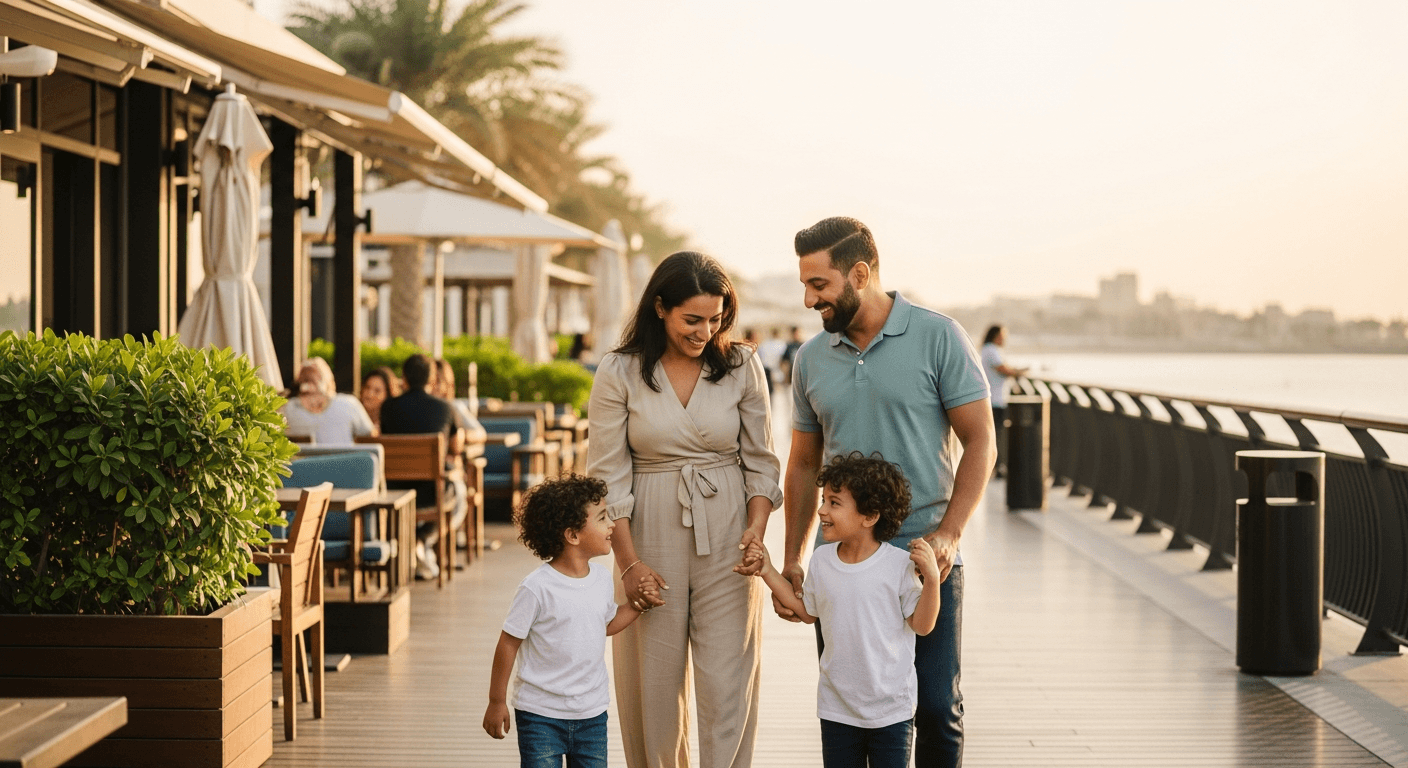
Dubai's Best Amenities: A Lifestyle Expert's Guide
The quality of shared amenities now defines a property's true value in Dubai. A lifestyle expert breaks down which facilities are worth the service charges and which are just expensive novelties.

When I first moved to Dubai over a decade ago, a building’s 'amenities' often meant little more than a small, shaded pool and a gym with a single treadmill tucked away in a basement. Today, that world feels like ancient history. The conversation around residential property has fundamentally shifted. It’s no longer just about the square footage of your apartment or the view from your balcony. It’s about the life you can live the moment you step outside your front door.
In my work at Gaia Living, guiding clients through the city’s vast property landscape, I’ve seen this evolution firsthand. The quality, variety, and management of a community’s shared spaces are now among the most critical factors driving property value and, more importantly, a resident's quality of life. From morning swims in a temperature-controlled infinity pool to evening strolls through manicured parks, these lifestyle facilities are the invisible architecture of a great Dubai neighbourhood. But not all amenities are created equal, and their costs — paid for by every homeowner through service charges, are very real. The challenge for any prospective buyer is to look beyond the glossy brochures and understand what you're truly paying for.
Here's what we'll explore:
- The evolution of amenities from basic features to complete lifestyle ecosystems.
- How to decode service charges and calculate the true cost of community living.
- A deep dive into the communities that set the standard for families, wellness, and social life.
- My personal take on which amenities add genuine, lasting value.
- A look ahead at branded residences and the future of `lifestyle facilities dubai`.
The Amenity Arms Race: More Than Just a Pool
To understand Dubai's property market today, you must understand the 'amenity arms race'. It's a competition between developers to offer bigger, better, and more unique shared facilities to attract discerning buyers. This shift was driven by a maturing market. As the city grew, buyers and renters who had options began demanding more. They weren't just looking for a place to sleep; they were looking for a place to live, work, socialise, and relax.
Master developers like Emaar Properties and Meraas were pioneers in this space. They realised that the true value wasn't just in the towers they built but in the community they curated around them. They started designing neighbourhoods, not just housing projects. The focus moved from a simple checklist of facilities (pool, gym, parking) to a holistic lifestyle experience. This meant lush parks, F&B promenades, cycling tracks, community event spaces, and even public art installations. The space *between* the buildings became a core part of the product.
In my view, this was the single most important development in Dubai real estate over the last 15 years. It created a clear distinction between a standalone tower, which might offer a great apartment, and a master community, which offers a complete lifestyle. This is why a property in a well-managed master community often commands a higher price and retains its value better over time. The `shared amenities dubai` residents enjoy act as a powerful moat, creating a stickiness that makes people want to stay, and a desirability that constantly attracts new buyers and tenants.
This evolution is ongoing. We've moved past basic shared spaces into an era of professionally programmed and managed lifestyle hubs. It’s not enough to have a park; communities now host farmers' markets, outdoor movie nights, and fitness boot camps. A `community gym dubai` can't just have a few weights; it needs the latest Technogym equipment, yoga studios, and qualified trainers. The pool isn't just for a quick dip; it's an 'urban beach' with cabanas, a poolside cafe, and a dedicated kids' splash area. This is the new baseline for premium living in Dubai, and it has profound implications for what you should expect, and what you should be prepared to pay for.
Decoding Service Charges: The Real Cost of Lifestyle
 Featured project
For all the talk of resort-style living, it's essential to ground ourselves in financial reality. Every infinity pool, every landscaped garden, every 24-hour security guard comes at a cost. In Dubai's freehold property market, this cost is paid by homeowners through annual service charges. Forgetting to budget for these is one of the biggest mistakes I see new buyers make. Service charges are not an optional extra; they are a significant, recurring expense that is as certain as your mortgage payment.
These charges are levied by the Owners Association Management company and are calculated on a per-square-foot basis for your property's total area as registered with the Dubai Land Department (DLD). The rate itself is approved annually by the Real Estate Regulatory Agency (RERA), which provides a layer of oversight and consumer protection through the online Mollak system. This system ensures transparency by requiring all transactions and budgets to be logged and audited, preventing unilateral price hikes by management companies. You can, and should, check the RERA Service Charge and Maintenance Index for any building you are considering to see the approved rate.
So, what do these charges cover? Everything required to run and maintain the common areas of the community. This includes utilities (DEWA) for common areas, maintenance contracts for elevators and HVAC systems, security and cleaning staff, landscaping, insurance, management fees, and, of course, the upkeep and staffing of all those lifestyle amenities. A portion of the fee also goes into a 'sinking fund', which is a long-term savings pot for major future repairs like roof replacement or facade repainting. This is a critical component that protects your investment's long-term integrity.
Let’s make this concrete with a worked example. Imagine you’re considering a two-bedroom apartment of 1,500 sq. Ft. in a premium tower in Business Bay with extensive amenities. The service charge might be AED 24 per sq. Ft. per year. Your annual cost would be 1,500 x 24 = AED 36,000. Here’s how that might break down on a monthly and annual basis:
Sample Annual Service Charge Breakdown (1,500 sq. Ft. at AED 24/sq. Ft.) - Total Annual Cost: AED 36,000 - Monthly Cost: AED 3,000 - Where the money goes (illustrative breakdown): - Common Area Utilities (DEWA): ~25% (AED 9,000) - Maintenance Contracts (Elevators, A/C, etc.): ~20% (AED 7,200) - Staffing (Security, Cleaning, Concierge): ~20% (AED 7,200) - Amenity Upkeep (Pool, Gym): ~15% (AED 5,400) - Management & Admin Fees: ~10% (AED 3,600) - Sinking Fund Contribution: ~10% (AED 3,600)
This AED 3,000 per month is a significant cost. When you view it this way, you start to see amenities not as free perks but as services you are subscribing to. The crucial question then becomes: are you getting AED 3,000 of value every month? If you use the state-of-the-art gym daily, your kids are in the pool every afternoon, and you use the residents' lounge for work meetings, the answer is likely yes. If you travel constantly and rarely use the facilities, you're paying for a service you're not consuming. This is the simple, powerful calculation every buyer must make.
The Gold Standard: Emaar's Master-Planned Communities
When clients ask me for a benchmark of what a truly integrated, amenity-rich community looks like, I often point them towards the work of Emaar Properties. More than any other developer, Emaar mastered the art of creating not just buildings, but destinations. Their success lies in a deep understanding that modern residents crave convenience, community, and green space as much as they do a nice apartment.
Take Dubai Hills as a prime example. From an urban planning perspective, it’s a masterpiece. It isn’t just a collection of villas and apartment buildings; it’s a self-contained suburb designed for a specific quality of life. The amenities are woven into the very fabric of the place. You have the 18-hole championship golf course, the sprawling Dubai Hills Park with its splash park and skate park, the enormous Dubai Hills Mall, a world-class hospital, and multiple schools. This creates a complete ecosystem. A family living here can go through their entire week — school runs, grocery shopping, doctor's appointments, weekend recreation, without ever needing to leave the community's boundaries. This level of integration makes it one of the most sought-after `family communities with amenities` in the entire city.
The older, more established communities tell a similar story. Arabian Ranches pioneered this model in Dubai. When it first launched, its green, spacious, suburban feel was a revelation. Today, it remains beloved for its mature landscaping, community centres with pools and tennis courts, and a genuine neighbourhood feel that can be hard to find in a fast-paced city. Similarly, Downtown Dubai offers a different, more urban flavour of the same concept. Here, the 'amenity' is the city itself: the Dubai Mall, the Fountains, the Burj Khalifa, and the walkable, vibrant Sheikh Mohammed bin Rashid Boulevard. Living in Opera Grand, for example, means the Dubai Opera is your neighbour and an extension of your home's cultural life.
What Emaar understood early on is that consistent, high-quality management is as important as the initial design. The landscaping is always immaculate, the pools are clean, security is present but discreet, and community events are regular and well-organised. This operational excellence is funded by those service charges we discussed, and in these communities, you can clearly see where the money goes. In my professional opinion, this commitment to long-term stewardship is the reason properties in Emaar's master communities consistently hold their value and command premium rents. Buyers are willing to pay more because they are confident the lifestyle they are buying into will be protected and maintained for years to come.
Waterfront Wonders: Where the Pool Meets the Sea
There's a unique magic to waterfront living in Dubai. It’s a city built out of the desert, yet it offers some of the most spectacular coastal and marina lifestyles in the world. As a specialist in this area, I find that the psychology of buying here is different. It’s a more sensory, emotional decision. It’s about the feeling of the sea breeze, the sound of water lapping against the boardwalk, and the mesmerising views of a marina full of yachts. The amenities here are not just additions to the lifestyle; they are the lifestyle itself.
Palm Jumeirah is, of course, the global icon. What's fascinating to me is how it continues to evolve. Originally, the amenity was simply the private beach access for villas. Now, it's a full-fledged destination. The opening of Palm West Beach transformed the trunk of the Palm, creating a vibrant, walkable promenade lined with beach clubs and restaurants. This has become a de facto amenity for every resident in the vicinity. For apartment dwellers, the game has been elevated by towers offering some of the `dubai communities with best pools` you'll find anywhere. Buildings on the trunk compete to offer the most incredible infinity pools, residents' lounges, and private gyms, all with panoramic views of the sea and the city skyline.
Then you have the high-energy urban environments of Dubai Marina and Jumeirah Beach Residence (JBR). Here, the key amenity is the walkability and the sheer density of social infrastructure. You can step out of your building and have hundreds of cafes, shops, and restaurants at your doorstep. The 7km Marina Walk is a vast, open-air recreational space, perfect for jogging, cycling, or that evening stroll. In JBR, the beach itself is the main attraction, a bustling hub of activity. The trade-off is that it’s denser and can be busier than other areas, but for those who thrive on energy and want everything within walking distance, it’s an unbeatable proposition.
We are also seeing the next generation of waterfront communities take shape, learning from the successes of the past. Emaar Beachfront offers something unique: the fusion of the Dubai Marina lifestyle with the private beach exclusivity of the Palm. Every building has access to a 1.5km strip of pristine private beach, an amenity that was previously reserved for five-star hotels and the most expensive villas. Meanwhile, Creek Harbour is developing a different flavour of waterfront living, focused on the serene, natural ecosystem of the Dubai Creek. With its marina, waterfront promenade, and the Ras Al Khor Wildlife Sanctuary next door, it offers a calmer, more nature-oriented lifestyle. Each of these communities demonstrates that in Dubai, 'waterfront' is not a single concept but a spectrum of lifestyles, each with its own distinct set of amenities and appeal.
“In Dubai, you don't just buy a home; you buy into a lifestyle. The critical task is ensuring the lifestyle you're paying for is the one you'll actually live.”
The Green Sanctuaries: Al Barari and Beyond
While Dubai is famous for its coastline and glittering skyscrapers, some of the city's most exclusive and desirable amenities are not blue, but green. For a certain type of resident, the ultimate luxury is not a sea view but the sense of being enveloped by nature. This desire for tranquility, space, and wellness has given rise to unique communities that prioritise lush landscaping over high-density development.
The most prominent and ambitious example is Al Barari, which translates to 'the wilderness'. The name is fitting. Developed by the visionary Al Barari family, a staggering 60% of the development is dedicated to green space. Driving into Al Barari feels like entering a different world. The air feels cooler, the sound of the city fades, and you are surrounded by mature trees, botanical gardens, and flowing waterways. The community is built around a concept of wellness. The amenities here are not a gym and pool in a clubhouse; they are an organic restaurant (The Farm), a world-class spa, a health club, and kilometres of walking paths that meander through themed gardens. It's an extraordinary achievement in landscape architecture and a sign of a singular vision.
Of course, this level of curated nature comes at a price. Service charges in Al Barari are among the highest in Dubai, necessary to fund the army of gardeners and botanists who maintain this man-made oasis. The location is also further inland, meaning a longer commute for those working in the city's main business hubs. But for its residents, this is a feature, not a bug. They are choosing to trade proximity for privacy and peace. It's a community that attracts people who value wellness and a connection to nature above all else. In my experience, the people who live in Al Barari are fiercely loyal to it; for them, no other community in Dubai compares.
While Al Barari is unique, other communities have successfully used green space as a core amenity. Jumeirah Golf Estates is another beautiful example. It is designed around two championship golf courses, Fire and Earth, creating vast green corridors that snake through the residential clusters. Even if you're not a golfer, living there means having a permanent backdrop of rolling green hills, lakes, and mature trees. The country club serves as the community's social heart, and the network of paths is constantly used by residents for walking and jogging. These green sanctuaries offer a vital counterpoint to the city's urban intensity and prove that in a desert city, a well-maintained garden can be the most valuable amenity of all.
The Rise of the 'Super-Amenity' Building
While master-planned communities offer a holistic lifestyle, another significant trend has emerged: the standalone tower that acts as its own self-contained resort. These 'super-amenity' buildings are common in dense, central areas like Business Bay, DIFC, and along Sheikh Zayed Road. They cater to a demographic — often young professionals, couples, or international business travellers, who want a hotel-like experience with maximum convenience and minimal maintenance.
These buildings compete fiercely on the quality and range of their `lifestyle facilities dubai`. We're talking about a level of amenity provision that was once the exclusive domain of five-star hotels. The `community gym dubai` in such a tower is no longer a small, forgotten room; it's a sprawling, multi-zone fitness centre with commercial-grade equipment, dedicated studios for yoga or spinning, and sometimes even in-house personal trainers. The swimming pool is often a design statement — an infinity pool on a high floor with breathtaking skyline views, surrounded by a landscaped deck with cabanas, a pool bar, and sometimes even a separate, temperature-controlled lap pool for serious swimmers.
But it doesn't stop there. Developers are constantly adding new features to stand out. We now see buildings with private cinemas that residents can book, luxurious lounges and libraries that double as co-working spaces, games rooms with billiards and table tennis, golf simulators, and even temperature-controlled Padel tennis courts. For families, there are often dedicated indoor and outdoor play areas. A building like City Walk by Meraas perfectly exemplifies this, where the high-spec apartment buildings are set within a vibrant, pedestrianised district, offering the best of both worlds. The goal is to create a building so complete that residents have little reason to leave.
For potential buyers or renters, it's crucial to apply a critical eye when evaluating these towers. A long list of amenities looks impressive, but you must assess their quality and usability. I always advise my clients to do a thorough tour and ask pointed questions. Here is a quick checklist I use:
Checklist for Evaluating Tower Amenities:
- Gym: Is the equipment from a reputable brand (e.g., Technogym, Life Fitness)? Is there enough of it to avoid queues at peak times? What are the opening hours?
- Pool: Does the pool deck get sun for most of the day? Is the water temperature-controlled (essential for both summer and winter)? Is there enough seating for the number of residents?
- Shared Lounges: Are they genuinely usable spaces with good Wi-Fi, comfortable seating, and power outlets, or just for show?
- Kids' Facilities: Are the play areas safe, clean, and engaging? Are they suitable for the age of your children?
- Management: What is the condition of the common areas? Does the building feel well-maintained and professionally managed? Try to speak to a current resident if possible.
- Parking: Is guest parking available? This is a small detail that can become a major headache if overlooked.
The Future of Lifestyle: Branded Residences & Niche Communities
Looking ahead, the amenity arms race shows no signs of slowing down. In fact, it's becoming more sophisticated and targeted. The next frontier in `shared amenities dubai` is moving towards hyper-luxury, deep specialisation, and smooth digital integration. This is where the market is heading, and it's an exciting space to watch.
The most visible trend is the explosive growth of branded residences. This is where a luxury hospitality brand like Four Seasons, Ritz-Carlton, Bvlgari, or Atlantis lends its name, design aesthetic, and, most importantly, its service standards to a residential project. When you buy into one of these developments, the primary amenity you are purchasing is service. You get access to the hotel's facilities — the spa, the restaurants, the pools, but you also get the hotel's operational expertise brought into your home life. This means à la carte services like housekeeping, in-residence dining, and a world-class concierge who can handle everything from travel bookings to sourcing sold-out event tickets. This is the pinnacle of hassle-free living. The trade-off, naturally, is a significant premium on both the purchase price and the service charges, which can be two to three times higher than in a non-branded luxury building.
Alongside this move towards hyper-luxury, we are also seeing the rise of niche, a-la-carte communities. Instead of trying to be everything to everyone, these developments focus on catering to a specific passion or lifestyle. We already have well-established golf communities like Jumeirah Golf Estates and equestrian communities. Now, we are seeing the emergence of wellness-centric developments designed from the ground up around principles of health and mindfulness, taking the Al Barari concept to the next level. Developments in Dubai Sport City cater to active individuals, with cricket stadiums, football academies, and athletics tracks at their core. In my view, we will see this specialisation intensify, with communities potentially built around art and culture, sustainable living, or specific tech-enabled lifestyles.
Underpinning all of this is technology. Community apps are becoming standard, allowing residents to book facilities, report maintenance issues, receive community announcements, and even control smart home features from their phones. The Dubai government is a leader here, with platforms like the DLD's Dubai REST app providing a single window for all real estate services. The future will see these systems become even more integrated, creating a smooth experience where the building anticipates your needs, and services are delivered proactively and efficiently.
My Verdict: How to Choose the Right Amenities for You
After navigating the incredible array of `lifestyle facilities dubai` has to offer, from private beaches to botanical gardens, we arrive at the most important question: how do you choose? As a property professional and a long-term Dubai resident, my final piece of advice is simple: be ruthlessly honest with yourself about the life you actually live, not the one you imagine you might live.
It's easy to be seduced by a building that offers a private cinema, a golf simulator, and a rooftop yoga deck. But if you watch movies on your tablet, have never held a golf club, and find yoga boring, you are paying a premium for facilities you will never use. Every month, when that service charge bill arrives, it will feel like a waste. Conversely, for another buyer, those same amenities might be the foundation of their daily routine and social life, representing incredible value.
I encourage my clients to think in terms of 'cost-per-use'. If a community with extensive, expensive facilities has service charges that are AED 20,000 higher per year than a more basic option, ask yourself: would I spend AED 20,000 a year on a private gym membership, pool access, and a co-working space? If the answer is yes, then the high-amenity community is a financially sound choice. If not, you are better off saving on the service charges and paying for those activities à la carte as and when you want them. This is especially true for `family communities with amenities`; the value of integrated parks and playgrounds is immense when you have young children, but less so once they've grown up.
Ultimately, the best amenities are the ones that remove friction from your life and add genuine joy. For me, the most valuable community features are often the simplest. Walkability is a huge one. The ability to leave your car behind and stroll to a cafe, a park, or a grocery store is a luxury that has a profound, positive impact on daily life. Access to well-maintained green space is another. And a true sense of community, fostered by well-designed shared spaces where you can naturally meet your neighbours, is perhaps the most priceless amenity of all. The morning swims and evening strolls are not just activities; they are the rhythms of a well-lived life. Choose the community that lets you find your rhythm.
When choosing a home in Dubai, look beyond the apartment and evaluate the community's amenities as a subscription service. Calculate the cost via service charges and be honest about whether you will use the facilities enough to justify the expense. The best choice is always the one that aligns with your actual, day-to-day lifestyle.
## Sources - Dubai Land Department (DLD): dubailand.gov.ae - Real Estate Regulatory Agency (RERA): Part of the DLD, information available on the DLD website. - UAE Government Portal (Property Regulations): u.ae
Questions, answered
- What are typical service charges for good amenities in Dubai?
- Service charges can range from AED 10 per square foot in more basic communities to over AED 30 per square foot in premium, high-amenity buildings. Always check the RERA Service Charge and Maintenance Index on the Dubai Land Department website for official figures for a specific building.
- Which communities in Dubai are best for families with kids?
- Master-planned communities like Dubai Hills, Arabian Ranches, and Town Square are excellent choices. They offer a complete ecosystem with parks, playgrounds, schools, and family-oriented events, making them top `family communities with amenities`.
- Are community gyms in Dubai worth it?
- A high-quality `community gym dubai` can be a great value, saving you the cost of a separate membership. However, you should inspect it for equipment quality, size, and crowding during peak hours to ensure it meets your specific fitness needs.
- Do I have to pay for amenities I don't use?
- Yes. Service charges are mandatory for all homeowners in a community and are calculated based on the size of your property (in square feet), not your usage of the facilities. This is why it's crucial to choose a community whose amenities align with your actual lifestyle.
- Which Dubai communities have the best swimming pools?
- Waterfront communities like Palm Jumeirah and Emaar Beachfront are famous for their resort-style pools and private beach access. Many towers in Dubai Marina also feature stunning infinity pools with impressive views, making them some of the `dubai communities with best pools`.
- How are service charges regulated in Dubai?
- Service charges are regulated by Dubai's Real Estate Regulatory Agency (RERA). Owners' Associations must submit proposed annual budgets for approval, and all charges must be processed through the official DLD Mollak system, ensuring transparency and preventing arbitrary fee hikes.

Yusuf writes about how Dubai actually lives — waterfront mornings, community dining, walkability, and the lifestyle premium built into an address.
Related stories
Dubai's Big Squeeze: Smaller Plots, Denser Living
Dubai real estate is undergoing a fundamental shift towards smaller plot sizes and higher density. We analyse the economic drivers, the impact on property values, and what this new era of compact urban living means for both homebuyers and investors.
Resort Living as Your Dubai Reality
Explore how to trade temporary staycations for a permanent home with five-star amenities in Dubai. I'll break down the real costs, best communities, and lifestyle trade-offs of embracing high-end resort living every day.
Finding Your Tribe in Dubai's Villa Communities
I explore which of Dubai's renowned villa communities attract specific expat nationalities and lifestyle groups, offering insights to help you find a place that feels like home.
Echoes, in your inbox
One thoughtful email a month. Market insight, new launches, no spam.