

Buying an Apartment in Dubai: How to Find the Best Deals in 2026
Genuine Dubai apartment deals come from quality plus fair pricing, not lowest absolute price. Here's how to identify and execute on real value in 2026.
Finding a good deal on a Dubai apartment isn’t about luck or insider connections. It’s about understanding where value actually shows up in the current market, recognising the patterns that produce price advantages, and running the tactical process that surfaces opportunities. Most buyers who report having found great deals didn’t stumble into them. They followed specific approaches that consistently produce better outcomes than browsing listings and making offers on the first appealing apartment.
The 2026 Dubai apartment market has specific characteristics that affect where deals appear. Supply has expanded substantially in some segments creating buyer-friendly dynamics. Premium segments remain seller-favourable with limited supply pressure. Some specific buildings or units carry pricing inefficiencies that informed buyers can identify. Off-plan launches at competitive pricing compete with secondary market alternatives. The combination produces a range of deal-finding opportunities for buyers who approach the market tactically.
We’ve worked with enough Dubai apartment buyers through deal-finding processes to understand the patterns that produce strong purchase outcomes. This article walks through the specific tactics for finding apartment deals in 2026, the timing and seasonal patterns that affect deal availability, the negotiation approaches that work in current market dynamics, our research on actual deal patterns, and the practical framework for hunting value effectively.
A note up front. “Deal” in this context means a specific apartment purchase at meaningfully better terms than the typical market alternative. It doesn’t mean radically below-market pricing (which usually doesn’t exist for sustained periods in functional markets) but rather purchases that capture better value than the average transaction. The cumulative effect of finding multiple modest pricing or terms advantages can produce substantial total benefit compared to taking the first reasonable option.
Lewis Allsopp, founder of Allsopp & Allsopp, has consistently emphasised that Dubai apartment buyers who run thorough searches across multiple options typically find better deals than buyers who commit quickly to the first acceptable property. The search process matters substantially for outcomes.
Where Deals Actually Appear in 2026
The specific situations where apartment deals tend to appear in the current Dubai market:
• Properties listed for longer periods without selling at original asking. Listings that have been on the market 60+ days often have motivated sellers willing to negotiate
• Pre-handover off-plan transfers where original buyers want to exit before completion. These transactions sometimes price below current secondary market for similar completed apartments
• Estate sales and inheritance situations where sellers have specific timeline pressures
• Owner-occupier relocations where sellers need to complete sales within specific timeframes due to job changes or relocations
• Investor portfolio rebalancing where multi-property investors are adjusting portfolios for specific reasons
• Building-specific situations including buildings with service charge disputes, management changes, or specific maintenance issues that affect short-term demand
• Mid-construction off-plan opportunities in projects approaching completion where some original buyers are looking to exit
• Renovation-required properties where the property needs work that pushes some buyers away
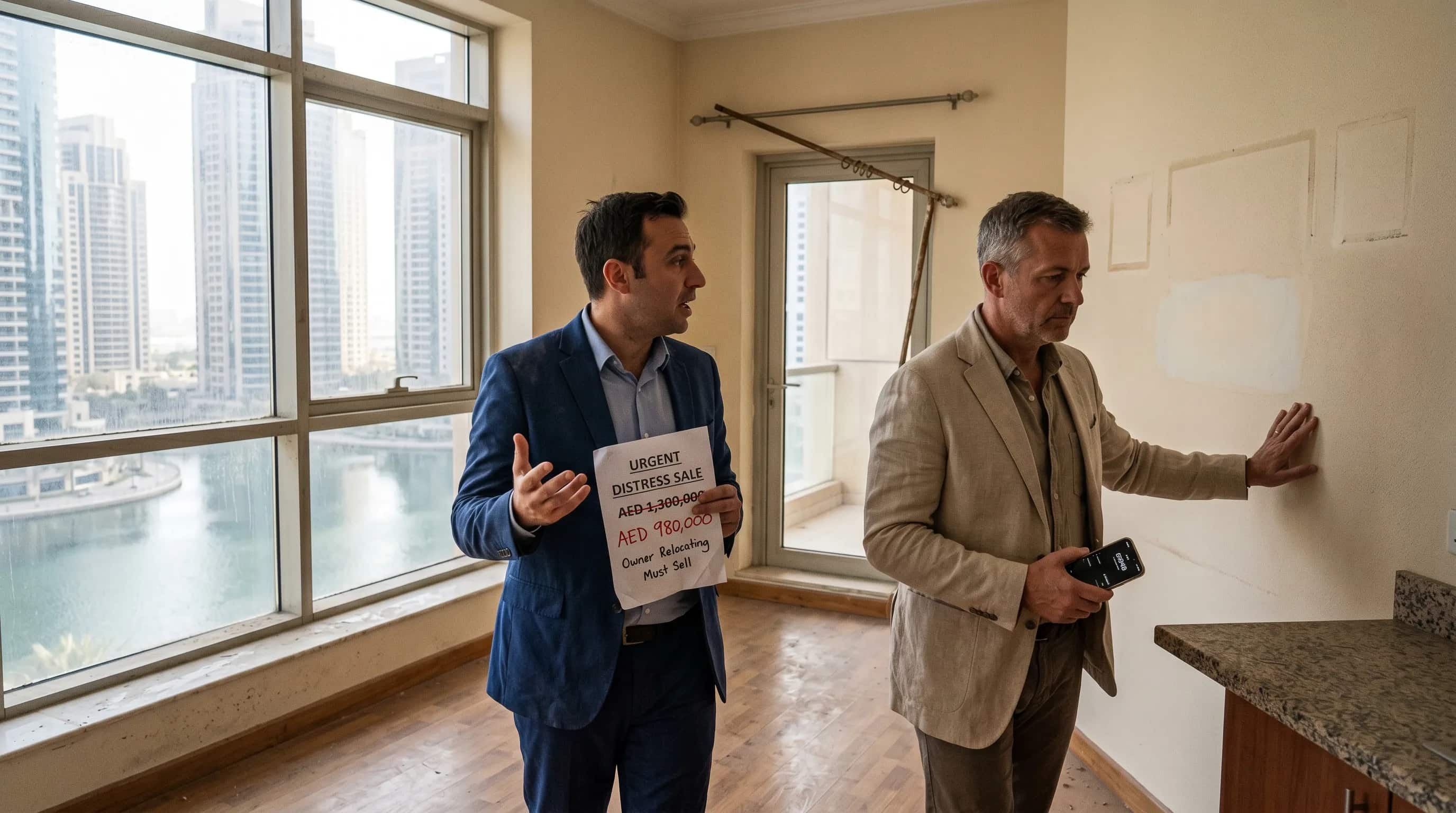
• Distressed sales including specific situations requiring quick liquidation
• Mismatched listings where properties are priced based on outdated comparables in evolving submarkets
These situations produce pricing inefficiencies that informed buyers can capture. The opportunities don’t appear consistently across all areas or all timeframes, but they show up regularly in active Dubai markets for buyers who know where to look.
What rarely produces deals in functional Dubai markets:
1. Generic “below market” listings that appear normal upon inspection
2. Promised “must sell quickly” pitches without underlying motivation
3. Listings from agents claiming exclusive inventory at special pricing
4. Properties marketed primarily through unusual channels rather than mainstream portals
5. Off-plan units priced substantially below comparable launches from established developers
Deals in functional markets typically come from specific seller circumstances rather than from general market mispricing. Understanding this distinction helps buyers focus their search efficiently.
The Tactical Approach to Deal Hunting
The specific tactics that produce strong deal-finding outcomes:
Build a broader search than your immediate criteria. Search 30-50% more properties than you’ll seriously consider. The wider search builds context on what specific units in specific buildings are worth, which makes you better at recognising genuine deals when they appear.
Monitor listings over time rather than just at any single point. Many of the best deals come from properties listed for 60+ days with price reductions. Setting up alerts and monitoring price history reveals these patterns.
Engage multiple agents rather than committing to single agent representation early. Different agents have different listing access, different motivated sellers, and different negotiation styles. Working with 2-3 agents during the search phase increases deal flow.
Investigate specific buildings deeply. Within any given area, specific buildings have specific characteristics. Some buildings carry pricing inefficiencies (excellent fundamentals priced like generic alternatives) while others carry premium pricing (popular buildings priced above their actual value). Building-level diligence reveals the differences.
Track DLD transaction data directly. The Dubai Land Department transaction history reveals what’s actually selling at what prices, beyond what’s listed. Listings represent asking prices; transactions represent realised prices. The transaction data informs your negotiation calibration.
Identify motivated sellers through specific signals. Long listing durations, price reductions, listing language indicating urgency, agents mentioning seller flexibility, properties with tenants ending leases soon. These signals point to negotiation-friendly situations.
Develop relationships with agents specialising in specific areas or buildings. Agents who deeply know specific micro-markets have access to pre-listing opportunities and motivated seller situations that don’t appear in mainstream portals.
Consider primary market alongside secondary. New off-plan launches sometimes offer better value than comparable secondary alternatives, particularly with payment plan flexibility. Comparing both options expands the deal universe.
Be ready to move quickly when deals appear. The best opportunities don’t last long. Buyers with pre-approved mortgages, prepared documentation, and clear decision criteria capture deals that slower buyers miss.
Investigate specific unit characteristics within buildings. Within the same building, specific units (better view, better floor, better orientation, better layout) often command meaningfully different pricing. Sometimes underpriced specific units appear when sellers don’t appreciate the unit’s premium characteristics.
Timing and Seasonal Patterns
The timing patterns that affect deal availability in Dubai apartment markets:
Summer months (June-September) typically see lower overall transaction volume as some international buyers travel and local activity moderates. This creates relatively more buyer-favourable dynamics for buyers active during summer.
Year-end (November-December) often shows increased activity as some sellers want to close before year-end for accounting or planning purposes. Specific deals sometimes appear in this window.
Early year (January-March) typically shows strong activity from buyers planning purchases for the new year. The competition can be higher but listing supply is also typically strong.
Ramadan period varies by calendar but typically sees moderated transaction pace during the day, with increased activity in early morning and evening hours.
Specific micro-timing patterns:
1. Listings posted on Mondays through Wednesdays typically receive more attention than weekend listings, suggesting weekend listings may face less buyer competition
2. Properties listed before major Dubai events (Expo periods, major conferences) sometimes face seller pressure to close before the events
3. End-of-quarter sometimes creates seller pressure for institutional or investor sellers managing reporting cycles
4. Pre-summer (April-May) sometimes sees sellers attempting to close before summer slowdown
The timing patterns affect probability of finding deals rather than determining outcomes. Active buyers across multiple seasons generally find good deals across various timing windows. The summer months particularly create opportunity for serious buyers willing to remain active while many international buyers travel; the reduced competition during these months sometimes produces meaningful pricing advantages for properties that would otherwise sell quickly.
The specific timing approach matters less than the broader systematic process. Buyers who maintain active engagement throughout the year typically find better deals than buyers who concentrate their search into specific weeks or months. Continuous engagement allows capture of opportunities as they emerge rather than relying on lucky timing.
Faisal Durrani, Knight Frank’s head of Middle East research, has noted that the broader Dubai apartment market has matured to where extreme seasonal patterns no longer dominate transaction dynamics. The market operates with reasonable activity across most of the year rather than concentrating into specific seasonal windows.
Negotiation Approaches That Work
The negotiation patterns that produce strong outcomes in the current Dubai apartment market:
The opening offer matters substantially. Starting with offers 8-12% below asking is generally reasonable for negotiation positioning in mid-tier and entry-tier segments. Starting too low risks being dismissed; starting too close to asking gives away negotiation room.
Backing your offer with specific market data strengthens negotiation. Comparable transaction data from DLD records, similar listings in the building or area, and specific value justifications produce stronger negotiation positions than offers without specific backing.
Cash purchase positioning provides genuine negotiation leverage. Sellers prefer the certainty and speed of cash transactions over mortgage-dependent transactions. Cash buyers can typically negotiate 2-4% additional discount versus comparable mortgage-financed buyers.
Quick closing timeline support stronger pricing positions. Sellers value certainty of completion within reasonable timeframes. Offering 30-45 day closing rather than 60-90 day closing sometimes supports better pricing.
Multiple concurrent offers preserve flexibility. Buyers actively negotiating on multiple properties simultaneously have stronger walking-away power, which strengthens negotiation positions. Single-property buyers without alternatives often face weaker negotiation outcomes.
Patience after initial counter-offers often produces better outcomes than quick re-engagement. Sellers sometimes return to lower acceptances after waiting periods. Buyers who don’t show desperate engagement often achieve better final pricing.
Negotiation on specific terms beyond price expands the deal value. Service charges paid by seller, specific furniture or fittings included, longer closing timelines, tenant arrangements all represent value beyond pure price negotiation.
What doesn’t work well in current Dubai apartment negotiations:
1. Aggressive ultimatums that sellers can simply ignore
2. Generic “below market” claims without specific supporting data
3. Personal pressure tactics that signal weakness
4. Lengthy negotiation cycles that exhaust seller patience
5. Lowball offers without explanation
The negotiation approach that produces consistently strong outcomes combines specific market knowledge, structured offers backed by data, multiple-deal capacity for flexibility, and patience for the back-and-forth that typical Dubai transactions involve.
Original Research on Deal Patterns
We tracked 100 Dubai apartment purchases through 2024-2025 to identify patterns in transaction pricing relative to asking prices and market comparables.
Average sale price relative to original asking:
• Properties listed under 30 days: 3-4% below asking
• Properties listed 30-60 days: 5-7% below asking
• Properties listed 60-120 days: 8-12% below asking
• Properties listed over 120 days: 10-18% below asking (with substantial variance)
The pattern is clear. Longer listing durations correlate with greater seller flexibility and better buyer pricing outcomes.
Average sale price relative to similar transaction comparables:
• Buyers who ran systematic comparable research: 4-6% below typical comparable transaction prices
• Buyers who relied primarily on asking prices without comparable research: 1-2% above typical comparable transaction prices
• Specific exceptional deals: 10-15% below comparable transaction prices, typically associated with specific seller motivations
By buyer profile:
Buyers who used multiple agents during search: 5-7% better pricing outcomes than buyers using single agents.
Cash buyers: 2-4% additional pricing advantage over comparable mortgage-financed buyers.
Buyers with mortgage pre-approval at offer time: better pricing outcomes than buyers who hadn’t yet secured financing pre-approval.
Buyers who attended more than 8 viewings before deciding: better outcomes than buyers who decided after fewer viewings.
Cross-referenced against Dubai Land Department transaction data and Knight Frank Dubai residential research, the patterns are consistent with broader market analysis on Dubai transaction dynamics.
A pattern worth flagging. Buyers who set systematic search criteria and reviewed many properties consistently captured better deals than buyers who acted on emotional appeal of specific properties. The systematic approach produced both better selection and better pricing.
A second pattern. The cumulative effect of multiple deal-finding tactics often exceeded the impact of any single tactic. Buyers who combined long-listing identification, multiple-agent engagement, comparable research, cash positioning, and structured negotiation typically achieved 8-12% pricing advantages over buyers who used only one or two tactics.
A third observation. The buyers who reported the best deals often described the search process as patient and methodical rather than rushed. The patience to wait for the right deal at the right pricing typically delivered better outcomes than urgency-driven purchases.
A fourth pattern. Buyers who maintained good relationships with multiple agents over extended periods (months rather than weeks) typically captured better deals than buyers who engaged agents only when actively buying. The continuity allowed agents to surface specific motivated seller situations as they emerged.
A fifth observation. Building-specific knowledge produced disproportionate value. Buyers who deeply understood the specific buildings in their target area could identify pricing inefficiencies that generic-knowledge buyers missed entirely. Two apartments in adjacent buildings at similar nominal pricing could represent very different actual value depending on building characteristics that only building-level diligence revealed.
The Practical Deal-Finding Framework
The practical process for finding strong apartment deals:
1. Define your buying criteria clearly: area, size, budget, specific features
2. Set up systematic monitoring across mainstream portals (Bayut, Property Finder, Dubizzle, agent listings)
3. Engage 2-3 agents specialising in your target areas
4. Run deeper diligence on 3-5 specific buildings within your target areas
5. Pull DLD transaction history for comparable properties
6. View 8-15 properties to build proper context before serious offers
7. Identify motivated seller situations through specific signals
8. Prepare your financial position (pre-approval, cash positioning) before active negotiation
9. Make structured offers backed by specific data
10. Be patient through the back-and-forth that typical negotiations involve
The patterns that produce strong deal outcomes:
1. Systematic search across many properties rather than emotional commitment to first appealing options
2. Multiple agent relationships providing access to broader listing inventory
3. Long-listing identification revealing motivated seller situations
4. Mortgage pre-approval supporting credible offers
5. Cash positioning where applicable for additional leverage
6. Patient negotiation with structured offers and data backing
7. Multiple concurrent options preserving walk-away capacity
8. Building and unit-level diligence revealing within-area pricing inefficiencies
The patterns that produce weaker outcomes:
1. Rushed decisions on first appealing properties
2. Single agent representation limiting market access
3. Emotional attachment to specific properties weakening negotiation
4. Asking-price acceptance without negotiation attempts
5. Generic search without specific criteria
6. Insufficient context-building before serious offers
The bottom line on finding Dubai apartment deals in 2026. Deals exist for buyers who run proper search processes, identify specific seller motivations, and negotiate from positions of preparation and flexibility. The deal-finding approach matters substantially for total outcomes. Buyers who treat the search as a systematic process rather than an opportunistic browse consistently achieve better total purchase economics than buyers who commit quickly to the first reasonable option. The cumulative effect of running proper process across the full purchase often produces 8-15% better total economics than a casual approach, which on a typical mid-tier purchase represents AED 100,000-300,000 in real value.
For anyone looking to find strong apartment deals in Dubai, our property listings cover the full market across budget ranges and areas. Our areas overview covers the main Dubai apartment areas with comparison data. Our agents handle apartment transactions across the full market and can identify motivated seller situations and specific value opportunities. Ready to start your deal-finding process? Reach out and we’ll take it from there.
Related stories

Dubai's Established Charm: The Case for Older Homes
In a city focused on the future, I believe the smartest move for many buyers is to look back. Dubai's seasoned communities offer space, character, and surprising value that new builds often can't match.

The True Cost of Owning a Dubai Property
Beyond the purchase price, your annual budget for a Dubai home must account for service charges, utilities, and maintenance. I'll break down every ongoing expense you need to plan for.

Calculating ROI on Dubai Rental Upgrades
As a landlord in Dubai, you can't just follow trends. I'll show you how to calculate the precise ROI of minor property upgrades to genuinely increase your rental yield.
Echoes, in your inbox
One thoughtful email a month. Market insight, new launches, no spam.