

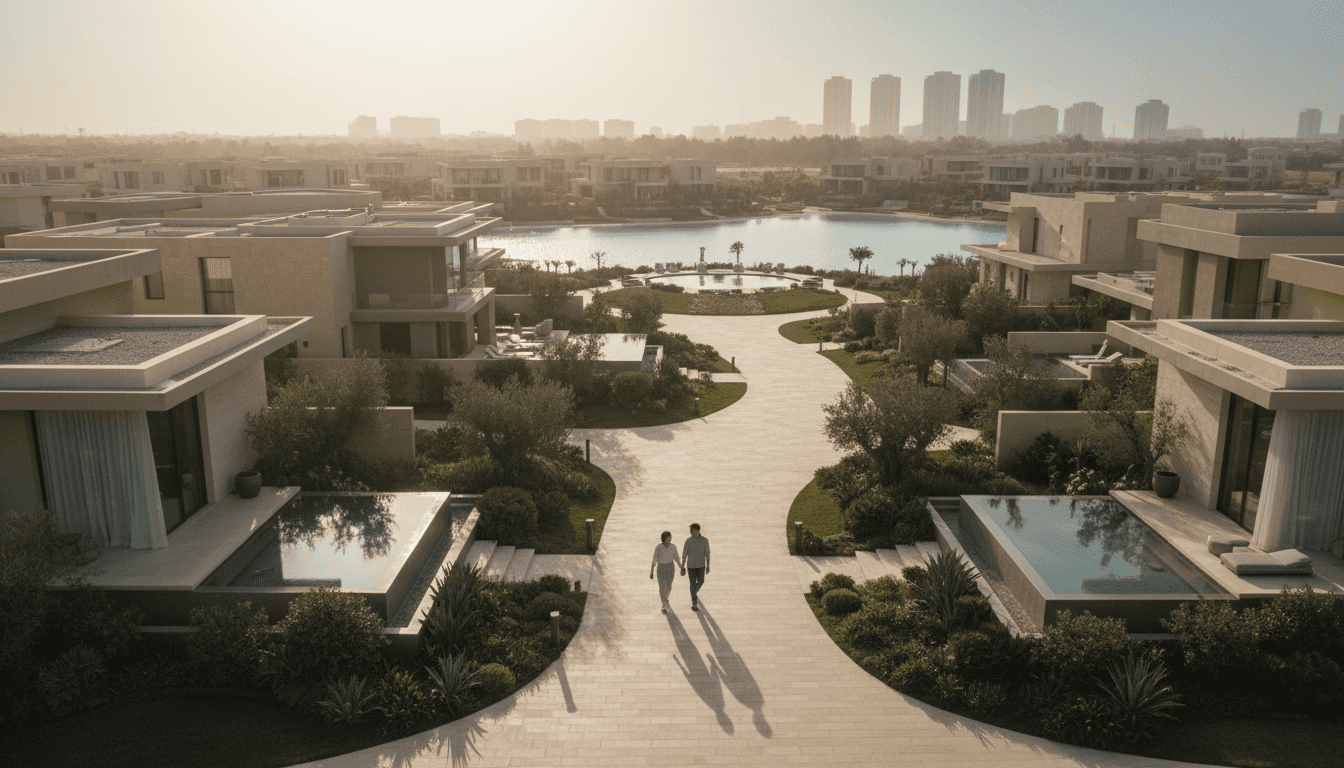
Work from Home, Reimagined
The line between office and home has blurred for good. I explore the Dubai villa communities that are truly designed for the new era of remote work, moving beyond spare bedrooms to offer integrated co-working hubs and thoughtful home office design.

The five-day commute is no longer the default for many of us. This shift towards remote and hybrid work has fundamentally changed what we ask of our homes, especially here in Dubai. A spare bedroom that doubles as a storage room is no longer a viable long-term solution. Today, professionals and families are actively seeking homes designed with intention, where work and life can coexist without compromising on either. These are the `home office communities` that are defining the future of family living in the emirate.
Here's what we'll explore:
- The evolution from a 'spare room' to integrated home offices.
- Why community-based `co-working spaces Dubai villas` are becoming a key amenity.
- A spotlight on the communities that get the balance right for `remote work friendly villas`.
- A look at the design details that truly matter in a work-from-home space.
- The financial implications: pricing, service charges, and the value of dedicated workspaces.
- Legal and visa considerations for remote workers buying property in Dubai.
- My personal verdict on which communities offer the best `family work-life balance`.
The New Necessity: Beyond the Spare Bedroom
For years, the concept of a 'home office' in a Dubai villa was an afterthought. It was whatever room was left over — the smallest bedroom, a nook under the stairs, or a corner of the living room. Developers, in my experience, focused on maximising living and sleeping areas, assuming work happened elsewhere. The global shift in work culture has forced a radical rethink. Today, a dedicated, well-designed workspace is not a luxury; it's a core requirement for a significant portion of buyers looking at villas for sale in Dubai. This demand has bifurcated into two distinct, but often complementary, solutions: the thoughtfully designed internal home office and the external `community business hubs`.
I’ve seen this firsthand in client conversations. The questions have changed. It's no longer just about the number of bedrooms or the size of the garden. Buyers now ask, “Is there a dedicated study?”, “How is the sound insulation?”, “Can the ground floor accommodate a client meeting without disrupting the family?”. These are practical, sophisticated questions from people who have spent years trying to make imperfect spaces work. They understand the nuances of productivity and the mental health benefits of being able to physically and psychologically 'close the door' on work Ultimately,. A proper office space within the home provides this separation, helping to maintain boundaries and improve `family work-life balance`.
Developers have been quick to respond. Newer launches, particularly from forward-thinking firms like Emaar Properties, Sobha, and Nshama, are now showcasing floor plans with `dedicated study areas` as a standard feature. We're seeing villas with glass-partitioned offices, separate entrances for a home-based consultancy, and even dual-key units where a small studio-office is attached to the main family home. This architectural shift is a direct answer to the market's call. It acknowledges that for many, the home is now also a place of production, creativity, and commerce. This is a far cry from the open-plan living obsession of the last decade, which prized flow and togetherness above all else. The new ideal is more zoned, more versatile, and more respectful of the individual's need for privacy and focus.
This isn't just about adding a room and calling it an office. The best designs consider factors like natural light, acoustic privacy, and built-in storage. I've toured recent handovers in communities like Arabian Ranches III where the study is positioned at the front of the villa, enjoying its own view and a degree of separation from the main family living areas at the rear. This is smart, user-centric design. It shows an understanding that work-from-home doesn't mean you want to hear the television or smell what's for lunch while on a video call. It's about creating an environment that is as professional and functional as a corporate office, but with the convenience of being just steps away from family life.
The Rise of the Community Co-Working Hub
 Featured project
While a great home office is essential, sometimes you need a complete change of scenery. The isolation of working alone, the desire to network with neighbours, or simply the need for a high-spec meeting room can drive residents out of their homes. This is where the community co-working space comes in. It’s the perfect middle ground between the solitude of a home office and the hassle of commuting to a commercial district like DIFC or Business Bay. These hubs are rapidly becoming one of the most powerful and desirable amenities a master community can offer, transforming a collection of houses into a truly integrated ecosystem.
Nshama’s Town Square Dubai is, in my opinion, the pioneer and gold standard for this model. Their centrally located co-working space is not just a room with desks; it's a professionally managed facility with meeting rooms, private booths, and a genuine entrepreneurial energy. Residents can pay for access by the day, week, or month, offering incredible flexibility. It’s a place to meet clients, collaborate with fellow freelancers in the community, or just work in a focused environment without household distractions. This amenity fundamentally enhances the value proposition of living in Town Square. It directly supports small business owners, consultants, and remote employees who call the community home.
Other major developers are following suit. Emaar's newer communities, such as Dubai Hills Estate and Emaar South, have integrated similar concepts into their community centres. The business centres in Dubai Hills Estate, for instance, are sleek, modern, and equipped with everything you'd expect from a commercial workspace. This is a strategic move. By providing these facilities, developers are future-proofing their communities and attracting a demographic of skilled professionals who have the freedom to work from anywhere. They are no longer just selling homes; they are selling a lifestyle that smoothly integrates work, family, and leisure. It's a powerful differentiator in a competitive market.
“The best community business hubs are more than just a desk and a Wi-Fi connection; they are the modern-day village square, fostering collaboration and economic activity right on your doorstep.”
The benefits extend beyond the individual user. These `community business hubs` create a local economic network. I’ve heard stories from residents who have found co-founders, clients, and collaborators simply by working out of their community hub. It fosters a sense of belonging and mutual support that is often missing in large cities. For families, it's a game-changer. One parent can be in a crucial meeting in the community hub, just a five-minute walk or buggy ride away, while the other is at home with the children. This proximity offers a level of flexibility and peace of mind that a distant downtown office simply cannot match. It’s a tangible improvement to the daily juggling act of modern family life.
Spotlight: Communities That Master Work-Life Integration
So, which communities are truly delivering on the promise of a balanced, remote-work-friendly lifestyle? Based on my tours and client feedback, a few stand out for their exceptional execution of either in-villa design, community facilities, or both.
Nshama Town Square: As mentioned, Town Square excels with its community infrastructure. While the townhouses and villas themselves have efficient layouts, it's the central hub that makes it a top choice for `remote work friendly villas`. The co-working space is a major draw, but the surrounding amenities — cafes, restaurants, and parks, also contribute. It allows a resident to take a coffee meeting, work for a few hours, run errands, and pick up the kids from the nursery all within their own neighbourhood. The affordability of Town Square relative to more central villa communities also means buyers can often afford a larger unit, securing that extra room for a dedicated home office without overstretching their budget.
Emaar's Dubai Hills Estate: This is a more premium option, but what you get is exceptional quality across the board. Many of the newer villa types in clusters like Golf Place or the townhouses in Maple and Sidra were designed with studies or flexible ground-floor rooms. The community centres have sophisticated business lounges, and the entire master plan is designed for convenience. The central location is another plus; if you do need to drive to a meeting in Dubai Marina or Downtown, you're not facing an hour-long commute. For those who can afford it, Dubai Hills Estate offers perhaps the most polished version of work-life integration in Dubai.
Sobha Hartland & Sobha Hartland II: Sobha Realty has built its reputation on quality, and this extends to its floor plan design. Their villas and townhouses often feature generous layouts with rooms explicitly labelled as 'Study' on the plans. They understand that a home office needs to be a functional, dedicated space. The community itself, with its lush green spaces and proximity to the city centre, provides a tranquil environment that is conducive to both focused work and relaxed family life. As Sobha Hartland II develops, I expect to see even more emphasis on integrated work-and-wellness amenities, cementing its status as a top-tier choice for professional families.
Aldar's Yas Acres & Saadiyat Lagoons (Abu Dhabi): While my focus is primarily on Dubai, it's impossible to ignore what Aldar is doing in the capital. Their approach in communities like Yas Acres is very much in line with this trend. Villas are designed with flexible spaces perfect for offices, and the community hubs are central to the lifestyle. For those considering Abu Dhabi, these communities offer a fantastic balance. Saadiyat Lagoons, in particular, is being marketed on a platform of nature and wellness, with work-from-home needs being a key part of that vision. It demonstrates that this is a UAE-wide trend, not just a Dubai phenomenon.
Designing for Productivity: Details That Matter
Having a room labelled 'Study' on a floor plan is one thing; having a space that genuinely enhances productivity is another. As you tour properties, whether in person or via our virtual viewings, I encourage you to look beyond the label and assess the practical details. I've developed a mental checklist for what makes a truly effective home workspace.
First, and perhaps most critically, is acoustic and visual privacy. Can you close a solid door? Are the walls properly insulated, or are they thin partitions that will let in every sound from the adjacent living room? I’ve seen some beautiful glass-walled offices, which look great but offer zero soundproofing. For anyone who spends their day on calls, this is a non-starter. A solid wall and a well-fitted door are paramount. Visual privacy is also important. A study that looks directly onto a high-traffic area of the home, like the kitchen or main hallway, is a recipe for constant distraction. The ideal placement is often at the front of the house or on an upper floor, away from the primary social zones.
Second, consider light and power. A dark, depressing room will sap your motivation. Look for a space with a decent-sized window that provides natural light. It's proven to boost mood and reduce eye strain. Equally important is the placement and number of electrical outlets. In our device-driven world, you'll need sockets for a computer, monitor, printer, lamp, and chargers. A room with only one or two outlets is poorly planned. A well-designed office will have multiple outlets, ideally on different walls, to give you flexibility in arranging your desk and equipment. Bonus points for integrated USB charging ports and floor boxes in larger office spaces.
Here are some other key design features to look for: - Sufficient Size: The room should be large enough to accommodate a proper desk, an ergonomic chair, and some storage (like a filing cabinet or bookshelf) without feeling cramped. A space less than 2.5m x 3m will likely feel tight. - Ventilation and Climate Control: Does the room have its own AC controller? A home office can get warm with computer equipment running, and being able to control the temperature independently from the rest of the house is a significant comfort factor. - Hard Flooring: While carpets are cosy in bedrooms, hard flooring (wood, tile, or high-quality laminate) is often more practical for an office. It makes rolling an office chair easy and is simpler to keep clean. - Connectivity: Is the room wired for high-speed internet, or will you be reliant on a weak Wi-Fi signal from a router at the other end of the house? For `remote work friendly villas`, robust connectivity throughout the property is a must-have.
Finally, think about flexibility. A room that can serve as a home office, a children's homework area, or even a guest room with a sofa bed offers long-term value. Look for simple, rectangular rooms without awkward angles, as they are the easiest to furnish and adapt as your family's needs change over time. The ultimate goal is a space that supports your work without feeling like a corporate cubicle has been airlifted into your personal sanctuary.
The Financials: Costs, Fees, and Return on Value
Choosing a villa with dedicated work facilities is not just a lifestyle decision; it's a financial one. It's crucial to understand how these features impact the purchase price, ongoing costs, and potential resale value. There isn't a simple 'home office premium', but the presence of these well-designed spaces is undoubtedly factored into the overall valuation of a property.
A villa with an extra study or a more generous square footage to accommodate an office will naturally command a higher price than a smaller unit in the same community. For example, a three-bedroom-plus-study townhouse in a community like Arabian Ranches will be priced higher than a standard three-bedroom unit. The difference reflects the larger built-up area (BUA) and the enhanced functionality. This initial investment, however, can pay dividends. In my view, as flexible working patterns become permanent, properties with these features will be more desirable and hold their value better than those without. They have a wider appeal and cater to a growing segment of the market.
Beyond the purchase price, you must budget for the associated costs. Let's create a sample cost breakdown for a hypothetical 4-bedroom villa with a study in a desirable community, priced at AED 4,500,000.
Upfront Purchase Costs (example): - Purchase Price: AED 4,500,000 - Dubai Land Department (DLD) Transfer Fee: 4% of price = AED 180,000 - DLD Registration Fees: Approx. AED 4,200 - Real Estate Agency Fee: 2% of price + 5% VAT = AED 94,500 - Mortgage Arrangement & Valuation Fees (if applicable): Approx. 1% of loan amount + VAT = AED 37,800 (assuming 80% LTV) - NOC Fee (from developer): Approx. AED 5,000 - Total Upfront Costs: Approx. AED 321,500 (plus the mortgage down payment)
If you are financing the purchase, you'll also need a significant down payment. For expatriate residents buying a property over AED 5 million, the Central Bank of the UAE mandates a minimum down payment of 35%. For properties under AED 5 million, it's 20%. In our example, a 20% down payment would be AED 900,000, bringing your total immediate cash outlay to over AED 1.2 million. It is vital to have these funds ready. You can find more detailed information on our buyer guides.
Then there are the ongoing costs. Service charges are a key consideration. These annual fees, billed per square foot of the property's BUA, cover the maintenance of all community amenities — including the pools, parks, security, and, yes, the `community business hubs`. For villa communities, these typically range from AED 3 to AED 6 per sq. Ft. For a 4,000 sq. Ft. villa, this could mean an annual bill of AED 12,000 to AED 24,000. While this may seem high, it's what pays for the high-quality environment you're buying into. And if you use the community co-working space regularly, you could be saving hundreds or even thousands of dirhams a month on external membership fees.
Visas and Legalities for the Remote Professional
The UAE government has shown incredible foresight in creating a legal framework that actively encourages remote professionals to make the country their home. This supportive ecosystem is a major factor for many of our clients who are considering buying property here. Two pathways are particularly relevant: the Golden Visa through property investment and the specific Remote Work Visa.
The most straightforward route for property buyers is the Golden Visa. According to the official UAE Government portal, an investment of AED 2 million or more in real estate makes you eligible to apply for a 10-year, self-sponsored renewable residence visa. This is a game-changer. It decouples your residency status from your employment, giving you the ultimate flexibility to work for a foreign company, run your own business, or work as a freelancer without needing a local sponsor. For a family, the visa also extends to your spouse and children, providing stability and long-term peace of mind. Buying that perfect villa with a home office isn't just a lifestyle upgrade; it's a pathway to securing your long-term future in Dubai.
Alternatively, for those not ready to purchase property, there is the Virtual Work Programme (Remote Work Visa). This one-year visa allows you to relocate to Dubai while continuing to work for your current employer based overseas. The key requirements include providing proof of employment with a contract valid for one year, a minimum monthly salary of USD 3,500 (or its equivalent in foreign currency), and the previous month's payslip. This visa is an excellent way to 'try before you buy', allowing you to experience life in Dubai and explore different neighbourhoods before committing to a purchase. Many of our clients start with this visa, rent a villa in a community they're interested in, and then proceed to buy once they are certain it's the right fit for their family.
From a legal standpoint, it's also important to understand the regulations around running a business from home. For most remote employees or freelancers, simply working from a home office is perfectly acceptable. However, if you plan to run a licensed business with a trade name, see clients at your home regularly, or hire staff, you will need to register your company and obtain the appropriate trade license. Free zones like DMCC or Dubai Internet City offer freelance permits and company setup packages that are well-suited to this, and many consultants can guide you through the process. The key is to ensure you are operating within the legal framework, which is robust and well-defined in Dubai.
My Verdict: The Future of Residential Real Estate
Having walked through countless villas and spoken with hundreds of families over the years, my conviction is this: the integration of work and life is the single most significant trend shaping residential real estate in Dubai today. It's a movement away from seeing a home as merely a place of rest and towards viewing it as a platform for living in the fullest sense — a place for family, for leisure, for wellness, and for productive, professional work. The communities that understand this and deliver on it are the ones that will thrive and command a premium in the years to come.
In my professional opinion, the ideal solution is a combination of both a well-designed private home office and access to a vibrant community co-working hub. The home office provides the day-to-day convenience and focus, while the community hub offers a vital third space for collaboration, networking, and a change of pace. Communities like Nshama's Town Square and Emaar's Dubai Hills Estate are leading the pack because they deliver this dual offering so effectively. They've recognised that you don't always want to be at home, but you don't want to commute for an hour either.
For families considering a move, my advice is to think about your daily and weekly rhythms. How many days a week will you work from home? Do you need absolute silence, or do you thrive on a bit of background buzz? Do you need to host client meetings? Answering these questions will help you prioritise. If you are a solo freelancer who needs deep focus, a villa with a perfectly isolated study in a quiet community like Al Barari might be ideal. If you're a consultant who thrives on networking, a townhouse in a community with a bustling business hub like Town Square or Emaar South could be a better fit. There is no one-size-fits-all answer, but the great news is that the Dubai market now offers a diverse range of options to suit these varied needs.
The most successful and desirable villa communities of the next decade will be those that treat work-from-home not as a problem to be solved with a spare room, but as an opportunity to create a more integrated, convenient, and balanced lifestyle for residents. The focus on `dedicated study areas` and `community business hubs` is not a fleeting trend; it is a fundamental and permanent evolution in what we expect from our homes and our neighbourhoods.
At Gaia Living, we have seen this shift reflected in our clients' priorities every single day. If you're looking for a home that works as hard as you do, our team has the on-the-ground knowledge to guide you to the communities and properties that truly understand the new way of living. We can help you navigate the options, from off-plan launches with innovative floor plans to established communities with proven amenities. The perfect space to balance your ambition with your family life is out there, and we'd be delighted to help you find it.
## Sources - UAE Government Portal (u.ae) - Golden Visa Information: https://u.ae/en/information-and-services/visa-and-emirates-id/residence-visas/golden-visa - Dubai Land Department (DLD) - Official Website for Transaction Information: https://dubailand.gov.ae/en/ - Central Bank of the UAE (CBUAE) - Mortgage Regulations: https://www.centralbank.ae/
Questions, answered
- Which Dubai communities have the best co-working spaces for residents?
- Communities like Nshama's Town Square and Emaar's Dubai Hills Estate are leaders, offering professionally managed co-working spaces within the community hub. Newer developments from Aldar and Sobha are also integrating business centres as a standard amenity.
- Are there villas specifically designed with home offices?
- Yes, many newer villa and townhouse developments from developers like Emaar, Sobha, and Nshama now include dedicated studies, office nooks, or flexible rooms in their floor plans. This is a significant shift from older layouts where a spare bedroom was the only option.
- How much extra does a villa with a dedicated home office cost?
- The cost is integrated into the overall price, not a specific add-on. A villa with a dedicated study will naturally be larger and priced higher than a similar villa without one. The premium depends on the community, but expect it to align with the additional square footage.
- Can I use a community co-working space if I am just a tenant?
- Yes, in most cases. Community amenities, including business hubs and co-working spaces, are typically available to all residents, both owners and tenants. Access is usually managed through a resident access card and is covered by the service charges paid by the landlord.
- What are the typical service charges for a villa with these amenities?
- Service charges for villa communities with extensive amenities like co-working spaces, pools, and parks typically range from AED 3 to AED 6 per square foot of built-up area annually. This is generally lower than apartment towers but can add up for larger properties.
- Is the Golden Visa applicable when buying a villa for remote work?
- Yes, purchasing a property worth AED 2 million or more makes you eligible to apply for a 10-year renewable Golden Visa. This visa is not tied to an employer, making it ideal for freelancers, entrepreneurs, and remote workers who own their home in Dubai.

Sophia profiles Dubai's villa communities — schools, commute times, green space, and the intangible feel of a neighbourhood. She writes for families putting down roots.
Related stories
Dubai's Big Squeeze: Smaller Plots, Denser Living
Dubai real estate is undergoing a fundamental shift towards smaller plot sizes and higher density. We analyse the economic drivers, the impact on property values, and what this new era of compact urban living means for both homebuyers and investors.
Resort Living as Your Dubai Reality
Explore how to trade temporary staycations for a permanent home with five-star amenities in Dubai. I'll break down the real costs, best communities, and lifestyle trade-offs of embracing high-end resort living every day.
Finding Your Tribe in Dubai's Villa Communities
I explore which of Dubai's renowned villa communities attract specific expat nationalities and lifestyle groups, offering insights to help you find a place that feels like home.
Echoes, in your inbox
One thoughtful email a month. Market insight, new launches, no spam.