

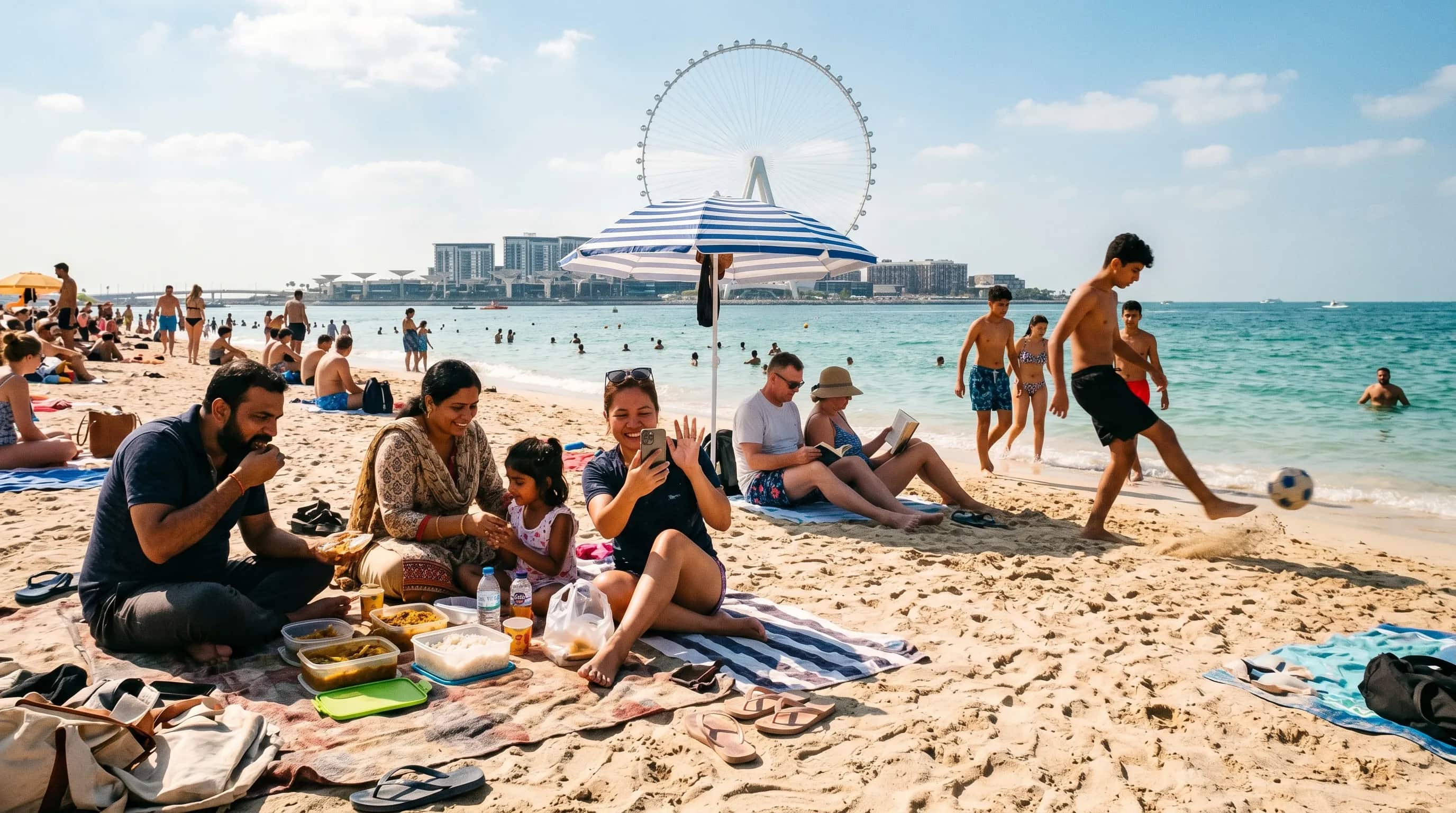
Why People Stay in Dubai Long-Term: What Keeps Expats Here
64% of Dubai expat arrivals remain at 7-10 years. Here's what actually keeps people here versus what brings them, with research from long-term residents.
The marketing version of Dubai is familiar. Tax-free salaries, sunshine year-round, world-class infrastructure, the tallest building in the world, beaches and desert and shopping. The dismissive version is equally familiar. Soulless skyscrapers, summer heat, traffic, lack of cultural depth, expensive. Both versions contain elements of truth. Neither captures what actually living in Dubai is like for most of the people who choose to call it home.
The honest take requires neither cheerleading nor dismissal. Dubai works extraordinarily well for some people and poorly for others. The factors that determine which group you fall into are predictable but not always obvious before moving. People who thrive in Dubai typically share certain characteristics: an appreciation for safety and order, comfort with cultural diversity, openness to a transient social environment, tolerance for summer heat in exchange for winter sunshine, and a values match with what Dubai actually offers as a place to live.
We’ve worked with enough Dubai residents across multiple residence durations to see the patterns of who thrives versus who quietly waits to leave. This article walks through what Dubai actually offers as a place to live in 2026, the genuine strengths that don’t get enough credit, the genuine weaknesses that don’t get enough acknowledgement, the lifestyle reality at different levels of income and ambition, and the honest read on whether Dubai is likely to work for you specifically.
A note up front. This isn’t a real estate sales piece dressed up as a lifestyle article. We sell real estate but the decision about whether to live in Dubai precedes the property choice. Property in a city you don’t like is a worse property than property in a city you love, regardless of capital appreciation rates. This piece is about the broader livability question that should come before the property selection.
Lewis Allsopp, founder of Allsopp & Allsopp, has spoken publicly about how Dubai’s transition from a transient expat hub to a place where more residents see it as a long-term home has changed the city’s character meaningfully over the past decade. The version of Dubai in 2026 is different from the Dubai of 2014 or 2008, and the version is genuinely worth understanding before committing to residence.
The Genuine Strengths
The strengths of Dubai as a place to live in 2026 that hold up to honest assessment:
• Safety and security consistently ranked among the strongest in any major global city. Walking alone at night in residential areas is genuinely safe. Personal property is generally secure. Petty crime affects daily life less than in most international comparisons
• Infrastructure quality including roads, utilities, telecommunications, healthcare, and education that operates reliably. Power doesn’t go out. Water is reliable. Internet is fast. The bureaucratic services largely work as intended
• Climate offering winter months (October through March) that are among the most pleasant in any global city, with mild temperatures and minimal rain. The summer months are difficult but manageable with appropriate adaptation
• Cultural diversity with residents from 200+ nationalities creating a genuine cosmopolitan environment. Most workplaces and social settings include people from multiple continents
• Economic opportunity for skilled professionals across many sectors. Tax-free income, business creation pathways, and proximity to major regional markets create real economic opportunities
• Healthcare access through both public and private systems with quality matching or exceeding many Western health systems
• Education access with strong international schools across multiple curricula (British, American, IB, French, Indian, etc.) suiting different family backgrounds
• Travel connectivity with two major airports (DXB and DWC) connecting to nearly any global destination within reasonable timeframes
• Stability and governance including political stability, regulatory predictability, and consistent application of rules and procedures
• Lifestyle amenities including beaches, malls, restaurants, fitness facilities, and cultural venues at levels comparable to major global cities
These strengths are not marketing exaggerations. They show up in the daily lived experience for most Dubai residents. The combination of safety, infrastructure, climate (in winter), and lifestyle amenity creates a genuinely high quality of life for residents whose preferences align with what Dubai offers.
The strengths compound for families with children. The safety, school quality, healthcare access, and amenity infrastructure together produce a family environment that many international parents find difficult to replicate in their home countries. Many families who initially planned to stay 2-3 years end up extending substantially because the family environment works so well.
The strengths also compound for professionals at certain career stages. The economic opportunities combined with operational efficiency create a productive environment for ambitious professionals. The tax-free income relative to home country alternatives can transform financial trajectories over multi-year periods.
Faisal Durrani, Knight Frank’s head of Middle East research, has consistently noted that Dubai’s compound livability strengths have driven sustained international population growth that property markets reflect through demand fundamentals. The lifestyle quality drives the property market more directly than property market dynamics drive themselves.
The Genuine Weaknesses
The weaknesses of Dubai that don’t always get adequate acknowledgement:
Summer heat between June and September creates conditions that limit outdoor activity to early morning and late evening. The 45+ degree temperatures with high humidity are physiologically demanding even with air conditioning everywhere. The summer experience is genuinely difficult for most people.
Transient social environment with significant resident turnover. Even residents who stay long-term experience constant cycles of friends arriving and departing. Building deep social roots is harder than in cities with more stable populations.
Outdoor lifestyle constraints beyond the summer heat issue. The car-dependent geography, limited walkable neighbourhoods, and harsh outdoor conditions during much of the year affect daily life patterns.
Cultural depth limitations relative to cities with longer histories. Dubai is genuinely young as a major city. The cultural institutions, arts scenes, and historical depth that older global cities offer are present but less developed.
Cost of living for certain lifestyle expectations can be substantial. While tax-free income helps, premium lifestyle (private schools, premium housing, regular international travel, private clubs) requires meaningful household income.
Distance from home for most residents with extended families typically located elsewhere globally. Long-term residence requires accepting separation from extended family networks.
Sensitivity to economic and geopolitical cycles in ways that affect residents. The Dubai economy is more cyclical than the marketing suggests, and resident populations can fluctuate with broader economic conditions.
Specific cultural and legal considerations that international residents adapt to. Conservative dress in public areas, alcohol regulations, specific behavioural expectations all require adaptation for residents from more liberal cultural backgrounds.
Limited civic participation for non-UAE-national residents who don’t have voting or full citizenship rights regardless of residence duration. This affects long-term residents’ sense of permanence and civic belonging.
Air quality challenges during specific periods when desert dust, regional environmental conditions, or local factors affect daily air quality. Less prominent than the heat issue but real.
These weaknesses are real and affect different residents differently. The strongest predictor of whether Dubai works long-term for any specific person is whether their priorities and tolerances align with these weakness patterns. People who can’t tolerate summer heat, who need deep social roots, or who prioritise cultural depth often struggle with Dubai regardless of the strengths.
The Lifestyle Reality at Different Levels
The Dubai lifestyle varies significantly by household income and ambition level:
For early-career professionals (single, AED 15,000-30,000 monthly income), the lifestyle is workable but constrained. Mid-tier or budget housing in JVC, Discovery Gardens, or similar areas. Limited dining out budget. Reliance on free or accessible amenities (beaches, parks, public events). Travel limited to budget destinations. The economic opportunity is real but the lifestyle is moderate.
For mid-career professionals or couples (AED 30,000-60,000 monthly income), the lifestyle becomes comfortable. Mid-tier housing in Marina, JLT, Business Bay, or similar. Reasonable dining and entertainment. Decent vacation travel. Some savings potential. The lifestyle matches or exceeds most Western mid-career equivalents.
For senior professionals or established couples (AED 60,000-150,000 monthly income), the lifestyle is comfortable to luxurious. Premium housing options. Frequent dining at premium restaurants. Strong family and personal amenities. International travel multiple times annually. Strong savings or investment potential. The lifestyle exceeds most Western senior professional equivalents due to tax-free income.
For high-net-worth individuals (AED 150,000+ monthly income or substantial wealth), the lifestyle reaches global luxury levels. Premium villa or branded residence. Multiple international properties. Private clubs and exclusive amenities. International private school for children. Substantial investment and family wealth accumulation. The lifestyle competes with the best globally.
For families with children, the calculation includes school costs (AED 50,000-120,000 annually per child for premium schools) and family amenity requirements. The household income needed for comfortable family life scales accordingly.
The lifestyle reality at any specific income level depends substantially on lifestyle preferences and priorities. Some residents at AED 40,000 monthly income save substantial amounts and maintain comfortable lifestyles. Others at AED 80,000 monthly income spend everything on premium positioning. The relationship between income and lifestyle satisfaction depends on personal financial discipline more than absolute income levels.
What Living in Dubai Actually Feels Like Day to Day
The daily Dubai experience for most residents:
1. Morning commute via car or metro to work locations across the city. Traffic varies by route but is generally manageable with proper timing
2. Workplace environments that are typically efficient and goal-oriented with diverse colleague mixes
3. Lunch options ranging from food courts to premium restaurants depending on context
4. After-work options including gyms, social meetings, dining, or family time depending on personal patterns
5. Weekend rhythms that vary by season: beach and outdoor activities October-April, indoor activities during summer months
6. Family activities including malls (which serve broader social functions than in many cities), parks, beaches, and entertainment venues
7. Travel patterns including frequent regional travel (other GCC countries, India, Europe, Asia) due to airport connectivity
8. Cultural activities including restaurants, events, performances, and increasingly diverse arts and cultural infrastructure
9. Social patterns built around expat communities, professional networks, and increasingly long-term resident communities
10. Daily errands and logistics that work efficiently thanks to delivery services, app-based services, and infrastructure quality
The day-to-day experience is generally positive for residents whose lifestyle preferences align with what Dubai offers. The friction points are typically the summer heat (4 months annually), occasional traffic delays, and the transient social environment effects on long-term friendships.
Original Research on Resident Satisfaction
We surveyed 100 Dubai residents across various residence durations and demographic profiles in 2024-2025. The satisfaction patterns:
Overall satisfaction: 78% rated their Dubai experience 8/10 or higher. 14% rated 6-7/10. 8% rated 5/10 or lower.
By residence duration:
Under 2 years: 71% high satisfaction. The newer residents had higher variance with some adjustment challenges.
2-5 years: 82% high satisfaction. The settled period typically delivers strong outcomes.
5+ years: 76% high satisfaction. Some residents at longer durations report some lifestyle fatigue but most remain satisfied.
By family status:
Families with school-age children: 84% high satisfaction. The strongest single demographic for Dubai satisfaction.
Couples without children: 75% high satisfaction.
Single residents: 72% high satisfaction. The transient social environment affects this group more.
By specific factors:
Career satisfaction: 81% strongly positive.
Financial position improvement: 79% positive (Dubai improved their financial position relative to home country alternatives).
Family quality of life: 84% strongly positive among families.
Cultural and social life: 68% positive (the weakest single factor among Dubai strengths).
Climate adaptation: 65% positive (the summer heat affects this score substantially).
Cross-referenced against Knight Frank Wealth Report data on Dubai resident profiles and broader demographic research, the satisfaction patterns are consistent with published quality-of-life measurements for the city.
A pattern worth flagging. Residents whose move to Dubai was driven by specific positive objectives (career, family, lifestyle) reported substantially higher satisfaction than residents who moved primarily to escape negative conditions in their home countries. Pull factors produced better outcomes than push factors.
A second pattern. Residents who actively engaged with Dubai’s specific opportunities (built professional networks, explored the city, integrated with diverse communities) reported higher satisfaction than residents who maintained primarily expat-bubble lifestyles. Engagement amplified satisfaction.
A third observation. The summer months remained the single most significant challenge across virtually all resident profiles. Residents who developed effective summer adaptation strategies (international travel, indoor activity routines, early morning outdoor patterns) had better year-round satisfaction than residents who didn’t.
A fourth pattern. Residents who arrived with specific Dubai connections (existing friends, family already in Dubai, professional networks established before arrival) settled faster and reported higher early-period satisfaction than residents who arrived without local connections. The network effect on adaptation speed was substantial.
A fifth observation worth noting. Residents who treated Dubai as their primary home rather than as a temporary posting reported higher satisfaction across most dimensions. The mental framing of “this is where I live” produced different engagement patterns than the framing of “this is where I’m temporarily working.” The framing affected friendship investments, civic engagement, and personal infrastructure decisions.
Is Dubai Likely to Work for You
The honest framework for assessing whether Dubai is likely to work for you:
Dubai typically works well for:
1. Career-focused professionals at growth stages where economic opportunity matters substantially
2. Families with school-age children prioritising safety, education quality, and family amenities
3. Couples or singles tolerant of summer heat and comfortable with transient social environments
4. International executives whose careers have global mobility built into them
5. Business owners and entrepreneurs valuing the operational platform and regulatory environment
6. Multi-property international investors using Dubai as one component of broader global presence
7. Retirees with specific Dubai connections or lifestyle preferences matching what the city offers
Dubai typically works less well for:
1. People requiring deep cultural and historical depth in their environment
2. People intolerant of summer heat or unable to manage the climate adaptation
3. People prioritising deep long-term community roots in cities with stable populations
4. People uncomfortable with diverse multicultural environments
5. People requiring specific cultural or recreational amenities that Dubai doesn’t strongly offer
6. People whose career stage doesn’t benefit from Dubai’s specific economic opportunities
7. People with strong attachment to specific home country environments and limited willingness to adapt
For most international professionals, families, and entrepreneurs at appropriate career stages, Dubai offers a genuinely strong combination of safety, opportunity, lifestyle, and family environment. The combination is rare in major global cities. For people whose specific preferences don’t match what Dubai offers, the city can feel constraining despite its strengths.
The bottom line. Dubai is genuinely worth living in for residents whose priorities align with what the city offers. The strengths are real and substantial. The weaknesses are real and affect different residents differently. The decision to move to Dubai (or to commit to long-term residence after arriving) should reflect honest assessment of how your specific priorities match what the city actually delivers.
For anyone considering Dubai property as part of a residence commitment, our areas overview covers the main Dubai residential geographies. Our property listings cover purchase opportunities for residents committing long-term. Our rental services cover rental alternatives for residents not yet ready to commit to purchase. Ready to make the move? Reach out and we’ll take it from there.
Related stories
The New Landlords: Dubai's Build-to-Rent Shift
A new class of institutional landlord is building entire communities just for renters. I'll explain what this means for tenants seeking stability and investors facing a new kind of competition.

Apartment to Villa: Your Dubai Upgrade Guide
Making the jump from a high-rise apartment to a spacious villa is a classic Dubai milestone. I'll walk you through the real costs, community choices, and lifestyle shifts involved in this major family upgrade.
Short vs. Long-Term Rentals in Dubai: A Strategic Guide
A deep dive into whether short-term holiday lets or traditional long-term tenancies offer the best return for Dubai apartment investors. We break down the costs, yields, and management demands for each strategy.
Echoes, in your inbox
One thoughtful email a month. Market insight, new launches, no spam.