

Emerging Investment Areas in the UAE: Where the Growth Is Heading in 2026
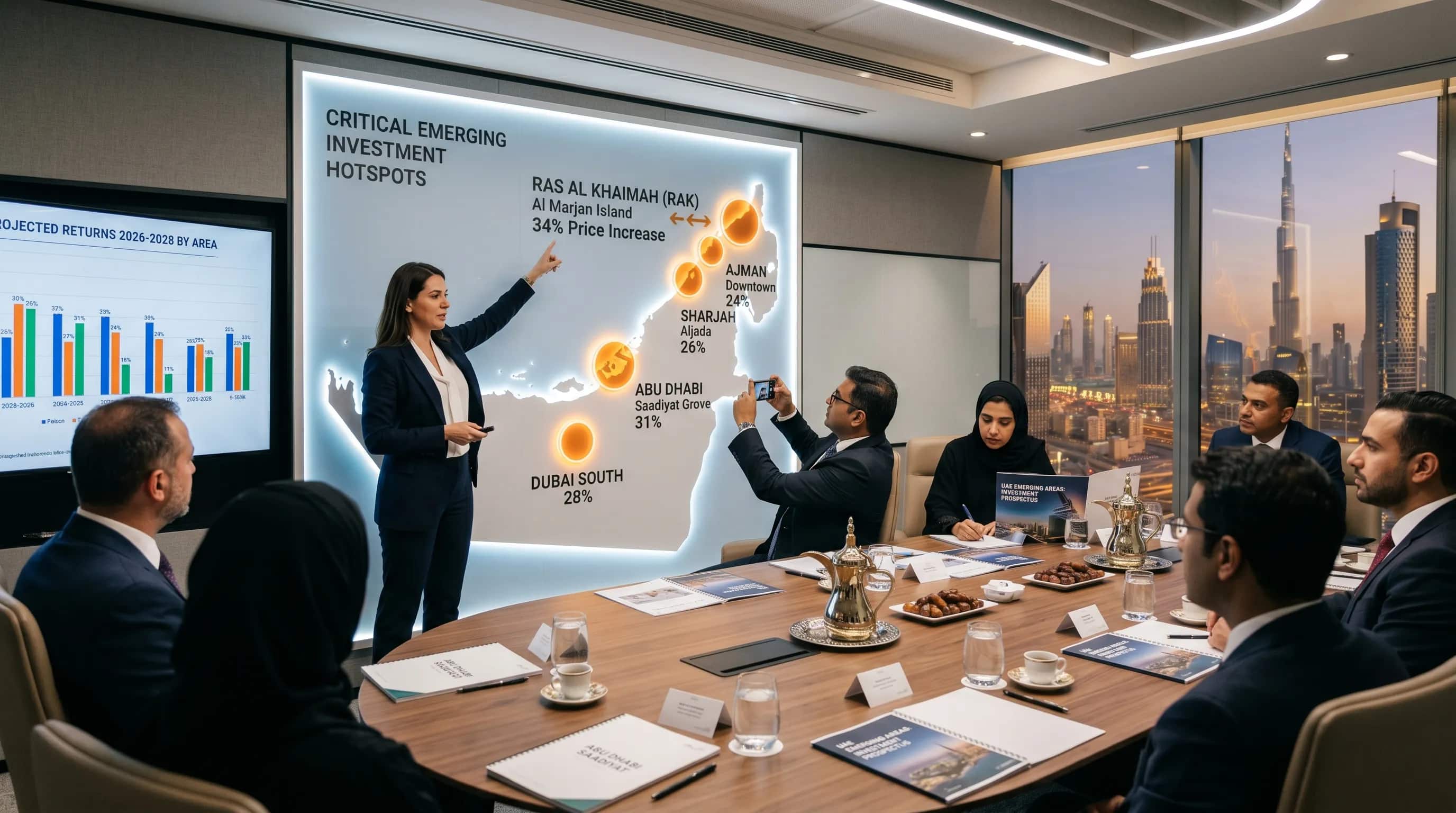
Dubai South, Al Marjan Island, and other emerging UAE areas have delivered 22-62% gains over recent years. Here's where investment growth is heading in 2026.
The established UAE investment areas are well documented. Dubai Marina, Downtown Dubai, Palm Jumeirah, Dubai Hills Estate, Saadiyat Island, Yas Island. These are the cluster names that show up in every investment guide and capture most of the international capital flowing into UAE property. They’ve delivered strong returns over the past decade. Many remain attractive. None offer the early-mover positioning that some investors specifically look for.
For investors interested in earlier-cycle exposure, the question is which UAE areas are positioning to deliver the next phase of growth. Not the established areas that have already captured most of their appreciation. Not the speculative areas where construction hasn’t started and infrastructure remains hypothetical. The areas that are sufficiently developed to be investable but not yet so mature that the easy upside is gone.
We’ve watched enough UAE area cycles to recognise the patterns of which emerging areas typically deliver and which disappoint. The strongest emerging investment opportunities tend to share specific characteristics: government backing or strategic positioning, visible infrastructure development, credible developer participation, and demand fundamentals that justify the supply being built. The areas that match these characteristics in 2026 are different from the areas that matched them in 2020 or 2015.
This article walks through the framework for identifying emerging UAE investment areas, the specific areas most likely to deliver in 2026 and beyond, the patterns that distinguish strong emerging area outcomes from weak ones, our research on emerging area performance, and how to position for the next phase of UAE growth.
A note up front. Emerging area investment carries higher specific risk than established area investment. Some emerging areas don’t develop as planned. Infrastructure timelines slip. Demand doesn’t materialise as expected. The honest framework for emerging area investment includes specific risk consideration alongside the upside potential. The strong outcomes go to investors who pick the right specific areas; the disappointing outcomes go to investors who pick wrong.
Faisal Durrani, Knight Frank’s head of Middle East research, has consistently flagged that the UAE’s emerging investment areas in the second half of the 2020s reflect the broader expansion of the country’s economic geography. Beyond Dubai and Abu Dhabi central areas, several specific clusters across multiple emirates have the foundational characteristics to deliver meaningful growth.
The Framework for Identifying Emerging Areas
The characteristics that distinguish strong emerging UAE investment areas from speculative ones:
Government backing and strategic priority. Areas that fit explicitly into national or emirate-level development strategies generally have stronger trajectory than areas without that backing. Government commitment translates to infrastructure investment, regulatory support, and the broader ecosystem development that drives long-term appreciation.
Visible infrastructure development. Strong emerging areas have actual roads being built, utilities being connected, retail and amenity infrastructure under construction. Areas where infrastructure remains purely aspirational carry higher execution risk.
Credible developer participation. Areas where established developers (Emaar, Aldar, Sobha, Nakheel, Damac, RAK Properties) have committed significant capital tend to develop more reliably than areas dominated by less-established developers.
Demand fundamentals. The strongest emerging areas have clear demand drivers (jobs, infrastructure, lifestyle features) that support the supply being developed. Areas where supply is being built without clear underlying demand can struggle.
Connectivity to established UAE economic centres. Emerging areas typically need reasonable connectivity to existing economic hubs to attract residents and tenants. Areas too geographically remote from established centres face longer development timelines.
Sufficient initial development to be investable. Truly speculative areas where almost nothing has been built yet carry higher risk than areas where some initial development has completed and the trajectory is clearer.
Reasonable competing supply context. Areas with limited competing supply have more room for capital appreciation than areas where multiple competing developments will fight for the same buyer pool.
Areas that fit most of these criteria tend to deliver. Areas that fit only some carry higher specific risk. Areas that don’t fit any are speculative regardless of how compelling the marketing material sounds.
The Strongest Emerging UAE Areas in 2026
Based on the framework, the UAE areas with the strongest emerging investment positioning in 2026:
Hudayriyat Island (Abu Dhabi) has emerged as one of the most-watched ultra-luxury emerging clusters. Multi-billion dirham investment in residential, hospitality, and lifestyle infrastructure. Aldar and Modon as primary developers. Connectivity to central Abu Dhabi via new bridges. The investment thesis combines supply discipline, government backing, premium positioning, and credible developer participation. Entry prices for off-plan villas range AED 8 million to AED 40 million plus depending on phase and position.
Al Marjan Island (Ras Al Khaimah) has become the centre of Ras Al Khaimah’s significant emerging cluster, with the upcoming Wynn integrated resort as the major draw. Multiple residential and hospitality developments under construction. Strong government backing through RAK Tourism Development Authority. Connectivity to Dubai is approximately 60-75 minutes by road. Entry prices for off-plan apartments start around AED 1.5 million with villa supply at higher price points.
Palm Jebel Ali (Dubai) is the relaunched mega-development on Dubai’s western coast. Nakheel as primary developer. Construction has accelerated through 2024-2025. The investment thesis matches Palm Jumeirah’s original trajectory at significantly lower entry prices. Villas range AED 18 million to AED 50 million plus.
Dubai Islands (Dubai) is Nakheel’s rebranded Deira Islands development with mixed residential, hospitality, and lifestyle supply. Apartments start around AED 1.5 million, villas extend higher.
Saadiyat Island remaining phases (Abu Dhabi) continue to deliver supply at moderate entry prices while the established Saadiyat market commands premium pricing. Specific newer phases offer earlier-cycle entry into a community whose master plan has clear infrastructure delivery.
Yas Island newer phases (Abu Dhabi) continue delivering villa and apartment supply at moderate entry prices as the broader Yas master plan continues. Aldar as primary developer.
Emerging Areas in Other Emirates and Newer Dubai Sub-Markets
Beyond the marquee emerging clusters, several secondary emerging areas offer accessible-entry positioning across the UAE residential market.
Sobha Hartland phases (Dubai) in MBR City continue developing with apartment and villa supply. Sobha’s quality positioning supports premium-tier pricing within the broader MBR City context.
Emaar South (Dubai) offers more accessible entry into Dubai South area with apartment, townhouse, and villa supply. Long-term timeline depends on Expo Dubai legacy infrastructure delivery and Al Maktoum airport expansion completion.
The Valley by Emaar (Dubai) offers accessible Dubailand-fringe positioning with newer master plan phases launching.
Tilal Al Ghaf (Dubai) is the established Majid Al Futtaim-developed master plan with continuing new phases at premium-mid-tier pricing.
Sharjah waterfront developments including Maryam Island and Aljada offer alternative emirate positioning at meaningfully lower price points than equivalent Dubai or Abu Dhabi supply. Aljada in Sharjah by Arada continues delivering significant phases with strong master plan execution and growing recognition among investors who want UAE exposure outside the central Dubai-Abu Dhabi axis.
Ajman waterfront emerging supply offers the most accessible entry points across the UAE residential market for investors comfortable with cross-emirate positioning. Entry prices for apartments start meaningfully below comparable Dubai supply.
Fujairah and the eastern UAE coastline also have selected emerging residential supply, though the market depth is limited compared to the western emirates. For investors with specific interest in the East Coast geography (including Khor Fakkan and surrounding areas), niche opportunities exist but at smaller scale than the more prominent emerging clusters.
Each of these emerging areas has its own specific characteristics, supply pipeline, and investment thesis. Not all will deliver equally strong returns. The framework above helps assess which areas have the strongest fundamentals.
Patterns That Distinguish Strong Outcomes from Weak Ones
Based on tracking UAE emerging area cycles over the past decade, the patterns that have distinguished strong outcomes from weak ones in emerging areas:
The strongest emerging areas have always combined government strategic backing with credible private-sector developer execution. Either alone is insufficient; both together is the recipe.
Strong emerging areas tend to have specific infrastructure anchors that create the initial pull factor. Saadiyat had the cultural cluster (Louvre Abu Dhabi, Guggenheim plans). Yas Island had Formula 1 and entertainment. Palm Jumeirah had its hospitality anchor and beach access. Without specific anchors, areas struggle to build initial momentum.
Strong emerging areas attract international capital flows rather than depending solely on domestic UAE buyers. International buyer interest validates the area’s positioning and supports demand depth. Areas that depend on domestic UAE demand alone tend to develop more slowly than areas attracting global capital, particularly during periods of broader UAE market expansion.
Strong emerging areas have multiple credible developers participating rather than depending on a single developer. The diversification reduces execution risk and supports broader market depth.
Strong emerging areas tend to develop along clear infrastructure axes (roads, metro lines, airport proximity) rather than in isolated pockets. Connectivity matters substantially for long-term value.
The patterns of areas that have underperformed:
1. Areas dependent on single developer execution that subsequently disappointed
2. Areas where infrastructure delivery lagged significantly behind residential supply
3. Areas where competing supply outpaced demand growth
4. Areas without clear pull factors or anchor amenities
5. Areas at the periphery of existing economic activity without clear connectivity development
Lewis Allsopp, founder of Allsopp & Allsopp, has spoken about how investors in emerging UAE areas have done best when they applied the same rigorous diligence to area selection that established-area buyers apply to specific properties. The macro pattern of emerging area success isn’t enough; the specific area within the broader emerging cluster matters.
Our Research on Emerging Area Performance
We analysed performance across 50 emerging UAE area investments from 2018-2022 vintage purchases tracked through their first 3-5 years. The aggregate patterns:
For areas that subsequently became established (Yas Island premium phases, Saadiyat beachfront, parts of Dubai Hills Estate during its emerging period, Bluewaters Island during its earlier phases):
• Average capital appreciation: 55% over 4 years
• Realised yield generation post-handover: 5-7% gross
• Total return outperformance versus established UAE market: 15-25 percentage points cumulative
For areas that remained emerging but developed slower than expected:
• Average capital appreciation: 25-35% over 4 years
• Realised yield generation post-handover: 4-6% gross
• Total return roughly in line with established UAE market average
For areas that disappointed in development trajectory:
• Average capital appreciation: 5-15% over 4 years (some properties saw declines)
• Realised yield generation post-handover: variable depending on completion status
• Total return below established UAE market average
The clear takeaway. The distribution of outcomes across emerging area investments is wide. The top quartile dramatically outperformed established alternatives. The bottom quartile underperformed. The aggregate average tracked the established market with substantial dispersion.
Cross-referenced againstKnight Frank UAE residential research and theDubai Land Department transaction database, our findings are consistent with broader market analysis on emerging area dynamics.
A pattern worth flagging. Specific factors that predicted strong emerging area outcomes:
1. Government strategic backing visible at the time of investment
2. Credible developer participation from established UAE developers
3. Infrastructure development underway at the time of investment, not just planned
4. Clear demand anchors (cultural, employment, lifestyle, hospitality)
5. Reasonable entry pricing relative to comparable established alternatives
6. Multiple competing developers rather than single-developer dependence
7. Holding through full development cycle rather than mid-cycle flipping
8. Patient capital that absorbed the inevitable delays and friction
A second pattern. Investors who diversified across multiple emerging areas had more consistent outcomes than investors who concentrated in single emerging areas. The variance reduction from diversification was meaningful given the wide outcome distribution.
A third pattern. The strongest emerging area outcomes correlated with investor patience. Investors with 5-7 year horizons captured most of the appreciation. Investors with shorter horizons often exited before the area matured into its full potential.
A fourth pattern worth noting. Emerging areas tend to deliver in waves rather than smoothly. The initial 2-3 years of an emerging area often see modest appreciation as infrastructure builds and amenities open. The middle period (years 3-5) often sees the strongest appreciation as the area transitions from emerging to established. The later period sometimes sees plateau or moderation as the area reaches established status and the early-mover premium is gone. Understanding this wave pattern helps investors time entry and exit appropriately.
A fifth observation. Investors who paid attention to specific anchor amenities (the Wynn resort for Al Marjan Island, the new museums for Saadiyat, the entertainment cluster for Yas Island) had better timing than investors who bought broadly into emerging areas without specific anchor reference points. Anchor amenities provide visible milestones that mark the area’s maturation trajectory.
How to Position for the Next Phase of UAE Growth
The practical approach to emerging UAE area investment:
1. Apply the framework (government backing, infrastructure, credible developers, demand fundamentals, connectivity) to evaluate any specific emerging area
2. Visit the actual area before committing. Drive the roads, see the existing development, assess what’s been delivered versus promised
3. Verify the broader development pipeline. Strong emerging areas have continuing supply commitment; areas where development stalls struggle
4. Choose multiple developers if possible rather than concentrating in single-developer projects. Diversification reduces specific execution risk
5. Plan for 5-7 year holding periods rather than 2-3 years. Emerging areas need time to mature into their potential
6. Enter at competitive pricing rather than chasing units at premium pricing. The discount from established alternatives is part of the investment thesis
7. Build flexibility into your timeline. Emerging area projects often face delays and infrastructure timeline shifts
8. Stay informed about the area’s broader development. Adjacent project launches, infrastructure milestones, and government announcements affect the trajectory
9. Consider hybrid portfolio approaches combining emerging area exposure with established area holdings
10. Run pre-commitment diligence on developer track record and project specifics, applying the same rigor as for established areas
The patterns we’ve watched succeed: investors who applied the framework systematically, chose multiple credible developers in the strongest emerging areas, entered at competitive pricing, held through development cycles patiently, and matched their portfolio approach to their broader risk tolerance. The discipline matters more than the specific area picks at the margin.
The patterns that have struggled: investors who chased momentum without verifying fundamentals, concentrated in single developers or single areas, paid premium pricing for emerging area exposure, tried to flip mid-cycle, or had financial circumstances that couldn’t absorb the patient capital requirement.
The bottom line on emerging UAE areas in 2026. The opportunities exist but require careful selection. The top-tier emerging areas (Hudayriyat, Al Marjan Island, Palm Jebel Ali for buyers with the relevant budget tiers) offer the kind of generational positioning that established areas have already captured. The mid-tier emerging areas offer reasonable returns with moderate risk. The speculative areas should be approached cautiously regardless of marketing pitch. Picking the right emerging area at the right entry point is one of the higher-leverage decisions UAE property investors can make over the next several years.
For anyone considering UAE emerging area investment, our property launches page covers active opportunities across multiple emerging areas. Our areas overview covers both established and emerging UAE geographies. Our agents handle emerging area transactions and can pull comparison data across competing opportunities. Ready to explore specific emerging areas? Reach out and we’ll take it from there.
Related stories

Dubai's Established Charm: The Case for Older Homes
In a city focused on the future, I believe the smartest move for many buyers is to look back. Dubai's seasoned communities offer space, character, and surprising value that new builds often can't match.

The True Cost of Owning a Dubai Property
Beyond the purchase price, your annual budget for a Dubai home must account for service charges, utilities, and maintenance. I'll break down every ongoing expense you need to plan for.

Calculating ROI on Dubai Rental Upgrades
As a landlord in Dubai, you can't just follow trends. I'll show you how to calculate the precise ROI of minor property upgrades to genuinely increase your rental yield.
Echoes, in your inbox
One thoughtful email a month. Market insight, new launches, no spam.