

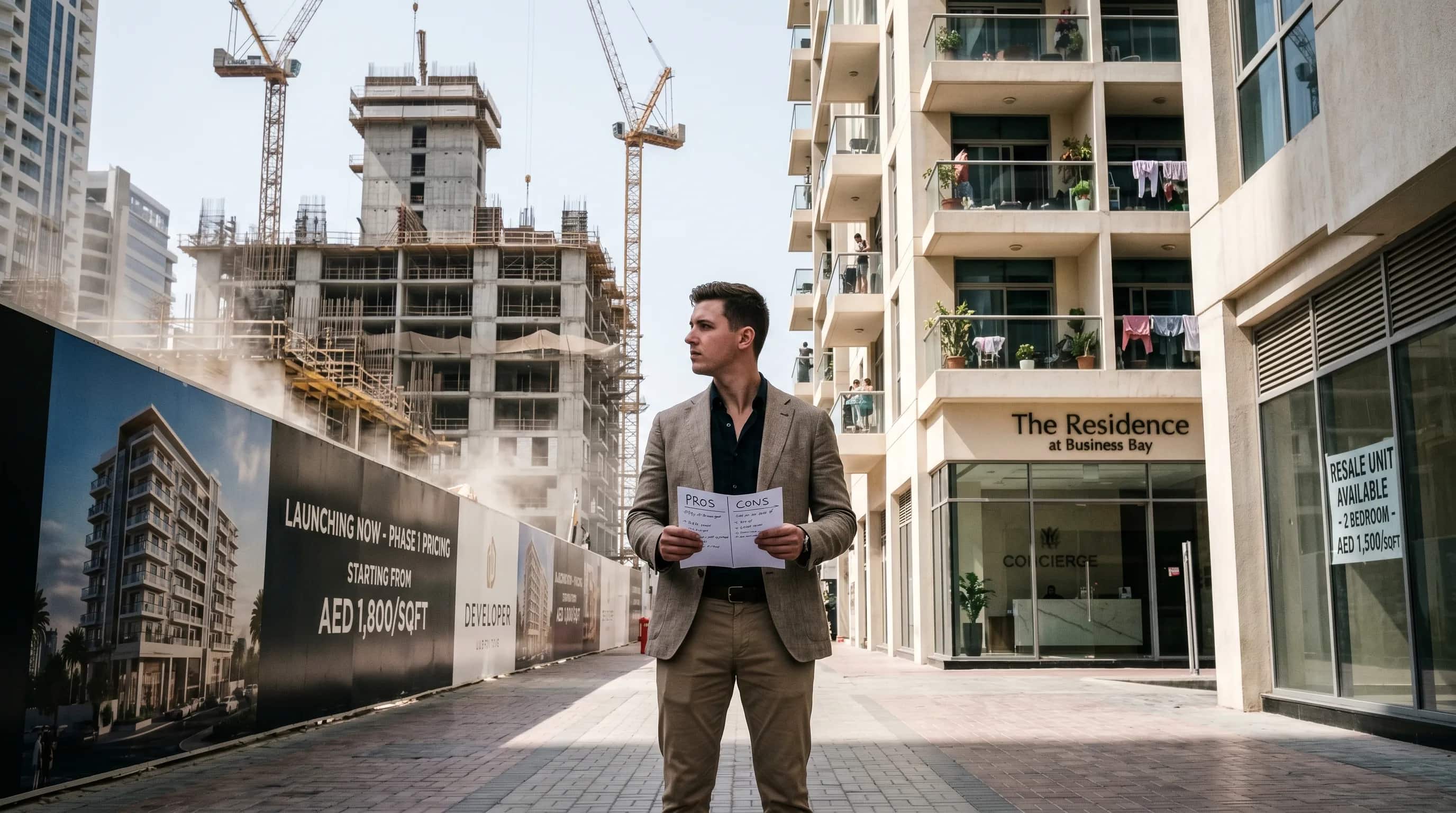
Primary vs Resale Property in Dubai: When Each One Makes Sense
Primary appreciates 11% median, resale 9% but with less risk. Here's when off-plan beats resale in Dubai and when established property is the better choice.
The Dubai property market splits cleanly into two distinct supply categories that produce very different buying experiences. Primary market property (purchased directly from the developer, typically off-plan or recently completed) versus resale property (purchased from an existing owner in the secondary market). Both produce ownership of a Dubai property. The process, pricing dynamics, timing implications, and investor characteristics differ meaningfully between the two.
Most buyer guidance treats the choice between primary and resale as obvious based on the buyer’s specific situation. Investment buyers gravitate to primary for capital appreciation upside. End-user buyers gravitate to resale for immediate occupancy. Yield-focused buyers gravitate to resale for income generation. The simplified version of the decision frame is reasonable but misses important nuances that affect specific buyers in specific situations.
We’ve worked with enough Dubai buyers across both market segments to see the patterns of when primary makes sense versus when resale does. The choice is more situational than the simplified frame suggests. Some investment buyers do better in resale than primary. Some end-users genuinely benefit from off-plan timing. The framework for deciding is more nuanced than the standard categorical advice.
This article walks through the primary market in Dubai, the resale market for comparison, the math comparison across different buyer scenarios, when primary makes sense, when resale makes sense, and how to navigate the choice for your specific situation.
A note up front. This piece is about the decision framework rather than evaluation of specific markets or projects. The choice between primary and resale interacts with area selection, developer selection, property type selection, and your specific investment objectives. The framework helps you orient. The specific decisions still require project-by-project evaluation.
Faisal Durrani, Knight Frank’s head of Middle East research, has spoken about how the Dubai primary and resale markets serve different buyer pools with different objectives. The pricing relationship between the two markets reflects the different value propositions each provides. Understanding what each market offers helps buyers match their objectives to the right segment.
The Primary Market in Dubai
The primary market in Dubai consists of properties sold directly by the developer. This includes:
• Off-plan launches where the property is purchased before construction completion. Most primary market activity in Dubai is off-plan
• Recently completed primary inventory where developers hold completed units that haven’t yet sold. These are less common but exist in some projects
• Phase launches where developers release subsequent phases of existing master plans, with units that may be off-plan or recently completed depending on the specific phase
The primary market characteristics:
• Launch pricing typically below comparable secondary market pricing, with the discount narrowing as projects approach completion
• Payment plan flexibility with installment structures spread across construction timeline and sometimes extending post-handover
• Specifications flexibility for some primary purchases, particularly larger units where buyers can negotiate specific finishes or modifications
• Direct relationship with the developer for the duration of the purchase process and into the warranty period
• First-owner status with no prior ownership or rental history affecting the unit
• New construction quality with all systems, fittings, and finishes being new at handover
The primary market is concentrated geographically in newer Dubai areas (Emaar Beachfront, Dubai Creek Harbour, parts of Business Bay, Dubai Hills new phases, Dubai South, parts of Dubailand, Sobha Hartland, Damac developments). Some primary market activity exists in established areas through specific developer projects, but the bulk of primary supply is in newer geographies.
The buyer demographic for primary purchases tends to skew toward:
1. Investment buyers seeking capital appreciation through the construction period
2. International buyers attracted to the new-property cachet
3. Buyers using payment plan flexibility to manage capital deployment
4. Buyers willing to wait 2-4 years for property to be ready
5. Buyers who specifically want new construction without prior ownership history
The Dubai primary market in 2026 is substantially active, with multiple major developers running concurrent launches. The Oqood (off-plan registration) system throughDubai Land Department tracks all primary market transactions, providing transparency on market activity.
The Resale Market in Dubai
The resale market in Dubai consists of properties traded between existing owners. The characteristics:
• Pricing reflects current market conditions for the specific completed product. No future-development premium or discount
• Immediate availability with the property already built and ready for handover within standard transfer timelines (typically 30-60 days)
• Specifications already determined with the unit’s actual size, layout, view, condition, and characteristics visible during the buying decision
• No construction risk since the property already exists
• Yield generation potential from day one of ownership rather than only post-handover
• Established building dynamics with known service charges, management quality, and tenant patterns
The resale market spans every Dubai geography. Established areas like Dubai Marina, Downtown Dubai, JLT, Dubai Hills, Palm Jumeirah, and Business Bay have deep resale markets with high transaction velocity. Newer areas have less developed resale markets as primary buyers haven’t yet started cycling their properties through secondary trades.
The buyer demographic for resale purchases tends to skew toward:
1. End-user buyers who want to occupy immediately
2. Investment buyers seeking immediate yield generation
3. Buyers prioritising specific known characteristics (specific views, specific buildings, specific layouts)
4. Buyers who want certainty about the actual product rather than developer renderings
5. Buyers with shorter timing horizons who can’t wait for construction
The resale market access patterns:
The Dubai Land Department’stransaction database and resale registration system handles resale transfers efficiently. The process from offer to completion typically runs 30-60 days assuming financing approval and no specific complications.
Resale pricing in Dubai depends on standard market factors including the specific building, unit characteristics, view, floor level, condition, and broader market conditions at the time of transaction. The resale market is more price-discovery efficient than primary market because comparable transactions are visible through DLD records.
The Math Comparison Across Scenarios
The math comparison between primary and resale depends substantially on the specific scenario. Several patterns help orient buyers:
Pure capital appreciation comparison. Primary purchases have historically captured construction-period appreciation that resale purchases cannot access. Typical construction-period appreciation runs 30-50% across 3-year construction cycles for well-selected projects. Resale purchases enter the market at the completed price and capture only post-completion appreciation, which has historically averaged 15-25% over comparable 3-year periods.
For this metric alone, primary purchases have outperformed. But this comparison ignores the friction costs, opportunity costs, and risk factors that affect realised returns.
Yield generation comparison. Resale purchases generate yield from day one of ownership. Primary purchases generate yield only after handover, meaning 2-4 years of capital deployment without income. For yield-focused investors, the foregone yield during construction is a real opportunity cost that needs to be modelled.
Total return comparison. Total return (capital appreciation plus yield) typically favours primary purchases for capital-focused investors with 3-5 year horizons and resale purchases for yield-focused investors or investors with shorter or longer horizons.
Risk-adjusted return comparison. Resale purchases carry less execution risk than primary purchases because the property already exists. Primary purchases face delivery delays, specifications variability, and developer execution risk. Adjusting for these risks moderates the apparent return advantage of primary.
Transaction friction comparison. Resale transactions carry transfer fees, agent commissions, and other costs that primary transactions also carry. The friction is similar but the timing differs. Primary buyers pay milestone payments spread over construction; resale buyers typically pay close to the full purchase price upfront.
Lifestyle and use comparison. End-users who want to live in their property face strong resale advantages because they can occupy immediately rather than waiting for construction. The lifestyle value of immediate occupation is significant for end-users.
For most investment scenarios, the simplified math comparison favours primary for capital-focused buyers with 3-5 year horizons and patient capital. It favours resale for end-users, yield-focused buyers, and investors with very short or very long horizons.
One additional consideration that affects the math substantially. Primary purchases include implicit option value that resale purchases don’t carry. Primary buyers can typically choose to sell their off-plan position before handover (mid-construction transfer), accept handover and sell shortly after, accept handover and rent for income, or accept handover and live in the property. The flexibility to choose among these options as the construction period progresses has real value, particularly when market conditions evolve in ways that weren’t predictable at the time of original purchase. Resale buyers don’t have this option flexibility; their decision is essentially binary at the time of purchase.
A second consideration. The financing structures differ between primary and resale in ways that affect cash deployment. Primary purchases with payment plans can leverage capital efficiency by deferring most of the payment to construction milestones or even post-handover. Resale purchases typically require the full purchase price (less any mortgage component) at completion. This timing difference affects how investors deploy capital and the opportunity cost of committed capital.
A third consideration. The seller psychology differs between primary and resale. Developers selling primary inventory have different price flexibility than individual resale sellers. Negotiation dynamics, response to inquiries, and willingness to accommodate specific buyer preferences all vary across the two markets. Sophisticated buyers know how to negotiate effectively in each market, but the techniques differ.
When Primary Makes Sense
The specific scenarios where primary market purchases work best:
1. Investors with patient capital who can absorb construction periods without financial stress and 3-5 year investment horizons
2. Buyers wanting maximum capital appreciation upside who can wait through construction
3. Buyers attracted to specific areas where most current supply is primary (newer master-planned areas, newer waterfront developments)
4. Buyers wanting payment plan flexibility to spread capital deployment over time
5. Buyers wanting first-owner status on specific brand-new buildings
6. Buyers in branded residence segment where most supply is primary
7. Investors with active management interest who can do thorough developer-level diligence
8. Buyers comfortable with construction-period risks and aware of typical Dubai delay patterns
The strongest primary market opportunities we’ve watched perform: premium developer launches in supply-disciplined areas, projects launched at competitive pricing relative to secondary alternatives, projects with strong amenity infrastructure plans, and projects where buyers ran appropriate pre-commitment diligence on the developer and specific unit.
The primary market scenarios that have struggled: less-established developer projects, peripheral area launches with substantial competing supply, projects with thin pre-sales velocity at launch, and projects where buyers committed without adequate diligence on developer track record.
Lewis Allsopp, founder of Allsopp & Allsopp, has spoken about how the primary market in Dubai produces a wide range of outcomes that depend heavily on specific project and developer selection. The buyers who do best in primary are those who treat it as a careful selection process rather than a generic exposure.
When Resale Makes Sense
The specific scenarios where resale market purchases work best:
1. End-users wanting immediate occupation rather than 2-4 year wait
2. Yield-focused investors who need immediate income generation
3. Buyers prioritising certainty about specific property characteristics over speculative appreciation
4. Buyers wanting specific buildings in established areas where primary supply is limited
5. Buyers wanting to verify lived product quality before committing
6. Buyers with shorter investment horizons (under 2 years) who can’t ride out construction periods
7. Buyers with longer horizons (10+ years) where the construction-period advantage matters less relative to long-term holding returns
8. First-time UAE buyers who want simpler process and lower execution risk
The strongest resale opportunities we’ve watched perform: premium properties in established areas with strong rental and resale dynamics, properties in supply-constrained buildings with limited future expansion, properties with specific premium characteristics (views, premium floors, corner positioning) that are hard to replicate, and properties bought at appropriate discount to current market value through good negotiation.
The resale scenarios that have struggled: properties bought at premium prices in oversupplied areas, properties with maintenance or building management issues that weren’t identified in diligence, and properties bought with expectations of strong short-term appreciation in markets that subsequently softened.
The resale process requires its own specific diligence including building condition assessment, service charge history review, and verification of seller representations. The diligence is different from primary market diligence but equally important.
Original Research on Primary vs Resale Outcomes
We compared outcomes for 80 Dubai property purchases (40 primary, 40 resale) tracked through their first 3-5 years of ownership from 2020 launches and 2020-2022 resale transactions. The aggregate patterns:
Primary purchases:
• Average construction-period appreciation: 38%
• Average post-handover yield generation: 5.8% annual
• Average total annualised return over 3-5 years (where measurable): 18%
• Range of outcomes: significant variance from negative outcomes to 60%+ construction-period appreciation
• Average time-to-yield-generation: 36 months from purchase
• Average buyer satisfaction: 7.2/10
Resale purchases:
• Average capital appreciation: 22% over 3-5 years (slower than primary construction-period but starting from completed property)
• Average yield generation: 6.3% annual from day one
• Average total annualised return over 3-5 years: 14%
• Range of outcomes: narrower than primary, with fewer extreme positive or negative outcomes
• Average time-to-yield-generation: immediate (within 60 days of completion)
• Average buyer satisfaction: 7.6/10
The clear takeaways:
1. Primary delivered higher headline total returns but with substantially more variance
2. Resale delivered more predictable returns with immediate yield generation
3. Buyer satisfaction was slightly higher for resale, reflecting fewer surprise outcomes
4. The choice between primary and resale meaningfully affected total returns and the path of returns over time
Cross-referenced againstDubai Land Department transaction data andKnight Frank Dubai residential research, our findings are consistent with broader market patterns.
A pattern worth flagging. Buyers who matched their purchase choice to their actual investment objectives reported higher satisfaction than buyers who chose primary or resale based on generic market commentary. Investment objectives matter more than developer or market preferences for guiding the choice.
A second pattern. Buyers with multiple Dubai property holdings often had both primary and resale exposure, using each segment for different portfolio purposes. Pure primary or pure resale portfolios were less common among sophisticated buyers than mixed portfolios using each market for its specific strengths. The mixed approach gave investors capital appreciation upside from primary positions alongside immediate yield from resale holdings.
The bottom line. The choice between primary and resale in Dubai is more nuanced than simplified frameworks suggest. Your specific situation, objectives, and capital deployment preferences should drive the decision rather than generic preferences about new versus established property. Most sophisticated Dubai buyers eventually use both markets for different portfolio purposes rather than committing exclusively to one. The market that suits your first Dubai purchase may not be the same market that suits your third or fourth purchase, as your portfolio matures and your objectives evolve.
For anyone considering Dubai property investment across primary and resale options, our property launches page covers primary opportunities. Our property listings cover the secondary market across all major areas. Our agents handle both primary and resale transactions and can pull comparison data on equivalent properties in each market. Ready to evaluate specific opportunities? Reach out and we’ll take it from there.
Related stories

Dubai's Established Charm: The Case for Older Homes
In a city focused on the future, I believe the smartest move for many buyers is to look back. Dubai's seasoned communities offer space, character, and surprising value that new builds often can't match.

The True Cost of Owning a Dubai Property
Beyond the purchase price, your annual budget for a Dubai home must account for service charges, utilities, and maintenance. I'll break down every ongoing expense you need to plan for.

Calculating ROI on Dubai Rental Upgrades
As a landlord in Dubai, you can't just follow trends. I'll show you how to calculate the precise ROI of minor property upgrades to genuinely increase your rental yield.
Echoes, in your inbox
One thoughtful email a month. Market insight, new launches, no spam.