

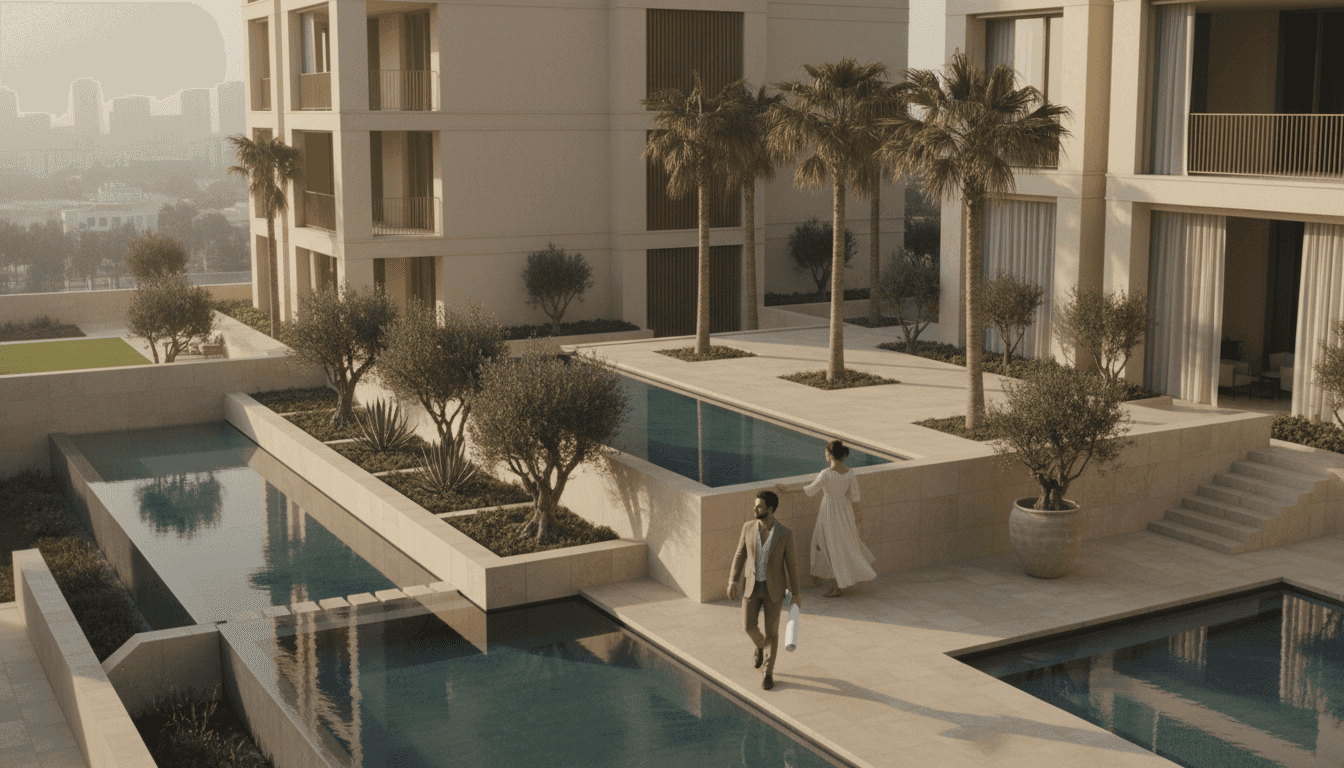
Using Off-Plan to Scale Your Dubai Property Portfolio
I explore the mechanics of using off-plan properties not just for a single gain, but as a systematic tool for building a multi-property real estate portfolio in Dubai.

Many investors approach Dubai's off-plan market with a singular goal: buy one unit, hope for rapid appreciation, and sell for a quick profit before handover. While this can work, it treats a powerful financial instrument as a one-shot lottery ticket. I believe the true potential of off-plan lies not in a single transaction, but in its strategic use as a foundation for a scalable, multi-property portfolio.
Here is the framework I'll be outlining for a Dubai multi-property investment strategy:
- The core principle of capital efficiency in off-plan investing.
- A step-by-step guide to the 'Stagger and Scale' portfolio method.
- How to select the right foundational asset to launch your strategy.
- The mechanics of financing your second, third, and fourth properties.
- Mitigating the unique risks associated with a multi-unit off-plan strategy.
- A case study modelling how the portfolio grows over time.
- How to diversify your holdings for long-term resilience.
- My final verdict on whether this strategy is right for you.
The Core Principle: Superior Capital Efficiency
The fundamental reason off-plan is so effective for building real estate wealth off-plan is its unmatched capital efficiency. When you buy a ready property, you must commit a significant amount of capital upfront. Under the Central Bank of the UAE regulations, an expatriate investor typically needs a 20-25% down payment for a mortgage, plus the 4% Dubai Land Department (DLD) transfer fee and around 2% in agent and administrative fees. On a property worth AED 2 million, you are deploying over AED 500,000 in cash almost immediately.
Contrast this with an off-plan purchase. Here, your initial outlay is dictated by the developer's payment plan. A common structure is a 10% or 20% down payment, with the 4% DLD fee paid at the same time. The remaining 80-90% is then paid in installments linked to construction milestones over several years, or even partly after handover. This structure is a form of interest-free financing offered directly by the developer. It means your capital is not tied up in a single asset; instead, it's deployed gradually, allowing the market time to work in your favour.
Let’s make this concrete. Imagine two investors, each with AED 600,000 in liquid capital. Investor A buys a ready one-bedroom apartment in Dubai Marina for AED 2 million. His upfront costs look like this:
- Down Payment (20%): AED 400,000
- DLD Fee (4%): AED 80,000
- Trustee & Mortgage Fees (~1%): AED 20,000
- Agency Fee (2% + VAT): AED 42,000
- Total Initial Outlay: AED 542,000
Investor A now owns one property and has most of his capital tied up. Investor B, however, pursues a capital efficient property investment Dubai strategy. She finds a promising off-plan project from a top-tier developer like Emaar Properties in an emerging area. She decides to buy two one-bedroom apartments, each priced at AED 1.2 million, on a 70/30 payment plan (70% during construction, 30% on handover). Her initial outlay for the *first* unit is:
- Down Payment (10%): AED 120,000
- DLD Fee (4%): AED 48,000
- Oqood Fee: ~AED 5,250
- Total Initial Outlay (Unit 1): AED 173,250
After securing her first unit, she still has over AED 425,000 in cash. Six months later, she could secure a second similar unit, committing another AED 173,250. Now, with less capital deployed than Investor A, she controls two assets poised for appreciation. This is the essence of use in the off-plan space — using the developer's payment plan to control a larger asset base with less upfront cash.
The 'Stagger and Scale' Strategy Explained
 Featured project
The 'Stagger and Scale' method is a systematic approach to scaling property investments Dubai. It turns the capital efficiency of off-plan into a repeatable cycle of acquisition. The goal is to use the appreciation and equity from your first off-plan property to fund the down payments for your second and third, creating a snowball effect. It requires discipline, careful timing, and a clear understanding of market cycles.
The process works in distinct phases:
1. Acquisition Phase 1 (The Seed Asset): You begin by purchasing your first off-plan property (Unit 1). As I'll discuss later, the selection of this initial asset is paramount. You need a property in a high-demand location from a developer known for quality and timely delivery. You are now on a payment plan, typically spanning 3-4 years until completion. 2. Appreciation Phase: During the construction period, several factors work in your favour. The project matures, construction progress becomes visible, and the surrounding community infrastructure develops. In a stable or rising market, this translates directly into capital appreciation. A property bought at AED 1.2 million might be valued at AED 1.5 million a year or two before handover. 3. The Decision Point (Flip or Hold): This is the strategic crossroads. You have two primary paths to scale: * The Flip-to-Scale Path: You sell Unit 1 before handover. In our example, selling at AED 1.5 million would crystallise your gain. After paying the outstanding amount to the developer and transaction costs, the profit becomes your seed capital for your next acquisitions. This profit could easily be enough to cover the 10-20% down payments on two or even three new off-plan properties, dramatically accelerating your portfolio growth. * The Hold-to-Scale Path: You take handover of Unit 1. You might pay the final installment with cash or secure a mortgage. The property is now a income-generating asset. The rental yield can help service the mortgage/payments, and you can later perform an equity release (refinance) to pull out capital for your next down payment. This is a slower, more conservative approach to scaling but builds a stable, long-term rental portfolio. 4. Acquisition Phase 2 (The Scale-Up): Using the capital unlocked from Unit 1 (either through profit from a sale or equity release), you now acquire Units 2 and 3. Crucially, you should stagger these purchases. Don't buy two properties with handover dates in the same quarter. By staggering their completion dates by 12-18 months, you ensure your major payment obligations (like the large handover payment) are spread out, reducing liquidity risk.
This cycle can then be repeated. As Units 2 and 3 appreciate, they become the source of capital for Units 4, 5, and 6. What started with one modest down payment can, over a 5-10 year period, evolve into a substantial and diversified property portfolio. This is not passive investing; it requires active management and a keen eye on market timing and project selection.
Selecting the Right Foundational Asset
The entire 'Stagger and Scale' strategy hinges on the performance of your first property. A poor choice can stall your progress indefinitely, tying up capital in a non-performing asset. A great choice provides the fuel for exponential growth. When I advise clients at Gaia Living on selecting this foundational asset, I stress a disciplined, data-driven approach over chasing trends.
Your first off-plan purchase should not be your 'dream home'. It is a financial tool. Therefore, it must be selected based on its investment merits, primarily its potential for strong capital appreciation and high rental demand upon completion. Key criteria include:
- Developer Reputation: This is non-negotiable. Stick with established master developers like Emaar, Nakheel, [Meraas], and Sobha Realty, or reputable private developers like Nshama or Binghatti who have a consistent track record of delivering quality projects on time. A delay in handover can wreck your scaling timeline and a poor-quality build will hurt both resale value and rental appeal. The DLD's REST app provides data on developer performance, which is an invaluable due diligence tool.
- Location & Infrastructure: Look for what I call 'path of progress' locations. These are areas with planned infrastructure improvements — new metro lines, roads, schools, and retail centres. Early entry into master communities like Expo City, Palm Jebel Ali, or new phases within established zones like Dubai Hills Estate can offer significant upside. Areas like Arjan and Al Furjan have seen tremendous growth as they mature from emerging to established communities.
- Unit Type and Layout: Focus on unit types with the broadest possible market appeal. In Dubai, this almost always means one and two-bedroom apartments, or three-bedroom townhouses in family-oriented communities. These are the easiest to rent and the most liquid in the secondary market. Avoid niche products like oversized penthouses or quirky layouts for your foundational purchase, as they have a smaller pool of potential buyers and renters.
- Payment Plan Structure: The payment plan itself is a strategic lever. A 'back-ended' plan (e.g., 40/60 or 50/50) where a large portion is due on or after handover is generally preferable for a scaling strategy. It minimises your capital deployment during construction, maximising the time for appreciation to work on a smaller cash investment. Conversely, a 'front-loaded' plan (e.g., 80/20) requires more cash during construction but can be attractive if the entry price is significantly below market value.
“The first off-plan asset you buy isn't just a property; it's the launchpad for your entire portfolio. A misfire here doesn't just cost you money, it costs you years of momentum.”
Selecting this asset is where professional guidance is invaluable. At Gaia Living, we don't just present launches; we analyse them against our clients' specific portfolio goals. We evaluate the developer's history, the master plan's viability, comparable sales data, and potential rental yields to identify assets that are not just attractive, but strategically sound. This initial choice dictates the trajectory of your entire off-plan portfolio diversification journey.
Financing the Scale-Up: Equity, Profit, and Use
Once your first off-plan property has appreciated, the next critical step is unlocking that value to fund your expansion. The mechanics of this are different depending on whether you chose the 'Flip-to-Scale' or 'Hold-to-Scale' path. Both require a clear understanding of the numbers and processes involved.
Let's first examine the 'Flip-to-Scale' approach. You bought Unit 1 for AED 1.2 million and now, a year before handover, you have a buyer willing to pay AED 1.5 million. At this point, you've paid 40% of the purchase price to the developer (AED 480,000). To complete the sale (known as an assignment sale), the new buyer must pay you your equity and take over the remaining payment plan. The transaction, facilitated through the developer and the Dubai Land Department, would look something like this:
- Selling Price: AED 1,500,000
- Original Purchase Price: AED 1,200,000
- Gross Profit: AED 300,000
- Your Payments to Developer: AED 480,000
- Your DLD/Oqood Fees Paid: ~AED 53,250
- Payment from New Buyer to You: AED 480,000 (your payments back) + AED 300,000 (your profit) = AED 780,000
- Net Profit (minus original fees): AED 300,000 - AED 53,250 = AED 246,750
This net profit of AED 246,750 is now your war chest. It's more than enough to cover the initial 10% down payment (AED 120,000) and 4% DLD fee (AED 48,000) for a new AED 1.2 million off-plan unit. In fact, you could potentially secure another unit shortly after, effectively turning one property investment into two. This is the fastest method for scaling property investments Dubai.
The 'Hold-to-Scale' path is more measured. You take handover of Unit 1. Let's assume you paid the final 30% (AED 360,000) in cash. The property is now fully paid for and valued at, say, AED 1.6 million. You can now approach a bank for an equity release mortgage. Banks in the UAE will typically lend up to 70-80% of the property's current market value. A 70% loan-to-value (LTV) on AED 1.6 million would be AED 1,120,000. You could use this loan to fund your next acquisitions. Simultaneously, you'd rent out Unit 1. A property of this value in a good community could generate AED 100,000-120,000 per year in rent, which helps service the new mortgage and contributes to your savings for the next down payment.
This method is slower but creates a base of stable, income-producing assets. It's often favoured by investors with a lower risk appetite. A popular hybrid approach uses post-handover payment plans. If Unit 1 was on a 50/50 plan with 50% payable over three years post-handover, you can take possession, rent it out, and use the rental income to cover the developer's installments. This frees up your own cash to be deployed into the down payment for Unit 2, offering a balance between the speed of flipping and the stability of holding.
Mitigating the Risks of a Multi-Unit Strategy
While the 'Stagger and Scale' strategy is powerful, it is not without risk. Scaling amplifies not just your potential returns, but also your exposure. Acknowledging and actively mitigating these risks is the hallmark of a professional investor, not a speculator. At Gaia Living, my conversations with portfolio-building clients focus as much on downside protection as on upside potential.
The primary risks are Market Risk, Developer Risk, and Liquidity Risk.
Market Risk: This is the most significant threat. The strategy relies on capital appreciation during the construction phase. If the market stagnates or corrects, your planned 'flip' might not generate a profit, or worse, you could be in a negative equity position. Similarly, if you plan to hold, a market downturn means lower rental yields and difficulty in securing an equity-release mortgage at a favourable valuation. Mitigation involves buying into master communities with proven resilience and diversifying your portfolio across different market segments. Don't put all your capital into high-end luxury if your risk tolerance is moderate; balance it with mid-market assets in high-demand rental areas like Jumeirah Village Circle (JVC) or Dubai Production City.
Developer Risk: This encompasses construction delays or, in the worst case, project failure. A significant delay can completely derail your staggered timeline, causing payment obligations to overlap unexpectedly. The escrow account system, mandated by RERA, protects your funds by linking payments to construction progress, but it doesn't protect you from the opportunity cost of a stalled project. Mitigation here is simple but crucial: rigorous due diligence. We vet developers obsessively, looking at their entire delivery history, financial stability, and the progress on their other ongoing projects. Never be the first to invest with a brand-new, unproven developer, no matter how attractive the price seems.
Liquidity Risk: This is the risk of not having cash on hand when a payment is due. As you scale to two, three, or four off-plan properties, you will have multiple payment schedules to manage. A common mistake is failing to budget for these future liabilities. It is essential to maintain a detailed cash flow forecast, mapping out all future payment due dates for all your properties. I advise clients to maintain a separate contingency fund, holding at least 15-20% of the total upcoming payments for the next 12 months in a liquid account. This buffer protects you from having to sell an asset at a fire-sale price to meet an obligation if your primary funding plan (e.g., the sale of another unit) is delayed.
Case Study: A Five-Year Portfolio Growth Model
To illustrate the power of this strategy, let's model a hypothetical five-year journey for an investor, 'Ali', starting with an initial capital of AED 350,000. This is a simplified model assuming a moderately appreciating market.
- Year 0: Ali purchases Unit 1, a one-bedroom apartment in a new Nshama project in Town Square for AED 800,000. The payment plan is 10% down, 40% during construction, and 50% on handover in Year 3. His initial outlay is AED 80,000 (down payment) + AED 32,000 (DLD fee) = AED 112,000.
- Year 0 to 2: Ali makes the 40% construction payments, totaling AED 320,000, from his salary and savings. By the end of Year 2, the property, nearing completion, is valued at AED 1.1 million due to strong market demand and community maturation.
- End of Year 2: Ali decides to execute a 'Flip-to-Scale'. He finds a buyer for Unit 1 at AED 1.1 million. His gross profit is AED 300,000. After accounting for his total cash paid (AED 112,000 + AED 320,000 = AED 432,000), he receives this back plus his profit. His net profit, after his initial DLD fee, is roughly AED 268,000. His total available cash is now his original seed money (less what he spent) plus this profit.
- Beginning of Year 3: Armed with his profits and recovered capital, Ali is ready to scale. He identifies two new opportunities:
- Unit 2: A studio in an emerging area like Dubai Science Park for AED 650,000 on a 20/80 plan. Initial cost: AED 130,000 (down payment) + AED 26,000 (DLD) = AED 156,000. Handover is in Year 5.
- Unit 3: A one-bedroom in a new phase of Sobha Hartland II for AED 1.3 million on a 10/90 plan. Initial cost: AED 130,000 (down payment) + AED 52,000 (DLD) = AED 182,000. Handover is in Year 6.
- Year 5: Ali now controls two off-plan properties with a combined purchase value of AED 1.95 million. His total capital deployed in down payments and fees is AED 338,000, funded entirely from his initial investment and the profits of the first flip. He has successfully leveraged an initial AED 800,000 asset into control of nearly AED 2 million in real estate, with staggered handovers that give him flexibility for his next move.
This simplified model shows the mechanics. In reality, market movements, finding buyers, and securing the right next project require skill and active management. However, it demonstrates how a Dubai multi-property investment strategy can be executed in a structured way, transforming a modest initial investment into a significant portfolio over a medium-term horizon.
Diversification: The Key to Long-Term Resilience
As your portfolio grows from one to three to five properties, your strategy must evolve from pure growth to growth plus resilience. A concentrated portfolio — all in one building, or all one-bedroom apartments, is brittle. A single localised issue (e.g., unexpected service charge hikes, a new building obstructing a view) can disproportionately impact your entire net worth. True off-plan portfolio diversification is your shield against this.
I advise clients to think about diversification across several vectors:
1. Geographical Diversification: Your first few properties might be in similar emerging communities to maximise growth. But as you expand, spread your risk across different parts of Dubai. If you hold assets in a growth area like Meydan, consider your next purchase in a stable, prime rental hub like Business Bay or DIFC. This balances high-growth potential with steady cash flow and proven value retention. 2. Asset Type Diversification: A portfolio of only studios is heavily exposed to shifts in the young professional rental market. Balance it with assets that appeal to other demographics. Add a two-bedroom apartment suitable for small families or a townhouse in a community like Arabian Ranches or The Meadows. This broadens your tenant pool and hedges against demographic-specific demand shocks. 3. Developer Diversification: Even if you love a particular developer, concentrating your entire portfolio with them creates a single point of failure. If that developer faces financial trouble or reputational damage, your entire asset base is at risk. By purchasing from several top-tier developers (Emaar, Nakheel, Aldar, Sobha), you distribute this risk. Each developer has different strengths, community styles, and payment plan philosophies, which can add healthy variety to your holdings. 4. Ready vs. Off-Plan Mix: The ultimate resilient portfolio contains a mix of both off-plan and ready properties. The off-plan units are your growth engine. The ready properties, which you might have taken handover of and decided to hold, are your cash flow engine. The rental income from your ready properties provides a stable financial foundation, funding your living expenses and providing a safety net, while the off-plan assets work to build capital value. Finding the right balance depends on your financial goals and stage of life.
Building a diversified portfolio is a conscious, long-term effort. It moves you from being an off-plan 'flipper' to a true real estate investor, focused on building sustainable, generational wealth. It's a journey we at Gaia Living are passionate about guiding our clients through, from their very first purchase to the management of a mature, multi-faceted portfolio.
Building a multi-property portfolio with off-plan is an active, not passive, strategy. It succeeds through disciplined execution of the 'Stagger and Scale' method, rigorous risk management, and strategic diversification. Your first asset choice is the most critical decision, as its performance fuels all subsequent growth.
My Verdict
Is using off-plan to scale a property portfolio the right strategy for every investor in Dubai? No. It requires a specific mindset: you must be comfortable with calculated risk, have a medium-to-long-term time horizon (at least 5-7 years), and be prepared to actively manage your investments. This is not a 'set and forget' path to wealth.
For those who see property not just as a home but as a financial instrument, however, this strategy offers a uniquely powerful mechanism for wealth creation. The developer-financed use inherent in off-plan payment plans provides a level of capital efficiency that is simply unattainable in the ready market. By starting with a well-chosen foundational asset and systematically reinvesting the proceeds, an investor can achieve a scale of ownership that would take decades to build through traditional means.
Success hinges on discipline. It requires resisting the temptation to over-use, diligently forecasting cash flows, and partnering with advisors who prioritise your long-term strategy over a quick commission. If you have the patience and the discipline, the Dubai off-plan market provides all the tools you need to build a truly substantial real estate legacy.
## Sources - Central Bank of the UAE: https://www.centralbank.ae/ - Dubai Land Department (DLD): https://dubailand.gov.ae/
Questions, answered
- Is it better to sell an off-plan property before or after handover when building a portfolio?
- Selling before handover (a 'flip') can quickly release capital and profit to reinvest into new off-plan units, accelerating portfolio growth. Holding and renting it out post-handover provides a steadier income stream and allows you to build equity, which can be leveraged for future purchases, but it's a slower scaling strategy.
- How much capital do I need to start an off-plan property portfolio in Dubai?
- For an entry-level apartment, you should budget for the initial 10-20% down payment plus the 4% DLD fee and Oqood registration fees. This could be between AED 150,000 to AED 300,000 to secure your first asset, with a plan for funding subsequent construction-linked payments.
- What is the biggest risk when using off-plan to scale a property portfolio?
- The primary risk is market risk. If the property market stagnates or declines during the construction period, the anticipated capital appreciation won't materialise. This makes it difficult to sell for a profit or refinance to fund your next purchase, potentially halting your scaling strategy.
- How do I diversify an off-plan property portfolio?
- Diversify by purchasing across different geographical areas (e.g., an apartment in Business Bay and a townhouse in Arabian Ranches), different property types (studios, one-beds, townhouses), and from various reputable developers. This spreads your risk and hedges against localised market issues.
- Can I use post-handover payment plans to help scale my portfolio?
- Yes, post-handover payment plans are a powerful tool for scaling. They allow you to take possession of the property and start earning rental income while still paying off the developer. This rental income can then be used to service the remaining payments or saved towards the deposit for your next off-plan investment.
- What are the main fees when buying an off-plan property in Dubai?
- The main upfront costs are the developer's down payment (typically 10-20%), the 4% Dubai Land Department (DLD) transfer fee, and an Oqood (off-plan registration) fee, which is around AED 5,250. You may also have a small administration fee payable to the developer.

Isabelle covers off-plan and investment strategy — payment plans, handover risk, developer track records, and the maths of buying before completion.
Related stories

Established vs. New Launch: Where Is Dubai's Enduring Value?
The Dubai property market presents a constant choice between the allure of new launches and the stability of established communities. I'll break down where true long-term value is found for investors and end-users.
Desert's Edge Serenity: Space and Calm in Dubai
The new definition of Dubai luxury isn't a penthouse view, but the space, quiet, and privacy found in its tranquil desert-edge communities. I'll explore where to find this serenity and what it truly costs.
Dubai's Most Walkable Villa Communities
For families seeking a life less reliant on the car, certain Dubai villa communities are pioneering pedestrian-friendly design. We explore the best options where you can walk to schools, shops, and parks, creating a true neighbourhood feel.
Echoes, in your inbox
One thoughtful email a month. Market insight, new launches, no spam.