

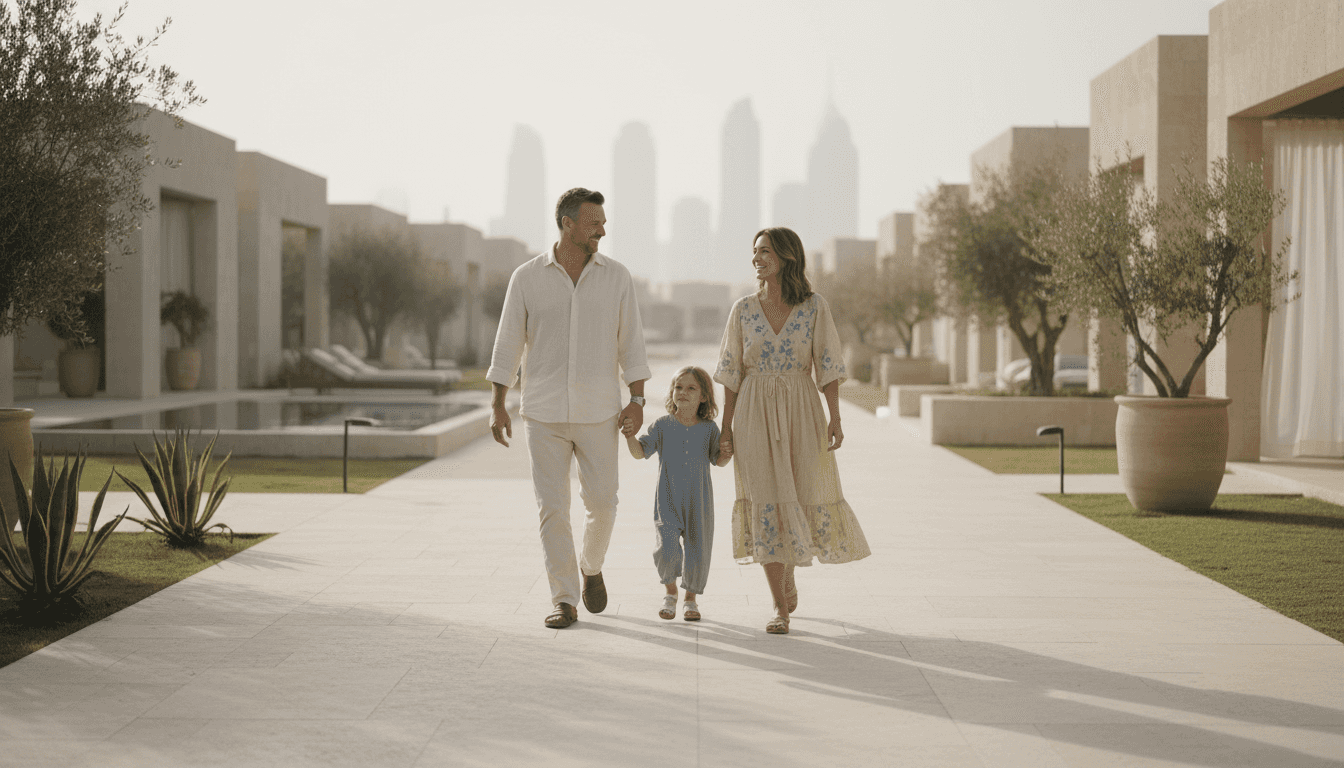
Dubai's Most Walkable Villa Communities
For families seeking a life less reliant on the car, certain Dubai villa communities are pioneering pedestrian-friendly design. We explore the best options where you can walk to schools, shops, and parks, creating a true neighbourhood feel.

The classic image of Dubai living involves a spacious villa, two cars in the driveway, and a life lived between air-conditioned boxes. For years, this was the undisputed model for family life in the suburbs. But a subtle and, in my view, wonderful shift is happening. A growing number of families are asking for something different: a life less dictated by the car. They want communities where children can safely walk to a friend's house, where a morning coffee is a stroll away, and where the park is part of the daily routine, not a weekend destination.
Here’s what we'll explore in our journey to find Dubai's most walkable communities:
- The shift in mindset: Why buyers are now prioritising pedestrian-friendly design.
- The original masterplan: A deep dive into Arabian Ranches and why it remains a benchmark.
- Connectivity as a core concept: How communities like Al Furjan are built around pathways.
- Emerging contenders: Analysing newer communities like Sobha Hartland and their approach to walkability.
- The 'walkable cluster' model: Finding pedestrian-friendly pockets within larger developments like DAMAC Hills.
- Assessing true walkability: A practical checklist for your property viewings.
- The financial implications: How walkability impacts property values and rental demand.
- My final verdict on the best community for a car-lite lifestyle.
The Changing Definition of Luxury
For a long time in Dubai, luxury was synonymous with scale and privacy. It meant a large plot, high walls, and a quiet cul-de-sac. The car was not just a convenience; it was a necessity and an integral part of the lifestyle. The idea of walking to get your groceries was almost alien. This design philosophy created pockets of beautiful homes, but they were often islands, disconnected from the very amenities that were built to serve them. You could live 500 metres from a supermarket but still have to drive, simply because there was no safe or pleasant way to walk there. This disconnect has been a long-standing frustration for many residents, myself included. We have these wonderful community centres, but their accessibility has historically been designed for vehicles first, people second.
Now, I am seeing a clear and consistent change in buyer priorities, especially among the young professional families who are putting down long-term roots here. They aren't just looking at square footage or the number of bedrooms. They are asking about the lifestyle. “Can my kids ride their bikes to the park?” “Is there a café I can walk to in the morning?” “How far is the school run on foot?” These questions, which were once secondary, are now often the primary considerations. This marks a significant evolution in the market. The new luxury is not just about the space within your four walls; it is about the quality of the space outside your gate. It's about convenience, community interaction, and promoting a healthier, more active lifestyle for the whole family.
This shift is partly driven by a global trend towards 15-minute cities and a greater emphasis on well-being. But it’s also a practical response to life in a growing metropolis. As Dubai's roads get busier, the appeal of leaving the car at home for daily errands grows stronger. Developers have taken note. Newer masterplans are increasingly incorporating concepts like shaded walkways, dedicated cycling tracks, and integrated retail and community hubs. It’s a move away from the isolated suburban model towards creating genuine, interconnected neighbourhoods. This focus on `Dubai family homes pedestrian friendly` design is no longer a niche feature but a powerful selling point that commands a premium. The demand is not just for homes; it’s for habitats.
The Blueprint: Why Arabian Ranches Still Sets the Standard
 Featured project
When you talk about `walkable villa communities Dubai`, it’s impossible not to start with Arabian Ranches. Developed by Emaar Properties, it was one of the first large-scale suburban communities to truly get the pedestrian experience right. Even today, nearly two decades after its launch, it remains the benchmark against which many others are measured. What Emaar understood early on was that a community is more than a collection of houses; it's the space between them that fosters a sense of place. The design of the original Ranches (now often called Arabian Ranches 1) wasn't just about building villas; it was about creating a neighbourhood fabric.
The genius of the Ranches masterplan lies in its simple but effective network of pathways. A central 'spine' of landscaped walkways connects the various sub-communities, parks, and pools, leading directly to the two central hubs: the Retail Centre and the Community Centre. This means that for a large portion of residents, a trip to the supermarket, a visit to the clinic, or dinner at a restaurant doesn't require a car. The paths are wide, well-lit, and beautifully landscaped, making a stroll a genuinely pleasant experience rather than a necessary chore. This thoughtful infrastructure encourages residents to be outdoors, fostering casual interactions and building a strong community spirit that is palpable when you visit.
Another key element is the integration of schools and nurseries within the community's boundaries. Jumeirah English Speaking School (JESS) is located right in the heart of the Ranches, allowing many children to walk or cycle to school — a rarity in Dubai and a massive draw for families. This feature alone transforms the daily routine, eliminating the stress of the morning car run for many. The community is also dotted with numerous parks, tennis courts, and swimming pools, all interconnected by the same network of paths. This design ensures that recreation is not a planned excursion but an easy, everyday option. It's this holistic approach, where homes, amenities, and green spaces are woven together by a pedestrian-first network, that makes Arabian Ranches a perennial favourite for those seeking a walkable lifestyle.
Of course, this quality comes at a price. Arabian Ranches is one of Dubai's most established and sought-after communities, and property values reflect that. A standard three-bedroom villa can range from AED 4 million to over AED 5.5 million, with larger, upgraded homes fetching significantly more. Service charges are also a consideration, typically running between AED 3.50 and AED 4.50 per square foot on the built-up area annually. These fees, managed by Emaar Community Management, cover the immaculate landscaping, 24/7 security, and maintenance of the extensive network of pools, parks, and pathways. In my professional opinion, while the costs are higher than in some newer suburbs, the value delivered in terms of lifestyle and community infrastructure is undeniable. For many families, it's a price worth paying for a life lived on foot.
Al Furjan: Connectivity by Design
If Arabian Ranches is the established classic, then Al Furjan, a project by Nakheel, represents a more modern and deliberate take on the same principles of connectivity. The very name 'Al Furjan' is Arabic for 'a collection of homes' or 'a small village', and the masterplan was explicitly designed to evoke this sense of a close-knit community. Located between Sheikh Zayed Road and Sheikh Mohammed Bin Zayed Road, Al Furjan's key selling point is its infrastructure, which prioritises pedestrians and cyclists. The community is structured around a series of 'Quortaj' and 'Dubai-style' villas and townhouses, all linked by an extensive network of dedicated walkways and cycle paths.
What sets Al Furjan apart is the sheer scale and integration of its pathway system. While other communities have walking paths, Al Furjan has a network that totals over 40 kilometres. These paths are not just an afterthought; they are the fundamental organizing principle of the community. They connect every home to parks, pools, and, crucially, to the two Al Furjan Pavilions. These community retail centres are the heart of the neighbourhood, hosting supermarkets, cafes, restaurants, gyms, and other essential services. The design ensures that a significant majority of residents live within a 5 to 10-minute walk of one of these hubs. This is a game-changer for daily life, making it one of the few places in Dubai where you can genuinely manage most errands without a car.
Beyond that, the community is directly served by its own metro station on the Route 2020 line. The Al Furjan metro station provides a direct link to areas like Dubai Marina, JLT, and Downtown Dubai. While the station is at the edge of the community, the internal pathway network connects to it, making a car-free commute a real possibility for residents. This is a unique advantage among Dubai villa communities and a massive plus for those looking to reduce their reliance on driving. The combination of internal walkability and external public transport connectivity makes Al Furjan a compelling option for those seeking a more sustainable and integrated urban lifestyle. It's a prime example of how thoughtful infrastructure planning can dramatically enhance quality of life.
In terms of property, Al Furjan offers a more accessible price point than Arabian Ranches. A three-bedroom townhouse might be found in the AED 2.8 million to AED 3.5 million range, while larger four-bedroom independent villas typically trade between AED 4.5 million and AED 6 million. This relative affordability, combined with its robust infrastructure, has made it incredibly popular with young families and professionals. The service charges, overseen by Nakheel, are also competitive, generally falling in the AED 3.00 to AED 4.00 per square foot range annually. When clients ask me for a community that balances family-friendly living, excellent amenities, and strong connectivity, Al Furjan is always high on my list. It delivers on its promise of being a 'village', where the `local amenities walking distance Dubai` promise is a daily reality.
The Rise of the Walkable Cluster
Not every master-planned community is uniformly walkable. In some of Dubai's vast suburban developments, the pedestrian-friendly experience is concentrated in specific clusters or sub-communities. This 'walkable cluster' model is becoming more common, and for buyers, it's crucial to understand these internal variations. A prime example is DAMAC Hills. It's an enormous community built around the Trump International Golf Club Dubai. While you certainly cannot walk from one end of DAMAC Hills to the other, certain clusters are designed to function as self-contained, walkable neighbourhoods.
Take the area around the main community centre and the 'Malibu Bay' wave pool, for instance. The villas and townhouses in clusters like Trinity, Richmond, and Rochester are within easy walking distance of the Carrefour supermarket, various restaurants, the gym, and the central park. For families living in these specific locations, the daily experience is highly pedestrian-friendly. They have `communities with pathways Dubai` style internal routes that lead directly to these core amenities. However, a resident in a cluster on the opposite side of the development, such as The Field or Queens Meadow, would face a significant walk or, more realistically, a drive to access the same facilities. This is a critical distinction I always point out to my clients. When buying in a mega-community, you are not just buying into the overall brand; you are buying into the specific micro-location of your property.
Another excellent example of this model can be found at Sobha Hartland, located in Meydan. While the community is expansive, the area along the Dubai Water Canal has been designed with a beautiful and functional promenade. The townhouses and villas in the 'Hartland Greens' and 'Waterfront' districts benefit directly from this. Residents can enjoy stunning canal-side walks, and the community is planned to include retail and dining outlets along this stretch, creating a vibrant, walkable waterfront environment. The presence of two Hartland International Schools within the development further enhances its appeal for families, with many homes being a short, safe walk from the school gates. Again, the key is the specific location within the masterplan. A villa deeper inside the community may not offer the same level of walk-to-amenity convenience.
This cluster-based approach requires a more discerning eye from buyers. It's not enough to see 'community centre' or 'park' on a masterplan. You have to map the physical distance and, more importantly, the quality of the path from your potential home to those amenities. I always advise my clients to do the walk themselves during a viewing. Is the path shaded? Is it safe for children? Does it require crossing a busy internal road? These practical details determine whether a community is truly walkable or just 'walkable on paper'. In my experience, the best clusters often command a price premium over less conveniently located properties within the same development, a premium that buyers are increasingly willing to pay for the lifestyle benefits.
A Buyer's Checklist for True Walkability
When you're on the hunt for a truly walkable villa, it’s easy to be swayed by a developer’s glossy brochure. But to understand if a community genuinely supports a pedestrian lifestyle, you need to look beyond the marketing and assess the reality on the ground. Over the years, I've developed a mental checklist that I run through with my clients during viewings. It helps cut through the noise and focus on what really matters for day-to-day living.
First and foremost is the quality and extent of the pathways. Are they just concrete sidewalks running alongside busy roads, or are they dedicated, landscaped walkways set back from traffic? Look for shade — provided by trees or architectural elements, which is non-negotiable for walking comfortably during Dubai's warmer months. A truly walkable community will have a dense, interconnected network of these paths, creating multiple routes to get from A to B. It shouldn't feel like you are following a single, prescribed line; it should feel like a network you can explore. The presence of separate, clearly marked cycling lanes is another huge plus, as it ensures the safety and comfort of both pedestrians and cyclists.
Second, analyse the 'anchor' amenities. Every truly walkable neighbourhood needs a core. This is typically a retail centre with a decent supermarket, a pharmacy, a few cafes, and perhaps a dry cleaner. My rule of thumb is the 'milk and bread test': can you comfortably walk to a shop to pick up essential groceries? If the answer is no, the community's walkability is significantly diminished. Proximity to schools and nurseries is another critical anchor for families. Map the walking route from your potential home to the school gate. Is it safe? Is it a reasonable distance for a child to walk? Finally, look at the recreational anchors: parks, playgrounds, and community pools. Are they centrally located and easily accessible on foot from most homes, or are they isolated on the periphery?
To make this more practical, here is a list of questions I encourage my clients to ask and observe during a viewing:
- Pathway Quality: Are the walkways shaded, wide enough for a stroller, and physically separated from roads?
- The 10-Minute Circle: What can you reach within a 10-minute walk? (e.g., a coffee shop, a small grocery, a park).
- Road Crossings: Are there safe, designated pedestrian crossings for any internal roads you need to traverse?
- Evening Ambience: Is the community well-lit at night? Do you feel safe walking after dark?
- Real-World Usage: Do you actually see other people walking, jogging, or cycling? A deserted pathway system is a red flag.
- Noise and Pollution: How much traffic noise and pollution do you experience on the main walking routes?
- Community Hub: Is there a clear central point — a pavilion or town square, that acts as a community focal point?
“The best-designed communities don't just give you a path to walk on; they give you a reason to walk.”
By systematically working through these points, you can build a much clearer picture of the lifestyle on offer. It's an approach that moves beyond simply looking at a map and instead focuses on the lived experience of `car-free living Dubai villas`, or at least, a life that is significantly less car-dependent.
The Financials: The Premium on Pedestrian-Friendly Living
It’s a simple market dynamic: high demand plus limited supply equals higher prices. This is precisely what we see with well-designed, walkable villa communities in Dubai. The convenience, enhanced lifestyle, and strong sense of community they offer are highly desirable features, and buyers are willing to pay a premium for them. In my experience, a villa in a genuinely walkable location can command a 10-20% price premium over a comparable property in a less connected, car-dependent community. This premium is not just a perception; it is reflected in transaction data and valuation reports.
Let's break down the purchase of a hypothetical villa in a prime walkable community like Arabian Ranches versus a newer, less-established one. A three-bedroom villa in Arabian Ranches 1 might be listed at AED 4,500,000. Here’s a simplified breakdown of the upfront costs you would face, based on Dubai Land Department (DLD) regulations:
- Purchase Price: AED 4,500,000
- DLD Transfer Fee (4%): AED 180,000
- DLD Registration Trustee Fee: ~AED 4,200 (including VAT)
- Agency Fee (2% + VAT): AED 94,500
- No Objection Certificate (NOC) Fee: ~AED 5,000 (varies by developer)
- Mortgage Registration Fee (0.25% of loan amount): ~AED 9,000 (assuming 80% LTV)
- Bank Processing & Valuation Fees: ~AED 8,000
- Total Upfront Costs: Approximately AED 299,700
This is on top of your mortgage down payment, which for a resident buying a property over AED 5 million would be at least 35% as per Central Bank of the UAE guidelines, or 20% for a first property under AED 5 million. For a non-resident, the minimum down payment is typically higher. The key here is that the higher purchase price directly scales up these associated costs, particularly the DLD transfer fee. However, the investment argument for these properties remains strong. Their desirability translates into greater resilience during market downturns and stronger capital appreciation during growth cycles. They are, in essence, a 'blue-chip' asset in the Dubai property market.
This premium extends to the rental market as well. As a landlord, owning a property in a walkable community gives you a significant competitive edge. You attract a higher quality of tenant — often long-term families, who are willing to pay more for the lifestyle benefits. Rental yields might be slightly compressed due to the higher capital cost, but occupancy rates are typically higher, and void periods are shorter. Tenants in these communities tend to stay longer, reducing turnover costs and providing a more stable income stream. When we at Gaia Living list a rental property in a prime spot in Al Furjan or Arabian Ranches, the level of interest is consistently higher than for properties in more isolated locations. The narrative of 'walking distance to the school/park/shops' is one of the most powerful marketing tools in our arsenal.
My Verdict: The Best Community for a Life on Foot
Having walked the pathways, spoken with countless residents, and analysed the transactions in all of these communities, I have developed some firm views. While each community has its merits, if I were advising a family whose absolute top priority is a walkable, car-lite lifestyle, my recommendation would consistently lean towards the original Arabian Ranches. It simply gets more things right than anywhere else. The maturity of the landscaping provides ample shade, the pathway network is intuitive and comprehensive, and the integration of a top-tier school and two well-stocked retail centres is flawlessly executed. It is the complete package. The community has a soul, built over years of family barbecues, children's laughter in the parks, and neighbours bumping into each other on their morning walks. It feels lived-in and authentic, something newer communities are still working to create.
However, it's not without its trade-offs. The villas, while charming, are of an older design, and many require some degree of renovation to meet modern tastes. The price point is also undeniably at the higher end of the market, which can be a barrier for some buyers. This is where a community like Al Furjan presents a compelling alternative. It offers perhaps 80% of the walkability of the Ranches but at a more accessible price point and with more modern properties. The connection to the Dubai Metro is a unique and powerful advantage that even the Ranches cannot offer. For a budget-conscious family or a professional who values public transport, Al Furjan is an outstanding choice and, in my opinion, represents excellent value.
For those with a bigger budget seeking modern luxury combined with walkability, the waterfront clusters at Sobha Hartland are incredibly promising. The vision of a vibrant canal-side community with retail, dining, and recreation is rapidly becoming a reality. It offers a more urban, sophisticated take on the walkable suburb, with the stunning backdrop of the Downtown skyline. It's a different flavour from the cosy, village-like feel of the Ranches, but for the right buyer, it's a perfect blend of suburban space and urban energy. Ultimately, the 'best' community is a deeply personal choice, dependent on your family's specific needs, budget, and lifestyle preferences. My advice is always to spend time in each of them. Go for a walk, have a coffee, and see which one feels like home.
For those seeking the gold standard of established, family-oriented walkability with a village-like feel, Arabian Ranches remains unmatched, though it comes at a premium. For a more modern, connected, and value-driven alternative, Al Furjan's pathway network and metro access make it a powerful contender. Your final choice will depend on balancing budget, property style, and the specific flavour of community life you are searching for.
## Sources - Dubai Land Department (DLD): dubailand.gov.ae - RERA Service Charge and Maintenance Index: dubailand.gov.ae - UAE Government Portal (Property Purchase Information): u.ae - Central Bank of the UAE (Mortgage Regulations): centralbank.ae
Questions, answered
- Which are the most walkable villa communities in Dubai for families?
- In my experience, Arabian Ranches, Al Furjan, and some clusters in DAMAC Hills and Sobha Hartland are among the most walkable. They are designed with extensive pathways, community centres, and schools that are often accessible on foot, which is a key feature for Dubai family homes pedestrian friendly design.
- Is true car-free living possible in a Dubai villa?
- While completely car-free living is challenging in Dubai, these communities make it possible to handle daily errands like school runs, grocery shopping, and park visits without a car. For commuting to major business hubs, a car or ride-hailing service is still typically necessary.
- Are walkable communities more expensive?
- Yes, there is often a price premium for well-designed, walkable communities with integrated amenities. The convenience, lifestyle benefits, and strong sense of community they offer create high demand, which supports higher property values and rental yields.
- What should I look for when assessing a community's walkability?
- Look for a dense network of shaded pathways separate from roads, well-maintained landscaping, and the proximity of a retail centre, school, and park. I always recommend visiting at different times of the day to see how residents actually use the outdoor spaces.
- How do service charges in walkable communities compare to others?
- Service charges can be slightly higher to cover the maintenance of extensive parks, pathways, and community facilities. However, the value is often clear in the quality of life and the consistently high demand for these properties. Always verify the RERA Service Charge Index for a specific building or cluster.
- Can I get a mortgage for a villa in a pedestrian-friendly community?
- Yes, absolutely. All the communities discussed are in freehold areas where banks offer mortgages to eligible residents and non-resident buyers. You will typically need a down payment of at least 20% for residents or 25% for non-residents, plus associated purchase costs like the 4% DLD fee.

Sophia profiles Dubai's villa communities — schools, commute times, green space, and the intangible feel of a neighbourhood. She writes for families putting down roots.
Related stories
Established vs. New Launch: Where Is Dubai's Enduring Value?
The Dubai property market presents a constant choice between the allure of new launches and the stability of established communities. I'll break down where true long-term value is found for investors and end-users.
Desert's Edge Serenity: Space and Calm in Dubai
The new definition of Dubai luxury isn't a penthouse view, but the space, quiet, and privacy found in its tranquil desert-edge communities. I'll explore where to find this serenity and what it truly costs.
Dubai's Private Pool Apartments: The Ultimate Guide
A deep dive into apartments with private plunge pools and jacuzzis in Dubai, covering the best buildings, real costs, hidden fees, and the critical questions you must ask before buying.
Echoes, in your inbox
One thoughtful email a month. Market insight, new launches, no spam.