

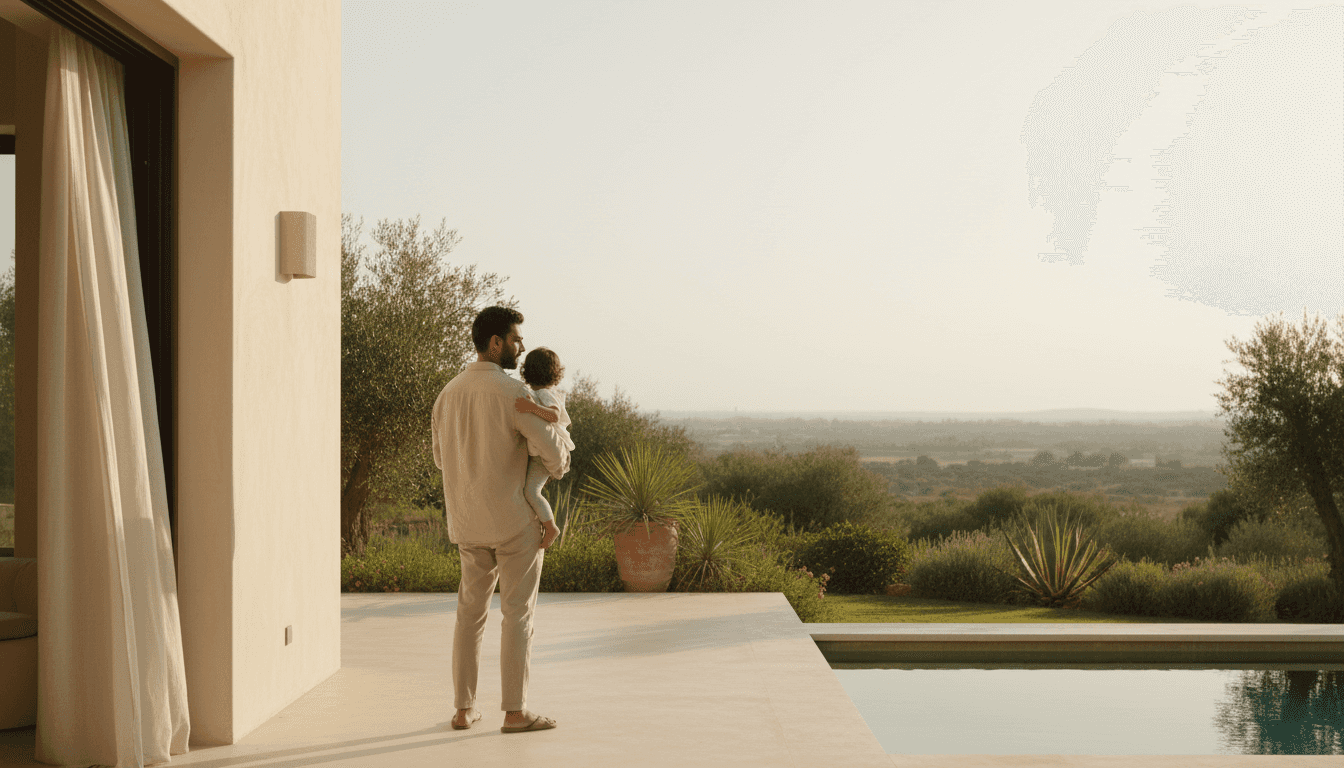
Desert's Edge Serenity: Space and Calm in Dubai
The new definition of Dubai luxury isn't a penthouse view, but the space, quiet, and privacy found in its tranquil desert-edge communities. I'll explore where to find this serenity and what it truly costs.

The new definition of Dubai luxury isn't a penthouse view, but the space, quiet, and privacy found in its tranquil desert-edge communities. I'll explore where to find this serenity and what it truly costs.
Here's what we will explore:
- The great re-evaluation of luxury, where space trumps density.
- A deep dive into three iconic communities: Arabian Ranches, Al Barari, and Damac Hills II.
- The lifestyle verdict: what you gain and what you give up.
- A complete, line-by-line cost breakdown of buying on the fringe.
- Future-proofing your investment in the desert.
The Great Re-Evaluation: Why 'Luxury' Now Means Space
For years, the postcard image of Dubai living was a glittering high-rise, a balcony suspended over the hypnotic lights of the marina or the choreographed dance of the fountains. I've sold countless apartments in Dubai Marina and Business Bay, and the appeal is undeniable. It's a life of convenience, of being steps away from a world-class restaurant, a life plugged directly into the city's vibrant, 24/7 energy. But over the past few years, I've witnessed a profound shift in the conversations I have with clients. The definition of 'the good life' is changing. The ultimate luxury, for a growing number of discerning buyers, is no longer vertical density but horizontal expanse. It’s the sound of birds, not traffic. It's a private garden for the children to play in, not a shared elevator. It’s about finding a genuine nature retreat Dubai can offer, right at your doorstep.
This isn’t just a feeling; it's a market trend we at Gaia Living see playing out daily. The global pandemic accelerated a desire for personal space, a home office that isn't a corner of the dining table, and a connection to nature. In Dubai, this translated into a surge of interest in established villa communities and the new generation of Dubai desert homes that masterfully blend modern living with the stark beauty of the surrounding landscape. People are re-evaluating their priorities. Is a 15-minute commute to the office worth sacrificing the chance to watch the sunset over the dunes from your own backyard? For many, the answer is a resounding no. They are seeking peaceful living Dubai style, which increasingly means looking beyond the city's traditional core.
This re-evaluation is also driven by value. While prime apartment prices have soared, the price-per-square-foot for a villa on the city's edge often presents a far more compelling equation. You simply get more for your money: more indoor living area, private outdoor space, and access to community amenities like parks, lakes, and golf courses that high-rise living cannot replicate. The developers have responded. What were once sandy peripheries are now meticulously planned, self-contained towns. Master developers like Emaar Properties and Damac have perfected the art of creating quiet communities Dubai residents aspire to, complete with excellent schools, retail centres, and clinics. The 'outskirts' are no longer a compromise; for many, they are the goal.
Deep Dive: Three Tiers of Desert Serenity
 Featured project
When clients ask me for spacious homes Dubai has to offer, I tell them to think not of a single area, but of a spectrum of lifestyles. The 'desert's edge' isn't a monolith. It’s a collection of unique communities, each with its own character, price point, and promise. To illustrate this, let's look at three archetypes: the established classic, the ultra-luxury oasis, and the accessible frontier. They represent different entry points and philosophies but are all united by the pursuit of space and tranquillity away from the urban core.
First, we have the benchmark: Arabian Ranches. Developed by Emaar, this is the original blueprint for premium desert community living. When it launched, it felt a world away. Today, it’s a mature, deeply rooted community with a palpable sense of neighbourhood. It’s the sound of children riding bikes on manicured streets, the weekend buzz at the community centre, the familiar faces at the golf club. The architecture is consistent — inspired by Arabian and Mediterranean aesthetics, and the landscaping is lush and established. For many families, Arabian Ranches is the epitome of the Dubai dream, offering a stable, secure, and green environment. We’ll look at the different phases and what the cost of entry looks like for this gold-standard community.
At the very top of the spectrum lies Al Barari. The name itself means 'the wilderness' in Arabic, and it’s a promise the community delivers on. This is less a housing development and more a botanical-themed private reserve. With a staggering percentage of its land dedicated to landscaped gardens, freshwater lakes, and winding streams, Al Barari feels like a different country, let alone a different part of Dubai. It’s a true nature retreat Dubai residents can live in. The focus here is on privacy, wellness, and seclusion. The villas are architectural marvels, often custom-built, set on vast plots. It’s a community for those for whom budget is a secondary concern to achieving an unparalleled lifestyle of green, private luxury. The cost is significant, but for its residents, the value is in the unique environment that cannot be found anywhere else in the city.
Finally, let's consider the new frontier: communities like Damac Hills II. Situated further out, these developments represent the evolution of the desert community concept, applying the lessons learned from earlier projects but at a more accessible price point. The value proposition here is powerful: the opportunity to own a spacious, brand-new villa or townhouse for what a smaller, older property might cost closer to the city. These communities are designed as self-sufficient 'cities-within-a-city', often themed around unique concepts — water parks, sports hubs, equestrian centres, to create a strong lifestyle draw. They are a bet on the future expansion of Dubai, attracting younger families and first-time villa buyers looking for outskirt villas Dubai offers with long-term growth potential.
The Lifestyle Verdict: Gains and Trade-Offs
Moving to a desert-edge community is a conscious lifestyle choice, and it comes with a distinct set of gains and trade-offs. I always advise my clients to be brutally honest with themselves about their daily routines, their tolerance for driving, and what they truly value. The biggest gain, without question, is space. This isn't just about a larger floor plan. It's about mental space. It's the quiet that descends in the evening, the unpolluted view of the stars, the ability to open your doors to a private garden. It's a lower-stress environment for raising children, where the 'outdoors' is safe, accessible, and part of daily life. Communities like these are designed for families, with playgrounds, parks, and pools forming the social heart of the neighbourhood. You're not just buying a house; you're buying into a community fabric that is often harder to find in the transient, anonymous corridors of a high-rise.
“The real luxury isn't the marble in the lobby; it's the silence in your garden at 10 PM. That's the commodity you're buying on Dubai's fringe.”
The second major gain is wellness. Many of these communities are built to encourage an active lifestyle. Think of the running and cycling tracks in Arabian Ranches, the world-class golf courses at Damac Hills, or the sheer immersive nature of Al Barari. This focus on health and well-being is a core part of the product. You're more likely to go for an evening walk when you have beautiful, safe paths to explore. Your children are more likely to be active when a park or a sports court is a short walk away. This contrasts sharply with the often-sedentary nature of apartment living, where getting to a gym or a park requires a deliberate, and often traffic-filled, journey.
Of course, there are trade-offs. The most obvious is the commute. While Dubai's road network is superb, living in an area like Damac Hills II means accepting a 30-40 minute drive to major business hubs like DIFC or Downtown. This requires a significant adjustment for those accustomed to a 10-minute taxi ride. You become more reliant on your car for everything, from the school run to grocery shopping. While community retail centres are excellent, your options for spontaneous, high-end dining or entertainment are more limited than in the city centre. It's a planned life versus an spontaneous one. You might spend Saturday evening enjoying a barbecue in your garden rather than trying the latest restaurant in Jumeirah. For many, this is a welcome change, but it’s a critical factor to consider.
The True Cost: A Line-by-Line Breakdown
Talking about 'spacious' and 'peaceful' is one thing, but the decision to buy always comes down to numbers. To make this tangible, let's walk through a realistic, line-by-line cost breakdown for purchasing a resale villa in one of these communities. It's crucial to look beyond the headline purchase price to understand the total capital required. Let's use a hypothetical but typical four-bedroom villa in a community like Arabian Ranches or Damac Hills as our example.
Example Purchase: Four-Bedroom Resale Villa - Agreed Purchase Price: AED 5,000,000
This is the number everyone focuses on, but it's just the starting point. Here are the other costs you must budget for, mandated by Dubai regulations.
- Mortgage Down Payment (20% for expatriates): AED 1,000,000
- As a non-UAE national buying a property over AED 5M, the Central Bank of the UAE mandates a minimum down payment. For your first property, it's 20% of the purchase price. This is the single largest upfront cost and must be in cash.
- Dubai Land Department (DLD) Transfer Fee (4%): AED 200,000
- This is a non-negotiable government fee, calculated as 4% of the property's purchase price. You can find the official fee structure on the Dubai Land Department (DLD) website. It's typically split between buyer and seller, but it is common for the buyer to cover the full amount.
- DLD Administrative Fees: Approx. AED 4,200
- These are fixed fees for the administrative processing of the title deed transfer.
- Real Estate Agency Fee (2%): AED 100,000 (+ 5% VAT)
- The standard brokerage commission in Dubai is 2% of the purchase price. This is our fee at Gaia Living for sourcing the property, negotiating the deal, and managing the entire transfer process. A 5% Value Added Tax (VAT) is applicable on the fee itself, adding AED 5,000.
- Mortgage Arrangement Fee (up to 1%): AED 40,000
- If you are taking a mortgage (for the remaining 80% or AED 4,000,000 in this case), the bank will charge a processing fee, which can be up to 1% of the loan amount.
- Mortgage Registration Fee (0.25% of loan): AED 10,000
- The DLD requires you to register the mortgage against the title deed, and this fee is 0.25% of the total loan value, plus a small fixed fee.
- Property Valuation Fee: Approx. AED 3,000
- The bank will require an independent valuation of the property to confirm its worth before approving the loan. This is a fee paid by the buyer.
- Trustee Office Fee: Approx. AED 4,000
- This fee is for the services of a RERA-approved Trustee Office that handles the secure transfer of funds and title deeds.
Total Upfront Cash Required: Adding it all up, the cash you need on hand to complete this purchase is not AED 5,000,000. It is:
- Down Payment: AED 1,000,000
- DLD Transfer Fee: AED 200,000
- Agency Fee (+VAT): AED 105,000
- Bank & Admin Fees: ~AED 57,200
- Total Initial Outlay: Approximately AED 1,362,200
This calculation is an eye-opener for many first-time villa buyers. It demonstrates that you need roughly 27-28% of the purchase price in liquid cash to close the deal. And this is before factoring in moving costs, any initial furnishing, or the first year's service charges, which for a villa of this size could range from AED 20,000 to AED 30,000 annually, depending on the community.
Future-Proofing Your Desert Home
Investing in an outskirt community is, in many ways, an investment in Dubai's future growth. As the city expands, today's 'fringe' becomes tomorrow's established suburb. We saw this happen with the first villa communities from the early 2000s. However, not all peripheral communities are created equal. To future-proof your purchase, both as a home and as a financial asset, there are several key factors I urge my clients to consider.
First, scrutinise the master developer. A developer's track record is the single most important predictor of a community's long-term success. Look for established names like Emaar, Nakheel, or Meraas. These companies have a history of not just building properties but of creating and managing entire ecosystems. They deliver on promised amenities, maintain the public realms to a high standard, and manage the community effectively over the long term. A well-run community with high-quality landscaping, clean common areas, and responsive management will hold its value far better than one where the developer cut corners and moved on.
Second, look at the planned infrastructure. Is the community located near a future metro line extension? Are there new road networks planned that will improve commute times? The Dubai 2040 Urban Master Plan is an essential document to study. It outlines the city's long-term vision for development, focusing on sustainability and creating integrated communities. Properties located within or near the plan's key development corridors are more likely to see sustained demand and value appreciation. The expansion of Al Maktoum International Airport and the growth of the logistics and exhibition hubs around Expo City make the entire Dubai South corridor a strategic area to watch.
Third, consider the community's 'moat' — its unique selling proposition. Is it built around a world-class golf course? Does it have a unique theme, like the water features of DAMAC Lagoons or the dense forestry of Al Barari? A community with a strong, defensible identity is less susceptible to market fluctuations. It creates a stickiness that keeps residents there and attracts new buyers who want that specific lifestyle. A generic villa in a non-descript development has to compete purely on price. A home in a community with a soul competes on lifestyle, and that's a much stronger position to be in. When we advise clients at Gaia Living, we look for these qualitative factors just as closely as we analyse the quantitative data.
The wisest investments on Dubai's desert edge are not just in bricks and mortar, but in the reputation of the developer, the forward-thinking of the city's master plan, and the unique lifestyle proposition the community offers.
My Verdict
After years of walking clients through every conceivable type of property in this city, from penthouses on Palm Jumeirah to lofts in DIFC, my perspective on these desert-edge communities has crystallised. They are not a compromise. They are a destination. For a certain type of buyer — increasingly, the majority of families and long-term residents, they represent the most logical and desirable form of living in Dubai.
The city's genius lies in its ability to reinvent itself, and the rise of these quiet communities Dubai offers is a sign of that. It's a maturing of the market, a recognition that after the hustle, people want a place of refuge. The trade-off of a longer commute is, for many, more than compensated for by the gift of space, quiet, and a tangible connection to nature. The key is to go in with your eyes open, understanding both the lifestyle you are embracing and the full financial commitment it entails.
My advice is simple. First, spend time in these communities. Don't just look at a floor plan. Drive there on a weekday evening to experience the commute. Visit on a Saturday morning to feel the community's atmosphere. Sit in a café at the local retail centre and observe the residents. Does this feel like your tribe? Second, do the math. Use the breakdown above as a template and run your own numbers. Be conservative. A home should be a source of peace, not financial strain. Finally, work with a professional who understands the nuances of each community, not just the sales pitch. At Gaia Living, we pride ourselves on giving this kind of grounded, honest advice. The desert's edge offers a serene and spacious version of the Dubai dream, and for the right person, it's the most rewarding investment you can make in your quality of life.
## Sources - Dubai Land Department (DLD): https://dubailand.gov.ae/ - Central Bank of the UAE (CBUAE): https://www.centralbank.ae/ - UAE Government Portal (The 2040 Urban Master Plan): https://u.ae/
Questions, answered
- What are the most peaceful communities in Dubai?
- For genuine peace and quiet, communities like Al Barari, Arabian Ranches, and the newer phases of Damac Hills II offer a retreat from the city's bustle. They are designed with extensive green spaces, lower density, and a focus on a serene, family-oriented lifestyle.
- Is it cheaper to live on the outskirts of Dubai?
- Generally, your money buys you significantly more space in Dubai's outskirt communities compared to prime central areas like Downtown or Dubai Marina. While a large villa on the edge might cost the same as a smaller apartment in the centre, the price per square foot for property is substantially lower.
- What are the downsides of living in Dubai's desert communities?
- The main trade-offs are longer commute times to business hubs, a greater reliance on cars as public transport is less extensive, and potentially fewer immediate dining and entertainment options compared to dense urban areas. However, these communities are increasingly self-sufficient with their own retail centres and amenities.
- Are Dubai's outskirt communities a good investment?
- They can be excellent long-term investments, particularly for end-users seeking a better quality of life. These areas often see strong capital appreciation as the city expands and infrastructure develops around them. However, as with any investment, it's crucial to research specific sub-communities and developer track records.

Yusuf writes about how Dubai actually lives — waterfront mornings, community dining, walkability, and the lifestyle premium built into an address.
Related stories
Established vs. New Launch: Where Is Dubai's Enduring Value?
The Dubai property market presents a constant choice between the allure of new launches and the stability of established communities. I'll break down where true long-term value is found for investors and end-users.
Dubai's Most Walkable Villa Communities
For families seeking a life less reliant on the car, certain Dubai villa communities are pioneering pedestrian-friendly design. We explore the best options where you can walk to schools, shops, and parks, creating a true neighbourhood feel.
Dubai's Private Pool Apartments: The Ultimate Guide
A deep dive into apartments with private plunge pools and jacuzzis in Dubai, covering the best buildings, real costs, hidden fees, and the critical questions you must ask before buying.
Echoes, in your inbox
One thoughtful email a month. Market insight, new launches, no spam.