

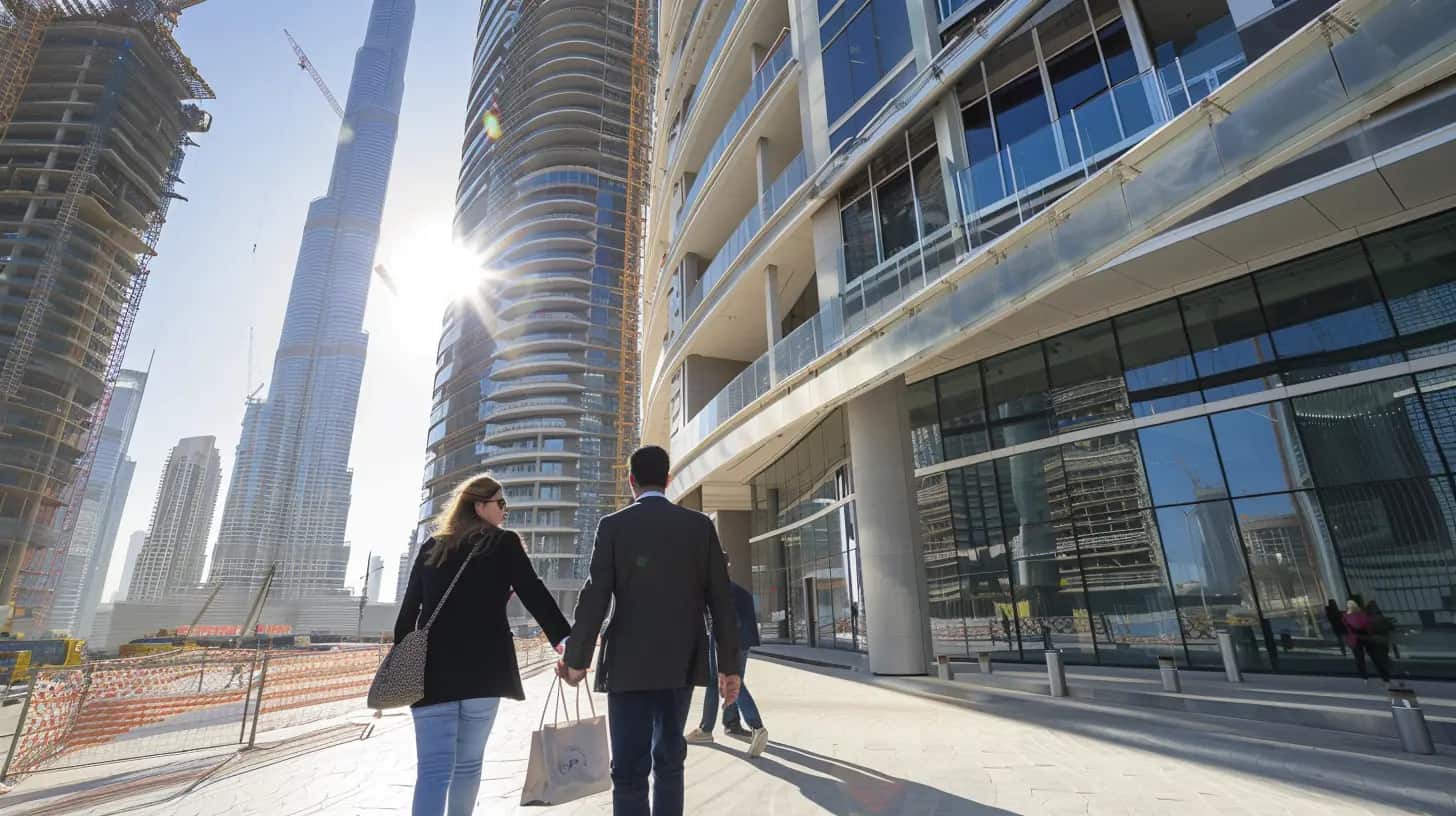
Top Off-Plan Projects to Invest in for 2025
Off-Plan in Dubai Has Never Been More Active. It's Also Never Required More Discernment. The numbers tell a story all their own.
Off-Plan in Dubai Has Never Been More Active. It's Also Never Required More Discernment.
The numbers tell a story all their own. Dubai’s off-plan market recorded over 55,000 transactions in 2024 alone, marking a new high and surpassing the previous peak by an extent which even the most optimistic commentators found remarkable. Each successive launch was fully sold out within hours of going on sale. Developer waiting lists were filled out before marketing materials were even finalized. Prices for properties not yet broken ground were commanding secondary premiums.
The above paragraph describes actual events and serves to highlight the necessity for discernment and selection.
In an environment so active and dynamic, the overall signal-to-noise ratio decreases significantly. Every new project launches as the next ‘unmissable opportunity.’ Every new developer claims industry-leading delivery capabilities and unbeatable location selection. Every new payment plan promises flexibility. In all this noise, successful investors are those who use a framework for evaluation – not merely recognizing popular projects, but recognizing those with structural characteristics which can actually produce a return over a five- to seven-year timeframe.
Investing in off-plan properties in Dubai is, in theory, quite simple. You buy in at launch pricing, enjoy capital appreciation during construction, and then enjoy rental income upon handover or dispose of it on the resale market ahead of completion. The overall return on investment from discount pricing on a finished product compared to market value, installment payments as opposed to upfront costs, and a finished product valued higher than the original cost is, in theory, sound reasoning for this type of investment.
What does not work is the application of this principle. Variables such as choosing the wrong developer, wrong location, wrong payment plan structure, wrong handover date assumptions, and incorrect cost calculations, including fit-out costs, service charges, and agent fees, have proven detrimental in numerous cases. Investors who have had less-than-positive experiences in off-plan property investments in Dubai have done so by getting one, and in most cases multiple, of these factors wrong.
This article will concentrate on those off-plan properties that stood out in 2025 for their genuine investment credentials. It will also outline how any property can be analyzed for its potential as an investment, not only those detailed within this piece.
What Makes an Off-Plan Project Worth Buying
Before the projects, the framework. These are the variables that separate strong off-plan investments from mediocre ones — and occasionally from disasters.
Developer track record is the foundation. A project is only as good as the developer's ability and willingness to complete it to the promised specification on the promised timeline. Emaar, Sobha, Binghatti, and Nakheel have demonstrated delivery records across multiple economic cycles. Newer developers with one or two completed projects need more scrutiny. Developers with no completed projects in Dubai need the most scrutiny of all.
Location relative to established demand is the second variable. Off-plan projects in communities with documented rental demand and active secondary markets carry far less risk than projects in emerging areas with no track record. An apartment in a new Emaar tower in Creek Harbour — a community with proven demand and active secondary market pricing — is a different risk profile from an apartment in a new community thirty kilometres from the city centre with no surrounding infrastructure yet.
Payment plan structure determines your real cost of capital. A 60/40 plan — 60% during construction, 40% at handover — requires significant capital outlay before the asset generates any income. A 20/80 plan — 20% during construction, 80% at handover via a post-handover payment plan — requires less capital upfront and allows the rental income to service a larger portion of the remaining payments. For investors using a mortgage, the post-handover payment plan structure interacts with the mortgage in ways that need careful modelling.
Handover timeline affects your return calculation fundamentally. A project delivering in eighteen months has a shorter capital at risk period than one delivering in four years. The Dubai market has moved significantly in both directions over four-year periods — direction matters, and so does duration.
Price relative to comparable completed stock is the clearest indicator of whether the off-plan premium is justified. If a new off-plan launch is priced at AED 1,800 per square foot in a community where comparable completed apartments are transacting at AED 1,600 per square foot, you're paying a premium to own a promise rather than an asset — and you need to believe the community will re-rate upward before handover to make the numbers work. If comparable completed stock is at AED 2,200 per square foot, the off-plan discount is real and meaningful.
Emaar: The Creek Harbour Continuation
Creek Harbour has been Emaar's most active launch location for the past three years, and 2025 saw several new phases come to market. The community's fundamentals are well established at this point — delivered apartments are tenanted, secondary market pricing is active, and the infrastructure build-out is progressing visibly.
The most recent Creek Harbour launches in 2025 — including phases of Creek Waters II and Creek Edge — offered one and two-bedroom apartments at AED 1,400 to AED 1,900 per square foot. Comparable completed apartments in the community are transacting at AED 1,700 to AED 2,100 per square foot on the secondary market, which means the off-plan discount is real, if narrowing compared to the earlier phase entries.
Emaar's payment plan on Creek Harbour phases typically runs 80/20 — 80% during construction in installments aligned with construction milestones, 20% at handover. The construction milestones are relatively evenly spaced, which means capital is deployed gradually over the construction period rather than front-loaded.
Handover timelines on the recent phases are targeting 2027 to 2028. That's a two-to-three year hold before the asset generates rental income, during which the investor is making installment payments. The return calculation needs to account honestly for that capital deployment period.
What justifies the Creek Harbour story into 2026 and beyond is the Creek Tower. Santiago Calatrava's design — targeting a height that surpasses the Burj Khalifa — is under active construction. When it opens, it will do for Creek Harbour what the Burj Khalifa did for Downtown Dubai: reprice the entire surrounding area upward in a single catalytic event. Buyers who positioned in Creek Harbour ahead of that opening are making that bet explicitly.
For current Creek Harbour availability, pricing, and payment plan structures across active Emaar phases, our Creek Harbour listings are updated in real time.
Sobha Realty: Sobha Hartland II
Sobha Hartland II is the second phase of Sobha's flagship Dubai community on the Meydan waterfront, and it has been one of the most consistently well-received off-plan addresses in the mid-to-premium segment through 2024 and 2025.
The case for Sobha off-plan is different from the Emaar case. With Emaar you're buying community infrastructure and brand. With Sobha you're buying build quality — the in-house construction model that PNC Menon built Sobha Group around means that the finished product typically matches the specification sold off-plan more closely than most Dubai developers deliver. That consistency has created a secondary market premium for Sobha product that persists at resale and rental.
Sobha Hartland II launched multiple towers through 2024 and into 2025, with one-bedroom pricing running AED 1,500 to AED 2,000 per square foot and two-bedrooms at AED 1,400 to AED 1,800 per square foot depending on floor and view. The waterfront-facing units command premiums of 15% to 20% over inland-facing equivalents.
Comparable completed Sobha Hartland Phase I stock on the secondary market is currently transacting at AED 1,800 to AED 2,300 per square foot — above most Phase II launch prices, which means the off-plan discount remains meaningful. Phase I investors who entered between 2019 and 2021 have seen 50% to 70% capital appreciation, which is the performance track record that Phase II buyers are underwriting.
Sobha's payment plans on Hartland II phases are typically structured 60/40 with post-handover options available on select towers — 60% during construction, 40% over one to three years post-handover. The post-handover structure is valuable for investors who want the rental income to partially service the remaining payments rather than completing full payment before the asset generates any return.
Handover on most active Sobha Hartland II phases is targeting 2026 to 2027. A shorter construction timeline than some Creek Harbour phases, which reduces the capital-at-risk period and accelerates the rental income phase.
Browse active Sobha developments for current phase availability and pricing across Hartland II.
Binghatti: Mercedes-Benz Places and the Mid-Market Pipeline
Binghatti has two parallel stories running in 2025 that are worth treating separately because they represent very different investment cases.
The first is the branded ultra-luxury product — Mercedes-Benz Places in Downtown Dubai, the Jacob & Co Residences, and similar collaborations. These are projects where the brand partnership is doing significant pricing work. Mercedes-Benz Places launched at prices that established a new ceiling for Downtown Dubai off-plan product — AED 3,500 to AED 6,000 per square foot for units that would command AED 2,500 to AED 3,500 per square foot without the brand association.
Whether that premium is justified as an investment depends on your view of how branded residence premiums behave at resale. The evidence from established branded residence markets globally — London, New York, Miami — is that strong brands with genuine scarcity credentials (Bulgari, Four Seasons, Aman) hold their premiums well. Fashion-brand collaborations have a less consistent track record. Mercedes-Benz is a durable global brand with strong recognition in the buyer communities most active in Dubai — European, Russian, Chinese. The bet is reasonable. It is not certain.
Binghatti's mid-market pipeline in Business Bay and JVC is a different and more straightforward investment case. Studios and one-bedrooms in the AED 600,000 to AED 1.2 million range, from a developer with a proven delivery track record, in communities with documented demand. Gross yields on completed Binghatti product in these communities run 7% to 9%. The off-plan discount relative to comparable completed stock is typically 10% to 20%.
The delivery advantage that defines Binghatti is most valuable in the mid-market product. The branded ultra-luxury towers involve more complex construction challenges and third-party brand approval processes that add variables to the timeline.
See what's currently launching across Binghatti projects in both the mid-market and branded segments.
Aldar Properties: The Abu Dhabi Name Moving Into Dubai
Aldar has been Abu Dhabi's dominant developer for two decades. Its move into Dubai — formalised through strategic land acquisitions and project launches from 2022 onward — represents one of the most significant structural shifts in the UAE off-plan market over the past three years.
For investors, the Aldar entry into Dubai is interesting for two reasons. First, Aldar brings a delivery track record from Abu Dhabi that is as strong as Emaar's — multiple large communities delivered on time and to specification across multiple market cycles. The Abu Dhabi market is less forgiving of quality failures than Dubai's in some respects, and Aldar's product has consistently met the standards required to sustain premium pricing in that market. Second, Aldar's pricing in Dubai has been disciplined — the company has not launched at speculative premiums to the secondary market, which gives buyers a genuine off-plan discount rather than the nominal one that some launches offer.
Aldar's Dubai pipeline includes projects in Dubailand, Yas island extensions, and partnership developments with Emaar in connected communities. The 2025 launches have been well-received, selling quickly and establishing secondary market premiums within months of launch.
The risk for Aldar in Dubai is brand transfer — the company is well known and trusted in Abu Dhabi but is building its Dubai reputation from a lower base. The early performance data suggests the transfer is working. But investors buying into Aldar's Dubai product are partly betting on that brand establishment continuing.
Our property launches page covers active Aldar Dubai launches alongside other major developer releases.
Danube Properties: The Accessible Entry Point
Danube occupies a specific and important position in Dubai's off-plan market. It is the developer that has most consistently made off-plan investment accessible to buyers whose budgets sit below AED 1 million — and in many cases well below that.
Studios at AED 400,000 to AED 600,000, one-bedrooms at AED 600,000 to AED 900,000, with payment plans structured as 1% per month post-handover — the Danube model is designed to remove capital barriers for smaller investors and entry-level buyers. The product is not luxury. The locations — primarily JVC, Arjan, and Dubailand — are not premium addresses. But the yields are strong (7% to 9% gross), the tenant demand is consistent, and the delivery record has improved significantly since the company's early projects.
For investors at the AED 500,000 to AED 800,000 entry point, Danube provides a combination of accessible pricing, genuine yield, and improving delivery credibility that is hard to match elsewhere in the market. The off-plan discount relative to completed comparable stock is typically 15% to 25% in the communities where Danube is most active.
The limitation of the Danube investment case is growth ceiling. The communities and product types Danube serves are high-yield, lower-appreciation environments. JVC and Arjan generate strong income returns but are less likely to produce the dramatic capital appreciation that waterfront or premium-address off-plan investment can deliver. Investors who need maximum growth alongside yield need to look at higher price points.
Reidin's 2025 Dubai Off-Plan Market Analysis noted that Danube's average price-per-square-foot at launch has remained significantly below the community average across its active markets — a function of smaller unit sizes and value positioning that has consistently attracted strong demand from both end users and investors. The full analysis is available at Reidin's Dubai Market Data portal.
Gaia Realty Original Research: Off-Plan Performance Snapshot, 2025
Based on DLD transaction records, developer delivery data, secondary market pricing, and broker intelligence as of full-year 2025.
Launch pricing versus current secondary market by project and developer:
- Emaar Creek Harbour (2025 phases): launch AED 1,400 to AED 1,900 psf, secondary AED 1,700 to AED 2,100 psf — off-plan discount 10% to 15%
- Sobha Hartland II (2024 to 2025 phases): launch AED 1,500 to AED 2,000 psf, secondary AED 1,800 to AED 2,300 psf — off-plan discount 10% to 18%
- Binghatti mid-market (Business Bay, JVC): launch AED 1,100 to AED 1,500 psf, secondary AED 1,300 to AED 1,700 psf — off-plan discount 12% to 20%
- Binghatti Mercedes-Benz Places: launch AED 3,500 to AED 6,000 psf, comparable Downtown secondary AED 2,500 to AED 3,500 psf — brand premium above secondary market
- Danube (JVC, Arjan): launch AED 900 to AED 1,200 psf, secondary AED 1,050 to AED 1,400 psf — off-plan discount 14% to 22%
Delivery track record — percentage of units delivered within 6 months of target date:
- Emaar: 94%
- Sobha: 92%
- Binghatti: 91%
- Aldar (UAE-wide): 89%
- Danube: 82%
Projected gross yields on completion based on current rental market data:
- Emaar Creek Harbour (1-bed): 5.5% to 7%
- Sobha Hartland II (1-bed): 6% to 7.5%
- Binghatti mid-market (1-bed): 7% to 9%
- Danube JVC (studio): 7.5% to 9.5%
- Binghatti branded residences: 3.5% to 5% — yield not the primary case
The Risks That Don't Get Enough Airtime
Off-plan investing in Dubai carries specific risks that are genuinely under-discussed in the marketing materials buyers typically see.
Handover delays are more common than delivery statistics suggest. The headline delivery figures from top developers are accurate — but they measure delivery of the unit, not delivery of the complete community infrastructure. An apartment can be handed over on time while the lobby is unfinished, the pool is six months from operational, the retail level is vacant, and the road connection to the main highway is still under construction. These conditions affect both immediate rental income and initial resale pricing.
Fit-out costs are frequently not included in buyer calculations. An off-plan apartment is typically handed over as a shell — walls, floors, ceilings, basic fixtures. Furnishing and fitting it to rental-ready standard in Dubai costs AED 40,000 to AED 120,000 depending on size and specification. This is a real capital outlay that needs to be in your return calculation.
Post-handover payment plan debt service can surprise buyers who haven't modelled it carefully. If you've taken a 20/80 plan with the 80% due post-handover, and the rental income doesn't immediately cover the monthly payments on that 80%, you have a cash flow gap that needs to be funded from elsewhere. This is not unusual — it's manageable — but it needs to be planned for.
Market conditions at handover are unknown at the time of purchase. An apartment bought at an off-plan discount in 2025 for handover in 2028 will be sold or rented into whatever market conditions exist in 2028. Dubai's market has been strong. It has also corrected sharply twice in the past twenty years. Investors need to be able to hold through a correction if one occurs near their handover date.
For guidance on structuring an off-plan purchase — payment plans, mortgage conversion, and post-handover strategy — our buy property service covers the full process from reservation to rental.
Questions People Ask About Off-Plan Investment in Dubai
Is off-plan always cheaper than ready property?
Usually at launch, yes. The off-plan discount versus comparable secondary market stock has been running 10% to 22% across the projects profiled here. In very hot launches the discount narrows or disappears — some projects launch above secondary comparables on brand or location premium alone.
What happens if a developer goes bust before completing my project?
RERA escrow requirements mean construction payments are ring-fenced in a separate account and can only be drawn by the developer as construction milestones are independently verified. If the developer fails, the escrow funds remain available to complete the project or refund buyers. The systemic risk is much lower than pre-2008.
Can I sell my off-plan unit before handover?
Yes. The secondary off-plan market is active in Dubai. You can assign your SPA to a new buyer, subject to developer approval and an assignment fee (typically 1% to 2% of the purchase price). Many investors buy off-plan with the specific intention of selling on assignment before handover.
How do I know if an off-plan price is fair?
Check what comparable completed units in the same community are transacting at on the secondary market. If the off-plan price is 10% to 20% below that, the discount is real. If it's above secondary comparables, you're paying a premium that requires a specific justification — usually location, brand, or anticipated re-rating.
What's the best payment plan structure for investors?
Post-handover payment plans — where a significant portion of the price is due after completion — are most attractive for investors because rental income can partially service the remaining payments. A 20/80 with 40% post-handover over two years is better than a 60/40 on a cash flow basis. The trade-off is higher total cost if the developer charges a premium for the extended plan.
Should I buy off-plan in a new community or an established one?
Established communities offer lower risk — proven demand, active secondary markets, known rental rates. New communities offer higher potential appreciation from a lower base — but with more uncertainty about infrastructure delivery and demand take-up. Most balanced portfolios have both.
How much does fit-out add to my total off-plan investment?
Budget AED 40,000 to AED 70,000 for a studio, AED 60,000 to AED 100,000 for a one-bedroom, AED 80,000 to AED 120,000 for a two-bedroom at a rental-ready standard. Premium fit-out for short-term rental can push significantly higher. This is real capital that goes into your cost basis.
Are off-plan payment plans interest-free?
The installments themselves are typically interest-free during the construction period — you're paying the purchase price in stages, not borrowing money. The mortgage, if you take one at handover, carries the standard EIBOR-linked or fixed interest rate. Some post-handover installment plans from developers carry a nominal carrying cost — check the SPA carefully.
What's the difference between a completion certificate and a handover?
Completion certificate is issued by Dubai Municipality confirming the building is structurally complete and safe to occupy. Handover is when the developer transfers the unit to the buyer. There can be a gap of weeks to months between the two. The handover date — not the completion certificate date — is what triggers your payment obligation and your ability to take occupancy or rent.
How important is the escrow agent's identity?
The escrow agent must be a RERA-approved bank or financial institution. Major UAE banks — Emirates NBD, Abu Dhabi Commercial Bank, First Abu Dhabi Bank — are common escrow agents for large developers. Confirm the escrow agent and account number before transferring any funds. Funds paid outside the escrow structure have no regulatory protection.
Can international buyers purchase off-plan in Dubai remotely?
Yes. The process — reservation, SPA signing, payment — can be completed entirely remotely. Many developers have digital signing capabilities. The due diligence process is the same whether you're in Dubai or London — and arguably needs more care when done remotely because you can't do a site visit or walk the community before committing.
What's the single most common off-plan mistake?
Buying on payment plan attractiveness without checking the developer's delivery record. A 1% per month post-handover plan sounds attractive regardless of who the developer is. The plan is worthless if the project doesn't complete. Developer track record comes first — payment plan structure comes second.
The Off-Plan Market Rewards Preparation, Not Enthusiasm.
Dubai's off-plan market in 2025 is characterized by significant levels of activity and, for the investor seeking the right projects at the right price, significant returns. There was also a notable volume of purchases in the off-plan market in Dubai in 2025, characterized by FOMO or fear of missing out, instead of proper research and analysis. These purchases were a result of the market being so active that buyers felt they had to make a decision quickly.
The off-plan projects included in this article, such as Emaar's Creek Harbour continuation, Sobha Hartland II, Binghatti's mid-market pipeline, Aldar's Dubai market entry, and Danube's accessible off-plan offering, all have one or more common characteristics that make them defensible investment opportunities, rather than merely popular ones. These characteristics include developer track records, off-plan discounts over comparable second-hand stock, rental demand in already developed or rapidly developing communities, and payment plans that accommodate a variety of investor cash flows.
No investment is completely free of risk. Delays in handover, market conditions upon completion, and post-handover payment obligations are all variables that should be considered. However, it is the investors who are able to approach off-plan investment in a professional manner, creating a return model prior to committing to a project, staying patient during the development period, and professionally managing the handover to a revenue-producing asset upon completion, that will achieve the best returns.
It is the framework that is just as important as the project. A framework allows an off-plan investment seeker to evaluate sound off-plan investment opportunities in any market condition. Without a framework, a seeker is at the mercy of the developer for their research and analysis, and this is not a sound basis for making investment decisions.
If you want to work through the numbers on a specific project or compare options across the current pipeline, reach out and we'll take it from there.
Related stories
Dubai's Established Charm: The Case for Older Homes
In a city focused on the future, I believe the smartest move for many buyers is to look back. Dubai's seasoned communities offer space, character, and surprising value that new builds often can't match.

The True Cost of Owning a Dubai Property
Beyond the purchase price, your annual budget for a Dubai home must account for service charges, utilities, and maintenance. I'll break down every ongoing expense you need to plan for.
Calculating ROI on Dubai Rental Upgrades
As a landlord in Dubai, you can't just follow trends. I'll show you how to calculate the precise ROI of minor property upgrades to genuinely increase your rental yield.
Echoes, in your inbox
One thoughtful email a month. Market insight, new launches, no spam.