

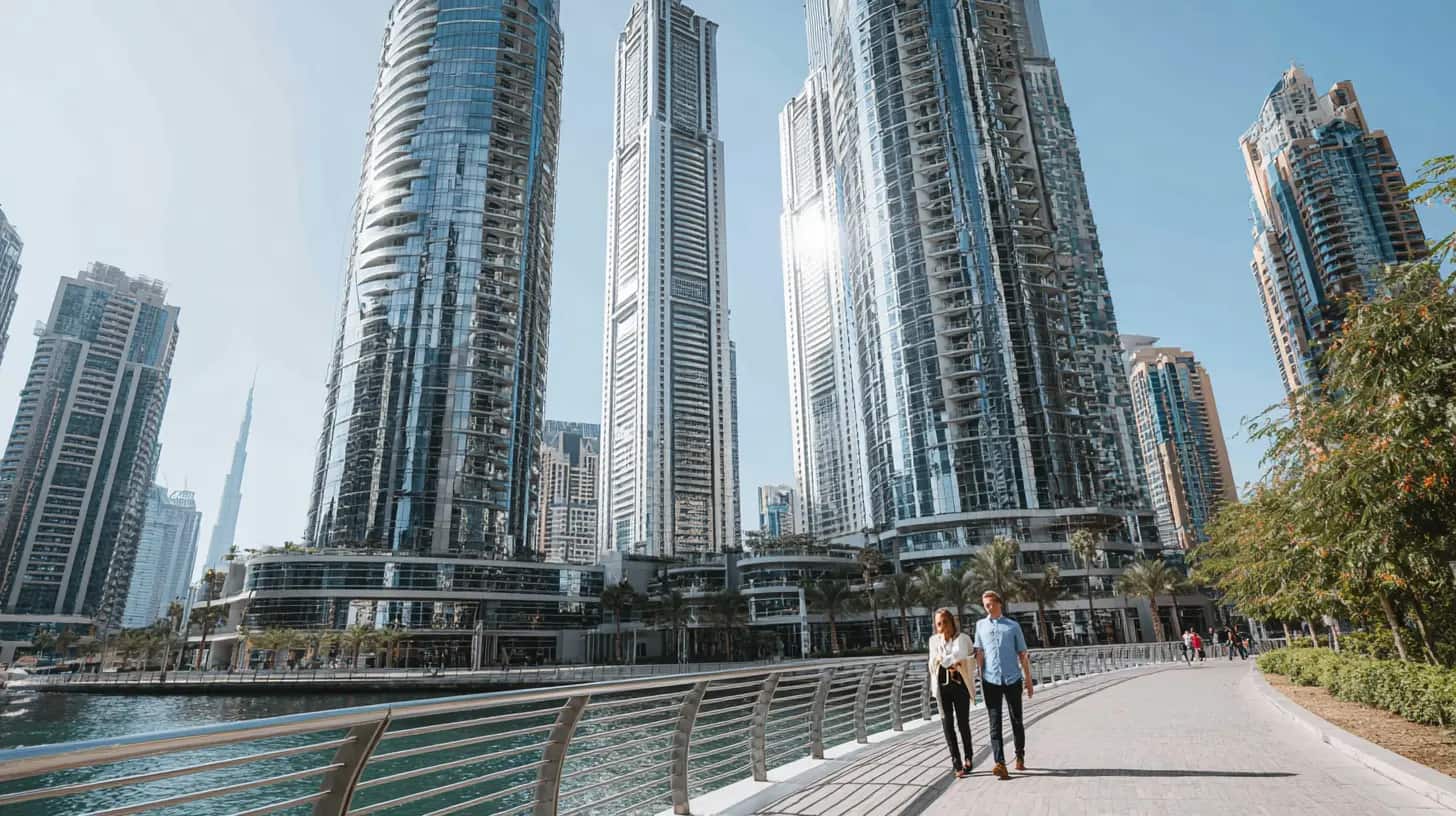
Best Neighborhoods in Dubai for High ROI in 2025
High ROI in Dubai Is Not One Thing. It Depends Entirely on What You're Optimising For. The pertinent query is often raised as to which area in Dubai promises the highest returns.
High ROI in Dubai Is Not One Thing. It Depends Entirely on What You're Optimising For.
The pertinent query is often raised as to which area in Dubai promises the highest returns. The only honest—and indeed relevant—response is that it depends on how much return one is seeking, how much time one is prepared to invest, and how much cost of finance and cost of management one is prepared to accept.
Dubai has some areas that promise gross rental yields of 9%, while others promise 4%. Some areas have registered 120% in capital appreciation over the last three years, and others have registered 25%. Some areas specialize in short-term rentals and excel in gross revenue in peak season but fare less well when operator commissions, voids, and furnishing costs are factored in. Some require an entry cost of AED 600,000 and a broad tenant base, while others require an entry cost of 30 million and a waiting time of six months for a suitable purchaser.
None of these profiles is superior to the others. Rather, they are different investment styles for different types of investors. A retired professional with AED 2 million to invest and generating passive income with minimal management effort requires a different discussion from a 35-year-old investor with AED 800,000 to invest and a ten-year investment horizon. A family office with AED 50 million to invest in five assets requires a different discussion from an expatriate looking to purchase their very first investment property.
This article aims to bring you the real story of six communities in Dubai that constantly top the charts in our ROI analysis, not because they offer the same return, but because each of them offers a credible and documented story of investment potential in 2025. We will look at the yield figures, the capital appreciation story, the demand drivers, risks, and circumstances under which each of these communities would be a good investment. These figures are facts, and the analysis is simple.
A word of caution: When we write this article, we write in early 2026, based on figures from 2025 and the conditions of the time. Market conditions do change. It’s always best to check figures with a lender or agent before making any investment decisions.
Jumeirah Village Circle: The Volume King
JVC is not glamorous. It doesn't have a beach. The name recognition among international property investors is lower than the Marina or the Palm. If you describe it to someone who doesn't know Dubai, "a masterplanned residential community built around a circular road network inland from the Marina" is not going to generate excitement.
And yet JVC has consistently delivered some of the highest gross rental yields in Dubai for the past several years. The reason is straightforward: affordable entry price, very wide tenant pool, high occupancy rates, and a supply of mid-market apartments that matches what a large proportion of Dubai's working population can afford and wants to live in.
Entry prices in JVC for one-bedroom apartments sit between AED 600,000 and AED 950,000 at the current market. Gross rental yields run 7% to 9% for well-located units. The tenant profile is primarily young professionals, couples, and small families who work in the Marina, Downtown, or the tech and media clusters around JLT and Dubai Internet City. These tenants are not transient — they stay for two and three years, and renewal rates in JVC are consistently above the Dubai average.
Capital appreciation in JVC has been real but not spectacular compared to waterfront communities. Units that transacted at AED 550,000 to AED 700,000 in 2020 are selling at AED 750,000 to AED 1.1 million today — appreciation of roughly 35% to 55% over five years. Solid, not transformative.
The supply risk is the most relevant concern for JVC investors. Dozens of towers are under construction at any given point, and new supply has kept rental rate growth more moderate than in supply-constrained communities. Investors who hold well-located stock in established buildings have done better than investors in newer peripheral buildings where supply competition is highest.
According to property analyst Lynnette Abad of Property Monitor, writing in the firm's 2025 Dubai Mid-Market Rental Report: "JVC has demonstrated that yield and community scale are not mutually exclusive — its consistent occupancy and renewal rates reflect genuine residential demand rather than speculative positioning." The full report is worth reading for investors focused on the mid-market: Property Monitor 2025 Dubai Report.
Browse current JVC listings to see where entry prices and configurations sit today.
Business Bay: The Yield-Capital Blend
Business Bay occupies a different position in the ROI conversation from JVC. The entry price is higher — one-bedrooms run AED 1.1 million to AED 1.8 million, two-bedrooms AED 1.6 million to AED 2.8 million — but the yield profile is strong at 6% to 8% gross, the tenant pool is wide and includes corporate relocations and DIFC professionals, and the capital appreciation since 2020 has been more significant than JVC's at 50% to 70% across most product types.
What makes Business Bay distinctive as an investment address is the combination of genuine commercial activity — it is a functioning business district with office towers, hotels, and corporate occupiers — and residential density that has reached a critical mass. Communities with real daytime economic activity generate different tenant profiles from purely residential dormitories. Business Bay attracts tenants who need to be close to where they work, which means lower sensitivity to competing supply in other parts of the city.
The canal — Dubai Water Canal runs through Business Bay and adds a waterfront dimension to what might otherwise be a purely commercial urban address — has contributed meaningfully to capital appreciation in the canal-facing buildings. Units with canal views command 15% to 25% premiums over equivalent inland-facing stock and have held that premium consistently.
Binghatti has a significant presence in Business Bay and several of their projects here have generated strong investor returns. The developer's delivery speed has been particularly valuable in Business Bay, where project delays from other developers have created comparative advantages for reliable completions.
Short-term rental performs well in Business Bay given the proximity to DIFC and Downtown and the year-round business travel demand. Occupancy rates are more stable across seasons than in purely leisure-facing communities, which smooths the annual yield picture.
See what's available across Business Bay with current pricing for both ready and off-plan product.
Dubai Marina: The Evergreen Performer
Dubai Marina has been in every Dubai ROI conversation for fifteen years. It keeps appearing because it keeps delivering — not the highest yield in the market, not the most dramatic appreciation, but consistently strong performance across both metrics in a location with global brand recognition and deep, liquid secondary markets.
The Marina's durability as an investment address comes from its demand diversity. Leisure tourists, corporate renters, long-term professional residents, short-term rental operators, buy-to-let investors — the Marina serves all of them simultaneously, and that diversity of demand is the best protection an investment community can have against any single demand driver softening.
Gross yields in the Marina run 5% to 7% for apartments — lower than JVC but with stronger capital appreciation and better liquidity. One-bedrooms sit at AED 1.2 million to AED 2 million. Two-bedrooms run AED 1.8 million to AED 3.5 million. The capital appreciation story since 2020 has been solid at 40% to 55%, with canal-facing and high-floor units at the upper end.
Short-term rental in the Marina is one of the most active markets in Dubai. Gross annual revenues of AED 80,000 to AED 180,000 for a well-managed one-bedroom are achievable. The trade-off is management intensity and the operator commission (15% to 25%) that comes with professional holiday home management. Net yields after all costs are typically 5% to 6.5% for short-term rental versus 5% to 7% for long-term — the short-term premium is smaller than most investors expect once costs are properly accounted for.
Simon Baker, former CEO of REA Group, noted in a 2024 Gulf property market commentary that "the Marina's liquidity profile is unmatched in Dubai's residential market — it combines deep buyer demand with active short and long-term tenant markets in a way that makes it the most reliable exit for investors who need flexibility." That liquidity premium is real and worth paying for.
Our Dubai Marina listings are updated in real time across ready and off-plan product.
Dubai Hills Estate: Steady Compounding Over Time
Dubai Hills appears in the high-ROI conversation for different reasons than JVC or the Marina. The yield isn't the highest — 5.5% to 7.5% gross depending on product type — and the capital appreciation, while strong at 40% to 120% across product types since 2020, reflects a community that has been delivering into genuine end-user demand rather than speculative momentum.
What Dubai Hills provides that few communities can match is stability. The tenant base is anchored by families with children in the community's schools — GEMS Wellington Academy and GEMS Metropole are both within the masterplan — and by medical professionals at King's College Hospital. These tenants do not move frequently. Renewal rates in Dubai Hills are among the highest in Dubai, which keeps vacancy costs low and makes annual yield calculations more reliable than in communities with higher turnover.
The golf course premium is documented and durable. Golf-facing apartments command 15% to 20% more than equivalent apartments without the view on both rental and sale. That premium has been consistent across several years of market data and shows no signs of compression — it reflects genuine tenant and buyer preference for the green corridor rather than cyclical sentiment.
For investors who don't want the management intensity of short-term rental and don't need the highest possible gross yield, Dubai Hills provides a compelling combination of reliable income, solid capital growth, and a tenant profile that reduces the operational friction of property management.
Emaar continues to launch new phases in Dubai Hills and the community is still growing. The off-plan pipeline adds some supply risk for apartment investors. The villa and townhouse side is more supply-constrained and has demonstrated the strongest capital appreciation in the community.
Check Dubai Hills listings for current secondary market pricing and available off-plan phases.
Creek Harbour: The Long Game
Creek Harbour is the highest-risk, highest-potential community in this analysis. That's not a criticism — it's a description of the investment profile. Buying into Creek Harbour in 2025 means buying into a community that is still materialising. The towers going up around the Creek Tower construction site are being purchased by investors who are pricing in a future state that doesn't fully exist yet.
That's exactly how the best Dubai property investments have historically worked. Downtown Dubai buyers who entered before the Burj Khalifa opened paid prices that looked aggressive at the time and look transformative in hindsight. Palm Jumeirah buyers who held through the post-2008 correction came out with returns that justified the wait. Creek Harbour is making the same kind of claim on investor patience.
Gross yields in Creek Harbour currently run 5.5% to 7% for delivered apartments — solid but not exceptional for the risk profile. The capital appreciation story on earlier phases has been more interesting: buyers who entered Creek Horizon and Creek Gate phases in 2019 and 2020 have seen 35% to 55% appreciation. New phases are launching at higher prices, which means the easy gains from the earliest entries are gone. Future appreciation is tied to the Creek Tower delivery timeline and the broader maturation of the community's retail and hospitality infrastructure.
The Creek Tower question — designed by Santiago Calatrava, targeting a height above the Burj Khalifa — is the single largest variable in the Creek Harbour investment case. Construction has restarted after COVID delays. The current target is ambitious. When it opens, it will reprice everything around it the way the Burj Khalifa repriced Downtown. That's the bet.
For investors with a five-to-seven year horizon and appetite for development-stage risk, Creek Harbour offers a combination of current yield and structural appreciation potential that is genuinely compelling.
Explore current Creek Harbour listings across ready and off-plan stock.
Jumeirah Lake Towers: The Underrated Yield Play
JLT sits across Sheikh Zayed Road from Dubai Marina and is consistently undervalued in the ROI conversation relative to what its numbers actually deliver. Entry prices are lower than the Marina — one-bedrooms sit at AED 850,000 to AED 1.4 million — while gross yields run 6.5% to 8.5%, putting it ahead of the Marina on yield at a meaningfully lower capital outlay.
The community has a genuine commercial dimension — JLT is a free zone with over 5,000 registered companies and a significant daily working population — that sustains rental demand across the business cycle in a way that purely residential communities don't. Professionals who work in JLT companies prefer to live in JLT. That preference is sticky and creates a reliable base of well-qualified long-term tenants.
The lake views — three interconnected artificial lakes run through the centre of the community — add a visual quality that the surrounding infrastructure doesn't always reflect in photography but residents consistently value. Lake-facing units command premiums of 10% to 15% on both rental and sale and have maintained those premiums consistently.
Capital appreciation in JLT since 2020 has been 35% to 55% depending on building and position — in the same range as JVC but with better commercial underpinning and more distinctive address credentials. The community is fully built out, which eliminates new supply risk but also limits the development-stage appreciation opportunities that Creek Harbour or new JVC launches can offer.
Short-term rental in JLT is active but not as strong as the Marina given the more mixed residential-commercial character of the community. Long-term rental is where the numbers are most reliable.
Gaia Realty Original Research: Dubai High-ROI Community Snapshot, 2025
Based on DLD transaction data, RERA rental registrations, active listing analysis, and operator yield data across profiled communities as of full-year 2025.
Gross rental yields by community and product type:
- JVC 1-bed: 7% to 9%, avg. occupancy 89%, avg. annual renewal rate 68%
- JLT 1-bed: 6.5% to 8.5%, avg. occupancy 87%, avg. annual renewal rate 65%
- Business Bay 1-bed: 6% to 8%, avg. occupancy 85%, avg. annual renewal rate 62%
- Dubai Marina 1-bed: 5.5% to 7%, avg. occupancy 83%, avg. annual renewal rate 58%
- Dubai Hills 2-bed apartment: 5.5% to 7%, avg. occupancy 91%, avg. annual renewal rate 74%
- Creek Harbour 1-bed: 5.5% to 7%, avg. occupancy 79%, avg. annual renewal rate 55%
Capital appreciation since January 2020 by community:
- Dubai Hills villas: 90% to 120%
- Business Bay: 50% to 70%
- Dubai Marina: 40% to 55%
- JVC: 35% to 55%
- JLT: 35% to 50%
- Creek Harbour: 35% to 55% on delivered phases
Average days on market for secondary sales in 2025:
- Business Bay: 23 days
- Dubai Hills: 24 days
- Dubai Marina: 26 days
- JLT: 28 days
- JVC: 31 days
- Creek Harbour: 34 days
Total return (yield plus capital appreciation, annualised since 2020) — approximate:
- Dubai Hills villas: 22% to 28% per annum
- Business Bay: 17% to 22% per annum
- Dubai Marina: 14% to 18% per annum
- JVC: 13% to 18% per annum
- JLT: 12% to 17% per annum
- Creek Harbour: 12% to 18% per annum on delivered phases
What the Numbers Actually Tell You
Total return — yield plus capital appreciation combined — is the most honest way to compare these communities because it accounts for both income and growth rather than optimising for one at the expense of the other.
On that measure, Dubai Hills villas have been the strongest performer over the five-year window. The combination of meaningful capital appreciation (90% to 120%) and consistent yields (5% to 6%) produces annualised total returns that beat most asset classes globally over the same period. The catch is entry price — villa purchases in Dubai Hills start at AED 9 million and above for the product that has driven those numbers.
For investors at the AED 800,000 to AED 1.5 million entry point, JVC and JLT produce the best yield-weighted total returns. The capital appreciation is lower than waterfront communities but the yield carries more weight in the total return at these price points, and both communities have demonstrated reliable occupancy and renewal rates that make the yield figure real rather than theoretical.
Business Bay is the strongest all-round performer across the yield-liquidity-appreciation matrix for mid-market apartment investors in the AED 1.1 million to AED 2.5 million range. It's not the leader in any single category but it's consistently near the top across all three, which is what a balanced portfolio needs.
The Marina's value is in optionality — it works for long-term rental, short-term rental, and capital preservation. If you're not sure how you want to run the investment, the Marina gives you the flexibility to change strategy without changing the asset.
Creek Harbour is for investors who are specifically comfortable with development-stage risk and have the time horizon to wait for the Creek Tower catalyst. The current yield is reasonable. The long-term appreciation case is compelling. The execution risk is real.
Our property search lets you filter across all of these communities by price range, property type, and availability if you want to compare current market options side by side.
Questions People Ask About High-ROI Investing in Dubai
Which Dubai community has the highest gross yield right now?
JVC consistently tops gross yield tables at 7% to 9% for one-bedrooms. But gross yield is not net yield — factor in service charges, management fees, vacancy, and maintenance before comparing.
Is a 7% yield in Dubai actually achievable or just marketing?
Achievable in JVC and JLT for well-located, well-managed one-bedrooms. Less common once you move to larger units or premium communities. Always ask for the net yield figure and check what assumptions are built into it.
Should I prioritise yield or capital appreciation?
Depends on your investment horizon and income needs. Short horizon, need income — weight yield. Long horizon, no income requirement — weight appreciation. Most investors benefit from a blend across both metrics rather than optimising for one.
What's the minimum investment for a positive cash flow property in Dubai?
Around AED 700,000 to AED 800,000 in JVC or JLT, financed with a standard 80% LTV mortgage at current rates, can achieve positive cash flow. Tighter than it was two years ago given price appreciation, but still achievable in the right communities.
Does buying off-plan always give better returns than ready property?
Not always. Off-plan gives you launch pricing and development-stage appreciation — which can be significant. It also gives you delivery risk and a period with no rental income. Ready property generates income from day one but you've paid the post-delivery price. Which is better depends on the specific project and your cash flow needs.
Is short-term rental really worth the extra management effort?
In the Marina and Downtown, possibly — the revenue uplift over long-term rental can be 15% to 25% gross in peak season. Net of operator fees and costs the gap narrows. In JVC or Dubai Hills, generally not — the tourist demand profile isn't strong enough to justify the operational complexity.
How many properties should I own before it makes sense to use a property manager?
From the first one, if you're not based in Dubai or don't want the operational involvement. Self-management works for hands-on owners. For everyone else, the cost of professional management is worth it from a single property.
What's the impact of new supply on yields in high-volume communities?
Real and worth tracking. JVC and Business Bay have active development pipelines. New supply keeps rental rate growth moderate and means your specific building's quality and location within the community matters more than the community-level numbers suggest.
Are Dubai yields sustainable or likely to compress further?
Yields have compressed in most communities since 2020 as capital values outpaced rent growth. Some further compression is likely as prices continue to rise. The communities most exposed to compression are the ones with the most active new supply — JVC, Business Bay. The most insulated are supply-constrained communities like the Palm and Bluewaters.
Can I get a mortgage to buy investment property in Dubai?
Yes. Standard UAE Central Bank LTV rules apply — 80% for a first property under AED 5 million, 70% above that. Investment property mortgages are available from all major UAE lenders. The debt burden ratio cap of 50% of monthly income applies, so your existing financial commitments affect how much you can borrow.
Is 2025 still a good time to buy or have I missed the market?
The easy gains from the 2020 to 2022 repricing are gone. Current prices in most communities are near or at historical highs. That said, the demand fundamentals — population growth, tourism, business activity, Golden Visa uptake — remain strong. Investors who buy quality assets at fair current prices and hold five-plus years are likely to be rewarded. Short-term speculation is harder to make work at current entry prices.
What's the single most important thing to get right when investing in Dubai?
Location within the community, not just the community itself. A well-located unit in JVC outperforms a poorly located unit in the Marina. Floor, view, building quality, proximity to the community's amenity anchors — these micro-location factors drive more of the return difference than most investors realise until they've owned a few properties.
In Dubai, ROI Is Not Found. It's Engineered.
The communities discussed in this article are not secret ones. JVC yields, Business Bay liquidity, Marina optionality, and Dubai Hills stability are widely known and discussed among property enthusiasts and experts. Those who achieve impressive returns in these areas on a consistent basis do not do so because they have access to information not generally known by others. Rather, they achieve better results through a more detailed evaluation of what drives returns: entry price, product quality, location, management quality, and holding discipline.
Several things become obvious from the 2025 data. Total return, not just yield, is what matters. Yield without appreciation is not a compelling case at current entry prices in Dubai. Appreciation without yield is holding costs over a long period of time and betting on an exit price at some point in the future. The communities and product types that have delivered both yield and appreciation—Dubai Hills villas, Business Bay mid-market apartments, and JLT one-beds in good buildings—share a common factor: real demand from real tenants and real end-users who want to occupy space regardless of market conditions.
This is simple, and it requires hard work: fact-checking actual yield figures, evaluating supply pipelines, checking management quality, and evaluating total costs of ownership before they look as rosy as they do in the brochure.
The best time to do all of this hard work is before you buy.
Our team works across all of these communities daily and can help you build an honest picture of what the numbers look like for a specific property at a specific price point. Reach out and we'll take it from there.
Related stories
Dubai's Established Charm: The Case for Older Homes
In a city focused on the future, I believe the smartest move for many buyers is to look back. Dubai's seasoned communities offer space, character, and surprising value that new builds often can't match.

The True Cost of Owning a Dubai Property
Beyond the purchase price, your annual budget for a Dubai home must account for service charges, utilities, and maintenance. I'll break down every ongoing expense you need to plan for.
Calculating ROI on Dubai Rental Upgrades
As a landlord in Dubai, you can't just follow trends. I'll show you how to calculate the precise ROI of minor property upgrades to genuinely increase your rental yield.
Echoes, in your inbox
One thoughtful email a month. Market insight, new launches, no spam.