

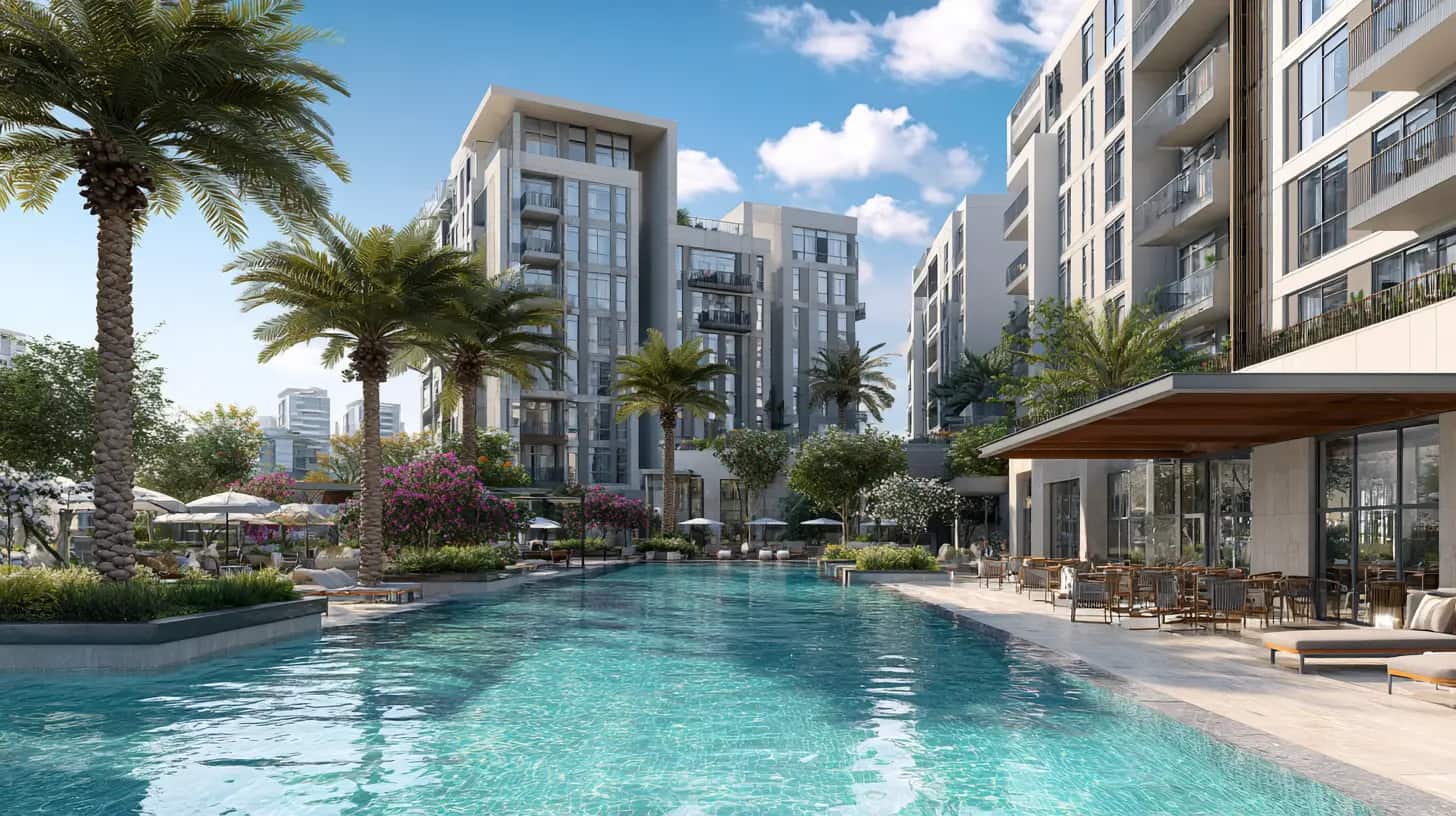
ROI Potential in Dubai Hills Estate
Consistent yields, strong capital appreciation, and one of Dubai's most stable tenant bases. Here's what investing in Dubai Hills actually delivers in 2026.
Dubai Hills Wasn't Built to Be Flashy. That's Exactly Why It Works.
There is a type of Dubai development that is based on spectacle and includes elements such as height, exclusive islands, large mall space, and record-breakers of various kinds. Dubai Hills Estate is not of this type. It was created by Emaar and Meraas as a master-planned community based on a golf course, parks, schools, a hospital, and a retail center, i.e., elements of liveability as opposed to photogenic qualities.
This strategy has proven to be a sound financial one. Not in spite of a lack of aspiration—its scale is approximately 11 square kilometers and it is designed for hundreds of thousands of inhabitants—but precisely because of its alignment with the evolving aspirations of a maturing market. The buyer of sea views and tower height in 2008 is, in many cases, the same buyer now seeking a school within walking distance and a park where they can let their children play on a Tuesday evening. Dubai Hills Estate was created for this type of buyer, but this type of buyer had not really materialized as a type until Dubai Hills Estate was created.
As a result, the community has shown remarkable consistency in both capital appreciation and rental yield measures since the start of delivery in 2019 and 2020. Its growth has not shown the spike experienced by the waterfront communities from 2021 to 2022. Its growth has not shown the correction experienced by the rest of the market when the sentiment weakened. It has continued to grow steadily quarter by quarter due to genuine end-user demand.
This article will discuss what the performance of the community means for investors. It will discuss the data related to capital appreciation, the yield of the community across various types of products, the drivers of the continued demand for the community, the risks to be aware of, and the type of investor for whom Dubai Hills is a sensible investment option in 2026. The figures mentioned are real. The discussion is candid. While the Palm is the trophy asset of Dubai, Dubai Hills is the trophy performance. For many investors, performance is more important than trophy.
What Dubai Hills Estate Actually Is
Before getting into the investment numbers it's worth being clear on the geography, because Dubai Hills is large enough that location within the community matters significantly for returns.
The community sits between Al Khail Road and Umm Suqeim Road, roughly midway between Downtown Dubai and Dubai Marina. That central position — equidistant from the city's two primary commercial and lifestyle districts — is one of its strongest geographic selling points. Neither a long drive from the city centre nor dependent on being part of the city centre, it occupies a position that works for a wide range of residents.
The golf course sits at the heart of the community. Properties facing the fairways — particularly the villa plots and apartment buildings on the golf course perimeter — command a premium over equivalent product without golf views. The premium is real and has been durable. A two-bedroom apartment overlooking the golf course consistently achieves both higher rents and higher resale values than a comparable two-bedroom facing the internal streets.
Dubai Hills Mall opened in 2022 and completed the community's retail infrastructure. It's a full-scale regional mall — over 600 retail outlets, a large dining offer, entertainment anchors — and its presence has reinforced Dubai Hills as a self-contained community rather than a bedroom suburb. Residents don't need to leave for most of what daily life requires, which strengthens both occupancy and resale demand.
King's College Hospital Dubai opened in the community in 2019, the first international hospital brand to establish a full facility in Dubai. For families — the dominant buyer profile in Dubai Hills — a world-class hospital within the community is a genuine pull factor, not just a marketing point.
The Product Mix
Dubai Hills offers a wider range of product types than most masterplanned communities — studios and one-bedrooms in apartment buildings, two and three-bedroom apartments in mid-rise complexes, townhouses, semi-detached villas, and standalone villas across multiple sub-communities. The price range runs from around AED 700,000 for a studio at the entry end to AED 30 million and above for a large standalone villa on a premium golf course plot.
That breadth is an investment advantage. It means the community serves multiple buyer and tenant profiles simultaneously — young professionals in the apartments, growing families in the townhouses, established families and executives in the villas. A diverse demand base provides more stability than a community that depends on a single buyer type.
The Capital Appreciation Story
Dubai Hills has delivered consistent capital appreciation since its first units came to market, with particularly strong performance from 2020 onward.
The villa segment has been the standout. Four and five-bedroom standalone villas in Dubai Hills that were transacting at AED 4 million to AED 6 million in 2019 and 2020 are now changing hands at AED 9 million to AED 16 million. That's 80% to 120% appreciation in five years on a product type that buyers were sometimes hesitant about — the fear at the time was that the community was too far from established infrastructure to command premium villa prices. That fear has not been validated.
Townhouses have performed similarly well. Three-bedroom townhouses that launched off-plan at AED 1.8 million to AED 2.2 million are now selling on the secondary market at AED 3.5 million to AED 5 million. Buyers who took early off-plan positions — particularly in the Maple and Sidra sub-communities — have made returns that compare well with any residential asset in Dubai over the same period.
The apartment segment has been strong but less dramatic. Apartment appreciation in Dubai Hills since 2020 runs at roughly 40% to 65% depending on building and configuration, which is solid rather than spectacular against the villa comparison. The apartment market is also where most of the new supply is coming — Emaar continues to launch apartment phases in Dubai Hills, and that ongoing supply exerts more of a ceiling on price growth than the villa segment faces.
Matthew Benson of Knight Frank MENA, whose 2024 UAE Residential Market Report tracked performance across Dubai's masterplanned communities, observed that "Dubai Hills has demonstrated the rarest combination in real estate — community-level appeal that sustains demand across both rental and sale markets simultaneously, without being dependent on a single demand driver." That observation holds when you look at the data.
The Yield Picture
Capital appreciation is what makes the headlines. Yield is what pays the mortgage.
Dubai Hills sits in a genuinely useful position on the yield spectrum — not the highest-yielding community in Dubai, but consistently in the range that makes investment cases work across most financing scenarios.
Villa Yields
Long-term rental yields on Dubai Hills villas run between 4% and 6% gross depending on size and position. Golf course-facing villas are at the lower end of that range — higher capital values compress the yield — while villas in the inner sub-communities without premium views run higher.
The villa rental market in Dubai Hills has been very active. Tenant demand from families — particularly those relocating with children who want access to the community's schools — has kept vacancy low. GEMS Wellington Academy, GEMS Metropole, and the King's College Hospital complex all function as demand anchors for family tenants in a way that most communities can't replicate.
Apartment Yields
Apartment yields in Dubai Hills are stronger than villas, running 6% to 8% gross for well-located one and two-bedrooms. The tenant profile is younger than the villa market — professionals, couples, smaller families — and the competition from ongoing new supply means that rental rate growth has been more moderate than the villa side.
Golf course-view apartments command a meaningful premium on both rental and sale — typically 15% to 20% above equivalent apartments without the view. This premium has been consistent and shows no sign of compressing, which suggests it reflects genuine tenant and buyer preference rather than temporary sentiment.
Short-Term Rentals
Dubai Hills is not primarily a short-term rental market. The community is residential in character — the golf course, the schools, the hospital — rather than tourist-facing. Short-term rental activity exists but occupancy rates are lower than in the Marina or Downtown, and the nightly rate premium that tourist-facing communities command is not available here.
Investors targeting short-term rental returns in Dubai Hills typically find the numbers less compelling than in waterfront communities. The community works best as a long-term rental or owner-occupier play. Investors who buy here for holiday home yield are usually disappointed.
Gaia Realty Original Research: Dubai Hills Estate Investment Snapshot, Q1 2026
Based on DLD transaction records, current secondary market listings, and rental data from active property management engagements as of Q1 2026.
Capital values and appreciation since 2020:
- Studios: AED 700K to AED 1.1M, up 40% to 55%
- 1-bed apartments: AED 1.1M to AED 1.8M, up 45% to 60%
- 2-bed apartments (no view): AED 1.6M to AED 2.4M, up 40% to 60%
- 2-bed apartments (golf view): AED 2M to AED 3.2M, up 55% to 70%
- 3-bed townhouses: AED 3.5M to AED 5M, up 80% to 110%
- 4-bed standalone villas: AED 9M to AED 16M, up 90% to 120%
- 5-bed signature villas (golf course): AED 16M to AED 30M+, up 100% to 130%
Rental yields by product type:
- Studios: 6.5% to 8% gross, strong demand from young professionals
- 1-bed apartments: 6% to 7.5% gross, consistent occupancy year-round
- 2-bed apartments: 5.5% to 7% gross, family and professional tenants
- 3-bed townhouses: 5% to 6.5% gross, high family demand, low vacancy
- 4-bed villas: 4.5% to 6% gross, executive family tenants
- 5-bed villas: 4% to 5.5% gross, premium tenant profile
Average days on market in 2024 versus 2021:
- Villas: down from 68 days to 24 days
- Townhouses: down from 54 days to 19 days
- Apartments: down from 41 days to 27 days
Cash buyers as percentage of transactions: 58% for villas, 44% for townhouses, 36% for apartments.
What Drives Continued Demand
The investment case for Dubai Hills is only as good as the demand that underpins it. So it's worth being specific about where that demand actually comes from and why it's likely to continue.
The school infrastructure is the single most underrated demand driver in the community. Dubai Hills has multiple well-regarded schools within the masterplan, and families with children in those schools have a strong incentive to stay in the community rather than move when leases expire. This creates stickiness in the tenant base that most communities don't have — renewal rates in Dubai Hills are consistently higher than the Dubai average, according to data from RERA lease registrations.
The hospital is a secondary but real factor. King's College Hospital has attracted a significant number of medical professionals to the community — nurses, doctors, administrative staff — who want to live close to where they work. That demand is stable and largely recession-resistant.
The golf course has a demand effect that extends beyond golfers. Non-golfers pay a premium for golf course views and proximity to the green corridor because it represents a quality of landscape and space that Dubai's more urban communities can't provide. As Dubai's residential population has grown and density has increased in the city's core, the value of accessible green space has increased with it.
Emaar's brand carries weight with a specific buyer profile. Buyers from India, Pakistan, the wider South Asian diaspora, and increasingly from East Africa associate the Emaar name with delivery quality and investment credibility. A significant share of Dubai Hills buyers come from these markets, and Emaar's track record in the community reinforces ongoing demand from those communities for new phases.
To explore what's currently available in Dubai Hills across apartments, townhouses, and villas, our listings reflect the current secondary and off-plan market in real time.
The Risks Worth Taking Seriously
Dubai Hills has performed well. That doesn't make it risk-free, and the risks that exist deserve honest attention.
Supply is the most relevant near-term risk. Emaar has continued to launch new apartment phases in Dubai Hills throughout the community's development, and more is coming. The off-plan pipeline for apartments is significant. When that supply delivers, it competes with existing stock on both the rental and sale side. The villa and townhouse segments have less new supply exposure — the land is more constrained — but the apartment market is genuinely susceptible to supply overhang if absorption slows.
Location is not for everyone. Dubai Hills sits inland, without water views, and some distance from the beach communities that define Dubai's tourism identity. Buyers for whom a Marina or Palm address is important won't consider it. That narrows the buyer pool relative to waterfront communities, which matters for liquidity — particularly at the higher villa price points.
Price growth has already been significant. Buyers entering at 2025 prices on villas are paying 90% to 120% more than buyers paid five years ago. The case for continued appreciation depends on demand staying strong relative to supply. That case is reasonable — but the easy gains are largely in the past. Future returns are more likely to resemble steady compounding than the sharp run of 2020 to 2023.
Management quality matters more in a community of this scale. With hundreds of apartment buildings and thousands of villa plots, service charge management, community maintenance, and building quality vary more across Dubai Hills than in a smaller, more tightly controlled development. Do your due diligence on the specific building or sub-community, not just the masterplan brand.
Our property management services cover Dubai Hills across all product types if you want professional management for an investment property here.
Who Dubai Hills Makes Sense For
The honest version of this question is about fit, not just financial metrics.
Dubai Hills makes strong sense for investors who want a combination of solid yield and durable capital growth without the volatility and illiquidity that comes with trophy assets. It's not going to make you the 150% gain that a frond villa buyer from 2020 made. It is going to give you consistent 6% to 7% yields on apartments and steady appreciation in a community that has proven its demand fundamentals across several years of delivered product.
It makes excellent sense for end users with families. The schools, the hospital, the parks, the mall — this is genuinely one of the best-planned family communities in Dubai. Buyers who move in with children tend to stay for years, which turns what might be a pure investment decision into something with lifestyle value on top.
It makes sense for investors who want to hold through a standard property cycle — five to ten years — and let the compounding do the work. The community is still growing. The infrastructure is still being added. The population is still building. Communities at this stage of development tend to reward patient holders.
It makes less sense for investors who need maximum yield right now, or who want a short-term flip in a volatile market, or who specifically want the short-term rental income profile that tourist-facing communities provide.
If you're at the decision stage and want to talk through whether Dubai Hills is the right fit for your investment goals, our real estate agents know this community in detail. Reach out and we'll take it from there.
Questions People Ask About Investing in Dubai Hills Estate
What's the entry-level price for an investment property in Dubai Hills?
Studios start around AED 700,000. That's the accessible end, with yields of 6.5% to 8% and consistent tenant demand from young professionals.
How does Dubai Hills compare to JVC on yield?
JVC yields slightly higher — 7% to 9% gross on apartments — but Dubai Hills commands better capital appreciation and a more stable tenant profile. Depends whether you're optimising for yield or total return.
Is Dubai Hills good for short-term rentals?
Not particularly. It's a residential community, not a tourist destination. Long-term rental is where the numbers work here. Investors targeting holiday home yields should look at Marina or Downtown instead.
Are there good schools in Dubai Hills?
Yes — several well-regarded schools are within the masterplan itself, including GEMS Wellington Academy and GEMS Metropole. It's one of the strongest school catchment areas in Dubai and a major driver of family tenant demand.
What's the golf course view premium worth?
Roughly 15% to 20% on both rental and sale prices compared to equivalent product without the view. That premium has been consistent and appears structural rather than sentimental.
How much new supply is coming in Dubai Hills?
Emaar continues to launch apartment phases. The pipeline is active and meaningful for the apartment segment. Villa and townhouse supply is more limited — the land is largely spoken for. New supply is the key risk to monitor for apartment investors.
Can I get a mortgage to buy in Dubai Hills?
Yes. Standard UAE LTV rules apply. Most apartment and townhouse purchases in Dubai Hills are financeable through major UAE lenders. Villa transactions at the higher price points are predominantly cash.
What's the Golden Visa threshold for Dubai Hills purchases?
Properties above AED 2 million qualify for a 10-year Golden Visa. Most villas and many larger apartments in Dubai Hills exceed this threshold comfortably.
How liquid is the Dubai Hills market?
Very liquid compared to most Dubai communities. Average days on market for villas fell to 24 days in 2024. Apartments are similarly active. It's one of the more tradeable communities in the city.
Is Dubai Hills still considered off-plan or fully delivered?
Mixed. Large portions of the community are fully delivered and occupied — the Maple, Sidra, and Golf Place sub-communities are mature. New apartment phases continue to launch off-plan. Both options exist depending on what you're looking for.
Does the Emaar brand add a meaningful premium?
Yes, among specific buyer communities — particularly South Asian buyers for whom Emaar's track record is well known. It supports resale liquidity and rental demand in a way that a lesser-known developer's product wouldn't in the same location.
What's the biggest mistake investors make in Dubai Hills?
Buying an apartment in a new phase at launch price without checking what comparable completed stock is trading at on the secondary market. Off-plan pricing in active communities can sometimes exceed secondary market levels — and if it does, your day-one return on paper is negative.
Dubai Hills in 2026: The Case for Steady Over Spectacular
The most compelling feature of Dubai Hills Estate as an investment option is also the least showy to talk about: it works quarter after quarter, quarter after quarter. It does not generate headlines around the sale of a Palm Jumeirah villa or a Creek Harbour launch selling out in a day... nor should it.
Over the last six years, Dubai Hills Estate has created what is more difficult to achieve than spectacle: community credibility. The first residents remain residents, schools operate at full capacity, the hospital is open for business, and the mall has some activity on weekday afternoons. This is a community that has delivered on what master-planned communities promise.
This is what it means for investors: a tenant profile that will stay, a buyer profile that is broad and eager, and a liquidity profile that works on their timeline and not on waiting for some hypothetical buyer of choice. These are not sexy benefits, but they are real ones.
What has been delivered in terms of capital appreciation suggests that the era of dramatic appreciation—buying a townhouse at 2019 prices and selling five years later at twice the purchase price—has been and gone. What is left is appreciation and yield, and not re-pricing of an asset. For an investor looking for a five- to ten-year investment horizon and not requiring maximum yield in the short term, what Dubai Hills Estate offers is what they want.
Dubai Hills Estate was designed to be a long-term investment option, and those who have invested long term have been rewarded so far. Those who continue to do so will likely continue to be rewarded as well.
Related stories
Dubai's Established Charm: The Case for Older Homes
In a city focused on the future, I believe the smartest move for many buyers is to look back. Dubai's seasoned communities offer space, character, and surprising value that new builds often can't match.
The True Cost of Owning a Dubai Property
Beyond the purchase price, your annual budget for a Dubai home must account for service charges, utilities, and maintenance. I'll break down every ongoing expense you need to plan for.
Calculating ROI on Dubai Rental Upgrades
As a landlord in Dubai, you can't just follow trends. I'll show you how to calculate the precise ROI of minor property upgrades to genuinely increase your rental yield.
Echoes, in your inbox
One thoughtful email a month. Market insight, new launches, no spam.