

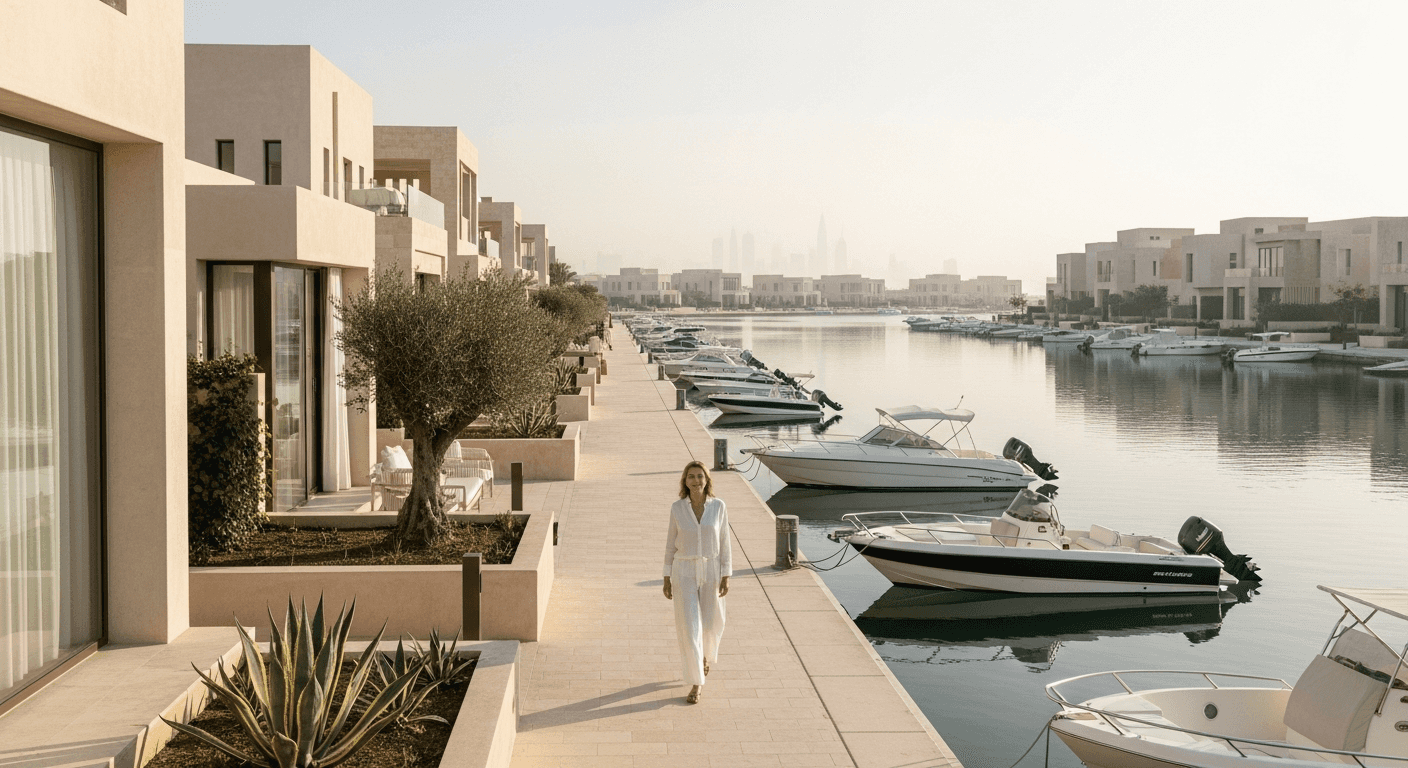
The Off-Peak Advantage: Dubai Villas for Flexible Lives
Forget the 9-to-5 grind. For Dubai's growing ranks of flexible workers, the best villa location is not about the rush hour commute, but about strategic, all-day access. Here's my guide to the communities that deliver.

The traditional Dubai property search used to hinge on a single, relentless question: “What’s the rush hour commute like?” For years, the value of a home was tethered to its proximity to the city’s core business hubs during two very specific windows of the day. But as I sit with clients now, I find that question is becoming increasingly irrelevant for a growing number of them. The world of work has changed, and so has the rhythm of life in Dubai. The city’s magnetic pull for entrepreneurs, creatives, and global professionals on flexible contracts means that for many, the 'rush hour' is a concept that applies to other people.
This shift demands a new way of thinking about location. It’s no longer just about a painful 45 minutes on Sheikh Zayed Road at 8 am. It’s about the freedom of a 20-minute clear run to a client meeting in Dubai Marina at 11 am, an easy school pick-up at 2:30 pm, and smooth access to the airport for a late-night flight. This guide is for those of you who measure your day in completed tasks, not clocked-in hours. It's my take on the villa communities that offer true, modern connectivity.
Here’s what I'll be exploring:
- Why the 9-to-5 commute is an outdated metric for many in Dubai
- My personal criteria for a great 'off-peak' community
- A deep dive into the Al Qudra corridor, including Arabian Ranches and its neighbours
- Exploring the strategic value of the E311/E611 axis communities
- Analysing the southern hub of Al Furjan and its unique transport links
- Looking ahead to the future-proofed communities of Dubai South
- A detailed financial breakdown comparing the real costs of these locations
- My practical checklist for stress-testing a community's access for yourself
The Fading Dominance of the 9-to-5 Commute
I remember a time, not too long ago, when almost every family villa search we at Gaia Living handled began with a pin dropped firmly in either DIFC or Media City. The conversation would then spiral outwards, a negotiation between time, traffic, and budget. A bigger garden meant a longer, more arduous crawl into the city. That calculus, however, is being fundamentally rewritten. The rise of the hybrid model, the explosion of freelance talent drawn by initiatives like the Golden Visa, and the global nature of business in Dubai mean that an increasing number of residents simply don't operate on a fixed schedule. Their 'office' might be a laptop at a local café, a workshop in Al Quoz, a client’s boardroom in Abu Dhabi, or a series of video calls from a home study.
This new professional class values something different. They require flexibility not just in their work, but in their geography. Their need isn't for a home that minimises one specific, repetitive journey. Instead, they need a base that provides efficient access to the *entire* city, and beyond, at various times of the day. They are the masters of non-rush hour commutes Dubai is so well-equipped for, if you know where to look. They understand that a 40-kilometre journey on an empty motorway at 10 am is infinitely preferable to a 10-kilometre crawl through Downtown at 5 pm. This isn't just a lifestyle preference; it's a strategic advantage that unlocks time and reduces stress.
Beyond that, the pandemic accelerated a trend that was already bubbling under the surface: the desire for self-contained communities. When your work, school, and leisure are all happening within a few kilometres of your front door, the daily trip to a central business district becomes the exception, not the rule. This has elevated the importance of local amenities — the quality of the community centre, the variety of shops and restaurants, the accessibility of parks and sports facilities. A great 'off-peak' community isn't just about empty roads; it's about having a rich and fulfilling life right on your doorstep, reducing the need to travel in the first place.
What Makes a Great 'Off-Peak' Villa Community?
 Featured project
So, if we're moving beyond the simple metric of 'distance to Downtown', what are the new criteria for an exceptional, flexibly located villa community? Over years of driving these roads and listening to what truly makes families happy, I've developed my own framework. It’s a more nuanced evaluation that prioritises strategic positioning and lifestyle integration over raw proximity.
First and foremost is multiple arterial access. A community that relies on a single entry/exit point onto a major road is a bottleneck waiting to happen, regardless of the time of day. The best locations are cradled by at least two, ideally three, major highways. Think of communities that offer a choice between Sheikh Mohammed bin Zayed Road (E311), Al Khail Road (E44), and Emirates Road (E611). This redundancy is crucial. It gives you the power to check real-time traffic and choose the path of least resistance. It's the ultimate trump card for achieving smooth connectivity villas should offer.
Second is the quality of internal infrastructure and self-sufficiency. The fewer reasons you have to leave the community for daily needs, the more 'convenient' it becomes. I look for mature communities with well-stocked supermarkets, good independent cafés, reliable clinics, and, critically, high-quality schools and nurseries. When the school run doesn't involve crossing a six-lane highway, your entire day's schedule becomes more manageable. This is where older, more established communities often have an edge over brand-new developments.
Third is what I call 'reverse commute' potential. This involves looking at the map from a different perspective. If your work or business is based in areas like Jebel Ali Free Zone, Dubai Investment Park, or the growing logistics hub around Al Maktoum International Airport (DWC), living 'south' of the city in a community like Al Furjan or even certain parts of Damac Hills and Damac Hills II is a masterstroke. You are travelling against the vast wave of traffic heading into the city in the morning and back out in the evening. This principle of easy access villa living is about being smarter than the traffic, not just faster.
Finally, I consider the daytime lifestyle ecosystem. Where can you go for a coffee and to work for a few hours? Where can you meet a client for a casual lunch? Is there a gym or a padel court you can use at 2 pm? The communities that thrive for flexible workers are those with vibrant, active daytime hubs. This creates a sense of life and energy that extends beyond the evening and weekend rush, making the community a place you want to spend time in, not just a place you sleep.
The Al Qudra Corridor: Arabian Ranches & Its Neighbours
When we talk about benchmark family villa living in Dubai, the conversation often starts with Arabian Ranches. Developed by Emaar Properties, it set the standard for what a master-planned desert community could be. What makes it enduringly popular, especially for those with flexible schedules, is its strategic location and mature infrastructure. Situated at the juncture of Sheikh Mohammed bin Zayed Road (E311) and Umm Suqeim Street, it offers multiple paths into and across the city. The completion of road upgrades around it has further enhanced this. While the Hessa Street access can still be challenging during peak school run times, for the rest of the day it provides a swift corridor towards the coast, reaching areas like Jumeirah and Umm Suqeim in under 25 minutes on a good run.
What I personally appreciate about the Ranches is its self-containment. You have the Arabian Ranches Golf Club, the Jumeirah English Speaking School (JESS) right inside the community, and the Ranches Souk for retail and dining. This ecosystem means that for many residents, the need to venture out for daily errands is minimal. For a freelance parent, this is invaluable. You can do the school drop-off, grab a coffee, hit the gym, and be back at your desk without ever leaving the community's gates. This is the essence of off-peak travel villa communities — the best journey is sometimes the one you don't have to take. The community is divided into distinct sub-communities, each with its own character, from the original phases like Saheel and Mirador to the newer townhouses in Reem.
Just across the road, you have the sprawling communities of Damac Hills and Damac Hills II. DAMAC Hills (the original) benefits from a prime spot on Hessa Street and offers a different flavour. Centred around the Trump International Golf Club Dubai, it has a more glamorous, resort-like feel. Its access is also excellent, with routes via Hessa Street and Umm Suqeim Street. For the flexible worker, the appeal is similar to the Ranches but often with a slightly sharper price point and newer properties. Further out, DAMAC Hills 2 offers even more competitive pricing in exchange for a longer drive, but its position on Al Qudra Road means it's a straight, traffic-free shot for much of the journey, especially off-peak. These communities demonstrate the power of the Al Qudra corridor, a spine that provides a direct, scenic route out towards the desert and connects back into the city's main arteries.
The E311/E611 Axis: Value, Space, and Emerging Lifestyle
For residents who prioritise space and value, the axis formed by Sheikh Mohammed bin Zayed Road (E311) and Emirates Road (E611) is a treasure map of opportunity. This is where you find sprawling villas and townhouses that would command a significant premium if they were located 15 minutes closer to the coast. Communities like The Villa Project, a collaboration between Dubai Properties and Mazaya, and the residential clusters of Dubai Silicon Oasis and Liwan offer some of the best price-per-square-foot value in the city, without feeling disconnected. Their secret weapon is strategic positioning. Being set between these two major North-South highways provides ultimate flexibility. If there’s an accident on the E311, you can effortlessly divert to the E611, a luxury not afforded to residents in more linear, coast-hugging communities.
I have a soft spot for The Villa in particular. The Spanish-style homes are enormous, with generous plots that are a rarity in newer developments. It has a quiet, established feel, and its location, directly accessible from the E311 and close to the intersection with the Dubai-Al Ain Road (E66), makes it surprisingly central. A 10 am drive to Business Bay or DIFC can often take less than 30 minutes. This is a perfect example of a community that looks 'far' on a map but is incredibly practical for non-rush hour commutes Dubai drivers can appreciate. The community has also matured beautifully, with its own community centres, shops, and a growing sense of identity.
Slightly further north, the ecosystem around Dubai Silicon Oasis (DSO) presents another compelling case. While known for its tech park and apartment buildings, DSO also has beautifully designed villa communities like Cedre Villas. These offer a secure, gated environment with excellent facilities and direct access to schools and retail. The area benefits from a well-planned road network and its proximity to the E311 and E66. What I find most interesting here is the synergy with the neighbouring community of Liwan, which is seeing a surge in new residential and retail development. This entire zone is becoming a vibrant, self-sustaining hub, perfect for professionals working in the tech park or those who simply want easy access to the city without living in its most congested parts.
The Southern Hub: Al Furjan and the New Dubai Corridor
If there is one community that perfectly encapsulates the idea of smart, flexible living, in my opinion, it is Al Furjan. Developed by master developer Nakheel, it sits in a strategic pocket of 'New Dubai' that was once considered the city's southern frontier but is now very much at its heart. Its location is its superpower. Al Furjan is bordered by Sheikh Zayed Road on one side and Sheikh Mohammed bin Zayed Road on the other, with Al Yalayis Street and Garn Al Sabkha Street providing critical east-west connections. This web of major roads means that no matter where you need to go — Dubai Marina, Downtown, the Expo site, or Abu Dhabi, you have multiple, high-speed routes to choose from.
But the real game-changer for Al Furjan, and what sets it apart from almost every other villa community in Dubai, is its connection to the Dubai Metro. The opening of the Route 2020 line gave Al Furjan its own dedicated station. This is revolutionary. For a family, it means a teenager can safely and independently get to a mall or a friend's house. For a professional, it provides a stress-free, car-free option to get to major hubs like DMCC, Dubai Marina, and beyond. This multi-modal transport access provides a level of easy access villa living that is future-proof and incredibly rare. It's a huge selling point and a major contributor to the community's stable property values and high rental demand.
Beyond its connectivity, Al Furjan has matured into a wonderful community. I’ve watched it grow from a collection of building sites into a vibrant neighbourhood. It has two excellent community retail centres, the Al Furjan Pavilions, which host supermarkets, gyms, restaurants, and medical facilities. The landscaping is mature, and the community has an active, engaged resident population. It is the perfect example of a 'reverse commute' hub. Anyone working in the Jebel Ali Free Zone, the port, Dubai Parks and Resorts, or the Expo City district finds themselves travelling against the main flow of traffic, enjoying a commute that is often less than 15 minutes. It’s a community that simply works, on every level.
The Future on the Fringe: Dubai South and Expo City
Looking further ahead, the most exciting frontier for flexible villa living is undoubtedly the vast area designated as Dubai South, incorporating the legacy site of Expo 2020, now known as Expo City. This isn't just a new suburb; it's a new city being built from the ground up, an 'aerotropolis' with Al Maktoum International Airport at its core. For the pioneering and forward-thinking buyer, the opportunities here are immense. The communities being developed, such as Emaar South and the villas within Expo City itself, are being designed with the lessons of the last 20 years of Dubai's development in mind. They are planned to be 15-minute cities, where residents can access work, education, shopping, and leisure all within a short walk, bike ride, or electric shuttle journey.
For a flexible worker today, living in Dubai South requires a specific profile. It is ideal for someone whose work is airport-centric — pilots, logistics professionals, global consultants who travel frequently. The proximity to DWC is an unparalleled advantage. It's also perfect for those involved in the growing exhibition and events industry based at Expo City. The commute from a townhouse in this area to the exhibition centre is a matter of minutes, a luxury that will become increasingly valuable as the site's calendar fills up. The road network is brand new and built for capacity, offering wide, clear routes to connect with the rest of Dubai.
Of course, buying here now involves an element of vision. While the core infrastructure is in place, the full ecosystem of schools, retail, and community life is still in the process of being built out. However, developers are offering attractive prices and flexible payment plans to incentivise early adopters. We at Gaia Living are seeing a lot of interest from long-term investors and end-users who see the trajectory. They understand that what feels like 'the fringe' today will be a central hub tomorrow. These are the ultimate flexible commute Dubai villas — designed for a future where your home, work, and lifestyle are smoothly integrated.
“The best villa communities for flexible workers aren't just about escaping rush hour; they're about having strategic access to the whole of Dubai, on your own schedule.”
The Financials: A Cost-Benefit Analysis
Choosing a community based on flexible access isn't just a lifestyle decision; it's a significant financial one. The price differences between a villa in a central, established area and one in a strategically located 'off-peak' community can be substantial, freeing up capital for investment, education, or simply a better quality of life. Let's break down a hypothetical, yet realistic, comparison for buying a four-bedroom villa.
To illustrate the point, I'll compare a villa in a well-regarded, mature community like Arabian Ranches with a similar-sized property in a newer, but well-connected community, for instance in the Dubailand area near the E311/E611 axis.
Scenario A: 4-Bed Villa in Arabian Ranches * Purchase Price (approximate range): AED 5,500,000
Scenario B: 4-Bed Villa in a newer Dubailand community * Purchase Price (approximate range): AED 3,500,000
The initial saving on the purchase price alone is a staggering AED 2,000,000. But the savings compound when you factor in the mandatory upfront purchasing costs, which are calculated based on the property's value. According to the Dubai Land Department (DLD), the transfer fee is a fixed percentage. Let's look at the full cost breakdown, which is something we always walk our clients through at Gaia Living.
Upfront Costs Breakdown (Illustrative)
- Dubai Land Department (DLD) Fee (4% of Purchase Price)
- Scenario A: AED 220,000
- Scenario B: AED 140,000
- DLD Admin Fee
- Both Scenarios: AED 4,200 (approximate)
- Registration Trustee Fee
- Both Scenarios: AED 4,200 (approximate)
- Agency Fee (2% of Purchase Price + 5% VAT)
- Scenario A: AED 115,500
- Scenario B: AED 73,500
- If Mortgaged: Bank Valuation Fee & Arrangement Fee
- Typically adds another AED 10,000 - AED 15,000
Total Estimated Upfront Costs (excluding mortgage fees): * Scenario A (Arabian Ranches): ~AED 5,839,700 * Scenario B (Dubailand): ~AED 3,717,700
This calculation, which you can verify on the official Dubai Land Department (DLD) website, shows a total upfront difference of over AED 2.1 million. For a flexible worker, the crucial question is: is the perceived convenience of the more central location worth that much? If your travel patterns are off-peak, the actual time difference in your daily journeys may be negligible, making the financial saving a clear and logical victory. You could use that saving to invest, start a business, or simply enjoy the freedom of having a lower mortgage payment each month. This financial reality is a powerful driver behind the growing popularity of these well-connected, high-value communities.
My Personal Checklist for Your Commute
Choosing the right home is deeply personal, and what works for one family might not work for another. Before you commit to a location, I always advise my clients to move beyond the brochure and the online map, and to do their own practical research. A home's suitability is tested in the real world, not on paper. Here is the checklist I use to help families stress-test a potential community's access and convenience for their specific lifestyle.
- Track Your Real-World Travel: For one week, keep a log of every trip you make. Don't just focus on the 'work commute'. Note down trips to the school, supermarket, gym, friends' houses, and your favourite weekend spots. Note the time of day and the duration. This will give you a true picture of your family's 'travel footprint'.
- Be a Time-Traveller with Google Maps: Once you have a target community, plug your top 5 most frequent destinations from your travel log into Google Maps. Crucially, don't just check the route for 'now'. Use the 'Depart at' or 'Arrive by' feature to check the estimated travel time for a Monday at 8:30 am, a Wednesday at 11:00 am, a Thursday at 3:00 pm, and a Friday at 6:00 pm. The variations might surprise you.
- Do the Drive, Both Ways: There is no substitute for getting in the car. Drive from your potential new home to your most important location (e.g., your child's school or your most frequent client's office) during the time you would actually be doing it. Then, drive back. Pay attention not just to the time, but to the stress level. Are there too many lane changes, confusing junctions, or aggressive drivers?
- Analyse the 'Last Mile': Getting to the community entrance is only half the battle. How easy is it to get from the main road to your actual front door? During school drop-off or pick-up times, does the community's internal road network grind to a halt? Are there multiple entry/exit points, or is everyone funnelled through a single security gate?
- Inventory the Internal Amenities: Do a walk-through or a drive-around of the community centre. Does the supermarket stock what you need? Is there a café you would actually want to work from? Is the gym well-equipped? The more your daily needs are met within the community, the less you'll have to rely on the road network.
- Consider the Future: Look for signs of future-proofing. Is there a Metro station nearby, even if you don't plan to use it now? Are new road interchanges being built? Is the community investing in new facilities? Choosing a home is a long-term decision, and it's wise to choose a community that is growing and evolving.
The conversation about the 'best' location in Dubai has become far more interesting and nuanced. For the growing number of us who don't live by a traditional 9-to-5 schedule, the optimal choice is no longer about being closest to the city core. Instead, it's about strategic positioning. Communities that offer a combination of multiple arterial road options, strong internal amenities, and excellent value for money represent a smarter, more modern way to live. Locations like Al Furjan, Arabian Ranches, and the emerging hubs along the E311/E611 corridors provide a powerful blend of space, lifestyle, and off-peak freedom, allowing residents to command their own schedules and truly make the most of life in this dynamic city.
## Sources - Dubai Land Department (DLD) - https://dubailand.gov.ae - Roads & Transport Authority (RTA) - https://www.rta.ae - UAE Government Portal - https://u.ae
Questions, answered
- Which villa communities in Dubai are best if I don't have a standard 9-5 commute?
- Communities like Al Furjan, Arabian Ranches, DAMAC Hills, and those along the E311/E611 corridors like The Villa are excellent choices. They offer multiple access routes that are often clear outside of peak rush hours.
- Is it cheaper to live in a villa community further from the city centre?
- Generally, yes. You can often get more space for your money in communities like DAMAC Hills II or those in Dubailand compared to more central locations. The key is balancing the purchase price saving with your personal travel needs.
- What is a 'reverse commute' in Dubai?
- A reverse commute involves travelling against the main flow of traffic. For example, living in Al Furjan and working in Jebel Ali Free Zone means you're driving south in the morning while most traffic is heading north into the city, resulting in a much faster journey.
- Are there any villa communities in Dubai with good public transport?
- Yes, Al Furjan is a prime example. It is one of the few villa communities with its own dedicated station on the Dubai Metro's Route 2020 line, offering a fantastic car-free option for getting around.
- What should I check before choosing a villa based on its commute?
- Test the drive yourself at different times of day, assess the 'last mile' access in and out of the community, and evaluate the internal amenities that might reduce your need to travel for daily essentials.

Sophia profiles Dubai's villa communities — schools, commute times, green space, and the intangible feel of a neighbourhood. She writes for families putting down roots.
Related stories
Dubai's Big Squeeze: Smaller Plots, Denser Living
Dubai real estate is undergoing a fundamental shift towards smaller plot sizes and higher density. We analyse the economic drivers, the impact on property values, and what this new era of compact urban living means for both homebuyers and investors.
Resort Living as Your Dubai Reality
Explore how to trade temporary staycations for a permanent home with five-star amenities in Dubai. I'll break down the real costs, best communities, and lifestyle trade-offs of embracing high-end resort living every day.
Finding Your Tribe in Dubai's Villa Communities
I explore which of Dubai's renowned villa communities attract specific expat nationalities and lifestyle groups, offering insights to help you find a place that feels like home.
Echoes, in your inbox
One thoughtful email a month. Market insight, new launches, no spam.