

The Investment Potential of Buying on Palm Jumeirah
Frond villas up 130% since 2020, scarcity-driven pricing, and a maturing luxury market. Here's what Palm Jumeirah investment actually looks like in 2026.
The Palm Was Supposed to Be Too Ambitious. Then It Worked.
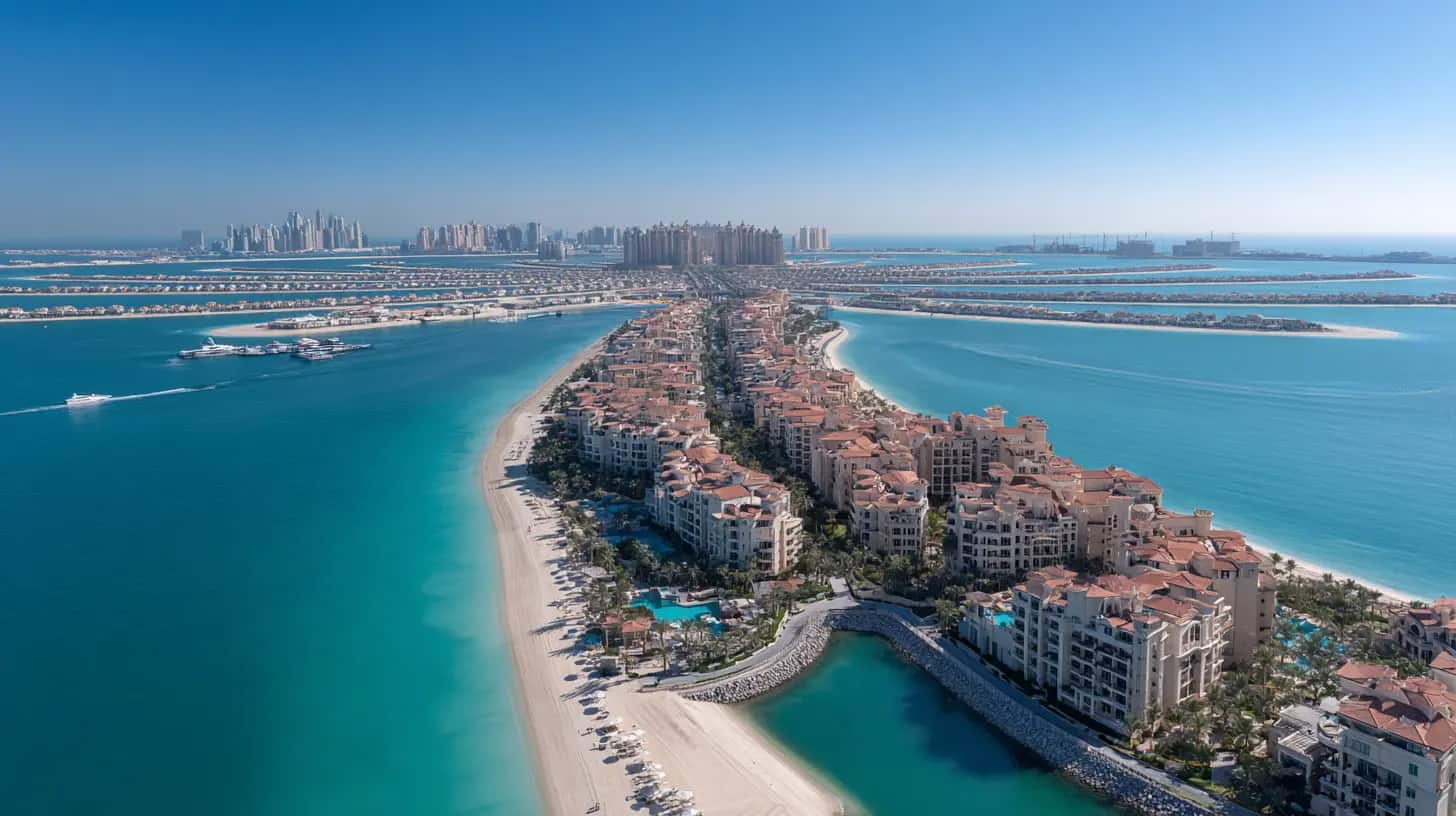
When Nakheel announced the project of Palm Jumeirah in 2001, the reaction of a significant section of the international property community was one of polite skepticism. An island in the shape of a palm tree, created from sand dredged up from the Arabian Gulf, and increasing the city’s coastline by forty kilometers in the process, in a city that never had a real estate industry in the first place. One set of questions related to the engineering of such a project; another set of questions related to whether anyone would actually choose to live there.
Two decades later, the answer to the latter question has been provided in the most emphatic manner possible. Palm Jumeirah has become one of the most recognized addresses in the world. There are residents from over sixty different nationalities who own properties in the development. The frond villas, launched in the mid-2000s at AED 3 million to AED 5 million, are currently selling in the range of AED 30 million to AED 80 million and above. The Shoreline apartments, launched at AED 800,000 in the mid-2000s and perceived as expensive at the time, are currently selling in the secondary market at AED 2.5 million to AED 4.5 million. The crescent of the palm, initially a breakwater with a small number of hotel plots, currently has Atlantis The Royal, one of the most awaited hotel launches in the world in 2023.
The investment story for the Palm is not an easy one, and any claims to the contrary are likely based upon an incomplete investigation of the issue. There were times, for example, between 2008 and 2012 and then between 2015 and 2018, when prices fell significantly, and buyers who had purchased at the peaks were paying the price for having entered at the worst time. There was speculation involved at the outset, which meant real losses for many buyers.
What has transpired since these corrections are crucial for understanding the Palm today. The market that has re-emerged after the 2020 correction has a very different character than the market prior to 2020. This market now has buyers who are more international, more focused on end-use, and financially stronger than the speculative buyers who defined the market in the mid-2000s. At the high end, the product has achieved a truly global status as a luxury good. And finally, the supply constraints imposed by the fact that the Palm Jumeirah fronds do not have any available land for new supply are an attribute not often found among the many communities within Dubai.
This article will seek to evaluate the Palm as an investment prospect for 2026 based not upon myth or marketing, but hard numbers and the kind of buyer for whom the Palm remains a relevant investment prospect.
What You're Actually Buying on the Palm
The Palm Jumeirah is not one market. It's several distinct sub-markets with different product types, different price points, different yield profiles, and different buyer bases. Treating it as a single investment category leads to confused analysis.
The Frond Villas
The fronds are the sixteen palm branches extending from the trunk. Each frond has villas on both sides, with private beach, private pool, and direct sea access. This is the product that defines the Palm's global identity — the imagery you've seen on every piece of marketing. It's also the most expensive and the most illiquid part of the market.
Frond villas range from four-bedroom townhouses starting around AED 15 million to bespoke signature villas at AED 50 million to AED 100 million and above. Transaction volumes are relatively low — there are only so many frond villas and they don't change hands frequently. When they do, the deals tend to be significant.
Capital appreciation on frond villas since 2020 has been extraordinary by any measure. Knight Frank's 2025 Wealth Report cited Palm Jumeirah as one of the top-performing luxury residential markets globally, with prime villa prices increasing 130% between 2020 and 2024. That number gets quoted frequently. What gets quoted less is that it followed a decade of flat to negative performance in parts of the segment.
The Shoreline and Apartment Buildings
The Shoreline Apartments — a series of low-rise buildings running along the trunk and the inner crescent edge — represent the Palm's most accessible and most liquid product. Eighteen buildings, thousands of units, a well-established secondary market with consistent transaction volumes.
One-bedrooms in the Shoreline currently sit at AED 1.6 million to AED 2.2 million. Two-bedrooms run AED 2.2 million to AED 3.8 million. These are units that trade regularly, can be financed with a standard mortgage, and generate rental income on both short and long-term bases.
The newer apartment buildings — FIVE Palm, Serenia, Palm Beach Towers, and others — occupy the mid-to-upper tier. Better finishes, more recent construction, higher price per square foot. FIVE Palm in particular has become a landmark of Palm apartment living, though the building's hotel-residential hybrid structure creates a management environment that not all buyers find straightforward.
The Crescent
The outer crescent of the Palm is primarily hotel and hospitality — Atlantis The Palm, Atlantis The Royal, the One&Only, Sofitel, and several others. But there are residential components in some of these developments, and the ultra-luxury branded residences that have launched on the crescent in recent years represent a different product category from the rest of the Palm.
The Royal Atlantis Residences, for example, launched at prices that were considered eye-watering at the time and have appreciated significantly since. These are not conventional investment properties — they're trophy assets for buyers for whom price per square foot is not the primary consideration.
The Numbers: What the Palm Has Actually Delivered
Talk about investment potential is only useful when it's grounded in what actually happened.
According to CBRE's 2025 Dubai Residential Market Outlook, Palm Jumeirah recorded the highest average residential transaction value of any Dubai community in 2024, with an average sale price of AED 8.2 million across all property types. That figure reflects the concentration of high-value villa transactions pulling the average up — but it signals something real about where the market has moved.
On capital appreciation, the story breaks down by period and product type:
2005 to 2008: rapid price growth driven by speculative demand, early off-plan flipping, limited actual supply delivered
2008 to 2012: significant price correction, some frond villa values fell 40% to 50%, apartment markets fell 30% to 40%
2012 to 2019: gradual recovery, uneven across product types, villa market slower to recover than apartments
2020 to 2024: the run that defined the current market — villas up 100% to 150% on some products, apartments up 60% to 80%
The investors who made the strongest returns were those who bought during the 2012 to 2015 window, when the market was soft and sentiment was poor. That pattern — buying quality assets in a recognised location when the market is quiet — is how most significant property gains are made, on the Palm and everywhere else.
Dr. Hussain Sajwani, founder of DAMAC Properties and one of Dubai's most prominent real estate developers, has noted in multiple industry forums that "the Palm demonstrated something no other development in the region had — that you could create scarcity artificially and have the market price it as genuine scarcity over time." The observation is pointed. The Palm's land supply is genuinely fixed, and that constraint has become more valuable as the broader Dubai market has grown around it.
For a full view of what's currently available on the Palm, our Palm Jumeirah listings are updated regularly across all product types.
Gaia Realty Original Research: Palm Jumeirah Investment Snapshot, Q1 2026
Based on DLD transaction data, active secondary market listings, and operator yield data as of Q1 2026.
Capital values by product type:
- Frond villas (4-bed): AED 18M to AED 35M, up 90% to 120% since 2020
- Frond signature villas (5-6 bed): AED 40M to AED 100M+, up 120% to 150% since 2020
- Shoreline 1-bed apartments: AED 1.6M to AED 2.2M, up 60% to 75% since 2020
- Shoreline 2-bed apartments: AED 2.2M to AED 3.8M, up 65% to 80% since 2020
- Palm Beach Towers 2-bed: AED 3.5M to AED 5.5M, up 55% to 70% since launch
- Royal Atlantis Residences: AED 8M to AED 25M, strong appreciation since launch
Rental yields by product type:
- Frond villas (long-term): 3% to 4% gross, stable tenant demand from senior executives and HNW families
- Frond villas (short-term): 4% to 6% gross, high seasonal demand, strong event-driven spikes
- Shoreline apartments (long-term): 5% to 6% gross, consistent occupancy
- Shoreline apartments (short-term): 6% to 8% gross, strong tourism demand
- FIVE Palm and newer buildings: 5% to 7% gross, complex management environment
Transaction volumes on the Palm in 2024 versus 2020:
- Total residential transactions up 85%
- Value of transactions up 210%
- Average days on market for frond villas down from 94 days to 31 days
- Cash buyers represent approximately 68% of frond villa transactions
The Scarcity Argument: Why No New Land Matters
This is the single most important structural factor for Palm Jumeirah investment and it doesn't get enough attention in the standard analysis.
Most Dubai communities face ongoing supply risk. Developers can — and do — build more towers in JVC, more towers in Business Bay, more units in almost any community where land is available. That supply keeps a ceiling on price appreciation in those markets. When demand rises, supply can rise to meet it, and prices stabilise or grow slowly.
The Palm fronds cannot be extended. There is no mechanism for adding new frond villa land. The supply of frond villas is functionally fixed at the number that exist today. When demand for that product increases — as it has consistently since 2020 — the only release valve is price. Sellers can ask more because there is nothing else to buy that is comparable.
This is what makes the frond villa market behave more like fine art or rare watches than like standard residential real estate. The comparison sounds hyperbolic but the structural logic is the same: fixed supply, growing pool of potential buyers, price discovery that moves upward over time with periodic corrections.
The apartment market on the Palm doesn't have this characteristic to the same degree — there has been more apartment supply added over time, and more is coming. The scarcity argument applies most cleanly to the frond villas and, to a lesser extent, the highest-quality crescent residences.
The Risks: What Can Go Wrong
Any honest account of Palm Jumeirah investment has to include the risk side of the ledger.
Liquidity risk is the most relevant for frond villa buyers. These are high-value assets with a relatively shallow buyer pool. When you need to sell, you're relying on a buyer with AED 20 million to AED 80 million available, specific interest in the Palm, and willingness to transact at your asking price. In good markets, that buyer exists within weeks. In softer markets, it can take months — and the negotiation can be significant. This is not a market for investors who need to be able to exit quickly.
Yield compression is a real consideration. The capital appreciation story on the Palm since 2020 has been impressive but it has come partly at the cost of yield — prices have risen faster than rents, so the gross yield on a frond villa bought today is lower than it would have been for a buyer who entered in 2015. Investors who are yield-dependent need to model current returns honestly rather than extrapolating from past appreciation.
Management complexity on short-term rentals is higher on the Palm than in most communities. The distance from the mainland, the villa product requiring more maintenance than an apartment, and the more demanding guest profile at the price point all add operational intensity that investors sometimes underestimate.
Market timing risk remains. The Palm's history includes two significant corrections. A third is not ruled out by the market's current strength. Buyers entering at 2024 and 2025 prices are buying at or near historical highs. That is not necessarily wrong — the same was true in 2015 relative to 2010, and buyers who entered then have done well — but the entry price matters for what your return profile looks like.
For investors looking at the lower end of the Palm market, our buy property service can help work through what makes sense at different price points and timelines.
Who the Palm Makes Sense For
The Palm is not the right investment for every buyer. Being honest about that is more useful than a blanket recommendation.
The Palm makes strong sense for end users who genuinely want the lifestyle and can afford to hold long-term. If you want to live on a private beach in Dubai, wake up with sea views, and be part of a community that has developed real depth and character over twenty years — the Palm delivers that. The investment case for end users is secondary to the lifestyle case, which makes the yield compression less relevant.
It makes sense for ultra-high-net-worth buyers for whom the Palm is one asset in a broader portfolio and capital preservation with upside is the objective. The scarcity argument, the global brand recognition, and the quality of the recent infrastructure investment on the crescent all support a long-term store-of-value thesis.
It makes sense for investors in the Shoreline and mid-tier apartment segment who want a combination of yield and capital growth at a price point that is high but financeable. This is a more conventional investment case — mortgage the property, generate rental income, benefit from appreciation over five to ten years. The numbers work if you buy well and manage the property professionally.
It makes sense less clearly for investors who need strong yields to service debt on a frond villa. The math is tight at current prices and current long-term rental rates. Short-term rental can improve it, but not without operational intensity.
Our team has worked across all Palm product types and can help you work out which end of the market — if any — fits your specific situation. Take a look at our agents and reach out if you want to have that conversation.
Questions People Ask About Investing in Palm Jumeirah
Has the Palm already peaked, or is there more upside?
Nobody knows — and anyone who says they do is guessing. What's structural is the supply constraint on frond villas. What's cyclical is sentiment and global capital flows. The long-term case for scarcity-driven appreciation is intact. Short-term, you're buying near historical highs.
What's the minimum budget to invest on the Palm?
Shoreline one-bedrooms start around AED 1.6 million. That's the accessible entry point with mortgage financing available. Frond villas start around AED 15 million to AED 18 million for a four-bedroom. The crescent branded residences go well above that.
Are Palm Jumeirah properties freehold for foreigners?
Yes. The Palm is one of Dubai's original designated freehold areas. Non-UAE nationals can buy, own, and sell without restriction.
What yields can I realistically expect on a Shoreline apartment?
Long-term rental generates around 5% to 6% gross. Short-term rental, well managed, can push 6% to 8% gross before operator fees and running costs. Net yields are typically 1.5% to 2% lower than gross.
How does the Palm compare to Emaar Beachfront as an investment?
Different risk profiles. Emaar Beachfront has more upside potential from a lower base and better yield at current prices. The Palm has stronger scarcity credentials, deeper brand recognition, and a more established community. One is a growth play, the other is a quality hold.
Is short-term rental viable on the Palm fronds?
Yes, and it's one of the stronger short-term rental segments in Dubai. Private beach and pool villas command premium nightly rates — AED 5,000 to AED 15,000 in peak season. The guest profile is high-end and the demand from families and groups is consistent.
What are the service charges on the Palm?
Higher than most Dubai communities. Frond villas typically run AED 20 to AED 30 per square foot. Shoreline apartments are lower at AED 15 to AED 22 per square foot. Factor this into net yield calculations — it's meaningful at these property sizes.
Can I get a mortgage to buy on the Palm?
Yes. Standard UAE Central Bank LTV rules apply — 80% for properties under AED 5 million, 70% above that. At frond villa prices, most buyers are cash or using private financing. Shoreline apartments are commonly mortgaged.
How liquid is the Palm market if I need to sell?
Shoreline apartments are relatively liquid — consistent buyer demand and regular transaction volumes. Frond villas are less liquid. In a strong market you might sell in weeks. In a slower market, months. Price expectations need to flex accordingly.
What's the Golden Visa situation for Palm buyers?
Purchases above AED 2 million qualify for a 10-year UAE Golden Visa. Almost every property on the Palm exceeds that threshold. It's one of the practical benefits of buying here.
Is the Atlantis The Royal good or bad for nearby property values?
Good, broadly. The opening in 2023 reinforced the Palm's global brand in a way that no amount of developer marketing could. Ultra-luxury hospitality at that level signals to the market that the address is serious. Nearby residential values responded accordingly.
What happens to the Palm if Dubai's economy slows?
The Palm has been through two significant corrections — 2008 and 2015 — and recovered both times. In a genuine downturn, frond villa values would likely fall meaningfully given their illiquidity. Shoreline apartments are more resilient. The long-term case depends on Dubai remaining an attractive global city, which has held through various economic cycles so far.
The Palm in 2026: A Mature Market With a Structural Edge
Palm Jumeirah has moved from a speculative concept to a proven luxury lifestyle product in the past twenty years. This journey is now over. The question for investors today is not whether Palm Jumeirah is real—a question answered long ago and decisively in the affirmative—but rather whether or not the price level is right for the investment return profile desired.
In frond villas, there is a scarcity-driven product with real structural underpinning. Supply does not increase. The total pool of global consumers who are both able and willing to purchase a private beachfront villa in a zero-tax environment has steadily increased over time. The brand has recognition in the Russian, Indian, UK, European, and GCC markets, which drive the majority of our consumers. This will not change unless and until Dubai itself changes dramatically as a destination, and there is little evidence of that in the past decade.
In apartments, we have a more traditional investment product: real yields, strong appreciation, and a Palm premium over comparable apartments in Dubai proper that has proven remarkably resilient. This is not a high-yield product at current prices. It is a product of quality and location in a premium environment with a proven brand and address that works for both rental and resale.
However, risks are also substantial and warrant serious consideration. Those who succeed investing on Palm Jumeirah are those who do so with a healthy dose of reality and a long investment time horizon and a clearly defined rationale for why they believe this investment at this price is right for their specific circumstances.
If you want to work through that thesis with people who know this market in detail, reach out and we'll take it from there.
Related stories
Dubai's Established Charm: The Case for Older Homes
In a city focused on the future, I believe the smartest move for many buyers is to look back. Dubai's seasoned communities offer space, character, and surprising value that new builds often can't match.
The True Cost of Owning a Dubai Property
Beyond the purchase price, your annual budget for a Dubai home must account for service charges, utilities, and maintenance. I'll break down every ongoing expense you need to plan for.
Calculating ROI on Dubai Rental Upgrades
As a landlord in Dubai, you can't just follow trends. I'll show you how to calculate the precise ROI of minor property upgrades to genuinely increase your rental yield.
Echoes, in your inbox
One thoughtful email a month. Market insight, new launches, no spam.