

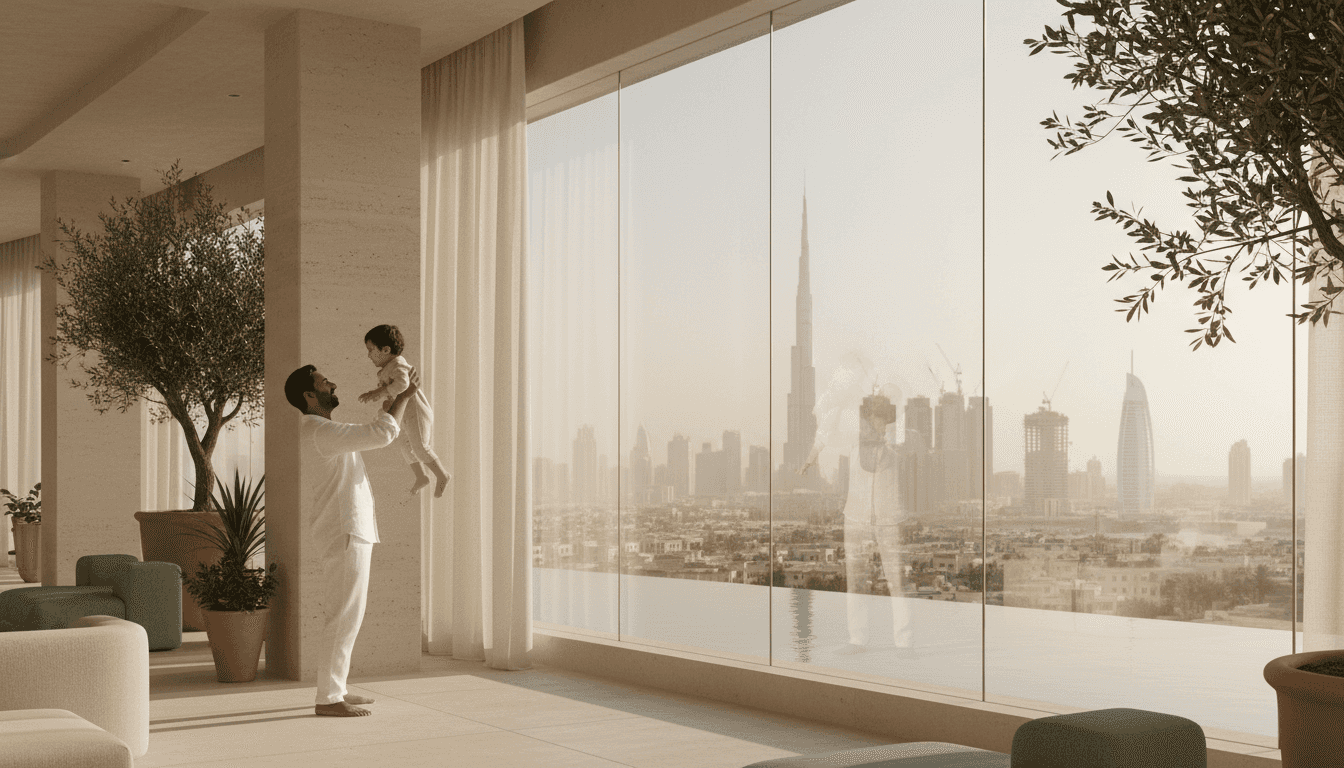
The Green Premium: Are Eco-Homes Worth It in Dubai?
Dubai is aggressively promoting green building standards, but does this translate into a tangible price premium for buyers and investors? We break down the real costs, benefits, and market reality.

Dubai's skyline is a sign of ambition, but a quieter, arguably more significant, revolution is taking place at ground level. The government's aggressive push for green building certifications is reshaping how our city is built. But for the investor and end-user, the critical question remains: do these eco-friendly properties actually command a premium?
Here’s my analysis of the a `sustainable property investment` in the UAE:
- The Regulatory Landscape: Decoding Al Sa'fat, LEED, and Estidama.
- The Developer's Calculus: Why are they building green?
- The Cost vs. Benefit for Buyers: Upfront expenses versus long-term savings.
- The 'Green Premium' Myth: What the market data actually shows about property value.
- Tenant Demand and Rental Yields: The real ROI of an eco-friendly asset.
- A Worked Example: The numbers behind an energy-efficient apartment.
- Future-Proofing Your Portfolio: Why sustainability is a non-negotiable long-term play.
- My Verdict: Is it worth paying more for green?
The Regulatory Landscape: Decoding Al Sa'fat, LEED, and Estidama
To understand the value of `eco-friendly real estate UAE`, you first have to understand the rules of the game. For years, developers in Dubai could build with relative freedom, prioritising speed and aesthetic impact. That has fundamentally changed. The regulatory environment now forms the bedrock of the city’s green transition, driven by a national strategy to achieve climate neutrality by 2050. This isn't just a marketing slogan; it's enforced by municipal-level codes that every developer must follow. The primary framework governing this is the Al Sa'fat Green Building Rating System, managed by Dubai Municipality. It's not optional. Since 2014, all new construction projects in Dubai must meet, at a minimum, the 'Bronze' Sa'fat standard. This has created a baseline level of sustainability across the city that didn't exist a decade ago.
The Al Sa'fat system is tiered: Bronze, Silver, and Gold. Each level requires adherence to an increasing number of sustainable practices. These aren't abstract goals; they are specific, measurable criteria covering everything from energy and water efficiency to the types of building materials used and how construction waste is managed. For example, a Bronze-rated building might be required to use solar water heaters and specific types of low-emissivity glass. A Gold-rated building will have far more stringent requirements, potentially including on-site renewable energy generation, advanced greywater recycling systems, and a high percentage of locally sourced or recycled materials. For a buyer, this means even a standard new apartment today is more `energy-efficient homes Dubai` than one built in 2010. It’s a crucial point that often gets lost in the marketing noise about luxury green projects.
Alongside Al Sa'fat, you'll frequently see two other certifications mentioned: LEED and Estidama. LEED, which stands for Leadership in Energy and Environmental Design, is the globally recognised benchmark from the U.S. Green Building Council. Many premium developers in Dubai pursue LEED certification (Certified, Silver, Gold, or Platinum) in addition to the mandatory Al Sa'fat rating. Why? Because LEED has international brand recognition. It signals a commitment to a global standard of sustainability that resonates with a diverse international buyer pool. While Al Sa'fat ensures compliance, LEED provides a competitive edge, particularly in the prime and super-prime segments. Projects like Creek Harbour and parts of Downtown Dubai often highlight their LEED certifications as a mark of quality. The third system, Estidama — meaning 'sustainability' in Arabic, and its Pearl Rating System is the equivalent of Al Sa'fat for Abu Dhabi. It's mandatory for all new projects there and serves the same purpose: setting and enforcing sustainability standards. So when you hear about `LEED Estidama Dubai`, it's often a conflation of the two dominant regional systems, one global (LEED), and one local to Abu Dhabi (Estidama's Pearl system), all co-existing with Dubai's own Al Sa'fat.
The Developer's Calculus: Why Are They Building Green?
 Featured project
Developers are not, by nature, philanthropists. Their decisions are driven by a mix of regulatory compulsion, market demand, and financial calculation. The initial driver for the shift towards green building was, without question, the mandatory Al Sa'fat regulations. Compliance is not a choice. This forced the entire industry to adapt, from architects and engineers to contractors and material suppliers. The supply chain for sustainable materials and technologies in the UAE has matured significantly as a result, bringing down the incremental cost of building to a higher standard. What was once a niche and expensive specialisation is now a standard operational requirement.
However, the story has moved beyond mere compliance. Leading developers like Emaar Properties, Aldar in Abu Dhabi, and boutique firms focused on wellness like Al Barari have embraced sustainability as a core part of their brand identity and a key market differentiator. They are not just aiming for the minimum Bronze Sa'fat; they are actively targeting Gold and Platinum LEED certifications. There are several reasons for this. Firstly, it enhances their brand reputation. In a competitive market, being known as a 'green developer' helps attract capital, build trust with buyers, and secure flagship government-backed projects. It aligns their corporate image with the UAE's national vision, which is a powerful positioning tool.
Secondly, there's a growing realisation that `property value green features` can translate into a commercial advantage, even if it's not always a direct, immediate price premium. Developers have found that certified green buildings can be more appealing to specific buyer segments. This includes institutional investors who have their own ESG (Environmental, Social, and Governance) mandates, multinational corporations seeking sustainable office space, and a growing cohort of high-net-worth individuals who prioritise health, wellness, and environmental responsibility. For these buyers, a LEED certificate is a proxy for quality, better air quality, and lower running costs. In the off-plan market, these certifications become a powerful marketing tool. Developers can use them to build a narrative of a superior, healthier, and more future-proof community, as we've seen in projects like those in Expo City, which was designed from the ground up with sustainability at its core.
Finally, there's the operational efficiency of the building itself. While the developer's primary concern is selling the units, they are often responsible for the building and community management for the first few years. A building designed with energy and water efficiency has lower common area utility bills and potentially lower maintenance costs for key systems. This can make the service charges more competitive, a key selling point for any off-plan property. This operational saving is a direct benefit that can be passed on to the homeowners association later, making the community more financially sustainable in the long run. It's a shift from thinking only about the cost to build, to considering the total cost of ownership over the building's lifecycle.
The Cost vs. Benefit for Buyers: Upfront Expenses Versus Long-Term Savings
For any potential buyer, the central question is simple: what does this cost me, and what do I get back? The perception is that green buildings are significantly more expensive. In the early days of the trend, this was true. The 'green premium' on construction costs could be as high as 10-15%, driven by the expense of specialised materials, consultants, and new technologies. Today, that premium has fallen dramatically. Based on discussions with contractors and developers, the incremental cost for a developer to achieve a basic Al Sa'fat Bronze or Silver rating is now marginal, perhaps 1-3% of total construction costs, because the practices are now mainstream. Achieving a high-level LEED Gold or Platinum certification still costs more, potentially adding 5-8% to the construction budget, as it requires more advanced systems and rigorous documentation.
Does this extra cost get passed on to the buyer? Yes and no. In the ultra-luxury segment, a developer like Omniyat might build a LEED Gold tower and price that premium directly into the high-end apartments, knowing their clientele will pay for the perceived quality and exclusivity. In the mass market, however, the picture is more complex. A developer like Nshama building in Town Square is bound by Al Sa'fat rules, but they are also competing fiercely on price. They will absorb the minimal extra cost of compliance rather than risk pricing themselves out of the market. My experience in the market shows that for two comparable apartments in the same area, one in a standard new building (which is Al Sa'fat compliant by default) and one in an older, pre-2014 building, the price difference is rarely attributable to the 'green' factor alone. It's more often tied to the age of the building, the quality of the finishings, and the reputation of the developer.
“The real financial return on a green property isn't found in a higher sale price; it's hiding in plain sight on your monthly DEWA bill and annual service charge invoice.”
The true benefit for the owner isn't in capital appreciation but in operational savings. This is the most misunderstood part of the `sustainable property investment` equation. These savings come from two main sources:
1. Lower Utility Bills: This is the most direct saving. A certified `energy-efficient homes Dubai` will have better insulation, high-performance windows, efficient AC systems, and water-saving fixtures. This can lead to a significant reduction in your monthly DEwa (Dubai Electricity and Water Authority) bill. Studies and project data from developers suggest savings can range from 15% to as much as 40% compared to a non-efficient building of the same size. In a city where air conditioning accounts for a huge portion of household electricity consumption, this is a material saving that adds up to thousands of dirhams per year.
2. Lower Service Charges: Service charges cover the maintenance and operational costs of a building's common areas. In a green building, these costs are inherently lower. Common area lighting uses LEDs, irrigation for landscaping uses recycled water or drought-resistant plants, and the building's overall energy footprint is smaller. These efficiencies are passed on to homeowners through lower service charges. While it can be difficult to isolate the 'green' component of a service charge, it's common to see newer, more efficient buildings having more stable or lower charges (calculated in AED per square foot) than older, less efficient towers that require more energy and maintenance.
The 'Green Premium' Myth: What the Market Data Shows
This is where the hype collides with reality. Does a LEED certificate add a clear, quantifiable percentage to a property's resale value in Dubai? The honest answer, as of today, is: not consistently and not across the board. While academic studies in mature markets like the US and Europe have found evidence of a 'green premium' of anywhere from 4% to 9%, the Dubai market doesn't yet behave in the same way. We at Gaia Living have analysed countless transactions, and it's almost impossible to isolate the green certification as the primary driver of a higher price when comparing two similar properties.
Why is this? Several factors are at play. First, the market's primary drivers are still location, size, view, developer reputation, and amenities. A non-certified apartment in Dubai Marina with a full sea view will always command a premium over a LEED Gold apartment in a less desirable location with an obstructed view. Second, the mandatory Al Sa'fat system has raised the baseline for all new properties. When every new building is 'green' to some extent, the differentiation is less pronounced than in markets with a wider quality gap between old and new stock. A buyer choosing between two five-year-old buildings in JVC knows that both had to meet the same basic sustainability codes, so it's not a deciding factor.
Third, and perhaps most importantly, there's an awareness and valuation gap. Many buyers, and even some real estate agents and mortgage valuers, are not yet fully equipped to price the long-term financial benefits of sustainability into an upfront valuation. A bank's valuer will look at comparable sales (the 'comps') in the area. If the market isn't consistently paying more for certified properties, the valuation won't reflect a premium. It becomes a self-fulfilling cycle. Until a critical mass of transactions explicitly demonstrates this premium, valuers will remain conservative. We are not yet at a stage where a bank will offer a higher loan-to-value ratio on a property simply because it has a LEED certificate.
Where we do see a difference is at the very top of the market and in specific niche projects. In communities like Al Barari or with developers who have built their entire brand on sustainability, the eco-credentials are part of the overall luxury package that commands a higher price. Buyers in this segment are purchasing a lifestyle, and the green features are an integral part of that proposition. Similarly, in the commercial real estate sector, the story is different. Large multinational corporations with ESG mandates will actively seek out and pay a premium for office space in LEED-certified buildings. This is driven by their own corporate reporting requirements and the desire to attract top talent. This trend in the commercial space is a leading indicator, and it's my belief that the residential market will eventually follow suit as buyer awareness grows.
Tenant Demand and Rental Yields: The Real ROI
If the capital appreciation premium is elusive, where is the real return for an investor? In my experience, it lies squarely in the rental market. The financial benefits of lower operating costs accrue directly to the occupant, whether they are an owner-occupier or a tenant. And in a competitive rental market like Dubai, this is a significant advantage. When a tenant is choosing between two identical apartments, the one that can credibly promise lower DEWA bills and is in a building with better amenities and potentially lower service charges (if included in the rent) will be more attractive.
This translates into two key benefits for landlords of green properties. First, reduced vacancy periods. A more desirable property rents faster. In a market with ample supply, every week a property sits empty directly eats into your annual return. An energy-efficient apartment with demonstrable cost savings is an easier pitch for a letting agent and a more compelling option for a prospective tenant. This is especially true for corporate tenants and professional expatriates who are often more aware of utility costs and sustainability issues. They are more likely to ask about the building's efficiency and factor that into their decision.
Second, the potential for higher net rental yields. Gross yield is the annual rent divided by the property price. But the number that truly matters to an investor is the net yield, which accounts for all your expenses, primarily service charges. Consider this simple scenario for a `sustainable property investment`:
- Property A (Standard): Price AED 1,000,000. Rent AED 70,000/year. Gross Yield: 7.0%. Service Charges: AED 20/sqft on 1,000 sqft = AED 20,000/year. Net Yield: (70,000 - 20,000) / 1,000,000 = 5.0%
- Property B (Green Certified): Price AED 1,030,000 (let's assume a small 3% premium). Rent AED 70,000/year. Gross Yield: 6.8%. Service Charges: AED 15/sqft on 1,000 sqft = AED 15,000/year. Net Yield: (70,000 - 15,000) / 1,030,000 = 5.34%
In this example, even though Property B was slightly more expensive and had a lower gross yield, its lower operating costs result in a significantly higher net yield for the investor. This is the hidden ROI of green buildings. The landlord benefits from a more stable, income-producing asset. As tenants become more sophisticated and tools become available to compare the all-in cost of living in different buildings, this advantage will only grow. Landlords who can market their properties with evidence of lower utility bills or more reasonable service charges will have a clear competitive edge.
A Worked Example: The Numbers Behind an Energy-Efficient Apartment
Let's move from theory to a concrete financial breakdown. Imagine you are considering buying a two-bedroom apartment of approximately 1,200 sq. Ft. in a newer community like Arjan or Dubai Science Park. You have two options: one in a building from 2012 (pre-Sa'fat) and one in a new, recently completed building with a Silver Sa'fat rating.
Let's assume the purchase price for both is broadly similar, around AED 1.5 million, as the market hasn't priced in a significant green premium. The real difference emerges in the annual running costs. Here’s a line-by-line comparison:
Building 1: 2012 Construction (Non-Certified Equivalent)
- Purchase Price: AED 1,500,000
- Annual Service Charges: @ AED 19 per sq. Ft. (a typical rate for an older building with higher maintenance)
- 1,200 sq. Ft. x AED 19 = AED 22,800 per year
- Annual DEWA Bill (Estimate): Based on average consumption in less efficient buildings.
- Electricity (higher AC load): ~AED 1,100/month
- Water: ~AED 250/month
- Housing Fee (5% of average rent, say AED 90k/yr): AED 375/month
- Total Monthly DEWA: ~AED 1,725
- Total Annual DEWA: AED 20,700 per year
- Total Annual Running Cost: AED 22,800 (Service Charge) + AED 20,700 (DEWA) = AED 43,500
Building 2: New Construction (Silver Sa'fat Certified)
- Purchase Price: AED 1,500,000
- Annual Service Charges: @ AED 16 per sq. Ft. (lower due to efficient common areas)
- 1,200 sq. Ft. x AED 16 = AED 19,200 per year
- Annual DEWA Bill (Estimate): Assuming a 20% efficiency saving.
- Electricity (lower AC load): ~AED 880/month
- Water (efficient fixtures): ~AED 200/month
- Housing Fee: AED 375/month
- Total Monthly DEWA: ~AED 1,455
- Total Annual DEWA: AED 17,460 per year
- Total Annual Running Cost: AED 19,200 (Service Charge) + AED 17,460 (DEWA) = AED 36,660
In this realistic scenario, the owner of the certified green apartment saves AED 6,840 per year. If you are an end-user, that's direct cash back in your pocket. If you are an investor, it means your net rental income is AED 6,840 higher, boosting your net yield from 4.72% to 5.18% (assuming a rent of AED 90,000 and ignoring other costs for simplicity). Over a five-year holding period, that's an extra AED 34,200 in your pocket. This is the tangible financial logic behind choosing a green property, and it has nothing to do with chasing a speculative capital premium.
Future-Proofing Your Portfolio: A Non-Negotiable Play
Investing in real estate is a long-term game. What seems optional today often becomes essential tomorrow. In my view, overlooking sustainability is a strategic error that could devalue a portfolio over the next decade. There are several powerful trends that point to the increasing importance of `green building certifications Dubai`.
First, regulatory tightening is a one-way street. The standards set by Al Sa'fat today are the floor, not the ceiling. It is highly likely that these requirements will become more stringent over time. We may see the mandatory minimum move from Bronze to Silver, or the introduction of new regulations around retrofitting older buildings. Properties that already meet a higher standard (e.g., LEED Gold) will be ahead of the curve, insulated from the costs of future mandatory upgrades. Buildings that are inefficient and fall behind the new standards could become less desirable, harder to rent, and potentially face obsolescence, a concept known as a 'brown discount' — the opposite of a green premium.
Second, utility prices. While electricity and water are subsidised in the UAE, the global trend is towards higher energy costs and a reduction in subsidies. Any future adjustments to utility tariffs will disproportionately impact inefficient properties. The financial savings offered by an energy-efficient home will become even more significant, making these properties exponentially more attractive to both tenants and buyers. The ability to market a property with demonstrably low running costs will become one of the most powerful tools in an owner's arsenal. This is a crucial aspect of future-proofing your `property value green features`.
Third, the evolution of 'Green Finance'. While still nascent in the UAE's residential mortgage market, the concept of green finance is well-established globally. Banks and financial institutions are increasingly integrating climate risk into their lending decisions. It is not a huge leap to imagine a future where UAE banks offer preferential mortgage rates or higher loan-to-value ratios for certified green properties, viewing them as lower-risk assets. An owner of a green property might be able to borrow more, or at a cheaper rate, than the owner of a comparable non-certified property. When this happens, it will create a direct and quantifiable financial premium for green homes.
Investing in a certified green property today is not about chasing an immediate, speculative 'green premium'. It is a defensive, long-term strategy. You are buying a higher-quality asset with lower running costs, greater appeal to a growing segment of tenants, and more resilience against future regulatory and market shifts. It's about ensuring your asset remains relevant, desirable, and profitable for years to come.
My Verdict: Is It Worth Paying More for Green?
So, we return to the central question. After stripping away the marketing hype and focusing on the numbers, what's my final verdict? I believe that while you shouldn't necessarily pay a significant, unsubstantiated premium for a green certification alone, you should absolutely prioritise certified green properties when making your investment decision. The focus should shift from 'What is the resale premium?' to 'What is the total return on investment?'.
The most intelligent approach is to treat green certification as a critical indicator of quality and long-term performance. When you see a LEED or a high-level Al Sa'fat rating, it tells you that the developer has paid attention to detail, used better materials, and built a home that will be cheaper to run and more comfortable to live in. It's a proxy for a well-constructed building. You are not just buying a certificate; you are buying better insulation, higher-performance windows, more efficient AC systems, and smarter water management.
For investors, the strategy is clear. When comparing two potential investments, the green-certified property offers a better risk-adjusted return. It promises lower vacancy rates, a higher net yield due to operational savings, and an asset that is fundamentally better positioned for the future. For end-users, the logic is even more compelling. The annual savings on utility bills and service charges are a direct increase in your disposable income, and you get to live in a healthier, more comfortable environment with better air quality and thermal comfort.
Therefore, my advice at Gaia Living is not to overpay for the 'green' label itself, but to actively seek out properties where sustainability is integrated into the design and construction. Look for the evidence: the certifications, the specific features like solar panels or greywater recycling, and the developer's track record. The smart money in Dubai real estate is no longer just looking at the view from the penthouse. It's looking at the service charge budget, the DEWA forecast, and the long-term resilience of the asset. In the Dubai property market, green is no longer a niche. It is the new standard of quality.
Sources
- Dubai Land Department (DLD): https://dubailand.gov.ae/en/
- Dubai Municipality - Al Sa'fat Regulations: https://www.dm.gov.ae
- UAE Government Portal - Climate Neutrality 2050: https://u.ae/en/information-and-services/environment-and-energy/climate-change
- Dubai Electricity and Water Authority (DEWA): https://www.dewa.gov.ae/en/
- Abu Dhabi Government - Estidama: https://www.dmt.gov.ae/en/ADM-Services/Estidama
Questions, answered
- Do green buildings in Dubai actually sell for more?
- Currently, there is no consistent, statistically proven 'green premium' on the sale price across the Dubai market. While some high-end, eco-conscious projects may command higher prices, the main financial benefit for owners comes from lower operational costs (service charges and DEWA bills) rather than a higher capital valuation at resale.
- What are the main green building certifications in Dubai?
- The primary certifications are the international LEED (Leadership in Energy and Environmental Design) system and the UAE's own Al Sa'fat rating system, which is mandatory for all new constructions in Dubai. Estidama's Pearl Rating System is the equivalent standard used in Abu Dhabi.
- Are green properties a good investment in Dubai?
- In my view, they are a smart long-term investment. While the upfront capital gain isn't guaranteed, the lower running costs lead to higher net rental yields and make the property more attractive to tenants. As energy prices rise and regulations tighten, these properties will likely become more desirable and hold their value better.
- How do green features lower my costs as a homeowner?
- Energy-efficient homes in Dubai reduce costs primarily through lower DEWA (electricity and water) bills due to better insulation, solar water heaters, and efficient AC systems. They also often have lower service charges, as common area power consumption and water usage for landscaping are reduced.
- What is the Al Sa'fat rating system in Dubai?
- Al Sa'fat is Dubai Municipality's green building rating system, mandatory for all new buildings since 2014. It has three levels — Bronze, Silver, and Gold, with requirements covering energy and water efficiency, materials, and waste management. It ensures a baseline of sustainability in all new developments.
- Can I get a 'green mortgage' in Dubai?
- While the concept is emerging, 'green mortgages' offering preferential rates for certified sustainable properties are not yet a widespread, mainstream product from major UAE banks. This may change as the market matures and lenders see the lower risk profile of energy-efficient homes.
Omar tracks the announcements that move the market — new launches, regulation, mega-projects, and developer moves — and tells you what they actually mean for buyers.
Related stories
The Price of Privacy in Dubai's Gated Enclaves
In a city defined by spectacle, the ultimate luxury is discretion. I explore the appeal of Dubai's exclusive gated communities and what it truly costs to live behind the gates.
Dubai's Best Villa Communities for Family Investment
I explore which established and emerging Dubai villa communities offer the best blend of family lifestyle and long-term investment value, moving beyond hype to focus on real market fundamentals.
The Resale Journey: Maximizing Your Apartment's Value
As an owner, preparing to sell your Dubai apartment requires more than just a listing. I'll walk you through the essential steps, from strategic pricing to final handover, to ensure you secure the highest possible market value.
Echoes, in your inbox
One thoughtful email a month. Market insight, new launches, no spam.