

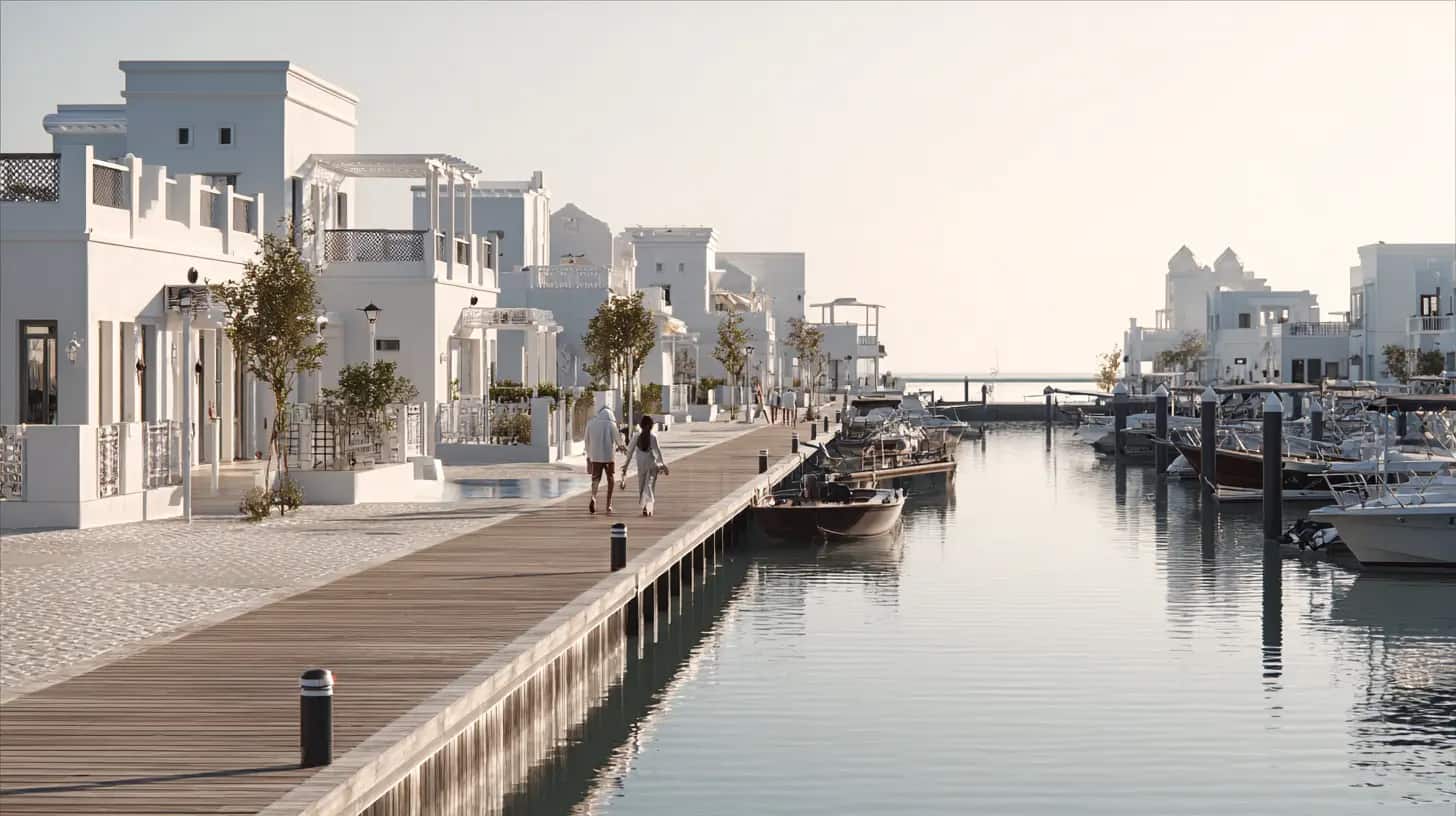
How Waterfront Living in Dubai Has Evolved
Dubai Didn't Have a Waterfront. It Built One. Three decades ago, the Dubai coastline looked significantly different.
Dubai Didn't Have a Waterfront. It Built One.
Three decades ago, the Dubai coastline looked significantly different. There was the Creek, the ancient hub of commerce that is in the DNA of Dubai’s business psyche. There was a beach area stretching north towards Sharjah and a handful of hotels. Beyond that, the concept of a city inextricably linked to water, where the prime locations are those with a water view or a marina berth, and artificial islands that add dozens of kilometers to the coastline, did not exist. In fact, a significant amount of it did not exist even fifteen years ago.
What has developed in the intervening years is one of the most impressive urban development stories in the past half-century. Dubai looked out over its landscape, a narrow coastline, a natural Creek, and a vast shallow Gulf, and saw these as not restricting, but liberating.
The first manifestation of this was the Palm Jumeirah, a manmade island in the shape of a palm tree and constructed from dredged sand. This artificial island added forty kilometers of coastline to a city that had little to begin with. And it succeeded—not immediately and not without controversy, but it succeeded—in demonstrating that Dubai residents would pay a significant premium to live on water, not just near it.
Subsequently, a new wave of waterfront development has been undertaken with no signs of slowing down since the mid-2000s. Dubai Marina has created an entirely new city district around a man-made canal. JBR has created a kilometre of beachfront retail and residential space within a single development. Emaar Beachfront has created a new residential district between the Marina and the Palm. Bluewaters Island has created a new leisure destination with a location for the world’s largest Ferris wheel. Creek Harbour is currently working towards creating a new development which may potentially feature the tallest building in the world alongside a natural waterway.
Each of these developments has been created around the same central idea: what does waterfront living mean? And for whom does it exist? This answer has changed significantly over the last two decades, and we will look at how it has evolved through the years and what it means today for buyers and residents. This article will provide a comprehensive overview of waterfront living in Dubai today and what it means for buyers and residents in 2026.
From Creek to Coast: The Origins of Dubai's Water Identity
Before the developers arrived, the Dubai Creek was the city's original waterfront. The abras still cross it today — small wooden water taxis that have been making the same journey between Deira and Bur Dubai for over a century. Gold souk on one side, spice souk on the other, dhows loaded with cargo moored along the banks. The Creek wasn't lifestyle real estate. It was commerce, history, and community in one narrow stretch of water.
The shift toward waterfront living as a residential concept began in the 1990s with the beach hotels. Jumeirah Beach Hotel, the Burj Al Arab, the string of resorts that turned the southern coastline into an international tourism destination. These weren't residential developments — but they established the idea that proximity to Dubai's water had a premium attached to it. People were paying to be near the sea. That signal was not ignored.
The first residential waterfront communities came in the early 2000s. Jumeirah Beach Residence — known universally as JBR — was among the earliest large-scale attempts to put permanent residents directly on the beach rather than behind a hotel fence. The development delivered over 6,900 apartments across 40 towers, all within walking distance of The Walk, which became one of Dubai's most visited outdoor retail and dining strips. JBR set a template that the market has been building on ever since.
What the Creek Became
The Dubai Creek has had its own second chapter. Dubai Creek Harbour — Emaar's massive masterplan on the eastern bank — is turning the area around the historic waterway into one of the most ambitious mixed-use developments in the city's history. The Creek Tower, designed to surpass the Burj Khalifa in height, is under construction. The residential product already delivered around the harbour has been well-received, and the retail and hospitality infrastructure is building out steadily.
As urbanist and Dubai real estate commentator Lynnette Abad of Property Monitor noted in a 2024 industry briefing: "Creek Harbour represents a generational shift in how Dubai thinks about its original waterway — from a trading route to a lifestyle address." That reframing is exactly what's happened, and it's happened faster than most observers expected.
The Palm Jumeirah: What Two Decades of Island Living Looks Like
No discussion of Dubai waterfront living gets far without the Palm. It opened to residents in the mid-2000s as the most audacious piece of residential real estate anywhere in the world — an artificial island shaped like a palm tree, with a trunk, sixteen fronds, and a crescent breakwater enclosing the whole structure.
The early years were complicated. Construction delays, quality issues in some buildings, a global financial crisis that hit Dubai's property market hard in 2008 and 2009. For a period the Palm was used as shorthand for speculative excess. Critics were not kind.
Then the market recovered. And recovered again. And then ran.
Palm Jumeirah villa prices today are in a different universe from the original launch prices. Signature villas on the fronds — the kind with private beach, private pool, and unobstructed sea views — are transacting at AED 30 million to AED 80 million and above. Apartments in the Shoreline buildings, which were the Palm's most accessible product when they launched, now sit at AED 2.5 million to AED 5 million for a two-bedroom. The Atlantis The Royal hotel, which opened in 2023, added a layer of ultra-luxury hospitality to the crescent that has reinforced the Palm's position as Dubai's premier address.
Who Lives on the Palm Now
The Palm's resident profile has shifted significantly over twenty years. The early buyers were largely speculative investors, many of whom sold before or shortly after handover. The community that has formed since is a different mix — a high proportion of long-term owner-occupiers, a significant ultra-high-net-worth cohort who use the Palm as a part-time residence alongside other global addresses, and a rental market that attracts senior executives and wealthy families who want the lifestyle but aren't yet ready to buy at Palm prices.
The short-term rental market on the Palm is also one of the most active in Dubai. Holiday home operators have found the product — private villas with beach and pool — maps well onto the premium end of the holiday rental market. Some villa owners generate yields that make the capital cost look less intimidating than the headline prices suggest.
Dubai Marina: The Waterfront That Became a City
The Palm is a destination. Dubai Marina is a city. That's the most useful way to understand the difference between them.
When Dubai Marina was masterplanned in the early 2000s, the idea was a purpose-built urban waterfront district — a marina canal surrounded by towers, with retail and dining at street level, and a resident population large enough to sustain a proper urban neighbourhood. At its peak of development, the Marina contained over 200 residential towers and became home to an estimated 55,000 to 60,000 residents. It is, by most measures, one of the densest residential developments in the world.
The Marina Walk — the promenade running around the canal — became one of Dubai's defining public spaces. Not because it was designed to be iconic, but because it was genuinely used. Residents walked it in the morning and evenings. Restaurants filled up seven nights a week. The marina berths attracted a mix of private yachts and tour boats. It felt, and still feels, like a place that works.
Rental demand in the Marina has been consistent for over fifteen years. The tenant pool is wide — young professionals, couples, small families, corporate relocations. Yields have compressed somewhat as capital values rose, but well-located Marina apartments still generate 5% to 7% gross. One-bedroom apartments currently sit between AED 1.2 million and AED 2 million depending on tower, floor, and view. Two-bedrooms run AED 1.8 million to AED 3.5 million.
JBR and The Walk: Still the People's Waterfront
Jumeirah Beach Residence sits adjacent to the Marina and shares much of its infrastructure, but its identity is distinct. Where the Marina is primarily a residential address, JBR is a destination — the beach, The Walk, the restaurants, the weekend crowds. It's where Dubai residents from other parts of the city come to spend a Friday afternoon.
That dual identity — local destination and residential community — has kept JBR relevant long after newer waterfront projects launched. The resident experience is noisier and more touristy than the Marina or the Palm, but it's also more alive. Some buyers specifically choose it for exactly that reason.
Emaar Beachfront and Bluewaters: The New Generation
The waterfront developments that have come online since 2018 represent a different approach to the product. Where the Marina was built at density and the Palm was built at spectacle, the newer generation of waterfront communities has been built with a more considered eye on lifestyle quality, amenity, and what it actually feels like to live there day to day.
Emaar Beachfront — a gated island community between the Marina and the Palm — launched in 2018 and has been one of the consistently strong performers in Dubai's residential market since. The product is straightforward: beachfront apartments with private beach access, views toward the Palm and the open sea, in a controlled community that keeps the density lower than the Marina. It's a cleaner, quieter version of the Dubai waterfront story, and buyers have responded. Prices have risen sharply since launch — off-plan buyers from the first phases have seen capital appreciation of 60% to 80% in some cases.
Bluewaters Island, sitting just off the JBR coastline and connected to the mainland by a bridge, took a different approach. The island is built around Ain Dubai — the world's largest observation wheel — and combines retail, hospitality, and a relatively small number of residential units. The residential product on Bluewaters is among the most expensive per square foot in Dubai outside the Palm. The community is intimate by Dubai standards, which is part of the appeal.
Prathyusha Gurrapu, Head of Research and Advisory at Cushman & Wakefield Core, observed in the firm's 2024 Dubai Residential Report that "the newer generation of waterfront communities has shifted buyer expectations away from views alone toward integrated lifestyle infrastructure — beach clubs, F&B, wellness, and walkability." That shift is visible in both what developers are building and what buyers are willing to pay for.
You can browse current listings across Emaar Beachfront and Bluewaters Island if you want to see where prices are sitting right now.
Creek Harbour: The Waterfront Dubai Is Building Next
If the Palm defined the last generation of Dubai waterfront living, Creek Harbour may define the next one. Emaar's masterplan for the eastern Creek covers over six square kilometres and is designed to become a fully self-contained urban district — residential towers, a retail downtown, parks, cultural institutions, and the Creek Tower at its centre.
The residential product delivered so far has been well-received. Creek Horizon, Creek Gate, Harbour Views — each phase has sold strongly, and the secondary market has been active. Buyers who entered in the earlier phases have seen meaningful appreciation, and new launches continue to attract strong demand despite rising prices.
What makes Creek Harbour different from previous waterfront developments is the scale of the public realm investment. Emaar has committed to parkland, waterfront promenades, and cultural programming that goes beyond what most previous Dubai developments delivered. Whether it fully delivers on that ambition remains to be seen — but the early signs are more positive than sceptics expected.
The Creek Tower Question
The Creek Tower — designed by Spanish-Swiss architect Santiago Calatrava and intended to surpass the Burj Khalifa — has had a complicated construction history. Work stalled during COVID and has restarted since. The current target completion date has shifted more than once.
When it opens, it will change the skyline and the address value of everything around it. Buyers who have positioned in Creek Harbour ahead of that opening are making a calculated bet on that effect. It's the kind of catalyst play that has worked on the Palm and at Downtown. It has also, on some projects, taken longer than anyone planned.
Check what's currently available across Creek Harbour — the pipeline is still active and there's off-plan product at various price points.
Gaia Realty Original Research: Dubai Waterfront Price Snapshot, Q1 2026
We pulled current asking prices, recent transaction data, and yield estimates across Dubai's main waterfront communities as of Q1 2026. Based on active listings, DLD transaction records, and broker intelligence.
- Palm Jumeirah apartments: AED 2.5M to AED 5M for 2-bed, yields 4% to 5%, buyer type predominantly end user and ultra-HNW
- Palm Jumeirah villas (frond): AED 30M to AED 80M+, yields 3% to 4%, high short-term rental activity
- Dubai Marina 1-bed: AED 1.2M to AED 2M, yields 5% to 7%, mixed investor and tenant market
- Dubai Marina 2-bed: AED 1.8M to AED 3.5M, yields 5% to 6.5%, strong long-term rental demand
- JBR apartments: AED 1.5M to AED 3M for 2-bed, yields 5% to 6%, high tourist and short-term rental activity
- Emaar Beachfront 1-bed: AED 2M to AED 3.2M, yields 5% to 6%, strong end-user demand
- Bluewaters Island: AED 3M to AED 6M for 2-bed, yields 4% to 5%, low supply and high capital values
- Creek Harbour 1-bed: AED 1.3M to AED 2.2M, yields 5% to 7%, investor-led with growing end-user base
Capital appreciation since 2020 by community:
- Palm Jumeirah villas: 120% to 150% on some frond products
- Emaar Beachfront: 60% to 80% from early off-plan phases
- Dubai Marina: 40% to 55% across most tower stock
- Creek Harbour: 35% to 50% on completed phases
- JBR: 30% to 45% broadly
For a broader view of what's available across Dubai Marina and JBR, our listings are updated in real time.
What's Still Coming: The Next Waterfront Chapter
Dubai is not done building on water. Several major projects are either under construction or in early development that will extend the waterfront story further.
Palm Jebel Ali
Nakheel relaunched Palm Jebel Ali in 2023 after nearly fifteen years of dormancy. The response was remarkable — early villa releases sold out rapidly at prices that validated the developer's confidence in the product. The Palm Jebel Ali fronds are larger than Palm Jumeirah's, the villas more spacious, and the masterplan includes a level of amenity infrastructure that the original Palm didn't have at launch.
Buyers who got in early on Palm Jumeirah and held made extraordinary returns. The question with Palm Jebel Ali is whether the same pattern plays out — and whether the infrastructure and community around it develops at the pace Nakheel is promising. You can explore current Palm Jebel Ali listings and see what's still available.
Dubai Islands
The Dubai Islands project — five islands off the Deira coastline — is the other major waterfront development to watch. The masterplan includes hotels, beach clubs, residential communities, and a marina. It's earlier stage than Palm Jebel Ali but the location, immediately north of the city centre, gives it a geographic logic that some of the further-flung developments lack.
According to Knight Frank's 2025 Dubai Wealth Report, demand for waterfront property in Dubai from ultra-high-net-worth individuals increased by 22% year-on-year in 2024, with the Palm, Emaar Beachfront, and Creek Harbour accounting for the majority of transactions above AED 10 million. The full report is worth reading for the buyer profile data: Knight Frank Dubai Wealth Report 2025.
Is Dubai Waterfront Property Worth the Premium?
The honest answer is: it depends on what you're buying and why.
The Palm commands a premium that has proven durable over two decades. Buyers who paid what felt like too much in 2007 or 2012 and held have been vindicated. The product is genuinely scarce — there is no more land on the Palm to develop — and scarcity combined with continued demand is a reliable price support. End users who buy on the Palm tend to stay. The community is established, the lifestyle is real, and the address retains its global cachet.
Dubai Marina is the practical choice for buyers who want waterfront living at a more accessible price point with better liquidity. The tenant pool is deep, the infrastructure is mature, the secondary market is active. Yields in the Marina aren't what they were when the towers were new, but they're solid and consistent. It's the waterfront community with the widest buyer and tenant base.
Emaar Beachfront is the premium mid-market play — better lifestyle quality than the Marina, significantly lower price than the Palm, with a controlled community feel that the denser developments can't match. The capital appreciation story from the early phases has been strong. New launches are now priced to reflect that.
Creek Harbour is the long game. The infrastructure is coming but it's not complete. The Creek Tower will eventually change the calculus. Buyers going in now are pricing in a future state that doesn't fully exist yet — which is exactly how the best waterfront investments in this city have always worked.
Our property listings cover all of these communities with current availability. Reach out and we'll take it from there.
Questions People Ask About Dubai Waterfront Property
Is waterfront property in Dubai actually on the water?
Depends on the community. Palm Jumeirah villas have private beach directly in front of the property. Marina apartments look onto the canal. JBR and Emaar Beachfront have shared private beach. Creek Harbour has waterfront promenades but not private beach access. "Waterfront" covers a wide range — always check what the specific property actually delivers.
How much more expensive is waterfront versus non-waterfront in Dubai?
Typically 20% to 40% premium over comparable non-waterfront product, though it varies significantly. A Marina apartment with direct canal view commands more than a Marina apartment facing inland. A Palm frond villa is priced at multiples of an equivalent mainland villa. The water premium is real and has been consistent.
Are short-term rentals allowed in waterfront communities?
Generally yes, with a DTCM holiday home licence. The Palm and JBR are two of the busiest short-term rental markets in Dubai. Creek Harbour and Emaar Beachfront have growing short-term rental activity. Some buildings have their own rules — check with the building management before assuming.
Which waterfront community has the best schools nearby?
Dubai Marina and JBR have good school access — several established schools within a short drive. The Palm is slightly more isolated and families typically rely on schools on the mainland. Creek Harbour's school infrastructure is still developing alongside the broader community.
Can I moor a boat if I buy in Dubai Marina?
Marina berths are available but they're separate from the residential units and priced additionally. Demand for berths is high and supply is limited — don't assume a berth comes with an apartment purchase. If this matters to you, confirm berth availability and cost before committing.
What's the difference between freehold and leasehold waterfront property?
Most of the communities covered here — the Palm, Marina, JBR, Emaar Beachfront, Bluewaters, Creek Harbour — are freehold for non-UAE nationals. Some older developments in Jumeirah and along the coast are leasehold. Freehold means you own the property outright. Always confirm tenure before buying.
Is the Palm Jumeirah still a good investment in 2026?
The capital appreciation story on the Palm over the past five years has been exceptional — some frond villas up 120% to 150%. Whether that rate continues is impossible to predict. What you're buying on the Palm now is scarcity, global brand recognition, and a mature community. It's not a yield play. It's a long-term store of value with lifestyle attached.
How does Creek Harbour compare to Downtown Dubai?
Creek Harbour is newer, less dense, and still building out its retail and hospitality infrastructure. Downtown is fully mature — Burj Khalifa, Dubai Mall, The Dubai Fountain — with all the crowds and noise that implies. Creek Harbour offers more space and a waterfront setting that Downtown doesn't have. Price per square foot is currently lower in Creek Harbour, though the gap has been closing.
What are service charges like on waterfront developments?
Higher than inland communities, generally. Beach maintenance, marina infrastructure, landscaped promenades — it all adds up. Emaar Beachfront runs around AED 18 to AED 22 per square foot. The Palm varies by building but frond villas can run AED 20 to AED 30. Marina apartments are typically AED 12 to AED 18. Factor this into net yield calculations.
Is there a risk of sea level rise affecting Dubai waterfront property?
It's a legitimate question and one more buyers are starting to ask. Dubai's coastal infrastructure is engineered to high standards and the city has invested heavily in sea defences. The Palm's breakwater crescent provides significant protection. That said, long-term climate risk is a factor in any coastal market globally — it's worth being aware of even if current engineering mitigates near-term exposure.
Which waterfront community is best for families?
Emaar Beachfront and Creek Harbour tend to attract more families — lower density, controlled access, good amenity balance. The Palm has a strong family community on the fronds. Dubai Marina works for families but the density and noise level isn't for everyone with young kids.
Can I buy waterfront property in Dubai with a mortgage?
Yes. All the freehold waterfront communities here are fully mortgageable. Standard UAE Central Bank LTV rules apply — 80% maximum for a first property under AED 5 million, 70% above that. The higher price points on the Palm and Bluewaters mean many transactions are cash, but mortgage financing is available and used regularly.
Dubai's Waterfront Isn't Finished. Not Even Close.
Two decades ago, Dubai had a creek and a beach. Today, it boasts the Palm, the Marina, JBR, Emaar Beachfront, Bluewaters, Creek Harbour, and two further large island projects in development. Dubai’s coastline has been extended, redefined, and reimagined beyond anything seen in modern urban development.
What has changed the most over the last two decades is not so much the landscape but the quality. The first projects, regardless of their intent, entering an unknown market, had to navigate a landscape of unknowns. They had to determine whether buyers would be prepared to pay a premium to live on an artificial island or in a purpose-built marina district. They quickly learned that buyers would. Each subsequent iteration of development has learned from this and continued to push the quality and lifestyle further, raising the bar for buyers in their expectations for value for money.
The buyer entering Dubai in 2026 is a far more discerning buyer than their equivalent in 2006. They have done their research. They know what the Palm offered and did not offer. They know the success of the Marina. They know Emaar Beachfront delivered a quality of product. They know exactly what Creek Harbour and Palm Jebel Ali offer and do not offer. They are a far more informed buyer.
This is a positive for the market. They are making the developer deliver and not just promise. They are making them price their products in a fashion that is far more accurate or, at least, more accurate than in the past. Thus, the waterfront communities that buyers want to live in and do live in in 2026 are those that have earned their right and not just those that boast the brash and brash marketing.
The next iteration, be it Palm Jebel Ali, Dubai Islands, or what have you, will be judged in exactly the same fashion. Dubai’s waterfront has a history. The question for buyers is which part of it suits their needs.
Our team works across all of these communities every day. If you want to talk through a specific area or development, reach out and we'll take it from there.
Related stories
Dubai's Established Charm: The Case for Older Homes
In a city focused on the future, I believe the smartest move for many buyers is to look back. Dubai's seasoned communities offer space, character, and surprising value that new builds often can't match.
The True Cost of Owning a Dubai Property
Beyond the purchase price, your annual budget for a Dubai home must account for service charges, utilities, and maintenance. I'll break down every ongoing expense you need to plan for.
Calculating ROI on Dubai Rental Upgrades
As a landlord in Dubai, you can't just follow trends. I'll show you how to calculate the precise ROI of minor property upgrades to genuinely increase your rental yield.
Echoes, in your inbox
One thoughtful email a month. Market insight, new launches, no spam.