

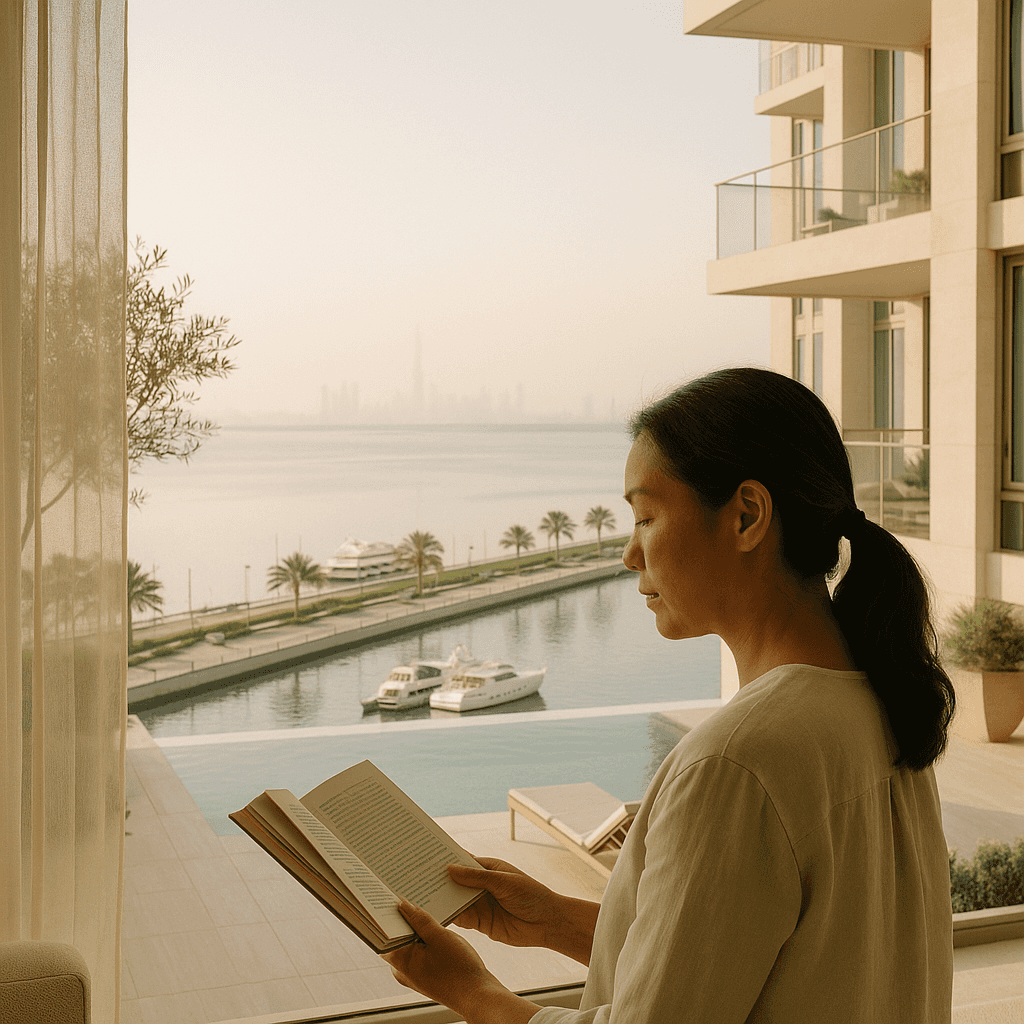
Smart Upgrades: Boost Your Dubai Apartment's Value
I explore how strategic, non-invasive smart home upgrades can significantly enhance your existing Dubai apartment's value and rental appeal, without the cost and disruption of a full renovation.

As the Apartments Editor at Gaia Living, I see thousands of listings. The ones that move fastest, and often for a premium, aren't always those with the most dramatic renovations. They are the ones that are smarter.
Here’s what we’ll explore:
- The new definition of a 'premium' apartment in the Dubai market.
- Focusing on Return on Investment: Which upgrades pay for themselves?
- Smart Climate Control: The single most impactful upgrade for Dubai.
- Intelligent Lighting: Setting the scene for efficiency and lifestyle.
- Security & Access: Modern convenience that buyers and tenants value.
- The Retrofit Process: How to install these systems without tearing down walls.
- The Hidden Value: Lower service charges and utility bills.
- Measuring the Uplift: How smart features translate to real-world value.
Redefining 'Upgraded': Beyond Marble and Parquet
For years, the concept of 'upgrading' a Dubai apartment has been synonymous with tangible, aesthetic changes. Ripping out a dated kitchen, installing parquet flooring, or retiling a bathroom with oversized marble slabs. These are projects that involve dust, disruption, significant capital outlay, and often, weeks of navigating building management approvals. While a beautifully executed renovation still holds immense appeal, I'm seeing a clear shift in what buyers and tenants perceive as 'premium'. The new benchmark for a truly upgraded apartment is intelligence. It's about functionality, efficiency, and a lifestyle that feels smooth and modern. This is where smart home upgrades for an existing apartment in Dubai come into play, offering a powerful path to apartment value enhancement Dubai without the sledgehammer.
The modern resident, whether an owner-occupier or a tenant, increasingly prioritises convenience and control. Think of a young professional in Business Bay or a family in JVC. Their lives are managed through their smartphones, from ordering groceries to booking a flight. They expect their home to offer the same level of intuitive control. Being able to cool the apartment on the way home from the office, ensure the lights are off from the airport, or grant a delivery driver temporary access without being physically present — these are no longer futuristic novelties. They are becoming baseline expectations for a high-quality urban living experience. An apartment that offers this built-in intelligence immediately stands out from the dozens of otherwise identical units in the same tower.
This shift is also driven by a growing awareness of sustainability and running costs. We all know the single biggest line item on a Dubai utility bill is air conditioning. Traditional AC systems are binary: they are either blasting cold air or they are off. This is incredibly inefficient. An apartment equipped with energy efficient apartment tech that learns your schedule and optimises cooling isn't just a gimmick; it's a financial tool that delivers measurable savings month after month. For an investor, this is a powerful selling point to a prospective tenant. You aren't just offering a two-bedroom apartment; you're offering a two-bedroom apartment with demonstrably lower DEWA bills. This can directly translate into a higher rental yield or a quicker lease-up period, providing a tangible return on the investment in the technology itself.
“The most valuable upgrade is no longer just what you can see, but what you can control. Functionality and efficiency now command a premium.”
Focusing on Return on Investment: Which Upgrades Pay for Themselves?
 Featured project
Not all smart tech is created equal, especially when viewed through the lens of property value. As an owner, your goal is to invest in upgrades that provide a clear return, either through capital appreciation, increased rental income, or reduced holding costs. It's easy to get carried away with high-tech gadgets that are impressive but offer little practical value to the next resident. The key is to focus on the core pillars of home life in Dubai: climate, lighting, access, and security. These are universal concerns for any resident, and improvements in these areas offer the most compelling ROI.
Before you spend a single dirham, I advise clients to perform a simple cost-benefit analysis. The 'benefit' isn't just a potential increase in sale price. It's a combination of factors. Will this upgrade make my property more attractive to renters, potentially reducing void periods between tenancies? Can I command a 5-10% rental premium over similar, non-smart units in my building? Will it lower my own utility bills if I'm living there, or lower the service charges for the building as a whole? For example, investing AED 1,500 in a top-tier smart thermostat that saves AED 150 per month on DEWA bills has a simple payback period of just ten months. After that, it's pure savings for the occupant, a feature that makes your apartment immensely more marketable.
Here’s my hierarchy of ROI for smart upgrades in a typical Dubai apartment:
1. Smart Thermostat: The undisputed champion. Direct, measurable impact on the single largest utility cost. It's a feature you can explicitly mention in a listing and quantify its benefit. 2. Smart Lighting (Switches & Dimmers): Offers both lifestyle and efficiency benefits. The ability to create 'scenes' (e.g., 'Movie Night', 'Dinner Party') adds a layer of luxury, while automated schedules and remote-off capability prevent wasted energy. 3. Smart Lock/Keyless Entry: A huge convenience and security upgrade. For landlords, it simplifies tenant changeovers and eliminates the risk of key duplication. For residents, it's the freedom of never carrying a key again. 4. Smart Plugs: The entry-level, low-cost hero. They can make 'dumb' appliances smart, allowing for scheduling and remote control of everything from lamps to coffee makers. A small investment that adds visible functionality. 5. Smart Water Heaters/Leak Detectors: A more subtle but crucial upgrade. A smart water heater can be scheduled to only run before peak usage times (mornings and evenings), cutting down on standby energy loss. Leak detectors, placed under sinks and near washing machines, can prevent catastrophic water damage — an issue that can take an apartment off the market for months.
Contrast this with more niche technology. While a smart fridge that orders milk might sound impressive, its value is highly subjective and it's a feature tied to a specific appliance that will eventually be replaced. The most successful smart apartment solutions Dubai are those integrated into the fabric of the apartment itself — the walls, the wiring, the front door. These become part of the property's core offering, not just a gadget left behind by the previous owner. This is the fundamental principle of a successful retrofit smart home Dubai project: focus on infrastructure, not just accessories.
Smart Climate Control: The Most Impactful Upgrade
If you make only one smart upgrade to your Dubai apartment, make it the thermostat. In a climate where air conditioning can account for up to 70% of a household's electricity consumption during the peak summer months, any technology that can intelligently manage this system provides immediate and substantial value. The standard thermostats found in most Dubai apartments, even in newer buildings by respected developers like Emaar Properties or Nakheel, are often basic digital models that offer little more than manual temperature setting. They are inefficient, unintuitive, and a prime target for a high-ROI upgrade.
A smart thermostat, such as those from brands like Nest, Ecobee, or Honeywell, replaces this basic controller with a connected, learning device. The installation is typically straightforward for a qualified electrician, often taking less than an hour. Once connected to your home Wi-Fi, it allows for complete control of your AC system via a smartphone app from anywhere in the world. The immediate benefit is convenience — the ability to start cooling your apartment when you're leaving the office, so you arrive to a comfortable home without having run the AC all day. Or the peace of mind of being able to check and turn off the AC from your holiday destination if you forgot to do so before leaving.
But the real financial power lies in their intelligent features. Many smart thermostats use geofencing to detect when your smartphone leaves the immediate vicinity of your home, automatically setting the AC to an energy-saving 'Away' mode. They learn your daily routines over the first few weeks, creating an optimised cooling schedule that avoids waste. For instance, it might learn that you typically lower the temperature at 10 PM and raise it at 7 AM, and it will automate this schedule. Some advanced models can even integrate with DEWA's peak/off-peak tariff structures, pre-cooling the apartment during cheaper periods to reduce load during the expensive afternoon peak. According to data from manufacturers and energy studies, these devices can reduce cooling costs by 15-20% on average. For a three-bedroom apartment in Dubai Marina with a summer DEWA bill of AED 2,000, that’s a potential saving of AED 300-400 per month.
When we at Gaia Living market a property for rent or sale, being able to state "Equipped with a Nest Learning Thermostat for optimised DEWA bills" is a far more powerful statement than a generic claim of "upgraded interior". It's a concrete, verifiable feature that speaks directly to the resident's wallet. It signals that the owner is thoughtful and has invested in the property's long-term efficiency. This is particularly appealing in communities with older buildings, such as some towers in Jumeirah Lakes Towers (JLT) or the original Greens development, where upgrading the central AC unit is not feasible. A smart thermostat is a cost-effective way to modernise the existing system's performance, making an older apartment competitive with newer stock. It is the cornerstone of any serious effort to introduce energy efficient apartment tech into a home.
Intelligent Lighting: Scene, Security, and Savings
After climate control, lighting is the next frontier for a high-impact, non-invasive smart upgrade. Traditional lighting is binary and inflexible. A switch is either on or off. Smart lighting transforms this, turning a simple utility into a dynamic element of the home's atmosphere and security. This isn't just about colourful party lights; it's about sophisticated control that adds a palpable sense of luxury and intelligence to a space. For a potential buyer walking through an apartment in DIFC or Palm Jumeirah, the ability to press a single button labelled 'Entertain' and have the lights dim to a pre-set warm glow is a powerful demonstration of a modern home.
The most effective way to implement this is by replacing existing wall switches with smart switches and dimmers from brands like Lutron, Legrand, or Sonoff. This is a crucial distinction. While colour-changing smart bulbs (like Philips Hue) are popular, they have a major flaw in a property context: if someone flips the physical wall switch, the 'smart' bulb loses power and becomes unresponsive. By replacing the switch itself, you retain manual control while adding a layer of smart functionality. This is a much more robust and intuitive solution for a retrofit smart home Dubai project. A qualified electrician can typically swap out the switches in a standard two-bedroom apartment in a few hours. The key consideration is the need for a 'neutral wire' for most smart switches, which is present in most buildings constructed in the last 15-20 years but may be absent in older properties. It's essential to check this before purchasing hardware.
Once installed, the benefits are threefold. First, lifestyle and ambience. You can create 'scenes' for different activities. A 'Cook' scene in the kitchen might bring the lights to 100% cool white for maximum visibility. A 'Watch Movie' scene in the living room could dim the main lights to 10% and turn on a soft accent lamp. This level of control, once the preserve of high-end custom-installed systems in villas in Al Barari, is now accessible for any apartment. Second, security. Smart lighting systems allow you to create vacation modes that randomly turn lights on and off in different rooms throughout the evening, creating a convincing illusion that someone is home. This is a significant security enhancement over simple timers. Third, energy efficiency. You can schedule all lights to turn off automatically at midnight, or link them to motion sensors in hallways and bathrooms so they are only on when needed. This systematic elimination of wasted electricity contributes to lower DEWA bills, reinforcing the apartment's efficiency credentials.
Let's consider a practical cost breakdown for a standard two-bedroom apartment:
- Smart Dimmer Switches (x5): AED 300-500 each = AED 1,500 - 2,500
- Smart On/Off Switches (x3): AED 200-400 each = AED 600 - 1,200
- Central Hub (if required by the system, e.g., Lutron): AED 400 - 600
- Electrician Labour (approx. 4-5 hours): AED 200/hour = AED 800 - 1,000
- Total Estimated Cost: AED 3,300 - 5,300
For a relatively modest investment, you fundamentally change the feel and function of the apartment's lighting. It becomes a feature to actively demonstrate during a viewing, adding a 'wow' factor that helps your property stand out from the competition.
Security & Access: Modern Convenience that Resonates
Peace of mind is a valuable commodity, and smart security and access control systems offer it in abundance. This category of upgrades directly addresses fundamental resident needs: feeling secure in your home and managing access for guests, deliveries, and service providers with ease. In the context of the Dubai property market, these features are rapidly transitioning from luxury add-ons to expected conveniences, particularly in the premium rental segment. For a landlord, they offer operational efficiencies that are hugely attractive, while for an owner-occupier, they provide a level of control that simplifies daily life.
The cornerstone of a smart access system is the smart lock. Replacing a traditional mechanical lock with a unit from a reputable brand like Yale, August, or Nuki is a transformative upgrade. These devices offer multiple ways to enter: via a smartphone app, a numerical keypad, a fingerprint scanner, or even a traditional key as a backup. The immediate benefit is keyless convenience. Residents no longer need to worry about lost or forgotten keys. But the real value lies in the ability to manage access remotely. Imagine you have a new tenant moving into your apartment in Dubai Hills Estate. Instead of a physical key handover, you can grant them digital access via the app, which they can activate on their move-in day. When they move out, you simply revoke their access with a tap. This eliminates the security risk of unreturned keys and the cost of changing locks between tenancies.
This remote access management is also invaluable for day-to-day living. You can grant a temporary digital key to a cleaner that only works on Tuesday afternoons, or create a one-time access code for a delivery from noon to 2 PM. Many systems keep a detailed log, showing you exactly who entered and at what time, providing a complete audit trail. When we list a rental property, highlighting 'keyless entry with manageable guest access' is a significant draw for corporate tenants and frequent travellers who value this flexibility and security. Installation is usually simple, with many smart locks designed to fit into the footprint of existing locks without major door modifications. You must, however, ensure you obtain any required No-Objection Certificate (NOC) from your building's management before altering the apartment's front door lock.
Beyond the lock, simple, standalone smart security cameras offer another layer of reassurance. Affordable Wi-Fi cameras from brands like Ring, Arlo, or Wyze can be placed inside the apartment to monitor activity when you are away. They offer motion alerts, two-way audio, and cloud recording. While many Dubai buildings have excellent security, an internal camera provides a personal layer of verification — whether it's checking in on a pet, confirming a maintenance worker has completed their job, or simply having a record in the unlikely event of an incident. These cameras are non-invasive; they simply need to be plugged into a power outlet and connected to Wi-Fi. They are part of the ecosystem of smart apartment solutions Dubai that gives residents total visibility and control over their personal space, a powerful psychological benefit that adds to the property's overall appeal.
The Retrofit Process: No Demolition Required
One of the biggest misconceptions about creating a smart home is that it requires extensive, disruptive, and costly rewiring — something that's often a non-starter in an existing apartment. The reality is that the vast majority of modern smart home upgrades for an existing apartment Dubai are specifically designed for retrofitting. They use wireless technologies like Wi-Fi, Zigbee, and Z-Wave to communicate, effectively creating an intelligent network within your home without the need to chase wires into walls. This makes the process faster, cleaner, and far more accessible for apartment owners and even long-term tenants (with landlord permission).
The key to a successful retrofit is choosing the right ecosystem and products. You want to avoid having a dozen different apps to control a dozen different devices. It's best to standardise on a single platform. For example, you might decide to build your system around Apple HomeKit, Google Home, or Amazon Alexa, and then select compatible devices (thermostats, switches, locks) that can all be controlled from that one central app. This creates the smooth, integrated experience that buyers and renters are looking for. Many professional installers in Dubai specialise in advising on and implementing these systems, ensuring all components work together flawlessly.
A typical retrofit project follows a clear, non-disruptive path:
1. Consultation and Planning: An expert will assess your apartment, discuss your goals (e.g., energy savings, convenience, security), and recommend a package of compatible devices that work with your existing infrastructure. They will check for critical requirements, like the presence of a neutral wire for smart switches. 2. Hardware Installation: This is the physical work, but it's more akin to minor electrical work than a renovation. A technician will replace your existing thermostat, light switches, and door lock with their smart counterparts. This phase can usually be completed in a single day. 3. Network Setup and Configuration: The installer will connect all the new devices to your home Wi-Fi network and to your chosen central hub or app. This is where the 'magic' happens. They will configure scenes, set up automations (e.g., 'Good Night' scene that turns off all lights and sets the AC to 24°C), and link voice control via your preferred assistant. 4. Handover and Training: The final step is a walkthrough where the installer shows you how to use the system, manage access, and customise settings through the app. A good installation company will provide ongoing support if you encounter any issues.
The beauty of this approach is its scalability. You can start small. Perhaps begin with just a smart thermostat and a couple of smart plugs, an investment of under AED 2,000. Later, you can add smart lighting to the main living area. A year later, you might decide to install a smart lock. Because these systems are modular and wireless, you can expand them over time as your budget and needs evolve. This incremental approach makes a retrofit smart home Dubai project manageable and financially prudent, allowing you to steadily increase your apartment's value and appeal without a large upfront capital expenditure.
The Hidden Value: Lower Service Charges & Utility Bills
While the upfront 'wow' factor of a smart home is compelling, one of its most significant long-term benefits is often overlooked: the potential for reduced running costs. This includes both the individual occupant's utility bills and, on a larger scale, the building's overall service charges. For any savvy investor or discerning owner-occupier in Dubai, these recurring costs are a critical part of the total cost of ownership equation. An apartment that can demonstrate lower running costs is fundamentally a more valuable and desirable asset.
The most direct and immediate saving, as we've discussed, comes from the reduction in DEWA consumption. The intelligent management of air conditioning and lighting via energy efficient apartment tech translates directly into lower monthly bills. When marketing a rental unit, being able to present past DEWA bills that are demonstrably 15% lower than the building average is an incredibly powerful tool. It allows you to justify a slightly higher rent, as the tenant's total monthly outlay (rent + utilities) may still be less than a cheaper, less efficient apartment. This effectively transfers the savings into your rental yield. For a buyer, it means lower living expenses from day one, which factors into their affordability calculations.
Beyond individual apartments, there's a wider benefit that affects service charges. Service charges in Dubai are calculated on a per-square-foot basis and cover the maintenance and utilities for the building's common areas — chillers, hallway lighting, water pumps, etc. A significant portion of this charge is attributable to common area electricity consumption. When a large number of apartments within a single building adopt smart energy-saving technologies, it can lead to a reduction in the building's overall peak electricity load. This is something DEWA is actively encouraging. Reduced overall consumption, particularly from the building's cooling plant which works less hard if individual apartments are better managed, can eventually lead to a re-evaluation and potential reduction in service charges for all owners.
Beyond that, some smart devices offer preventative maintenance benefits that protect value. Smart leak detectors are a prime example. A small, battery-powered sensor placed under a sink or water heater can send an instant alert to your phone at the first sign of moisture. In a high-rise tower, an undiscovered leak can quickly cause tens of thousands of dirhams in damage not only to your apartment but to the units below. This can result in costly repairs, insurance claims, and special levies on owners. An AED 200 sensor that prevents such a catastrophe provides an immense, albeit conditional, return on investment. It's a risk mitigation tool that protects the asset's value and prevents unforeseen costs, a feature that any prudent owner or owners' association would value highly.
Investing in smart, non-invasive upgrades is the most efficient way to enhance your apartment's marketability and financial performance in today's Dubai. It shifts the focus from costly aesthetics to intelligent functionality that delivers tangible benefits in convenience, security, and lower running costs — a combination that modern buyers and tenants are actively seeking and willing to pay a premium for.
Measuring the Uplift: How Smart Features Translate to Real-World Value
Quantifying the precise value-add of smart home technology can feel less direct than valuing an extra square foot or an ocean view. You can't simply add the AED 10,000 you spent on upgrades to your asking price. The value uplift is more nuanced, manifesting in three key areas: increased marketability, premium pricing power, and enhanced rental yield. As property advisors, we see these effects play out daily in the market.
First, and most importantly, is marketability. In a crowded marketplace with hundreds of similar listings, differentiation is everything. An apartment in a tower like The Address Residence Fountain Views, for example, already has a high baseline of quality. If your unit is one of ten available for sale, what makes it stand out? Having a fully integrated smart climate, lighting, and access system is a powerful differentiator. It gives us, as agents, a compelling story to tell. It becomes a key feature in the property portal listing, in marketing materials, and during viewings. This leads to more enquiries, more viewings, and ultimately, a faster sale. Reducing the time your property sits on the market is a direct financial benefit — every month it remains unsold is a month of carrying costs (service charges, etc.) you have to pay.
Second is the ability to command a price premium. While you may not recoup 100% of the installation cost in the sale price, a well-executed smart home system allows you to price your apartment at the top end of the comparable range and hold firm. If similar, non-smart two-bedroom apartments in your building are selling for between AED 2.0M and AED 2.1M, the smart features provide a strong justification for pricing at or even slightly above AED 2.1M. The buyer isn't just paying for hardware; they are paying for a finished, modern, and convenient living experience that they don't have to implement themselves. For many busy professionals or international buyers, this turnkey convenience is worth a premium.
Third, and perhaps most measurable, is the impact on rental yield. This is where smart upgrades truly shine as an investment tool. As discussed, the ability to offer lower utility bills can justify a higher rental price. Let's run the numbers on a typical one-bedroom apartment in Jumeirah:
- Standard Apartment Rent: AED 100,000 per year
- Smart Apartment Rent: Can realistically command a 5% premium = AED 105,000 per year
- Annual Gain: AED 5,000
- Initial Investment in Smart Tech (Thermostat, Lighting, Lock): AED 10,000
- Payback Period from Rental Uplift: 2 years
This calculation doesn't even include the reduced void periods due to the apartment's higher appeal. An apartment that rents out in one week instead of four saves you nearly a month's rent. Over the lifetime of an investment property, these gains compound significantly, improving your net yield and the overall performance of your asset. These are the smart apartment solutions Dubai that turn a standard property into a high-performing investment.
Sources
- Dubai Land Department (DLD): https://dubailand.gov.ae/en/
- Real Estate Regulatory Agency (RERA): https://dubailand.gov.ae/en/eservices/real-estate-regulatory-agency/
- UAE Government Portal (u.ae): https://u.ae/en
Questions, answered
- What's the best smart home upgrade for an apartment in Dubai?
- In my view, a smart thermostat is the single best upgrade for a Dubai apartment. It directly addresses the biggest utility cost — air conditioning, offering immediate savings on DEWA bills and a tangible feature for tenants and buyers.
- Can I install smart home tech in a rented Dubai apartment?
- Yes, many smart upgrades like smart plugs, bulbs, and standalone security cameras require no permanent installation and can be easily moved. For hardwired items like thermostats or switches, you must get written permission from your landlord and an NOC before making any changes.
- How much does it cost to make a Dubai apartment 'smart'?
- A basic starter kit with smart plugs, a few bulbs, and a hub can cost as little as AED 1,000. A more comprehensive retrofit including a smart thermostat, keyless entry, and smart switches for a two-bedroom apartment typically ranges from AED 8,000 to AED 15,000, depending on the brands and professional installation.
- Do smart upgrades actually increase my property's value?
- While it won't add a fixed percentage like an extra bedroom, smart home functionality significantly enhances an apartment's marketability. It can lead to faster sales, justify a higher asking price against comparable non-smart units, and attract a premium on rental income, improving your overall investment yield.
- Are these upgrades difficult to install in older Dubai buildings?
- Most wireless smart home systems are designed for retrofitting and work well in older buildings. The main consideration is the existing electrical wiring; some smart switches require a neutral wire which may not be present in very old properties. Always consult a qualified electrician to assess your apartment's compatibility.
- Can smart home tech lower my DEWA bills?
- Absolutely. A smart thermostat can reduce your cooling costs by 15-20% through efficient scheduling and remote management. Smart lighting and plugs also contribute by preventing energy waste from lights or appliances left on, leading to noticeable savings on your monthly DEWA bill.

Ravi lives and breathes apartment living — from studio yields in JVC to branded residences on the Palm. Floor plans, service charges, and view lines are his love language.
Related stories

Dubai's Big Squeeze: Smaller Plots, Denser Living
Dubai real estate is undergoing a fundamental shift towards smaller plot sizes and higher density. We analyse the economic drivers, the impact on property values, and what this new era of compact urban living means for both homebuyers and investors.
Resort Living as Your Dubai Reality
Explore how to trade temporary staycations for a permanent home with five-star amenities in Dubai. I'll break down the real costs, best communities, and lifestyle trade-offs of embracing high-end resort living every day.
Finding Your Tribe in Dubai's Villa Communities
I explore which of Dubai's renowned villa communities attract specific expat nationalities and lifestyle groups, offering insights to help you find a place that feels like home.
Echoes, in your inbox
One thoughtful email a month. Market insight, new launches, no spam.