

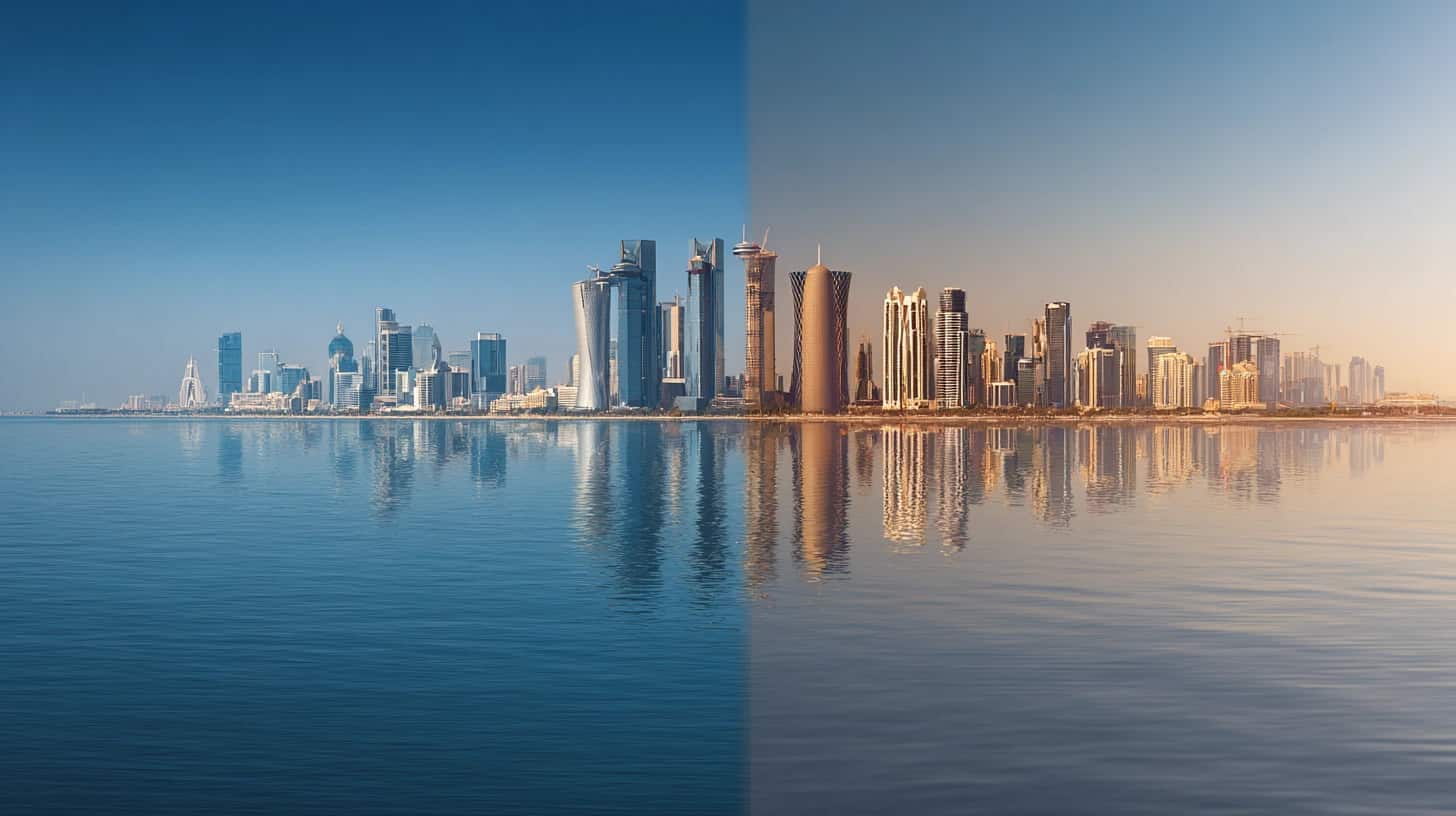
Key Differences Between the UAE and Qatar Property Markets
Both countries offer contemporary cities, high-income populations, large expatriate populations, and governments that are eager to attract international investment.
Both countries offer contemporary cities, high-income populations, large expatriate populations, and governments that are eager to attract international investment. At first glance, there are similarities in property investment opportunities in the UAE and Qatar. They are not. They differ in terms of structure, scale, regulation, and underlying demand. What works in Dubai does not automatically work in Doha. What makes Qatar attractive to one investor does not make it attractive to another. The objective of this guide is to offer information to property investors and buyers who are currently comparing these two property markets or who would like to know how each market works before committing to an investment. We will examine property rights, market scale, rental yields, regulation, developer market, and other relevant factors not mentioned in brochures. Our objective is to offer an honest appraisal of each market’s position. Both property markets offer merits and demerits. To succeed as an investor in either market, one should know how each market works before committing to a purchase. A word to set the scene: The property market in the UAE is far larger and more developed than that in Qatar. The Dubai Land Department announced that in 2023, Dubai’s property market recorded transaction value in excess of AED 400 billion in residential property transactions. The total value of Qatar’s entire residential property market is a small fraction of this. Size does matter in property investment.
Ownership Rights: Who Can Buy and What They Actually Own
This is the most fundamental structural difference between the two markets and the one that matters most for foreign investors.
In the UAE, freehold ownership for non-nationals has been available in designated areas since 2002. Dubai has the most developed freehold framework, with dozens of designated freehold areas covering the vast majority of the city's residential property stock. Non-UAE nationals can buy, own, sell, and mortgage property in these areas with full ownership rights and a title deed registered in their name at the Dubai Land Department. Abu Dhabi has its own freehold framework, and Ras Al Khaimah has expanded freehold access significantly in recent years driven by Al Marjan Island development activity.
The UAE's freehold framework is well-tested. Transactions happen daily. The DLD registration system is digital, transparent, and efficient. Dispute resolution through RERA and the courts is established. Foreign buyers who have been in the market for ten or twenty years have a track record of ownership, resale, and inheritance to point to. The legal foundation is solid.
Qatar opened freehold ownership to non-Qatari buyers in 2004, but the framework is narrower and less developed than the UAE's. Foreign buyers can own freehold property in a small number of designated areas — most notably The Pearl, Lusail City, and West Bay Lagoon. Outside these zones, non-nationals can access leasehold ownership with 99-year terms in certain areas, but full freehold title is restricted.
The Pearl Qatar is the most relevant freehold zone for most international buyers — a large artificial island development that functions as Qatar's equivalent of Palm Jumeirah in terms of lifestyle positioning and international buyer appeal. Quality is high, the community is well-managed, and it attracts a professional and executive tenant base. But the zone is smaller and the secondary market is less active than comparable Dubai freehold areas.
Ownership rights comparison:
- UAE freehold areas: dozens of designated zones covering most of Dubai's residential market
- Qatar freehold areas: The Pearl, Lusail City, West Bay Lagoon, and a small number of additional zones
- Title deed registration: Dubai Land Department (digital, efficient), Qatar real estate authority
- Freehold vs leasehold: UAE is primarily freehold in designated areas, Qatar has a mix of freehold and 99-year leasehold
- Inheritance rights: both countries have provisions for foreign owners, UAE framework is more tested
- Mortgage availability: well-developed in UAE from multiple local and international banks, less developed in Qatar
- Ownership for residency visa: UAE property above certain value thresholds qualifies, Qatar has similar provisions
- Corporate ownership: available in both markets with appropriate entity structures
- Resale restrictions: none in UAE freehold areas, some Qatar zones have developer approval requirements
- Foreign ownership cap: no cap in UAE designated freehold zones, Qatar zones are freehold without caps
Market Size, Liquidity, and What That Means for Investors
Market size and liquidity are not abstract concepts. They determine how easy it is to sell when you want to, how fairly your property is priced relative to comparable assets, and how resilient values are when external conditions change.
The UAE property market, led by Dubai, is one of the most liquid residential markets in the world relative to its size. The combination of a large and diverse buyer pool — local residents, regional investors, global buyers from Europe, Asia, and the Americas — a high transaction volume, and a well-functioning digital transaction infrastructure means that a fairly priced property in a good Dubai location can typically be sold in weeks rather than months. That liquidity has been demonstrated through multiple market cycles including the 2008 to 2009 correction, the 2014 to 2019 slowdown, and the subsequent recovery.
Qatar's property market is smaller by every measure. The overall population is around 3 million, of which the vast majority are expats on employment contracts rather than long-term residents. The domestic buyer base for investment property is limited — most Qatari nationals own their property outright rather than through investment-focused purchasing, and the expat community is less likely to buy than in the UAE given the more restrictive ownership framework and the employment-contract nature of most expat stays.
The secondary market in Qatar — meaning the resale market for existing properties — is less active than Dubai's. This matters for investors because it means longer time on market when selling, more price uncertainty at the point of sale, and less comparable transaction data to establish a fair value. Lynnette Abad, a widely respected UAE property market analyst who has tracked Gulf residential data for over a decade, has noted that secondary market depth is one of the most underrated factors in real estate investment decisions. Deep secondary markets protect value. Thin ones don't.
Market size and liquidity comparison:
- Dubai annual residential transaction value: over AED 400 billion in 2023, among the highest globally
- Qatar annual residential transaction value: significantly smaller, concentrated in freehold zones
- Buyer pool depth: UAE global and diverse, Qatar more concentrated among regional and expat buyers
- Secondary market activity: UAE significantly more active, faster selling timelines for well-priced assets
- Price discovery: UAE better, more transaction data available for comparable pricing
- Market cycle resilience: UAE has demonstrated multiple recovery cycles, Qatar's track record shorter
- Rental market depth: UAE deeper across all price points, Qatar concentrated in a few areas
- Institutional investor presence: UAE growing significantly, Qatar limited outside sovereign wealth
- Off-plan market: UAE dominant and well-developed, Qatar has limited off-plan activity for foreign buyers
- Market transparency: both improving, UAE further ahead on digital transaction records and public data
Rental Yields: How the Numbers Actually Compare
Rental yields are the most commonly cited metric when comparing Gulf property markets, and in this comparison there are some genuine suprises.
In the UAE, gross rental yields across Dubai range from around 3.5% to 4.5% in prime areas like Downtown Dubai and Palm Jumeirah up to 7% to 9% in outer areas like JVC, Dubai Silicon Oasis, and Dubai South. The mid-market — Business Bay, Dubai Marina, Dubai Hills — sits in the 5% to 7% range. These are gross figures. Net yields after service charges, management fees, and vacancy allowances are typically 1% to 1.5% lower.
In Qatar, gross rental yields on The Pearl and Lusail City apartments have typically run in the 5% to 7% range for well-located units. That puts Qatar broadly comparable to UAE mid-market on gross yield. The net picture is less favourable for Qatar because service charges and management costs in The Pearl are high relative to the rental income they're charged against, and vacancy risk is more pronounced given the smaller and more volatile tenant base.
The more important comparison is yield sustainability over time. UAE rental yields are supported by consistent population growth, economic diversification, a growing tourism sector, and a government actively working to attract long-term residents and businesses. That demand foundation makes current yields more durable than they might appear based on a snapshot.
Qatar's rental market is more cyclical and more event-driven. The FIFA World Cup in 2022 generated significant short-term demand that has since normalised. The tenant base in Qatar's freehold zones is heavily weighted toward corporate leases — companies renting apartments for senior employees — which can move in and out of the market quickly when business conditions change.
Rental yield comparison:
- UAE prime areas (Downtown, Palm): 3.5% to 4.5% gross
- UAE mid-market (Marina, Business Bay, Dubai Hills): 5% to 7% gross
- UAE outer areas (JVC, DSO, Dubai South): 7% to 9% gross
- Qatar freehold zones (The Pearl, Lusail): 5% to 7% gross for well-located units
- Net yield gap (gross minus costs): approximately 1% to 1.5% lower in both markets
- Qatar service charges (The Pearl): high relative to comparable UAE buildings
- UAE vacancy rates: lower than Qatar due to deeper tenant pool and population growth
- Short-term rental potential: UAE significantly better, DTCM holiday home framework well-developed
- Corporate lease market: strong in both, Qatar more dependent on it as a proportion of total demand
- Yield trend: UAE yields under modest compression due to price growth, Qatar more stable but lower demand growth
Regulatory Frameworks: How Each Market Is Governed
The regulatory environment shapes everything from how confident you can be in your ownership rights to how reliably transactions complete to how disputes are resolved if something goes wrong.
The UAE's real estate regulatory framework has been built over two decades and has been tested through multiple market cycles. In Dubai, RERA — the Real Estate Regulatory Agency — governs developer registration, agent licensing, off-plan escrow requirements, rental dispute resolution, and the standard form suite that underpins every transaction. The Dubai Land Department maintains the title register, processes transfers, and publishes transaction data that makes the market relatively transparent.
The escrow requirement for off-plan sales is one of the most investor-protective regulations in any property market anywhere. Developers must hold buyer funds in RERA-regulated escrow accounts and can only withdraw against construction milestones. This significantly limits the risk of developer insolvency leaving buyers without recourse — a problem that plagued earlier cycles in Dubai before the regulation was introduced and strengthened.
RERA's rental index governs how much landlords can increase rents at renewal, protecting tenants from arbitrary price hikes while giving landlords a fair framework for maintaining market-rate income. The rental dispute centre provides accessible, relatively fast resolution for landlord-tenant disagreements without requiring full court proceedings.
Qatar's real estate regulation has improved significantly over the past decade but is less developed in some areas. The Real Estate Regulatory Authority (RERA Qatar) oversees the market, and freehold zone developments like The Pearl operate under their own management frameworks. Dispute resolution options exist but are less tested and less accessible than the UAE's equivalents. The off-plan escrow framework is less comprehensively enforced than in Dubai, which adds a layer of developer risk for buyers in that segment.
Andrew Baum, professor at the University of Oxford's Said Business School and author of Real Estate Investment: A Strategic Approach, has noted that the quality of a real estate market's regulatory framework is directly reflected in the confidence of its institutional investors. The UAE's growing institutional investment activity is, in part, a vote of confidence in the regulatory environment. Qatar is working toward similar institutional credibility but hasn't yet reached the same level.
Regulatory comparison:
- Developer registration: mandatory in both, UAE framework more comprehensive and enforced
- Off-plan escrow: mandatory and well-enforced in UAE, less comprehensively applied in Qatar
- Agent licensing: mandatory RERA licence in UAE with annual renewal, Qatar has equivalent requirements
- Title register: digital and transparent in UAE via DLD, Qatar register less publicly accessible
- Rental dispute resolution: fast and accessible in UAE via rental dispute centre, Qatar process longer
- Rental increase rules: RERA rental index in UAE caps increases, Qatar has less structured framework
- Transaction data transparency: UAE publishes detailed DLD transaction records, Qatar less transparent
- Consumer protection for off-plan buyers: stronger in UAE due to escrow and milestone release rules
- Foreign investor protection: both provide legal framework, UAE more tested through disputes and appeals
- Regulatory reform pace: both improving, UAE has a longer track record of consistent reform
Developer Ecosystems and Off-Plan Market Comparison
The depth and quality of the developer ecosystem is one of the clearest points of difference between the two markets and one of the most practcal for buyers.
The UAE has one of the world's most competitive and prolific developer markets. Emaar, Nakheel, Meraas, DAMAC, Sobha, Danube, Samana, Binghatti, and dozens of others are all active simultaneously, launching projects across a wide range of price points, areas, and product types. That competition drives innovation in payment plans, product quality, and buyer incentives. It also creates choices that simply don't exist in smaller markets.
Emaar is the anchor of the UAE market — the developer with the strongest delivery track record, the most iconic projects, and the deepest secondary market for their completed stock. Their projects in Downtown Dubai, Dubai Hills, Creek Harbour, and Dubai South consistently attract strong buyer and tenant demand. Full details on their current projects are on our Emaar developer page.
Qatar's developer ecosystem is smaller and more concentrated. Barwa Real Estate, United Development Company (UDC), and Qatari Diar are the dominant players, with UDC being the developer behind The Pearl Qatar. The quality at the top end is good, but the range of options is far narrower than the UAE, and the competitive dynamics that drive innovation and buyer-friendly payment terms in Dubai are less present in Doha.
Off-plan activity for foreign buyers in Qatar is limited. The main freehold zones are largely built out — The Pearl is an established community rather than an active development pipeline — which means most foreign buyer activity is in the secondary market rather than off-plan. This eliminates the payment plan flexibility that is one of the UAE's biggest accessibility advantages.
Developer ecosystem comparison:
- Number of active developers: UAE dozens simultaneously, Qatar a handful of major players
- Developer competition: intense in UAE, drives innovation and buyer incentives, limited in Qatar
- Payment plan flexibility: UAE significantly better, wide range of off-plan structures available
- Developer delivery track record: UAE has 20-year track record with both successes and failures, Qatar shorter
- Off-plan availability for foreign buyers: UAE extensive, Qatar very limited in freehold zones
- Product range: UAE covers studios to ultra-luxury, Qatar concentrated in mid-to-high-end
- DLD fee waivers and promotions: common in UAE, not applicable in same way in Qatar
- New community development: UAE actively developing multiple new master-planned communities
- Established community resale: both markets have resale stock, UAE range significantly wider
- Quality at premium end: comparable, both markets have good high-end product
Our Honest Take: Which Market Is Right for Which Investor
In the case of most property investors, the United Arab Emirates would be the better choice. It has a clearer model of property ownership, deeper secondary market, more developed developer community, broader range of yields, and stronger underlying demand fundamentals. None of these features is expected to change materially in the short term.
Qatar is appropriate for a very specific category of property investors. This would include an individual looking to gain exposure to the Gulf property market but in a market that is less saturated than Dubai. It would include an individual who has a specific link to Qatar, be it through employment, sector adjacency, and existing relationships that enable a deep understanding of the market rather than a general optimism surrounding the Gulf property market. It would include an individual looking to purchase a lifestyle property in The Pearl for personal occupation who places a premium on the quality of that specific community. And lastly, it would include an individual who has a very long-term view and expects the ongoing diversification of the Qatar economy away from oil and gas to eventually create a property market that offers better quality and liquidity than is available today.
The mistake that most property investors make when considering these markets is to think of them as interchangeable choices. They are not. They serve different types of investors, have different risk profiles, and different circumstances in life. The choice between these markets should start with a clear understanding of why you wish to invest in property in these markets, rather than which market offers the higher property yield in the current quarter.
If you're considering UAE property investment and want to understand what the market looks like at your specific budget and area preference, our team covers everything from entry-level apartments to large investment portfolios. Check current listings across Dubai and the wider UAE on our property listings page, or reach out and we'll take it from there.
Related stories

Dubai's Established Charm: The Case for Older Homes
In a city focused on the future, I believe the smartest move for many buyers is to look back. Dubai's seasoned communities offer space, character, and surprising value that new builds often can't match.

The True Cost of Owning a Dubai Property
Beyond the purchase price, your annual budget for a Dubai home must account for service charges, utilities, and maintenance. I'll break down every ongoing expense you need to plan for.

Calculating ROI on Dubai Rental Upgrades
As a landlord in Dubai, you can't just follow trends. I'll show you how to calculate the precise ROI of minor property upgrades to genuinely increase your rental yield.
Echoes, in your inbox
One thoughtful email a month. Market insight, new launches, no spam.