

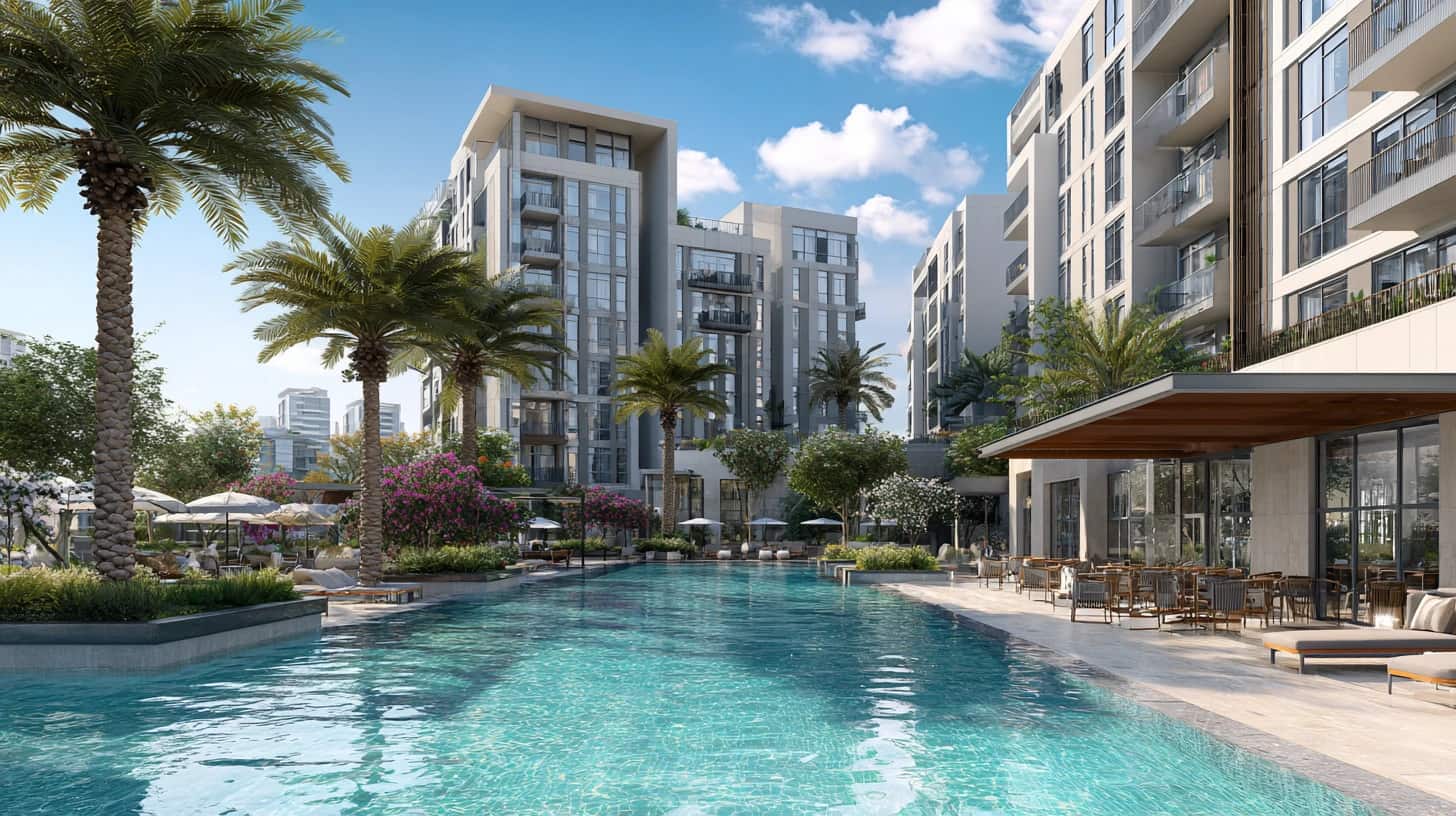
Dubai Hills vs Other Neighborhoods: Where Do You Get Better Value?
Dubai Hills Estate is one of the most scrutinized residential schemes within Dubai over the past five years. It is a master-planned, self-contained living neighborhood developed by Emaar…
Dubai Hills Estate is one of the most scrutinized residential schemes within Dubai over the past five years. It is a master-planned, self-contained living neighborhood developed by Emaar Properties with a golf course, large shopping mall, good schools, green spaces, and a variety of apartments and villas, located centrally within the emirate. The pitch is strong: a premium lifestyle without a premium price tag, not on the Palm or Downtown.
The pitch is substantially true; nevertheless, premium without a high price still equates to premium. Dubai Hills is not a budget option, and for buyers looking to optimize the value for money within their budget, the debate is no longer is Dubai Hills a good option? but is it a better option than alternatives at similar price points?
This guide will answer the question head-on. It compares Dubai Hills with five other areas in Dubai, namely Jumeirah Village Circle (JVC), Business Bay, Downtown Dubai, Arabian Ranches, and Creek Harbour, in terms of the factors that truly matter, such as cost per square foot, rental yield, quality of communities, lifestyles, and resale liquidity.
Note before the analysis: the value of an area is highly context-dependent, depending on the intended use of the area. An area may have high value in terms of yield, for instance, but may not have the same value in terms of access to educational institutions, for example. These use cases will be highlighted in the analysis in order to keep the comparison relevant regardless of the intended use by the purchaser.
According to the Dubai Land Department, Dubai Hills Estate has been ranked in the top ten areas in terms of transactional volumes for the past three consecutive years for properties priced over 2 million Dirhams. This is not mere sales talk; this is real demand for the area, spanning the broad range of profiles, and is highly significant in terms of resale liquidity when the time is right to sell.
What Dubai Hills Actually Costs and What You Get
Before comparing, let's establish the baseline. What does Dubai Hills actually cost and what does that price buy in terms of the product and the community?
Apartments in Dubai Hills currently range from around AED 900,000 for a one-bedroom in an older building to AED 3.5 million and above for a large two or three-bedroom in a premium tower. The average price per square foot for apartments sits in the AED 1,400 to AED 1,800 range depending on building, floor, and view. Villas and townhouses start around AED 3.5 million for a three-bedroom townhouse and go well above AED 10 million for a large villa on the golf course.
Rental yields on Dubai Hills apartments are typically 5% to 6.5% gross. Not the highest in Dubai — that's not the area's pitch. The pitch is quality of life and capital value stability, and on both of those metrics it delivers reasonably well. Tenant demand is consistent, driven by families who want the school access and green space, and by professionals who value the central-ish location and the community feel.
What you actually get for that price is meaningful. Dubai Hills Mall is a large, well-stocked retail destination that opened fully in 2022. The golf course is operational and well-maintained. Al Khail Road and Umm Suqeim Road give good road connectivity to both new and old Dubai. Multiple international schools are either in the community or within a short drive. Dubai Hills Park is one of the better public green spaces in the city. The community infrastructure feels complete in a way that newer master-planned developments often don't for several years after launch.
The weaknesses are real too. Metro access is the most frequently cited one — the nearest station is not within walking distance for most residents, which makes car dependency essentially mandatory. Some of the older apartment buildings are showing their age. And prices have risen sharply enough in the past three years that the yield story, while still solid, is less compelling than it was when the community first launched.
Dubai Hills price and product summary:
- One-bedroom apartment: AED 900,000 to AED 1.5 million
- Two-bedroom apartment: AED 1.5 million to AED 2.8 million
- Three-bedroom apartment: AED 2.5 million to AED 4 million
- Three-bedroom townhouse: AED 3.5 million to AED 5.5 million
- Four-bedroom villa: AED 6 million to AED 12 million
- Average price per sq ft (apartments): AED 1,400 to AED 1,800
- Gross rental yield (apartments): 5% to 6.5%
- Metro access: no direct metro, car dependent
- Community maturity: high, full infrastructure in place
- Key anchors: Dubai Hills Mall, golf course, multiple international schools, Dubai Hills Park
Dubai Hills vs JVC: The Value Comparison
Jumeirah Village Circle is the comparison that comes up most often when buyers are weighing Dubai Hills. It's close geographically, it's well-established, and the price gap between the two is significant enough to make the tradeoff worth examining honestly.
JVC is cheaper. Meaningfully cheaper. A one-bedroom in JVC is typically AED 650,000 to AED 950,000 versus AED 900,000 to AED 1.5 million in Dubai Hills. The price per square foot in JVC runs AED 900 to AED 1,200 versus AED 1,400 to AED 1,800 in Dubai Hills. For investors, JVC also offers higher gross yields — typically 6.5% to 8.5% versus 5% to 6.5% in Dubai Hills.
So JVC wins on yield and on entry price. Where does Dubai Hills win?
Community quality is the clearest answer. JVC is a dense, high-rise community with limited green space, inconsistent building management across its many towers, and a retail offering that's functional rather than attractive. Dubai Hills has significantly better public spaces, a genuine mall, and a community atmosphere that JVC simply doesn't have. For owner-occupiers — particularly families — that difference is felt daily in a way that yield calculations don't capture.
Resale and tenant quality also differ. Dubai Hills attracts a slightly higher-income tenant and buyer profile that tends to translate into lower vacancy, better-maintained units, and more reliable rent payments. JVC's tenant pool is broader and more varied, which is not inherently bad but does mean more management variability.
The honest verdict: for pure yield-focused investors who are not planning to live in the property, JVC is better value at current prices. For owner-occupiers and investors who care about community quality and long-term capital value, Dubai Hills justifies its premium.
JVC vs Dubai Hills head to head:
- One-bedroom entry price: AED 650,000 in JVC vs AED 900,000 in Dubai Hills
- Price per sq ft: AED 900 to AED 1,200 in JVC vs AED 1,400 to AED 1,800 in Dubai Hills
- Gross rental yield: 6.5% to 8.5% in JVC vs 5% to 6.5% in Dubai Hills
- Community quality: Dubai Hills significantly better on green space, retail, and community feel
- Metro access: both car-dependent, JVC slightly closer to main road network
- School access: Dubai Hills better, multiple schools within the community
- Tenant profile: Dubai Hills attracts slightly higher-income tenants on average
- Resale liquidity: comparable, both have active secondary markets
- Best for investors: JVC wins on yield at current pricing
- Best for owner-occupiers: Dubai Hills wins on community and lifestyle
Dubai Hills vs Business Bay: Different Buyer, Different Purpose
Business Bay and Dubai Hills are not really competing for the same buyer. They're different products serving different needs. But buyers with budgets in the AED 1.2 million to AED 2.5 million range sometimes consider both, and it's worth being clear about what each one actually offers.
Business Bay is urban. Dense, high-rise, close to Downtown, with the Dubai Canal running through it and strong metro connectivity at Business Bay station. The lifestyle is city-centre living — restaurants, bars, weekend brunches within walking distance, Downtown Dubai ten minutes by car. For professionals without children who want to be in the middle of things, it works well.
Dubai Hills is suburban. Green, spread out, community-focused, heavily family-oriented. The lifestyle is the opposite of Business Bay in almost every dimension.
On pure yield, Business Bay and Dubai Hills are fairly close — Business Bay runs 5.5% to 7% gross, Dubai Hills 5% to 6.5%. Business Bay wins slightly on yield. It also wins clearly on metro access and proximity to Dubai's main commercial and hospitality districts.
Dubai Hills wins on space. Apartments in Dubai Hills are generally larger for equivalent prices than Business Bay equivalents. A AED 1.8 million budget in Dubai Hills gets a large two-bedroom with good views. In Business Bay it gets a smaller two-bedroom or a well-located one-bedroom in a premium tower.
The honest distinction: Business Bay is better for professionals and investors targeting the short-term rental market through holiday home licensing, where proximity to Downtown and the Canal is a genuine pull for tourists and short-stay visitors. Dubai Hills is better for long-term residents and family tenants who want space and community infrastructure. Both are solid investments — they just serve different purposes.
Business Bay vs Dubai Hills head to head:
- One-bedroom price range: AED 900,000 to AED 1.4 million in Business Bay vs AED 900,000 to AED 1.5 million in Dubai Hills
- Price per sq ft: AED 1,500 to AED 2,000 in Business Bay vs AED 1,400 to AED 1,800 in Dubai Hills
- Gross rental yield: 5.5% to 7% in Business Bay vs 5% to 6.5% in Dubai Hills
- Metro access: excellent in Business Bay, car dependent in Dubai Hills
- Holiday home suitability: Business Bay significantly better for short-term rental income
- Family suitability: Dubai Hills significantly better for families with children
- Unit size for budget: Dubai Hills generally offers more square footage per dirham
- Community feel: Dubai Hills much stronger, Business Bay is transient by nature
- Proximity to employment hubs: Business Bay better, Dubai Hills requires a drive
- Long-term capital stability: comparable, both have strong Emaar backing and demand fundamentals
Dubai Hills vs Downtown Dubai: Is the Premium Worth It?
Downtown Dubai is Dubai's most iconic address and it prices accordingly. Comparing it to Dubai Hills is a comparison between two strong but quite different value propositions.
Downtown is more expensive across the board. A one-bedroom in Downtown starts around AED 1.4 million and can go well above AED 2.5 million for a well-positioned unit with Fountain or Burj views. Price per square foot is AED 2,200 to AED 4,500 depending on building and floor. Gross yields are lower than Dubai Hills — typically 4.5% to 5.5% — because the premium for the address compresses the income return.
What Downtown offers that Dubai Hills doesn't is global address recognition, a tenant and buyer pool that is genuinely international and deep, and the kind of irreplaceable location premium that holds value through market cycles better than almost any other Dubai address. Burj Khalifa, the Dubai Mall, the Fountain — these are not things that get replicated elsewhere in the city.
For investors buying purely for yield, Downtown doesn't make sense compared to Dubai Hills. The numbers don't support it at current prices. For investors buying for long-term capital preservation and global asset recognition, Downtown has an argument that Dubai Hills can't quite match.
For owner-occupiers comparing the two, it comes down to lifestyle preference. Downtown is urban density and iconic views. Dubai Hills is green space and community living. Both are genuinely good places to live. They're just very different places to live.
Downtown vs Dubai Hills head to head:
- One-bedroom entry price: AED 1.4 million in Downtown vs AED 900,000 in Dubai Hills
- Price per sq ft: AED 2,200 to AED 4,500 in Downtown vs AED 1,400 to AED 1,800 in Dubai Hills
- Gross rental yield: 4.5% to 5.5% in Downtown vs 5% to 6.5% in Dubai Hills
- Global address recognition: Downtown significantly stronger, Burj Khalifa address premium is real
- Green space and family lifestyle: Dubai Hills significantly better
- Metro access: Downtown excellent, Dubai Hills car dependent
- Resale liquidity: Downtown slightly stronger due to global buyer recognition
- Short-term rental income: Downtown better for holiday home investors
- Capital preservation through cycles: Downtown marginally stronger based on track record
- Value for money on sq ft: Dubai Hills clearly better, more space per dirham
Dubai Hills vs Arabian Ranches: The Family Community Comparison
Arabian Ranches is the comparison that matters most for families, because both communities are primarily villa-focused, family-oriented, and master-planned by Emaar. Understanding where each one sits on value is genuinely useful for buyers in the AED 3 million to AED 8 million range.
Arabian Ranches is older. Phase 1 launched in the early 2000s and the community has over two decades of history. The trees are mature, the community is settled, and the infrastructure has been proven over time. The horse-riding centre, the golf club, the retail strip — these are established, not promised. For families who value proven community over newness, Arabian Ranches has a credibility that Dubai Hills, despite being a great product, doesn't yet match simply because of age.
Prices in Arabian Ranches are broadly comparable to Dubai Hills for equivalent villa sizes, sometimes slightly lower in the older phases and slightly higher in Ranches 3 for newer product. The price per square foot comparison is similar for villas — AED 900 to AED 1,400 in Arabian Ranches versus AED 1,000 to AED 1,500 in Dubai Hills, with premium villa plots in both pushing above that.
Dubai Hills has better connectivity than Arabian Ranches. Al Khail Road gives Dubai Hills faster access to both old and new Dubai than Arabian Ranches' slightly more outlying position. For dual-income families where both adults commute, that connectivity difference is felt weekly.
Both are Emaar communities, which means a baseline level of management, maintenance, and service quality that is generally above the Dubai average. That's a meaningful practical advantage over independently managed communities where quality varies by building or plot.
Arabian Ranches vs Dubai Hills head to head:
- Three-bedroom townhouse price: AED 3.5 million to AED 5 million in both communities
- Four-bedroom villa price: broadly comparable, AED 5.5 million to AED 10 million range in both
- Community maturity: Arabian Ranches significantly more mature, trees and infrastructure established
- Road connectivity: Dubai Hills better access via Al Khail Road
- School access: comparable, both have good schools nearby or within the community
- Golf course: both have one, Arabian Ranches golf club is older and more established
- Developer management quality: comparable, both Emaar-managed
- Tenant demand for villas: strong in both, family tenants willing to pay well for both communities
- Capital appreciation track record: Arabian Ranches longer history, Dubai Hills growing quickly
- Overall lifestyle quality: comparable for families, preference is personal
The Honest Verdict: Where Does Dubai Hills Sit in the Value Landscape?
Dubai Hills appears to be a genuinely good place to live. It is not an overrated place. It is a well-planned place, well-managed, well-located, and well-backed by the presence of the mall, the golf course, and the school infrastructure. For a family residence or a long-term stay, it delivers most of its promises.
It may not be the best place for value for money in any one area in Dubai. For investors looking for rental yield, JVC and parts of Business Bay offer better rental yields for lower entry prices. For global recognition for address and capital safety, Downtown may offer a better proposition. For long-term living with a proven track record, Arabian Ranches may offer a better proposition.
Grant Cardone, the well-known entrepreneur and real estate investor from the USA, who has spoken at length about the factors that go into the selection of a property, has argued that the most important factor that goes into any property selection decision is not the property itself, but the demand that drives the property. From that perspective, Dubai Hills appears to score well as a place that appeals to a variety of demand profiles, from families to professionals to investors, thereby having a diverse demand profile that may not be available in any other area in Dubai.
The positives that Dubai Hills enjoys over any other place in Dubai include its central location, its quality as a place to live, its access to schools, its green spaces, its backing by a good developer, and its improving track record. It must be noted that there may not be any one place that beats Dubai Hills in all these factors. However, the question remains which factors are more important to any one investor.
If you want to see what's currently available in Dubai Hills or in any of the areas we've compared today, our team covers all of them and can give you current pricing and honest guidance on where the value sits right now. Reach out and we'll take it from there.
Related stories
Dubai's Established Charm: The Case for Older Homes
In a city focused on the future, I believe the smartest move for many buyers is to look back. Dubai's seasoned communities offer space, character, and surprising value that new builds often can't match.

The True Cost of Owning a Dubai Property
Beyond the purchase price, your annual budget for a Dubai home must account for service charges, utilities, and maintenance. I'll break down every ongoing expense you need to plan for.
Calculating ROI on Dubai Rental Upgrades
As a landlord in Dubai, you can't just follow trends. I'll show you how to calculate the precise ROI of minor property upgrades to genuinely increase your rental yield.
Echoes, in your inbox
One thoughtful email a month. Market insight, new launches, no spam.