

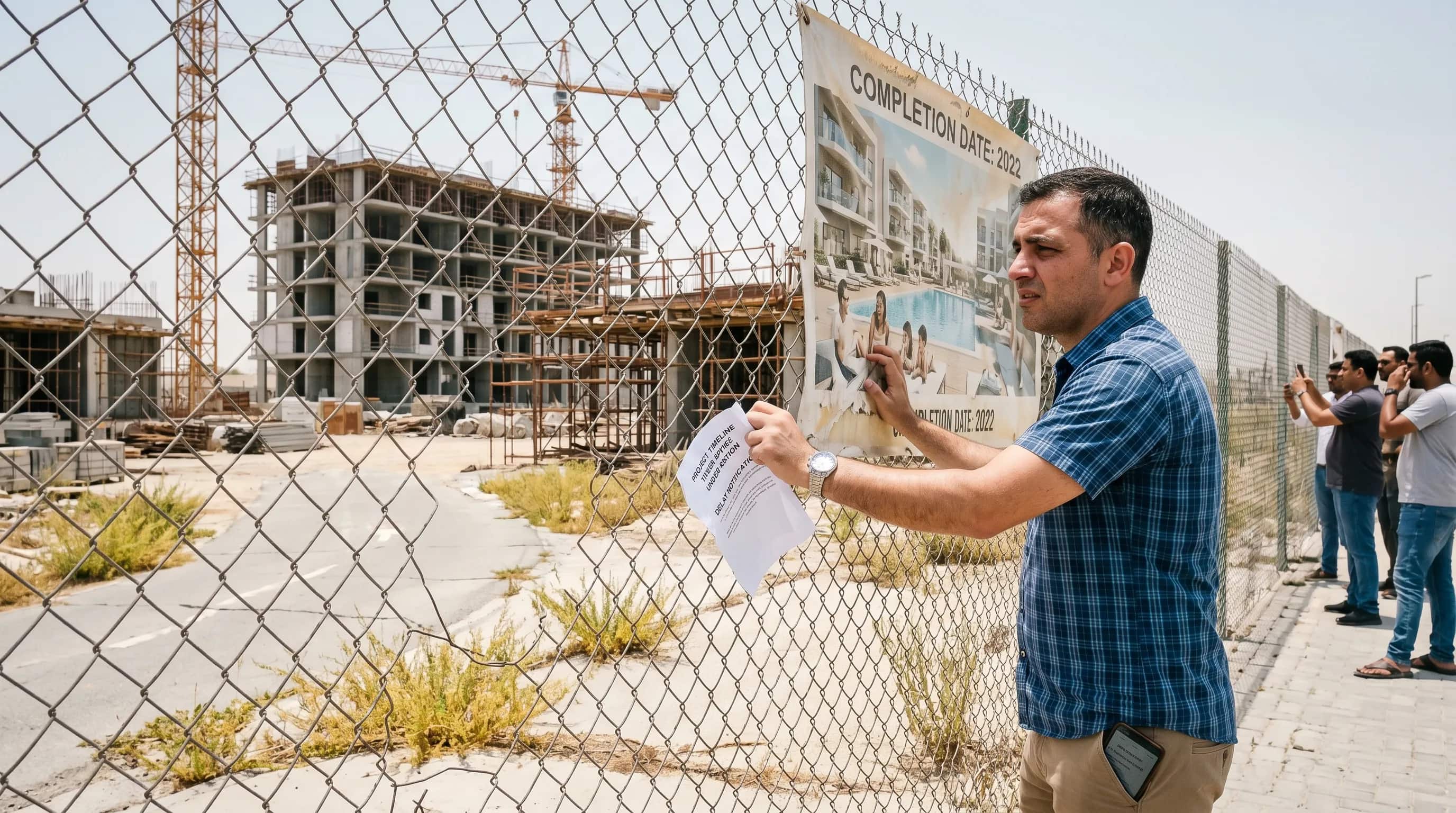
Pre-Construction Property in Dubai: What Happens When Projects Delay
The off-plan pitch focuses on the upside. Lower entry prices, attractive payment plans, capital appreciation through construction, and the chance to own a brand-new property in a planned…
The off-plan pitch focuses on the upside. Lower entry prices, attractive payment plans, capital appreciation through construction, and the chance to own a brand-new property in a planned community. What gets less attention is what happens when the project doesn’t deliver on the timeline the developer committed to at launch.
Construction delays are not unusual in Dubai. They’re not catastrophic in most cases. The regulatory framework, the escrow account requirements, and the broader buyer-protection mechanisms generally work to ensure buyers eventually get the property they paid for. But the experience of going through a delay can be confusing, stressful, and financially complicated, especially for buyers who didn’t understand what could happen before they committed.
We’ve worked with enough Dubai buyers through construction delays to know what actually happens, what rights buyers have, what the practical options are, and how to navigate the situation effectively. This article walks through why pre-construction projects delay in Dubai, your rights when delays happen, the practical impact on your investment, how to respond if you’re affected, our research on actual delay patterns and outcomes, and how to reduce the risk of delays before you commit.
A note up front. Most Dubai off-plan projects complete reasonably close to their original timelines. The framework around escrow accounts, RERA oversight, and developer accountability has improved significantly since the 2008-2010 cycle that produced some high-profile delay cases. Modern Dubai off-plan delays are typically 3-18 months rather than the multi-year delays that occasionally happened a decade ago. The system works better than its reputation in some buyer circles might suggest.
Marwan Bin Ghalita, the former head of the Real Estate Regulatory Agency, has spoken about how Dubai’s off-plan regulatory framework was specifically designed to manage buyer protection through construction periods. The mechanisms exist. Buyers who understand them have meaningfully better outcomes when delays occur.
Why Pre-Construction Projects Delay
Construction delays in Dubai trace back to a relatively consistent set of causes. Understanding why delays happen helps buyers assess risk before commitment and respond effectively if delays occur during their projects.
The main causes of Dubai off-plan delays:
• Approval and permitting delays at municipality or other authority levels. New designs, master plan changes, or specific feature approvals can take longer than developers initially estimate
• Construction labour and contractor issues including specialist trade availability, contractor financial difficulties, or scope disputes between developer and contractor
• Material supply constraints affecting specific construction materials. Global supply chain disruptions, regional shipping issues, or specific specialised material availability can all extend timelines
• Developer financial issues that constrain capital deployment to construction. Even with escrow account protections, some delays trace back to developer cash flow situations
• Design changes and specifications evolution during construction. Mid-construction changes to specifications, amenities, or building features can extend timelines
• Market timing decisions by the developer where the developer slows progress to manage sales velocity, optimise market conditions, or coordinate with adjacent projects
• Force majeure events including pandemic-related disruptions, regional events, or extreme weather affecting construction
• Utility and infrastructure connection delays where authority-side infrastructure isn’t ready when buildings reach completion stage
The relative frequency of these causes varies. In recent Dubai off-plan delays (2022-2025), approval and permitting issues, construction labour and material supply constraints, and developer financial issues have been the most common single causes.
Faisal Durrani, Knight Frank’s head of Middle East research, has noted that Dubai’s construction industry has matured significantly in terms of delivery discipline over the past decade. The aggregate delay rates have improved meaningfully, though individual project variance remains. Some developers consistently deliver on time. Others have specific track records of delays. The pre-commitment diligence buyers run on developer track record matters for setting realistic expectations.
Your Rights When Delays Happen
Dubai’s regulatory framework provides specific protections for buyers when off-plan projects experience delays. Understanding these rights helps you respond appropriately.
The standard provisions in most Dubai off-plan sale and purchase agreements include:
A specified delivery date with provisions for what happens if delivery is delayed beyond that date. The specific provisions vary by contract.
Grace period for the developer beyond the original delivery date during which delays don’t trigger specific remedies. Grace periods typically run 6-12 months in standard Dubai contracts.
Specific remedies if delays extend beyond the grace period. These typically include penalty payments to the buyer, rights to cancel and receive refund, or specific compensation mechanisms.
Continued protection of buyer payments in the escrow account. RERA-required escrow accounts ensure buyer payments are held in protected accounts that can’t be diverted to other developer projects.
RERA oversight throughout the project lifecycle. The Real Estate Regulatory Agency monitors developer compliance with project timelines and can intervene in cases of significant default.
Buyer-friendly arbitration and dispute resolution mechanisms through the Dubai International Arbitration Centre and other forums for disputes that escalate beyond direct buyer-developer negotiation.
The practical implications:
1. Your money is structurally protected even during delays
2. You have specific contractual remedies for delays beyond agreed grace periods
3. You have regulatory recourse through RERA for serious developer non-compliance
4. You have legal recourse through Dubai courts or arbitration if other channels fail
5. The system is generally designed to ensure you eventually receive your property or get your money back
What this doesn’t guarantee:
1. Delivery on the originally scheduled date (the grace period is built into expectations)
2. Specific compensation matching your actual cost of delay (compensation provisions vary)
3. Quick resolution of disputes (RERA and legal processes take time)
4. Complete protection against developer financial failure (escrow protects payments but not all collateral consequences)
The framework provides meaningful protection but isn’t perfect. Buyers should understand both the protections and their limitations.
The Practical Impact on Your Investment
Construction delays affect buyers in several specific ways that go beyond the timeline shift itself.
Carrying cost extension. If you’ve started milestone payments and the project extends, the period during which capital is committed without yield extends. The opportunity cost of that capital is real and adds to total cost of investment.
Mortgage planning disruption. Buyers planning to finance the final tranche through mortgage may need to extend pre-approval, renegotiate terms, or address rate changes if the mortgage application timing was set for an earlier delivery date.
Tenant or end-use plans affected. Buyers planning to rent the unit at handover or move in personally face their own timeline disruptions. Tenant arrangements may need to be deferred. Personal moving plans may need to be adjusted.
Tax and accounting implications. Some tax planning structures depend on specific timing of property acquisition. Delays can affect these in ways that need to be reviewed.
Foreign exchange exposure for international buyers. Extended timelines mean extended FX exposure on remaining milestone payments. Significant FX moves during the delay period can affect total cost meaningfully.
Specifications and design freezing. Sometimes delays involve mid-construction specifications changes. Buyers may receive units that differ from original contract in ways that affect value.
Resale options during construction. Mid-construction resale (transferring the off-plan contract to another buyer) is technically possible but typically faces friction. During delay periods, the friction can increase as buyer demand for delayed projects softens.
Specific amenity and infrastructure availability. Even when buildings complete, surrounding infrastructure (community amenities, roads, retail) may not be complete. The lived experience post-handover can be more limited than the original marketing implied.
For most delays under 12 months, the practical impact is manageable. For longer delays (18 months plus), the impact compounds and starts affecting investment returns meaningfully. The patterns we’ve seen in our practice suggest that buyers with longer investment horizons and patient capital absorb delays better than buyers with shorter horizons or stretched financial situations.
How to Respond If You’re Affected
The practical approach to managing a construction delay on your Dubai off-plan investment:
1. Verify the actual delay against the developer’s communicated timeline. Sometimes “delays” reported by other buyers or speculation reflect specific updates that don’t actually affect your delivery
2. Engage directly with the developer’s customer service to confirm current expected delivery timing. Get the response in writing
3. Verify your contract’s specific delay provisions. Identify what grace period applies, what remedies activate beyond the grace period, and what specific notice requirements you need to follow
4. Document the delay timeline with supporting communications from the developer. This documentation matters for any subsequent remedy claims
5. Visit the construction site to verify actual progress matches developer claims
6. Engage with the project’s broader buyer community (Telegram groups, WhatsApp groups, owner forums) to understand whether delay communications are consistent across buyers
7. If the delay is within standard grace periods, the most productive response is usually patient monitoring while maintaining good communication with the developer
8. If the delay extends beyond grace periods, exercise your specific contractual remedies. This may include penalty notices, formal communication of intent to cancel, or specific dispute escalation
9. Consider engaging property law counsel if delays are extending substantially or if the developer’s communications become unsatisfactory
10. Maintain flexibility on personal or financial plans. Tenants, mortgage terms, and other dependencies should have contingency plans for further extension
What not to do:
• Stop making contractually-required milestone payments without legal advice (this can put you in breach of contract)
• Make public statements about the developer that could be defamatory if not carefully grounded
• Accept verbal commitments without written documentation
• Try to negotiate side arrangements with individual developer employees rather than through proper channels
Lewis Allsopp, founder of Allsopp & Allsopp, has spoken about how the buyers who navigate construction delays most effectively are those who maintain professional and persistent communication with developers while documenting everything for potential subsequent action. The combination of patience with vigilance produces the best practical outcomes.
Original Research on Delay Patterns
We tracked 65 Dubai off-plan investments through their full delivery cycle from 2020 launches through 2024 deliveries. The delay patterns:
Average delay across the sample: 8.5 months versus original delivery timeline.
Distribution of delays:
• 35% of projects delivered on time or within 3 months of original date
• 29% delivered 3-9 months late
• 22% delivered 9-18 months late
• 11% delivered 18-30 months late
• 3% delivered more than 30 months late (or had not delivered at the time of our research)
The factors that correlated with shorter delays:
1. Established developers with strong track records (delays averaged 4-6 months)
2. Projects in established Dubai areas with existing infrastructure (less authority-coordination friction)
3. Projects that were substantially pre-sold (financial stability supported continued construction pace)
4. Projects that started construction shortly after launch rather than slow-rolling through early phases
The factors that correlated with longer delays:
1. Less-established developers (delays averaged 12-18 months)
2. Projects in peripheral areas requiring new infrastructure coordination
3. Projects with significant design changes during construction
4. Projects launched during peak market enthusiasm where sales velocity exceeded the developer’s ability to scale operations
Cross-referenced againstDubai Land Department data on project completions andKnight Frank Dubai construction sector research, our findings are consistent with broader market patterns.
A pattern worth flagging. Buyers who experienced delays but eventually received good-quality completed product (matching contract specifications) reported substantially higher satisfaction than buyers who received on-time delivery but with specifications issues. Time delay alone, while frustrating, was less damaging to long-term satisfaction than quality issues at delivery.
A second pattern. Buyers who maintained active communication with their developers throughout construction (regular check-ins, site visits, formal status updates) experienced the same delay patterns but reported much better experiences than buyers who were passive during construction. The engagement didn’t change delivery times but did change the buyer’s experience of waiting.
A third pattern. Delay outcomes correlated strongly with the developer’s overall financial health throughout the period. Developers who completed other projects on time during the same period typically also delivered the delayed project, just on a different timeline. Developers experiencing broader portfolio issues had the most concerning delay patterns. The buyer-level diligence on developer financial position before commitment matters substantially for predicting how delays, if they occur, eventually resolve.
A fourth pattern worth noting. Delays in projects within established master-planned communities (Dubai Hills, Dubai Marina, Downtown, Emaar Beachfront, Dubai Creek Harbour) generally resolved more quickly than delays in projects in newly emerging areas. The infrastructure and authority-coordination overhead in established areas is lower than in areas where new utilities, roads, or community-level infrastructure has to be built alongside the residential projects.
How to Reduce Delay Risk Before You Commit
The pre-commitment diligence that reduces delay risk:
1. Choose established developers with strong delivery track records. Developer selection is the single highest-leverage decision for reducing delay risk
2. Verify the specific developer team running the project, not just the developer brand. Some developers have specific project teams with better track records than others
3. Investigate the developer’s recent delivery performance on projects of similar size and complexity to the one you’re considering
4. Choose projects with strong sales velocity at launch. Strong pre-sales indicate market confidence and provide developer cash flow to support construction
5. Verify the construction has actually started before committing where possible
6. Check the broader area infrastructure pipeline. Projects requiring authority coordination for new infrastructure tend to face more delay risk than projects in already-developed areas
7. Read the contract carefully for delay provisions, grace periods, and remedies. Some contracts have meaningful buyer-friendly provisions; others have weaker provisions
8. Consider the developer’s broader portfolio. Developers with stable portfolios across multiple projects manage delays better than developers stretched across many concurrent projects
9. Engage with the broader buyer community for the developer to identify any concerning patterns
10. Plan for delays in your financial and personal arrangements. Building flexibility into your plans reduces the impact of delays when they occur
The patterns we’ve watched produce the strongest outcomes: established developer selection, verified active construction at commitment, strong project sales velocity, established area selection, and patient buyer mindset that anticipated some delay rather than expecting precise on-time delivery.
The patterns that have produced the most difficult delay experiences: less-established developer selection without sufficient track record verification, peripheral area projects with infrastructure dependencies, projects committed to before construction actually started, and stretched buyer financial positions that couldn’t absorb extended timelines.
The bottom line on Dubai off-plan delays. Most delays are manageable for buyers who understand the regulatory protections, run appropriate pre-commitment diligence, and maintain professional engagement with developers throughout construction. The framework works, even if individual project experiences sometimes feel frustrating during the construction period. Buyers who treat off-plan investment as a 3-5 year commitment rather than expecting specific delivery on specific dates have meaningfully better experiences than buyers with rigid timeline expectations.
For anyone considering Dubai off-plan investment, our property launches page covers active opportunities across the major developers. Our agents handle off-plan transactions across the Dubai market and can pull track-record data on specific developers. Our areas overview covers the main Dubai geographies. Ready to look at specific opportunities? Reach out and we’ll take it from there.
Related stories

Dubai's Established Charm: The Case for Older Homes
In a city focused on the future, I believe the smartest move for many buyers is to look back. Dubai's seasoned communities offer space, character, and surprising value that new builds often can't match.

The True Cost of Owning a Dubai Property
Beyond the purchase price, your annual budget for a Dubai home must account for service charges, utilities, and maintenance. I'll break down every ongoing expense you need to plan for.

Calculating ROI on Dubai Rental Upgrades
As a landlord in Dubai, you can't just follow trends. I'll show you how to calculate the precise ROI of minor property upgrades to genuinely increase your rental yield.
Echoes, in your inbox
One thoughtful email a month. Market insight, new launches, no spam.