

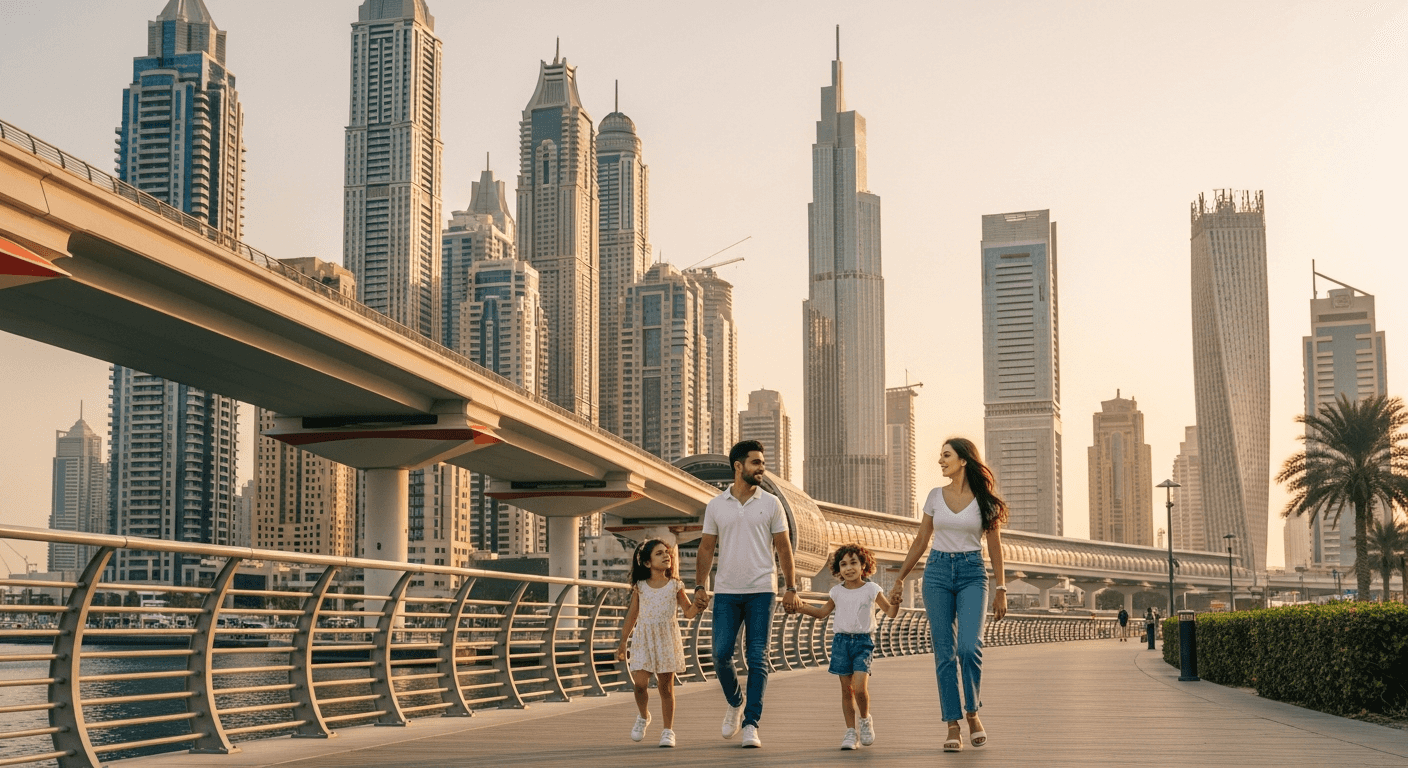
Living Smart: Dubai's Most Connected Neighbourhoods
Forget the traffic jams. I'll show you how to choose a Dubai home where true connectivity—via Metro, road, and footpath—gives you back your most valuable asset: time.

In my line of work, I talk to people about their dream home every day. They talk about space, light, views. But underlying all of it is a deeper, more fundamental desire: the desire for a better life. And in a city as dynamic and demanding as Dubai, a better life often starts with a smarter commute.
Here's what we'll explore in this guide to true connectivity:
- The foundational role of Sheikh Zayed Road and the Dubai Metro's Red Line.
- Why multi-modal hubs like Dubai Marina command a justifiable premium.
- A detailed cost analysis: Is living in a connected community financially worth it?
- The next wave of connected masterplans, from Dubai Hills to Creek Harbour.
- The underrated importance of arterial road access and avoiding choke points.
- How to assess a neighbourhood's complete transport network, including buses and ride-hailing.
- My final verdict on developing your personal connectivity strategy.
The Original Blueprint: Sheikh Zayed Road & The Red Line
When you think of Dubai's layout, you think of Sheikh Zayed Road. It’s the city’s spine, the original artery from which everything else grew. For decades, proximity to this twelve-lane river of steel and glass was the absolute definition of a prime location. It connected the old city with the new, linking the World Trade Centre to the burgeoning developments that would become the stuff of legend. Owning or renting a property with ‘a view of Sheikh Zayed Road’ was a status symbol, a declaration that you were at the centre of the action. This linear model of development defined the first phase of modern Dubai, and the properties that line this corridor are a direct reflection of that history.
Then, in 2009, everything changed. The launch of the Dubai Metro’s Red Line transformed the city’s physical and mental map. It wasn't just a new transport option; it was a paradigm shift. Suddenly, the city’s spine had a parallel, public counterpart that was immune to rush hour. The Metro overlaid a new layer of connectivity onto the city, one based not on car ownership but on accessibility. Neighbourhoods with stations blossomed. Areas that were previously just 'near Sheikh Zayed Road' were re-contextualized as 'on the Metro'. Downtown Dubai, with its direct link to the Dubai Mall/Burj Khalifa station, became exponentially more accessible. The financial district, DIFC, was no longer just a place you drove to; it was a destination you could reach effortlessly from dozens of points across the city.
This shift created two distinct but related property archetypes along this corridor. First, you have the established towers directly on Sheikh Zayed Road. They offer incredible convenience for drivers and often boast impressive, if sometimes noisy, views. But their design predates the Metro, so pedestrian access to the stations can sometimes be an afterthought, involving overhead bridges and long walks. Second, you have the properties that are a few blocks back from the highway but are closer to the Metro stations themselves. These often represent a sweet spot. They are insulated from the direct noise of the highway but enjoy all the benefits of the rail link. This is where we started seeing the first true examples of transit-oriented living in Dubai, and it laid the groundwork for a more sophisticated understanding of what 'well-connected areas dubai' really means.
The Multi-Modal Hubs: Where Metro, Tram, and Walkability Converge
 Featured project
True connectivity isn't just about one mode of transport. It's about the smooth integration of several. It’s the ability to leave your apartment, walk to a tram, take that tram to the metro, and then ride the metro to the airport, all without ever getting into a car. This is the magic of the multi-modal hub, and nowhere is this more brilliantly executed in Dubai than in the ecosystem of Dubai Marina and Jumeirah Beach Residence. This zone isn't just on the Metro line; it has its own circulatory system: the Dubai Tram. This crucial piece of infrastructure links the two Metro stations at either end of the Marina (DMCC and Sobha Realty) with the density of towers, the beach, and the key attractions within the community.
This is where the lifestyle promise of waterfront living truly delivers. I often tell clients to spend a Saturday morning there to understand it. You can live in a tower like Marina Gate or The Address Dubai Marina, take the elevator down, and walk along the promenade for a coffee. From there, you might decide to cross a bridge and hop on the Tram to get to JBR for lunch, or walk to the DMCC Metro station to head to the Mall of the Emirates. The entire experience is fluid, pleasant, and human-scaled. You're not battling for parking or sitting in traffic. This is the essence of what buyers are paying a premium for. It's not just the apartment; it's access to a frictionless lifestyle. The ability to make spontaneous decisions based on desire, not on a calculated assessment of traffic conditions. It turns the entire neighbourhood into an extension of your home.
Other areas are developing this multi-modal character. Downtown Dubai is a prime example. While it doesn't have a tram, its hyper-density and pedestrian-focused design — with the Dubai Mall, Souk Al Bahar, the Boulevard, and the Opera District all connected by walkways and bridges, create a similar effect. You can live in The Residences, walk to the Dubai Mall for groceries, catch a show at the Opera, and then take the Metro to DIFC for a business meeting the next day. The integration of the Metro, an extensive bus network (including the F13 route that circles the Boulevard), abundant taxis, and sheer walkability makes it one of the easiest places in Dubai to live car-free. Developer Emaar Properties was a pioneer in this thinking, understanding that building a community was more than just building towers; it was about building the connections between them.
This level of integration is the gold standard for easy commute neighbourhoods dubai. It redefines the daily routine. Your commute is no longer a stressful hour locked in a metal box. It could be a 10-minute walk to the office within Business Bay, a 15-minute scooter ride, or a 20-minute Metro journey where you can read a book or catch up on emails. This reclaimed time is a tangible, powerful asset. When we at Gaia Living talk to clients who have made this switch, the feedback is universal: their quality of life improves dramatically. They have more time for family, for fitness, for themselves. That's a return on investment you can't always measure in square feet, but it's perhaps the most valuable of all.
The Financials of Connectivity: Is the Premium Worth It?
It’s an undeniable fact: a property in a well-connected, walkable, multi-modal hub costs more than a comparable one in a car-dependent suburb. A two-bedroom apartment in Dubai Marina with a sea view and a five-minute walk to the Tram can easily command a 15-25% premium over a similar-sized apartment in a less-connected area like JVC or Dubai Sport City. The question clients always ask me is, “Yusuf, is it worth it?” My answer requires looking beyond the sticker price and doing a full, honest accounting of the total cost of a lifestyle.
Let’s run the numbers on a hypothetical purchase. Imagine you have a budget for a two-bedroom apartment. You could buy a 1,300 sq. Ft. apartment in Dubai Marina for, let's say, AED 2,800,000. Or, for a similar price, you could perhaps find a larger townhouse in a suburban community. Let’s focus on the apartment purchase first. The upfront costs are significant and governed by Dubai law.
Here is a line-by-line breakdown of the upfront costs for a AED 2,800,000 property purchase in Dubai, assuming you are a resident securing a mortgage:
- Property Price: AED 2,800,000
- Mortgage Down Payment (20%): AED 560,000 (as per Central Bank of the UAE regulations for residents on a first property under AED 5M)
- Dubai Land Department (DLD) Fee (4%): AED 112,000
- DLD Registration Fees: approx. AED 4,200 (this is a fixed fee for properties over AED 500k)
- Real Estate Agency Fee (2% + 5% VAT): AED 58,800
- Mortgage Arrangement Fee (up to 1%): AED 22,400 (based on the loan amount of AED 2,240,000)
- Valuation Fee: approx. AED 3,150
- Total Upfront Cash Required: AED 760,550
This is a substantial amount. Now, let’s consider the ongoing costs. The key variable here is the annual service charge. In a premium building in Dubai Marina, this could be around AED 22 per square foot. For our 1,300 sq. Ft. apartment, that’s AED 28,600 per year. These fees cover the maintenance of the pool, gym, security, and the pristine condition of the community — all things that contribute to the connected lifestyle. But now, we must factor in the savings. Living here, a couple might find they can go from a two-car household to a one-car household, or even car-free. The annual cost of owning, insuring, fueling, and maintaining a second mid-range SUV can easily be AED 30,000-40,000. Suddenly, the service charge is almost entirely offset by the transport savings. Add to that the monthly cost of a Nol card for unlimited Metro and Tram travel, which is a fraction of fuel and parking costs. The financial case starts to look much more compelling.
>The premium you pay for a connected property isn't just for concrete and glass; it's a direct investment in reclaiming your time and reducing your daily friction.
Beyond that, properties in these prime, connected locations tend to demonstrate stronger capital appreciation and higher rental yields. They are what we call ‘recession-proof’ assets in the sense that they are always in demand. During market downturns, it's the less-desirable, poorly located properties that see the biggest drops in value and the longest vacancy periods. A two-bedroom apartment in the Marina will always find a tenant because the demand from professionals who value the living near dubai transport links lifestyle is constant. When you factor in the time saved (which has a real monetary value for any high-earning professional), the lower transport costs, the stronger asset security, and the sheer improvement in quality of life, the premium for connectivity often proves to be one of the smartest investments a homebuyer in Dubai can make.
The New Wave: Emerging Corridors of Connectivity
While the Sheikh Zayed Road corridor set the original template, Dubai's master planners have learned valuable lessons. The new wave of master-planned communities is being designed with sophisticated, multi-layered connectivity baked in from the very beginning. These aren't just collections of villas and towers; they are integrated ecosystems designed for a future that is less car-dependent. Two prime examples I often discuss with clients are Dubai Hills Estate and Dubai Creek Harbour, both signature developments by Emaar.
Dubai Hills Estate is a masterclass in strategic location. Situated between Mohammed Bin Zayed Road and Al Khail Road, it offers phenomenal dubai property access main roads, allowing residents to get to Downtown, the Marina, or either of Dubai's international airports with remarkable ease. But the vision goes further. The plan has always included future integration with the Dubai Metro. The green line is slated for an extension that will cut through the community, and while the timeline is long-term, the foresight is clear. Even now, the community is serviced by the RTA's expanded bus network, linking it to the Mall of the Emirates Metro station. The developer, Emaar, designed the community with a central park, a destination mall, a championship golf course, and schools all within its boundaries. This creates a powerful internal connectivity, reducing the need for residents to leave the community for daily needs and leisure, which itself is a form of traffic reduction.
Then you have Dubai Creek Harbour. This ambitious project is envisioned as a new urban core for Dubai, a 'city within a city' that blends hyper-modern architecture with pedestrian-friendly living. Its connectivity strategy is truly multi-modal. It already has its own dedicated exit onto the Ras Al Khor road, providing a quick link to the city's main arteries. But the real game-changer is its embrace of water transport. The RTA water taxi (ferry) service already connects Creek Harbour directly to Dubai Marina, offering a commute that is not only efficient but breathtakingly scenic. Imagine swapping a congested highway for a serene journey across the water with views of the skyline. The master plan also includes a major metro interchange that will connect existing and future lines, making it one of the most significant public transport nodes in the city. Buying an off-plan property here is a bet on this future infrastructure, a bet that has historically paid off very well for early investors in Dubai.
Beyond these two giants, other communities are carving out their own connectivity niches. Al Furjan, a Nakheel development, was significantly boosted by the Route 2020 Metro extension. What was once a more remote suburban community suddenly found itself with several stations right on its doorstep, dramatically increasing its appeal and property values. Similarly, the areas around Expo City are part of a long-term plan to create a new, smart, and sustainable urban district built around this new transport infrastructure. When we look at these emerging areas, we're seeing the city's future taking shape. They represent a more mature, thoughtful approach to urban planning where quality of life and efficient movement are placed at the heart of the design.
Beyond Rail: The Arterial Road Advantage
While the Metro is a fantastic asset, let's be realistic: for many families and professionals in Dubai, the car remains a central part of life. For them, a different kind of connectivity is paramount: strategic access to the city's main arterial roads. Living near a Metro station is great, but if it takes you 20 minutes of navigating internal community traffic just to reach a main road, your overall commute can still be a nightmare. This is where the concept of 'multiple entry and exit points' becomes critically important, and it’s something I always scrutinize when evaluating a neighbourhood's true convenience.
A community with a single entrance or exit is a recipe for frustration. During peak hours, this creates a choke point that can add significant time and stress to your journey. In contrast, a well-designed community has several access points onto different major roads. My go-to example for this is Jumeirah Village Circle (JVC). For years, JVC had a reputation for being a bit of a maze. But as its internal road network has matured and, crucially, its connections to the outside have been perfected, its appeal has soared. JVC now offers three main points of access: one onto Al Khail Road, one onto Hessa Street, and another onto Sheikh Mohammed Bin Zayed Road. This is a game-changer. Depending on the time of day and your destination, you can choose the path of least resistance, effectively 'hacking' the city's traffic patterns.
This principle is what makes communities like Arabian Ranches and Dubai Hills Estate so consistently popular with families. Arabian Ranches I and II have direct access to both Sheikh Mohammed Bin Zayed Road and Emirates Road, giving residents options for travelling north, south, or towards Abu Dhabi. The internal road layouts are designed to funnel traffic efficiently towards these exits. It's a key reason why, despite being a suburban villa community, the 'commute' from the Ranches is often perceived as smoother than from other, geographically closer areas that suffer from poor road design. This is a sign of the foresight of developers who understand that a premium lifestyle doesn't end at your front door; it extends to the moment you join a free-flowing highway.
When evaluating a property based on road connectivity, here are a few things I advise clients to look for:
- Number of Access Points: Are there at least two, preferably three, distinct entry/exit points to the community?
- Proximity to Arteries: How long does it actually take, in minutes, to get from your potential front door onto a major highway like Sheikh Zayed Road, Al Khail Road, or Sheikh Mohammed Bin Zayed Road during peak and off-peak hours?
- Internal Congestion: Drive the community at 8:00 AM and 6:00 PM. Are there internal roundabouts or junctions that are constantly backed up? This can be as frustrating as highway traffic.
- Future Roadworks: Check with the RTA and developer plans. Are there any major new roads or interchanges planned that could improve (or worsen) the situation? The RTA's website, rta.ae, is a valuable resource for this.
This focus on road access is not about rejecting public transport. It's about recognizing that a truly connected neighbourhood offers choices. The ideal scenario is a community that combines excellent road access with viable public transport options — the very definition of living smart in Dubai.
The Unseen Network: Buses, Taxis, and Ride-Hailing
In our discussions of grand Metro lines and twelve-lane highways, it's easy to overlook the more granular, yet equally vital, components of Dubai's transport ecosystem: the buses, taxis, and ride-hailing services. A truly well-connected neighbourhood is one that is deeply integrated into this 'unseen network'. The presence of a frequent, reliable bus service can be the single factor that transforms a community from 'car-essential' to 'car-optional', dramatically broadening its appeal and affordability for a wider range of residents.
The Roads and Transport Authority (RTA) has done a remarkable job of expanding and optimizing the bus network to act as a 'feeder' system for the Metro and to provide coverage in areas the rail lines don't reach. Take a community like Arjan or Dubai Science Park. For a long time, these areas were considered accessible only by car. However, the introduction and increased frequency of routes like the F36 and others connecting to the Mall of the Emirates and DAMAC Hills has been transformative. It means a student, a young professional, or a family member who doesn't drive can now live there and still have independent access to the rest of the city. When evaluating a community, I always tell my clients to pull up the RTA's S'hail app and study the local bus routes. How frequent are they? Where do they go? Does the service run late into the evening? These are practical questions that have a huge impact on daily life.
Equally important is the ease with which taxis and ride-hailing services like Careem and Uber can access and navigate a community. In some labyrinthine or gated communities, directing a driver to your building can be a frustrating ordeal. In contrast, well-planned areas have clear signage, designated drop-off points, and logical street-naming conventions. In hubs like Downtown or Marina, there are dedicated taxi ranks and a constant flow of available cars. In newer suburbs, it's more about digital access. Is the area fully mapped on services like Google Maps and Waze? Does your building have a clear, searchable name that drivers can find? The ability to have a Careem at your door in under 5 minutes, 24/7, is a modern-day form of connectivity that provides immense convenience and peace of mind.
This granular level of connectivity also supports a more flexible and cost-effective approach to mobility. Instead of the binary choice of owning a car or relying solely on the Metro, residents in a well-serviced area can adopt a hybrid model. You might use the bus for your daily commute to the Metro, walk to local shops for groceries, use an e-scooter for short trips, and then use a ride-hailing service for a weekend trip to a restaurant in a different part of town. This 'transportation-as-a-service' model is not only financially savvy but also more environmentally sustainable. It’s the direction that all smart cities are heading, and Dubai, with its integrated RTA services, is at the forefront of this shift in the region.
My Verdict: Crafting Your Personal Connectivity Strategy
After years of guiding clients through the diverse landscapes of Dubai real estate, my core belief is this: there is no single 'best' connected neighbourhood. The concept is deeply personal. The perfect location for a single financier working in DIFC is entirely different from the ideal spot for a young family with children attending school in the Dubailand area. The key is not to search for a universally acclaimed 'best' but to define what 'connectivity' means for *your* specific life. It requires a thoughtful self-assessment of your daily routines, your priorities, and your vision for the life you want to lead in this city.
To help you with this, I encourage my clients to create a 'personal movement map'. For one week, track every journey you make: to work, to school, to the supermarket, to the gym, to see friends. Where do you go most often? At what times? What mode of transport do you use? This simple exercise will reveal the central arteries of your own life. Your ideal home base should be strategically located to optimize these personal routes, not some generic notion of a 'central' location. If your life revolves around your office in Media City and your weekends are spent at Kite Beach, a home in Dubai Marina or even Emaar Beachfront makes perfect sense. If you work from home but your children's lives are centred around the schools and activities in and around Dubai Hills, then the unparalleled road access from that community is your winning ticket.
Once you have your personal map, you can start evaluating potential neighbourhoods against a more meaningful checklist. Here are the questions I would ask:
1. Work Commute: What is the realistic door-to-door travel time to your primary workplace during peak hours, using your preferred mode of transport? 2. School Run: If applicable, how long and stressful is the school run? Are there school buses that service the area? 3. Daily Errands: Can you walk to a grocery store, a pharmacy, or a coffee shop? How much of your daily life can be accomplished without starting your car? 4. Transport Options: Does the area offer a choice? Can you take the Metro, but also easily get on a highway? Is it well-serviced by buses and taxis? 5. Future Proofing: What are the long-term plans for the area? Look at the Dubai 2040 Urban Master Plan. Is new infrastructure coming that will enhance connectivity? 6. The 'Time & Money' Test: Do a real calculation. Compare the higher rent or mortgage in a connected area against the total savings in fuel, car maintenance, parking, and, most importantly, the monetary value of your time. You might be surprised by the result.
Ultimately, choosing a home based on smart connectivity is about buying back your life. It's a conscious decision to trade time spent in traffic for time spent with family, pursuing a hobby, or simply relaxing. It elevates a property from being just a place to live to being a tool for a better, more efficient, and more enjoyable life in Dubai. At Gaia Living, that's the conversation we want to have. It's not just about square footage; it's about the quality of the hours you'll live there.
## Sources - RTA Dubai Metro Information: https://www.rta.ae/wps/portal/rta/ae/public-transport/metro/about-metro - Central Bank of the UAE (Mortgage Regulations): https://www.centralbank.ae/en/ - RTA (Roads & Transport Authority) Main Portal: https://www.rta.ae/wps/portal/rta/ae/home - UAE Government Portal (Dubai 2040 Urban Master Plan): https://u.ae/en/information-and-services/visiting-and-exploring-the-uae/dubai-2040-urban-master-plan - Dubai Land Department (DLD): https://dubailand.gov.ae/en/
Questions, answered
- What is the most connected area to live in Dubai?
- Areas like Dubai Marina and Downtown Dubai offer the best multi-modal connectivity with Metro, Tram, and high walkability. However, the 'best' area depends on your personal workplace location and lifestyle priorities, with communities like Dubai Hills Estate offering superb road network access.
- Is it expensive to live near a Dubai Metro station?
- Yes, properties within a short walk of a Metro station typically command a price and rent premium. This premium can be offset by significant savings on transportation costs, fuel, and the time saved on commuting.
- Can you live in Dubai without a car?
- Absolutely. In highly connected neighbourhoods like Downtown, DIFC, JBR, and Dubai Marina, it's entirely possible to live a full and convenient life without a car by using the Metro, Tram, buses, ride-hailing services, and simply walking.
- What are the key transport links to look for in a Dubai property?
- Look for a combination of factors: proximity to a Metro or Tram station (ideally under a 10-minute walk), easy access to major arterial roads like Sheikh Zayed Road or Al Khail Road, and good internal walkability with paths and local amenities.
- Are newer Dubai communities well-connected?
- Many new master-planned communities like Dubai Hills Estate and Creek Harbour are designed with connectivity as a core principle. They feature strategic road networks and often include plans for future Metro lines or other public transport links like water taxis.
- How much are service charges in well-connected areas?
- Service charges can be higher in well-connected, amenity-rich areas. Expect a range of AED 18-30 per square foot annually in prime locations like Dubai Marina, compared to AED 12-20 in some suburban communities. These fees cover the maintenance of premium facilities that contribute to the connected lifestyle.

Yusuf writes about how Dubai actually lives — waterfront mornings, community dining, walkability, and the lifestyle premium built into an address.
Related stories
Dubai's Big Squeeze: Smaller Plots, Denser Living
Dubai real estate is undergoing a fundamental shift towards smaller plot sizes and higher density. We analyse the economic drivers, the impact on property values, and what this new era of compact urban living means for both homebuyers and investors.
Resort Living as Your Dubai Reality
Explore how to trade temporary staycations for a permanent home with five-star amenities in Dubai. I'll break down the real costs, best communities, and lifestyle trade-offs of embracing high-end resort living every day.
Finding Your Tribe in Dubai's Villa Communities
I explore which of Dubai's renowned villa communities attract specific expat nationalities and lifestyle groups, offering insights to help you find a place that feels like home.
Echoes, in your inbox
One thoughtful email a month. Market insight, new launches, no spam.