

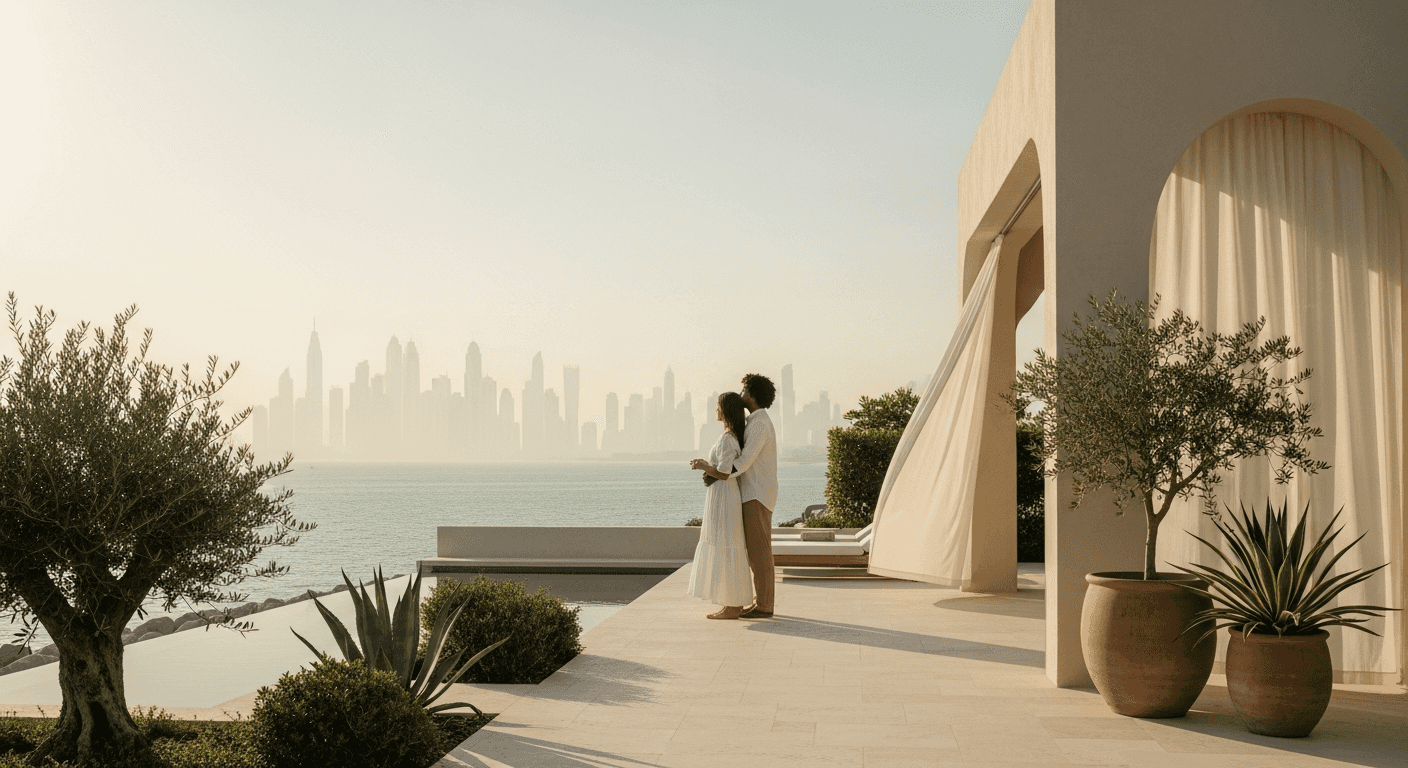
Homes for the Whole Family in Dubai
I explore Dubai's best communities for families who live and entertain on a grand scale, from sprawling villas to unique family compounds. This is my guide for those who value space, privacy, and togetherness above all.

The way we think about 'home' in Dubai is expanding. For a growing number of our clients, a home isn’t just a base for a nuclear family; it’s the heart of a much larger, inter-connected unit spanning multiple generations, designed for grand-scale hospitality and creating a lasting legacy.
Here's what we'll explore:
- The shifting definition of the 'family home' in modern Dubai.
- Classic choices: Established villa communities that set the standard.
- Ultra-luxe enclaves: Where privacy and space are paramount.
- The 'compound within a community' model for ultimate togetherness.
- Designing for entertainment: What makes a home truly guest-ready.
- The practicalities: Annexes, separate entrances, and future-proofing.
- Budgeting for a legacy home: A full, line-by-line cost breakdown.
- My verdict on the best neighbourhoods for bringing everyone together.
The New Demand for Togetherness
For years, the typical brief for a family home in Dubai was straightforward: a four or five-bedroom villa in a green, suburban community with good schools nearby. That demand still forms the bedrock of our market. But a new, more expansive vision is taking hold, driven by both cultural traditions and the practicalities of modern global life. I see it every week in the conversations we have at Gaia Living. Clients are looking for more than just bedrooms; they are searching for properties that can comfortably and elegantly accommodate grandparents, visiting adult children, and live-in staff, all while serving as a hub for significant social gatherings. This is the rise of multi-generational living Dubai style — grand, ambitious, and deeply personal.
This shift reflects Dubai’s maturing identity. As the city transitions from a transient hub to a place where families put down permanent roots, their housing needs evolve. The UAE's proactive visa policies, like the Golden Visa, have given people the confidence to plan long-term, encouraging them to bring their extended families to join them. It’s a return to a more traditional family structure, but updated for the 21st century. The ideal home is no longer just a private sanctuary; it's a versatile platform for family life in all its forms. This means spaces that can be both communal and private, adaptable to the changing needs of toddlers, teenagers, parents, and elders alike.
Architecturally, this translates into a search for specific features. A ground-floor bedroom suite is no longer a 'nice-to-have' but a near-essential for many, offering accessibility for elderly parents or creating a self-contained space for guests. Separate entrances, 'majlis' style reception areas for formal entertaining, and even secondary kitchens (the 'wet' or 'greasy' kitchen) are high on the priority list. The demand for spacious villas Dubai has always had is now more nuanced. It’s not just about square footage; it's about intelligent, flexible layouts that allow for both connection and independence. The ultimate expression of this trend is the quest for family compounds Dubai families are beginning to create — either by purchasing adjacent villas or by custom-building on large plots.
The Classics: Where Grand Living Was Born
 Featured project
When we talk about large-scale family living in Dubai, there are a few foundational communities that immediately come to mind. These are the neighbourhoods that pioneered the very concept of the sprawling suburban villa and, in my view, still set a high benchmark for quality of life. Arabian Ranches is perhaps the quintessential example. Developed by Emaar, it has a timeless appeal rooted in its established greenery, community feel, and variety of villa types. The original Ranches, in particular, offers homes with generous plot sizes that are increasingly rare in newer developments. The larger villas in sub-communities like Mirador La Colección or the original Mirador feature layouts with five or six bedrooms, often with ground-floor guest rooms and large, mature gardens perfect for family gatherings.
What Arabian Ranches does so well is blend privacy with community. You have your private garden and pool, but you're also just a short walk or buggy ride from the golf club, the community centre, or the equestrian facilities. This balance is crucial for multi-generational families. The grandparents might enjoy a quiet morning walk on the shaded pathways, while the children are at the community pool and the parents are playing a round of golf. The sense of an established, safe, and self-contained world is palpable here. Over the years, I’ve seen many families buy in Arabian Ranches and stay for a decade or more, upgrading from a smaller villa to a larger one within the same community as their family grows.
The Meadows, another Emaar classic, offers a similar proposition but with a focus on serene lake views. Part of the broader Emirates Living master community, The Meadows provides a slightly more central location than Arabian Ranches, with easier access to Sheikh Zayed Road. The villas here, especially the larger 'Type' villas, are known for their logical, family-friendly floor plans and solid construction. Again, the plot sizes are a major draw. Many have been extensively upgraded over the years, with owners adding everything from outdoor kitchens to home cinemas, transforming them into superb venues for entertaining. These communities represent a known quantity; they offer a predictable, high-quality lifestyle that has been tested and proven over two decades. They are the 'blue-chip' choice for large family homes Dubai buyers can trust.
The Ultra-Luxe Enclaves: Space and Seclusion
For those whose requirements for space, privacy, and prestige go beyond even the classic suburban communities, Dubai offers a handful of ultra-exclusive enclaves. These are neighbourhoods where the very concept of a home is redefined, moving from a villa to a private estate. The undisputed king in this category is Emirates Hills. From its inception, it was designed to be Dubai's answer to Beverly Hills — a gated community of sprawling, custom-built mansions overlooking the fairways of the Montgomerie Golf Club. Here, you are not buying a developer's floor plan; you are buying a plot of land and the freedom to create a home that is a unique expression of your family's identity.
I have walked through homes in Emirates Hills that are simply breathtaking in their scale and ambition. We're talking about properties with built-up areas exceeding 20,000, 30,000, or even 40,000 square feet on plots of up to 50,000 square feet. These are not just houses; they are private resorts. Features often include basement parking for a dozen cars, multiple formal and informal living areas, dedicated spa and wellness suites, professional-grade cinemas, and staff quarters that resemble a separate apartment block. For multi-generational living, this is the ultimate canvas. You can design wings for different branches of the family, create self-contained apartments for grandparents, and build entertaining spaces Dubai's finest hotels would envy. The investment is, of course, immense — with prices for these estates frequently starting from AED 70 million and soaring well past AED 200 million, but the result is a truly bespoke family legacy.
Another neighbourhood that offers this level of exclusivity, albeit with a different flavour, is Al Barari. Where Emirates Hills is about manicured grandeur, Al Barari is about lush, botanical seclusion. It’s a remarkable achievement in landscape design, a verdant sanctuary that feels a world away from the desert. The villas here, known as 'The Residences' and 'The Reserve', are enormous and designed to integrate with the surrounding nature. Floor-to-ceiling glass walls, multiple terraces, and rooftop gardens blur the line between indoors and out. The larger 'Reserve' villas, in particular, are built on huge plots and offer the space to create a genuine family compound. I’ve always been struck by the sense of tranquility in Al Barari; it's a place that prioritizes wellness and a slower pace of life, which can be incredibly appealing for a family with diverse ages and needs. The community’s focus on farm-to-table dining and nature trails provides a wholesome backdrop for family life.
The Compound Within a Community
For some families, even a single, very large mansion isn't the ideal solution. The perfect setup for them involves proximity without sacrificing total independence — a cluster of homes for different family members. This is the modern interpretation of the traditional family compound, and it’s a concept that is gaining traction. The most straightforward way to achieve this is by purchasing two or more adjacent villas in a master-planned community. I've worked with families who have done this successfully in areas like Dubai Hills Estate and even in some of the more established communities like Arabian Ranches. It allows, for example, for grandparents to live in one home, with their children and grandchildren next door. They share a garden wall, but maintain separate front doors.
This approach offers a brilliant 'best of both worlds' solution. You get the day-to-day closeness and support — grandchildren can run between houses, and shared meals are easy to arrange, but each family unit retains its own space and privacy. It avoids the potential friction of everyone living under a single roof and gives each household autonomy. From a practical standpoint, it requires careful planning and often a bit of luck to find adjacent properties on the market simultaneously. This is where working with a well-connected brokerage like ours can make a significant difference. We often have insight into off-market opportunities or can proactively approach homeowners in a target area on a client's behalf.
Developers are also starting to respond to this demand more directly. We are seeing the emergence of products specifically designed for this purpose. On the ultra-high-end, some developers in locations like Palm Jumeirah or Jumeirah Bay have offered the option to purchase entire floors of a residential building or to combine multiple plots. The most exciting evolution, however, is the concept of 'mansion clusters' within new master plans. Projects like the 'Hills Grove' in Dubai Hills Estate consist of a very limited number of enormous plots intended for palace-like homes, some of which are large enough to build a primary residence and a secondary guest villa within the same boundary. This is the ultimate integrated solution for family compounds Dubai is pioneering, offering a secure, private, and cohesive environment for the entire extended family, all within the context of a larger, amenity-rich community.
Designing for Grand Entertainment
A key part of the brief for these large family homes is the ability to entertain on a significant scale. This goes far beyond just having a large dining room. It’s about creating spaces that can handle everything from an intimate family dinner to a catered event for a hundred guests with grace and efficiency. The flow of the property is paramount. The most successful entertaining spaces Dubai has to offer are those where the indoor and outdoor areas are smoothly connected. Think vast sliding or bi-fold glass doors that open from the main living area onto a landscaped garden, a large terrace, and a pool deck. This creates a fluid, expansive environment where guests can mingle easily.
“In my experience, the single most important feature for serious entertaining is not a cinema or a games room, but a well-designed 'back of house' — a second, fully-equipped kitchen hidden from view.”
The 'show kitchen' and 'wet kitchen' concept is central to this. The show kitchen is the beautiful, open-plan space that is part of the main living area. It’s where you might have a casual breakfast bar or serve drinks to guests. The wet kitchen, or 'greasy kitchen', is the workhorse. It’s a separate, enclosed room, often located near the staff quarters, with powerful extraction fans, large commercial-grade appliances, and durable surfaces. This is where all the heavy-duty cooking, preparation, and cleaning happens, keeping the mess, smells, and noise completely separate from the guest areas. For anyone who plans to host catered events, this is a non-negotiable feature.
Other elements that define a true entertainer's home include a formal reception area or Majlis, distinct from the family's private living room, to receive guests. Basement levels are being used to great effect in many new spacious villas Dubai is building. Instead of being dark storage areas, they are being transformed into entertainment hubs with soundproofed home cinemas, games rooms, private bars, and even climate-controlled car galleries. Rooftop terraces are another highly sought-after feature, offering stunning skyline views and a perfect spot for evening gatherings. Ample and discreet parking is also critical. The most luxurious properties solve this with underground basements that keep cars out of sight and maintain the aesthetic purity of the home's frontage and landscaping. It's this combination of grand, beautiful spaces and flawless, practical logistics that defines a home truly built for hospitality.
Future-Proofing: Annexes, Lifts, and Adaptability
When buying a home for the long term, especially one intended for multiple generations, thinking about future needs is just as important as meeting current ones. A home that works for your family today must also be adaptable for the family of tomorrow. One of the most critical considerations is accessibility. A ground-floor bedroom suite is an excellent start, but for true future-proofing in a multi-level villa, installing a private home elevator is a wise investment. It ensures that elderly family members or anyone with mobility challenges can access all floors of the home comfortably and safely. This feature is becoming standard in the high-end market and is a significant value-add.
Separate annexes or guest houses are another powerful tool for creating a flexible living arrangement. This could be a small, self-contained unit attached to the main villa with its own kitchenette and entrance, or a completely detached structure in the garden. This provides the perfect solution for visiting relatives, adult children who want more independence, or even as a high-end home office or studio. It offers privacy and autonomy while keeping family close. In communities with large plots like Al Barari or Emirates Hills, designing a main residence with a separate guest house is a popular choice. This level of foresight ensures the property remains functional and comfortable as the family's structure evolves over the years.
Beyond physical structures, technological infrastructure is also key to future-proofing. A robust smart home system that controls lighting, climate, security, and entertainment is now an expectation in luxury properties. When planning for a multi-generational household, these systems can be particularly useful. You can create different 'scenes' or settings for various parts of the house, and security features like smart locks and cameras can provide peace of mind, especially for elderly residents living with a degree of independence. Ensuring the home is wired with high-speed fibre optics throughout is also essential to support the demands of multiple users streaming, working, and learning from home. Building in this adaptability from the outset makes the home a more sustainable and valuable asset for the long haul.
Budgeting for Your Legacy Home: A Full Breakdown
Purchasing a large family home is a significant financial undertaking, and the sticker price is only part of the story. Understanding the full, upfront costs is crucial for proper planning. The primary fees are mandated by the Dubai Land Department (DLD) and are consistent across all property transactions in the emirate. It is essential to budget for these on top of the agreed purchase price. There is no room for negotiation on these government charges. Let's break down the typical costs for a hypothetical purchase of a large family villa with an agreed sale price of AED 15,000,000.
Here is a line-by-line example of the acquisition costs you should expect:
- Agreed Purchase Price: AED 15,000,000
- DLD Transfer Fee (4% of Price): AED 600,000
- Real Estate Agency Fee (2% of Price): AED 300,000
- VAT on Agency Fee (5% of Fee): AED 15,000
- Trustee Office Fee (for transfer): AED 4,200 (fixed fee for properties over AED 500k)
- No Objection Certificate (NOC) Fee: AED 1,000 - AED 5,250 (variable, paid to the developer)
- DLD Title Deed Issuance Fee: AED 580
- Total Upfront Cost (approximate): AED 15,920,780
This breakdown clearly shows that the additional costs amount to over AED 920,000 on a fifteen-million-dirham property. This is a substantial sum that must be available in liquid funds at the time of the transaction, as these fees cannot be included in a mortgage. Speaking of mortgages, if you are financing the purchase, the Central Bank of the UAE has clear rules. For an expatriate buyer purchasing a property over AED 5 million, the maximum loan-to-value (LTV) ratio is 75%. This means you would need to provide a minimum down payment of 25%, which in this case would be AED 3,750,000. When you combine the down payment with the transaction fees, the total initial cash outlay would be approximately AED 4,670,780. It's a significant figure, and one that we at Gaia Living always ensure our clients are prepared for from our very first conversation.
Beyond the purchase, you must also consider the ongoing running costs. Annual service charges are payable to the community management company to cover the maintenance of common areas, security, landscaping, and amenities. These are calculated per square foot of your property's built-up area (BUA). For a premium villa community, this could range from AED 3 to AED 6 per square foot annually. For a 7,000 sq. Ft. villa, this could mean an annual bill of AED 21,000 to AED 42,000. You also have utilities (DEWA), home insurance, and a budget for private maintenance of your garden, pool, and the villa itself. Owning a legacy home is as much about maintaining it beautifully as it is about acquiring it.
My Verdict: Finding Your Forever Home
After years of walking through Dubai’s most impressive properties and listening to the stories of the families who call them home, my perspective on this segment of the market is clear. The search for a multi-generational home is not about extravagance for its own sake; it’s about a deep-seated desire for connection, legacy, and a certain quality of life. It’s about creating a central anchor for a family that may be spread across the globe.
For families who value an established, mature community with a warm, neighbourly feel and don't mind an older, renovated property, my recommendation often leans towards the classics. Arabian Ranches and The Meadows offer an unbeatable combination of space, greenery, and proven lifestyle. The value proposition here is strong, and you are buying into a known and beloved entity. The plots are generous, and the sense of community is genuine. These are places where children grow up together and lifelong friendships are formed.
For those for whom modernity, state-of-the-art amenities, and a more contemporary architectural style are paramount, Dubai Hills Estate is, in my opinion, the standout choice. It has successfully taken the DNA of the classic Emaar communities and updated it for the next generation. The quality of the infrastructure, the central park, the championship golf course, and the sheer variety of property — from townhouses to epic mansions, is unmatched. It is fast becoming the new centre of gravity for family life in Dubai.
Finally, for the client with the means and the vision to create something truly unique, a bespoke estate in Emirates Hills or a botanical sanctuary in Al Barari remains the pinnacle. This is less about buying a house and more about commissioning a work of art that will serve as the family’s heart for generations to come. The investment is profound, but the reward is a home that is a perfect, personal reflection of your family's story and aspirations.
Ultimately, the best neighbourhood for multi-generational living is the one that best reflects your family's unique culture. Whether it's the established charm of Arabian Ranches, the modern luxury of Dubai Hills Estate, or the bespoke privacy of Emirates Hills, Dubai offers a canvas to create a true family legacy. The key is to look beyond just the number of bedrooms and focus on the flow, flexibility, and feel of the home.
Sources
- Dubai Land Department (DLD): dubailand.gov.ae
- Central Bank of the UAE: centralbank.ae
Questions, answered
- What is considered a multi-generational home in Dubai?
- In Dubai, a multi-generational home is typically a large villa or townhouse with at least 5-6 bedrooms, often featuring separate living quarters or a ground-floor suite. These properties are designed with multiple living areas, large kitchens, and ample outdoor space to comfortably accommodate grandparents, parents, and children under one roof.
- Which Dubai communities are best for large families?
- Established communities like Emirates Hills, Arabian Ranches, and The Meadows are classic choices known for their spacious villas. For ultimate luxury and privacy, Al Barari and Jumeirah Bay Island offer exceptional properties. Newer areas like Dubai Hills Estate provide modern options with excellent amenities.
- How much does a large family villa cost in Dubai?
- Prices vary significantly by location and size. A 5-bedroom villa in a community like Arabian Ranches might start from AED 6-8 million, while a similar home in Dubai Hills Estate could be AED 10-20 million. Ultra-luxury properties in Emirates Hills or Palm Jumeirah can easily exceed AED 50-100 million.
- Are there specific features to look for in a home designed for entertaining?
- Yes, look for homes with open-plan living and dining areas that flow into a landscaped garden or terrace with a pool. A show kitchen paired with a separate, closed 'wet' kitchen is ideal for catering. Other valuable features include a private cinema, rooftop terrace, basement parking, and dedicated guest suites.
- Can I build my own family compound in Dubai?
- Yes, it is possible in certain freehold areas where developers sell large land plots. Emirates Hills and, to an extent, Dubai Hills Estate offer 'shell and core' or land-only options where you can work with architects to design a custom estate or multiple adjacent villas for a family compound.
- What are the extra costs when buying a large villa in Dubai?
- Beyond the purchase price, you must budget for a 4% Dubai Land Department transfer fee, a 2% real estate agency fee, a Trustee Office fee (around AED 4,200), and the cost of a No Objection Certificate (NOC) from the developer (up to AED 5,250). These fees are all plus 5% VAT where applicable.

Yusuf writes about how Dubai actually lives — waterfront mornings, community dining, walkability, and the lifestyle premium built into an address.
Related stories
Dubai's Big Squeeze: Smaller Plots, Denser Living
Dubai real estate is undergoing a fundamental shift towards smaller plot sizes and higher density. We analyse the economic drivers, the impact on property values, and what this new era of compact urban living means for both homebuyers and investors.
Resort Living as Your Dubai Reality
Explore how to trade temporary staycations for a permanent home with five-star amenities in Dubai. I'll break down the real costs, best communities, and lifestyle trade-offs of embracing high-end resort living every day.
Finding Your Tribe in Dubai's Villa Communities
I explore which of Dubai's renowned villa communities attract specific expat nationalities and lifestyle groups, offering insights to help you find a place that feels like home.
Echoes, in your inbox
One thoughtful email a month. Market insight, new launches, no spam.