

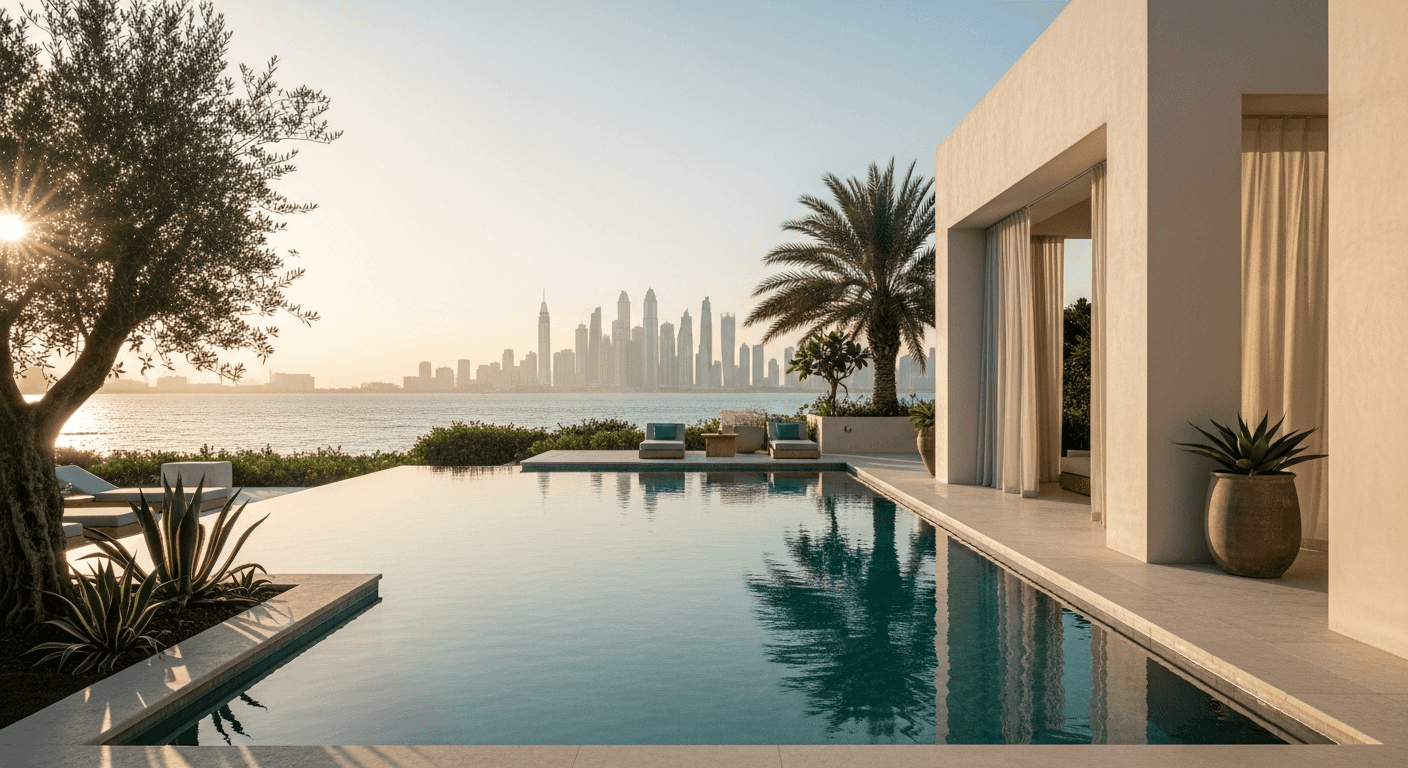
Dubai's Ultra-Luxury Market: A World Apart
Dubai's ultra-luxury property market is increasingly detached from the broader real estate cycle, operating on a distinct logic driven by global wealth flows and extreme scarcity.

For years, observers have spoken of a single 'Dubai property market'. I believe that view is now obsolete. My analysis of transaction data and demand-side fundamentals shows that the market has fractured. At the very top, a distinct and separate ecosystem has formed: the ultra-luxury segment. This is the world of AED 50 million penthouses and AED 200 million beachfront villas, and its performance has fundamentally decoupled from the dynamics that govern the rest of Dubai's residential real estate.
Here's what we will explore in this analysis:
- The specific attributes that define 'ultra-luxury' property in Dubai, beyond just a price tag.
- The global, non-local demand engine powered by ultra-high-net-worth individuals (UHNWIs).
- How extreme supply scarcity and the branded residence model create value.
- A comparison of price behaviour in the ultra-premium segment versus the mainstream market.
- The critical role of cash transactions in insulating this market from economic cycles.
- A detailed, line-by-line cost breakdown for acquiring a trophy asset.
- The intangible drivers of privacy, exclusivity, and bespoke service.
- My final verdict on the future resilience and trajectory of this unique market segment.
What Defines Dubai's Ultra-Luxury Property?
To understand the divergence, we must first define the segment. It’s a common mistake to use 'luxury' and 'ultra-luxury' interchangeably. In my view, they represent entirely different asset classes. A standard 'luxury' property in Dubai might be a spacious apartment in a prime tower in Dubai Marina or a four-bedroom villa in Arabian Ranches. These are high-quality homes, certainly, but their value is still tethered to the broader market, influenced by mortgage rates, rental yields, and local economic sentiment. They are, in essence, the top 10-15% of the mainstream market.
Ultra-luxury is another matter entirely. I would place the entry-point for this segment at a minimum of AED 25 million, though the most significant transactions frequently exceed AED 100 million. Price is only a starting point. The true delineators are a collection of non-negotiable attributes. Location is paramount, but it’s a specific type of location: absolute prime waterfront on the fronds of Palm Jumeirah, a direct marina-fronting plot, or the island seclusion of Jumeirah Bay. These are irreplaceable locations that offer a degree of privacy and prestige that cannot be replicated. Emirates Hills is another classic example, where the value is derived from the sheer size of the plots and the freedom to create a truly bespoke palace.
Beyond location, the asset itself must be extraordinary. We are talking about vast internal spaces, often exceeding 15,000 square feet, with architectural significance from internationally renowned designers. Finishes are not merely 'high-end'; they are bespoke, sourced globally, with extensive use of rare marble, handcrafted joinery, and state-of-the-art technology. The amenity stack is private and personal: basement parking for a collection of supercars, private cinemas, fully equipped spas, gyms that rival commercial facilities, and infinity pools that merge with the sea. This is a world away from the shared facilities of even the most luxurious apartment tower. It’s the difference between having access to a residents' lounge and having a private art gallery within your own home.
The Global Demand Engine: Beyond Local Economics
 Featured project
The fundamental reason the ultra-premium market behaves so differently is that its demand is not local. The buyers of these properties are not typically reliant on a Dubai-based salary or financing from a local bank. Instead, the demand engine is the global population of ultra-high-net-worth individuals. For this cohort, an AED 100 million villa in Dubai is not just a home; it is a strategic asset allocation, a diversification tool, and a lifestyle choice competing with similar assets in London, Miami, or Geneva. This international nature makes the `high-net-worth real estate Dubai` market a fascinating barometer of global wealth flows.
In recent years, we have observed distinct waves of demand from different regions, each with its own motivations. European buyers, for instance, are often drawn by the UAE's political and economic stability, viewing Dubai as a safe harbour for capital amid uncertainty in their home markets. The tax environment is, of course, a significant factor, but it's the combination of financial efficiency and an exceptionally high quality of life that seals the decision. For buyers from the CIS region, capital preservation and personal security are often the primary drivers. For affluent Indian and Asian families, Dubai represents both a strategic business hub and a generational lifestyle upgrade, a place to consolidate family and business interests in a world-class environment.
The UAE's Golden Visa programme has acted as a powerful accelerant for this trend. It formalises the link between a significant real estate investment (a minimum of AED 2 million) and long-term residency, providing a clear and secure pathway for UHNWIs to make Dubai their primary or secondary home base. This policy transforms a property purchase from a simple transaction into a move that provides jurisdictional diversification and long-term security for the buyer and their family. This is a crucial distinction. The buyer is not just purchasing square footage; they are buying into the entire Dubai value proposition: safety, connectivity, pro-business policies, and a sun-drenched lifestyle.
Supply Scarcity and the Rise of the Branded Residence
While global demand is the engine, profound supply scarcity is the mechanism that maintains value and drives prices in the ultra-luxury segment. There is a finite, and in some cases shrinking, supply of true trophy assets. Consider Palm Jumeirah: developer Nakheel created a fixed number of beachfront villa plots on the fronds. Once sold and developed, no more can be created. This absolute scarcity gives these properties a 'museum-piece' quality. The same logic applies to the limited number of villas on Jumeirah Bay Island or the largest plots in Emirates Hills. This is not a market where a developer can simply acquire an adjacent parcel of land and launch a new phase. The supply is structurally capped.
This scarcity has given rise to a powerful sub-market: the branded residence. Developers like Omniyat and Emaar Properties have excelled by partnering with world-renowned luxury brands from hospitality and high fashion — such as Dorchester Collection, Atlantis, Bulgari, and Armani. This is a genius move for several reasons. For the UHNWI buyer, the brand provides an immediate guarantee of quality and service. There is no uncertainty about the level of finishing, the attentiveness of the concierge, or the quality of the management. It de-risks the purchase, particularly for international buyers who may not be familiar with local developers.
These branded residences offer a 'lock-and-leave' lifestyle that is highly appealing to a global citizen who may own multiple homes around the world. All maintenance, security, and à la carte services (from in-residence dining to housekeeping) are handled by the hospitality brand, ensuring the asset is perfectly maintained in their absence. This turn-key convenience is a major selling point. Beyond that, many of these projects offer inclusion in a managed rental pool, providing a hassle-free, brand-managed yield when the owner is not in residence. This combination of scarcity, brand trust, and effortless ownership creates a powerful value proposition that commands a significant price premium over non-branded properties, a key element in current `prime Dubai property trends`.
“The ultra-luxury market isn't a segment of Dubai's property market. It's a segment of the global market for hard assets, which just happens to be located in Dubai.”
Dissecting Price Performance: A Tale of Two Markets
The performance divergence is most stark when you analyse price growth. While the broader Dubai market, tracked by various indices, might experience steady, cyclical growth — say, 5-15% in a strong year, the ultra-luxury segment behaves very differently. Its price movements are not smooth or linear. They are characterised by sharp, event-driven spikes, often when a new price record is set for a particular type of asset or location. A single AED 200 million transaction for a penthouse can re-price all other penthouses in that building and its vicinity, as it establishes a new benchmark for what the market is willing to pay.
This `luxury market resilience` comes from its insulation from typical market pressures. A 1% increase in mortgage rates might deter a family looking to buy a villa in Damac Hills and Damac Hills II, but it is utterly irrelevant to a cash buyer considering a AED 150 million property on Jumeirah Bay Island. Similarly, fluctuations in average rental yields across JVC have no bearing on the capital value of a signature villa on the Palm. The metrics are different. The value is driven by global wealth concentration, the scarcity of the asset, and its 'trophy' status, not by local affordability or rental income potential in the traditional sense.
Publicly available data from the Dubai Land Department (DLD) regularly highlights this trend. We see headlines about record prices per square foot being achieved in specific buildings or enclaves, while the city-wide average moves more modestly. For example, a record-breaking sale at the Bulgari Resort & Residences or on 'Billionaires' Row' on Palm Jumeirah doesn't necessarily lift prices in Business Bay; rather, it solidifies the top-tier's separation from the rest of the market. This is a key finding of my `ultra-premium market analysis`: you cannot use city-wide averages to understand the behaviour of the top 0.1% of properties. It’s a market that makes its own rules, driven by one-off transactions that create new value plateaus.
The Primacy of Cash: How Transactions Differ
Perhaps the most significant mechanical difference between the ultra-luxury segment and the rest of the market is the method of financing. The overwhelming majority of transactions above AED 25 million are completed in cash. This has profound implications for market stability and behaviour. It effectively decouples the segment from the monetary policy of the Central Bank of the UAE and the lending appetite of commercial banks. While the mainstream market holds its breath when interest rates rise, the ultra-luxury market is largely indifferent.
This cash-driven nature provides a powerful buffer against economic shocks. During periods of global financial tightening, when mortgage-dependent markets cool off, the cash-flush ultra-luxury segment can continue to transact, driven by wealth preservation and lifestyle decisions rather than the cost of borrowing. It also makes for a much faster and more private transaction process. Buyers can move quickly without the lengthy and often intrusive process of securing a mortgage, which can be particularly complex for international clients with global asset structures. This speed and certainty is often a deciding factor and gives cash buyers a formidable negotiating advantage.
Here’s a simple breakdown of why cash is king in this arena:
- Buyer Profile: UHNWIs typically hold significant liquid capital and prefer to deploy it directly into hard assets rather than using.
- Speed and Certainty: A cash offer is clean and fast, eliminating financing contingencies and the risk of a deal falling through due to bank underwriting.
- Privacy: Cash transactions bypass the deep financial disclosures required for a mortgage application, offering a higher degree of discretion.
- Negotiating Power: Sellers strongly favour the certainty of a cash buyer, often resulting in a more favourable purchase price or terms for the buyer.
This reliance on cash is a cornerstone of the segment's divergent performance. It creates a market that is less a real estate market in the traditional sense and more a private marketplace for hard assets, operating on a parallel track to the mortgage-driven mainstream.
A Case Study in Cost: Acquiring an Ultra-Luxury Villa
To make this tangible, it's useful to break down the real costs associated with acquiring an ultra-luxury asset in Dubai. The headline price is just one part of the equation. A buyer must be prepared for significant transactional fees. Let’s model the acquisition of a hypothetical signature villa on Palm Jumeirah with a purchase price of AED 80 million. The figures below are based on prevailing government regulations and standard industry practice.
Here is a line-by-line breakdown of the upfront costs:
- Agreed Purchase Price: AED 80,000,000
- Dubai Land Department (DLD) Transfer Fee (4% of purchase price): AED 3,200,000. This is a mandatory government fee, as stipulated by the Dubai Land Department, to register the change of ownership.
- Real Estate Agency Fee (2% of purchase price): AED 1,600,000
- VAT on Agency Fee (5%): AED 80,000
- DLD Registration Fees: Approximately AED 4,200 (this is a fixed fee for properties over a certain value).
- Trustee Office Fee (for secondary market transactions): Approximately AED 4,200, paid to a RERA-approved office to handle the title deed transfer.
- Developer No-Objection Certificate (NOC) Fee: This can range from AED 500 to AED 5,000, paid to the master developer (Nakheel in this case) to certify there are no outstanding service charges.
Total Estimated Upfront Cost: AED 84,888,400
As you can see, the transactional costs add nearly AED 5 million, or over 6%, to the purchase price. This is a substantial sum that must be factored into any acquisition budget. Beyond that, ongoing ownership costs are considerable. Service charges in ultra-premium communities can be anywhere from AED 5 to AED 15 per square foot of built-up area annually. For a 20,000 sq ft villa, this could equate to AED 100,000 to AED 300,000 per year, before accounting for private maintenance, utilities, and household staff. These are not incidental expenses; they are significant commitments that a buyer must be prepared to meet.
The Intangibles: Privacy, Exclusivity, and Bespoke Service
Finally, we must acknowledge the powerful, non-financial drivers that shape this market. For buyers at this level, privacy is not a feature; it is a fundamental requirement. They are purchasing seclusion. This is why a villa on an inner frond of the Palm Jumeirah may trade at a discount to one on the tip with open water views and no neighbours opposite. It's why the lush, dense foliage and large, set-back plots of Al Barari command such a premium. The design of these communities is focused on minimising visibility and maximising personal space.
Exclusivity is the other side of this coin. The value of an asset is enhanced by the profile of the community. Owning a property in Emirates Hills or on Jumeirah Bay Island is an automatic entry into one of the world's most exclusive clubs. This sense of a peer community is a powerful draw. It creates a network effect where the arrival of one prominent individual attracts others, further cementing the area's prestige and, in turn, its property values. Developers understand this well, curating their launches and marketing to a very specific global audience.
At Gaia Living, our work in this segment goes far beyond standard brokerage. It is about providing access and discretion. Many of the most desirable properties are never publicly listed. They are traded 'off-market' through trusted networks. Our role is to understand the specific, often unstated, needs of a UHNWI client — be it a particular architectural style, a desire for a private jetty, or the need for absolute transactional privacy, and to discreetly source the asset that meets them. It's a high-touch, advisory-led service that recognises these are not just property deals; they are strategic acquisitions for some of the world's most discerning individuals.
My Verdict: Future Outlook and Segment Resilience
My analysis leads me to a clear conclusion: Dubai's ultra-luxury property market will continue on its divergent path, operating with a logic distinct from the mainstream. Its fortunes are tied not to local wage growth or mortgage availability, but to Dubai's enduring appeal as a global hub for wealth, business, and talent. As long as the emirate maintains its safe-haven status, its pro-business policies, and its unparalleled lifestyle offering, the flow of global capital into its trophy real estate assets will continue.
This does not mean the segment is immune to all risks. A severe global economic crisis or a geopolitical event that fundamentally alters wealth flows could certainly impact demand. The market is also lumpy and can experience periods of lower transaction volumes. However, its core resilience is structural. The fixed, irreplaceable supply of the best assets provides a natural floor to value. The cash-based nature of transactions provides a powerful shield against monetary policy cycles. The motivations of its UHNWI buyers — wealth preservation, security, and lifestyle, are long-term drivers that tend to persist through economic volatility.
In my view, the `Dubai ultra-luxury property` market is no longer just about real estate. It has matured into a recognised asset class for global wealth management. Investors and residents are not simply buying a home; they are buying a stake in the success and stability of Dubai itself. For this reason, I expect its performance to remain robust and fundamentally disconnected from the broader market's cycles for the foreseeable future.
The ultra-luxury property market in Dubai has decoupled from the mainstream, driven by global UHNWI demand, absolute asset scarcity, and cash-based transactions. Its resilience is structural, tied more to Dubai's global safe-haven status than to local economic factors, a trend I expect to continue.
Sources
- Dubai Land Department (DLD): https://dubailand.gov.ae/
- Central Bank of the UAE: https://www.centralbank.ae/
- The UAE Government Portal: https://u.ae/
Questions, answered
- What is the price threshold for ultra-luxury property in Dubai?
- There is no official government definition, but in my professional view, the ultra-luxury segment begins around AED 25 million. The most exclusive trophy assets, however, often trade hands for well over AED 100 million.
- Are ultra-luxury properties in Dubai a good investment?
- These assets should be viewed primarily through the lens of wealth preservation and lifestyle acquisition, not short-term speculative returns. While significant capital appreciation can occur, it is not guaranteed and the market is driven by unique, global factors.
- Who are the main buyers of Dubai's ultra-luxury homes?
- The buyer pool is overwhelmingly international, comprising ultra-high-net-worth individuals (UHNWIs) from regions like Europe, the CIS, India, and greater Asia. Their motivations are typically a blend of seeking a safe haven for capital, benefiting from the UAE's tax environment, and acquiring a world-class lifestyle.
- Are these properties usually bought with mortgages?
- No, the vast majority of transactions in the AED 25 million+ bracket are cash-based. This insulates the ultra-premium market from local interest rate fluctuations and lending policies set by the Central Bank of the UAE.
- What are the most exclusive ultra-luxury areas in Dubai?
- The most sought-after enclaves for trophy homes include the 'Fronds' and 'Billionaires' Row' on Palm Jumeirah, the private island of Jumeirah Bay, the expansive plots of Emirates Hills, and the secluded, green sanctuary of Al Barari.
- What are the typical ongoing costs for an ultra-luxury Dubai property?
- Beyond the purchase price, owners must budget for significant annual costs. These include community service charges, which can be very high for premium locations, property management fees, and often the substantial expense of private household staff and bespoke maintenance.

Amara translates DLD transaction data, supply pipelines, and macro signals into clear calls on where Dubai's market is heading. She writes the numbers most brokers only feel.
Related stories
Dubai's Big Squeeze: Smaller Plots, Denser Living
Dubai real estate is undergoing a fundamental shift towards smaller plot sizes and higher density. We analyse the economic drivers, the impact on property values, and what this new era of compact urban living means for both homebuyers and investors.
Resort Living as Your Dubai Reality
Explore how to trade temporary staycations for a permanent home with five-star amenities in Dubai. I'll break down the real costs, best communities, and lifestyle trade-offs of embracing high-end resort living every day.
Finding Your Tribe in Dubai's Villa Communities
I explore which of Dubai's renowned villa communities attract specific expat nationalities and lifestyle groups, offering insights to help you find a place that feels like home.
Echoes, in your inbox
One thoughtful email a month. Market insight, new launches, no spam.