

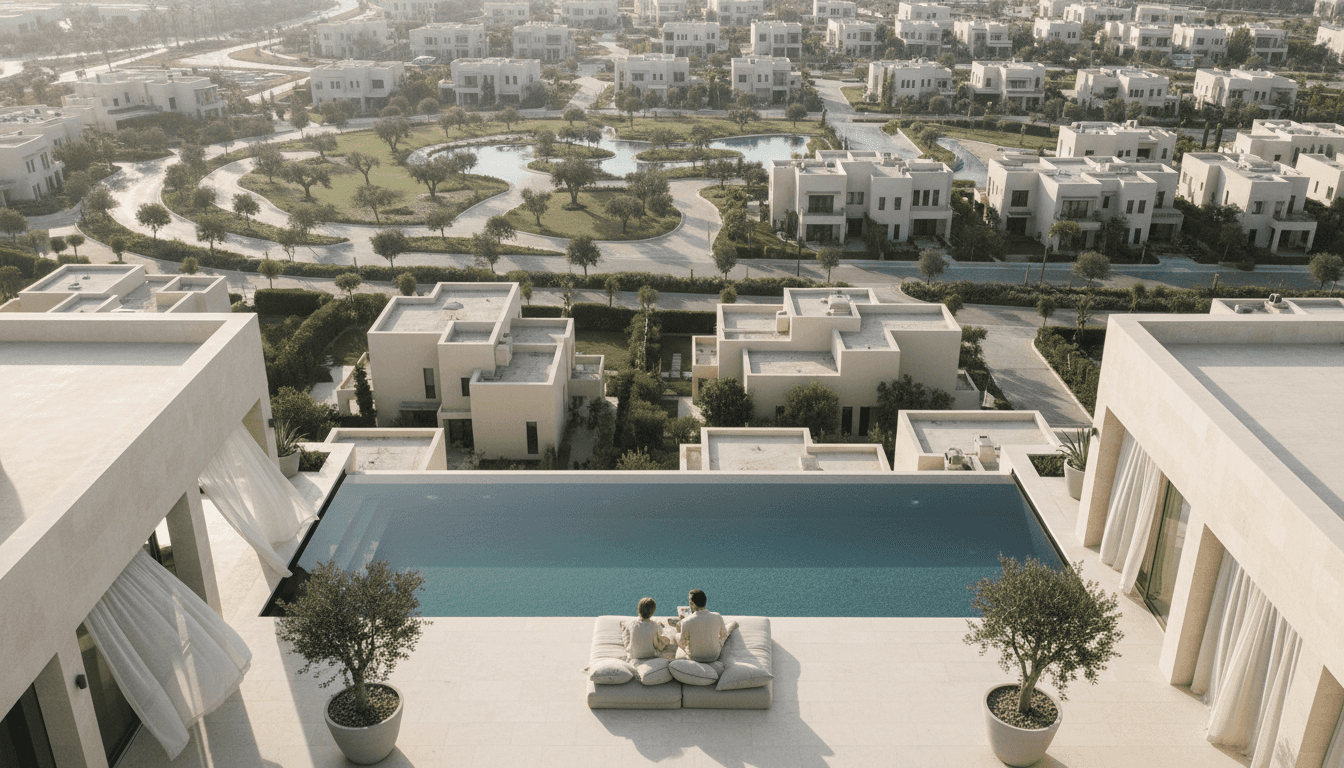
Dubai's Sun-Drenched Villas: A Guide to Light-Filled Living
I explore the Dubai villa communities that masterfully blend modern architecture with our brilliant sunshine, creating the bright, airy family homes so many of us crave.

In my years exploring every corner of Dubai's family communities, I've noticed a profound shift in what we seek in a home. The heavy curtains, smaller windows, and segmented rooms of the past — designed for privacy and to fend off the heat, are giving way to a new priority. Today, the ultimate luxury is light. We're searching for homes that don't just shelter us from the sun, but invite it in, creating spaces that feel expansive, uplifting, and connected to the world outside.
Here’s what we'll explore in this guide to Dubai's brightest homes:
- The fundamental shift in villa architecture towards light and space.
- Why master developers like Emaar Properties are now prioritising brightness.
- A deep dive into communities like Al Barari, the original champions of light.
- How newer players like Sobha are setting new standards for airy living.
- The crucial role of glass, layout, and orientation in creating a well-lit home.
- Practical considerations: balancing light with cooling costs and privacy.
- A worked example of the total cost of acquiring one of these beautiful homes.
The Architectural Shift: Why Light Is the New Luxury
For a long time, residential architecture in the Gulf was defined by a battle against the sun. Traditional homes featured thick walls, smaller, strategically placed windows, and internal courtyards to create shaded, passively cooled interiors. Early villa communities in modern Dubai, while not as extreme, often carried echoes of this philosophy. Homes in some older phases of Arabian Ranches or The Springs, for instance, had layouts that compartmentalised space, with distinct living, dining, and family rooms separated by solid walls. The focus was on creating cosy, defined zones rather than a smooth, flowing environment. This wasn't a design flaw; it was a reflection of the priorities and aesthetic preferences of the time. The idea was to create a cool, private sanctuary shielded from the intense climate.
Over the past decade, however, I've seen this paradigm completely invert. The demand for Dubai villas with natural light has surged, driven by a confluence of changing tastes, technological advancements, and a deeper understanding of well-being. Homebuyers today, especially the international demographic that makes up a large part of the market, arrive with an expectation of open-plan living. They want kitchens that flow into dining areas, living spaces that merge with the garden, and an overarching sense of volume and airiness. This represents a fundamental change in how we want to live. A home is no longer just a refuge from the elements; it's a platform for family life, for entertaining, and for personal wellness, all of which are enhanced by natural light.
This shift has been made possible by huge advances in building materials, particularly glazing technology. The floor-to-ceiling windows that define today’s airy home communities Dubai are not the simple panes of glass from twenty years ago. Modern villas use sophisticated double or even triple-glazed units with low-emissivity (Low-E) coatings. These advanced windows are engineered to allow visible light to pass through while reflecting a significant portion of the infrared radiation (heat). This is the magic formula: you get the beautiful, bright interiors and the views without the crippling energy bills. Developers can now design villas with large windows Dubai without compromising on thermal performance, a crucial factor in our climate. This technological leap has untethered architects, giving them the freedom to pursue a much lighter, more transparent design language.
Beyond aesthetics and technology, there's a powerful wellness component at play. The positive psychological effects of natural light are well-documented. It regulates our circadian rhythms, boosts mood, and increases productivity. After years of living and working in the built environment, people are craving a stronger connection to the outdoors. A bright, sun-drenched living room that looks out onto a green garden just *feels* better. It’s a quality of life upgrade that has become a non-negotiable for many of the families I work with. This isn't just a trend; in my view, it’s a permanent re-evaluation of what makes a house a home. Light, space, and a connection to nature are the new pillars of premium family living in Dubai.
Emaar's Evolution: From Cosy Enclaves to Luminous Living
 Featured project
When you think of Dubai villa communities, Emaar Properties is often the first name that comes to mind. As the master developer behind foundational neighbourhoods like Arabian Ranches, The Meadows, and The Springs, Emaar effectively wrote the playbook for suburban family life in the emirate. The original villas in these communities are beloved for their robust build quality, mature landscaping, and strong sense of community. Architecturally, they tended towards Mediterranean and Arabian styles, with terracotta roofs, arched windows, and often, more segmented interior layouts. While lovely and characterful, they weren't explicitly designed with maximising natural light as the primary goal.
However, watching Emaar's portfolio evolve over the years has been like witnessing the architectural shift of Dubai in miniature. With each new launch, you can see a deliberate move towards brighter, more contemporary designs. The contrast between Arabian Ranches 1 and the newer phases of Arabian Ranches III is a perfect example. While the original Ranches homes are charming, many homeowners spend considerable sums knocking down walls and enlarging window openings to brighten them up. In contrast, the villas in Arabian Ranches III — in sub-communities like June, Elie Saab, and Caya, are designed from the ground up for modern tastes. They feature much larger windows, higher ceilings, and more fluid, open-plan ground floors. The aesthetic is cleaner, the colour palettes are lighter, and the transition between indoor and outdoor space is far more smooth.
Emaar's flagship community, Dubai Hills Estate, is where this new philosophy is most evident. It's a masterclass in blending green landscapes with light-filled architecture. The villas in clusters like Golf Place, Parkway Vistas, and the ultra-exclusive Hills Grove Villas are defined by their vast expanses of glass. These are true bright family homes Dubai, where double-height entrance foyers and living rooms with floor-to-ceiling windows are standard. Emaar understood that for the premium segment, buyers weren't just purchasing square footage; they were buying volume, views, and an abundance of light. This design approach creates homes that feel both grand and welcoming, perfect for the modern family that values both impressive entertaining spaces and comfortable daily life.
This evolution makes perfect sense from a market perspective. Emaar is responding directly to buyer demand. The families moving to Dubai today, or upgrading from older homes, are explicitly asking for these features. At Gaia Living, when we take on a new family as clients, 'bright and open' is almost always at the top of their wish list. Emaar's newer projects deliver on this, and they do it at scale, offering a range of options from three-bedroom townhouses to sprawling golf course mansions. By embracing this light-centric design language, Emaar has ensured its communities remain the benchmark for family living in Dubai, adapting its successful formula to meet the desires of a new generation of homeowners.
Al Barari: The Original Champion of Light and Nature
Long before 'biophilic design' became a buzzword, there was Al Barari. I remember my first visit to the community over a decade ago, and it felt like stepping into a different world. At a time when much of Dubai's development was focused on density and desert-scape, Al Barari was a radical statement. It dedicated over 60% of its land to lush botanical gardens, pristine lakes, and meandering streams. It was, and still is, Dubai's greenest and most serene enclave. But its pioneering spirit wasn't limited to landscaping; it extended deep into the architecture of its homes. Al Barari was arguably the first major community to make natural light and a connection to the outdoors the absolute centrepiece of its design philosophy.
The villas in the initial phases, like The Residences and The Reserve, were groundbreaking. They introduced a scale of openness that was simply unheard of at the time. These weren't just homes with big windows; they were structures designed to dissolve the boundary between inside and out. Features that are now common in high-end villas — double-height living spaces, internal courtyards, and massive sliding glass doors that open entire walls to the garden, were pioneered here. The layouts were intentionally fluid, encouraging movement and sightlines through the home and out into the stunning greenery. For families seeking genuine well-lit villas Dubai, Al Barari set an impossibly high bar.
As the community has matured, this commitment to light has only deepened. Newer phases like Chorisia and The Nest offer a more contemporary, but no less luminous, take on the Al Barari lifestyle. Chorisia villas are particularly notable for their dramatic, light-flooded interiors, where huge glass panels and a central, open-air courtyard ensure that every room is bathed in sunshine. The Nest offers a slightly more compact but equally bright product, designed for families who want the Al Barari address and lifestyle in a more manageable footprint. What unites all these homes is a masterful understanding of how to use light to shape space. It’s used to create drama in entrance halls, to bring warmth to family rooms, and to constantly draw the eye outwards to the incredible gardens.
Of course, this level of design and quality comes at a price. Al Barari is firmly in the ultra-luxury segment. But for those who can afford it, the value proposition is about more than just a house. It's about a holistic lifestyle. It's about waking up to the sound of birdsong, having breakfast in a sun-drenched room overlooking your private pool and garden, and feeling a sense of peace and tranquility that is rare in a bustling metropolis. Privacy is also cleverly managed through masterful landscaping; even with wall-to-wall glass, you feel secluded in your own private oasis. In my professional opinion, Al Barari remains the gold standard for integrating architecture with nature, and its unwavering focus on creating bright, open, and soulful homes is a key reason for its enduring appeal.
Sobha Hartland: Engineering a Brighter Standard
If Al Barari represents the artisanal, botanical approach to luxury living, then Sobha Hartland and Sobha Hartland II represent the engineering-led, precision-built version of the same dream. Sobha Realty, with its unique backward-integration model — where they control everything from design to construction to materials, has made a significant mark on Dubai's property market. Their calling card is an obsessive focus on quality, and a key part of that quality proposition is the delivery of exceptionally bright and well-designed homes. When I walk clients through a Sobha villa, they are almost always struck by the sheer volume of light and the intelligent use of space.
Located in Meydan, just minutes from Downtown Dubai, Sobha Hartland offers a compelling blend of central location and serene, green living. The community's master plan dedicates a significant portion of its area to green space, and the villas are designed to take full advantage of this. The Forest Villas, for example, are a standout product. These homes are set amidst dense foliage and feature a radical amount of glass. The design is unapologetically modern, with clean lines, minimalist interiors, and multi-level layouts that create dramatic internal volumes. The floor-to-ceiling windows are not just a feature; they are the defining element of the architecture, wrapping around corners and extending across multiple floors to ensure the interiors are flooded with natural light and offer constant views of the surrounding greenery.
What I appreciate about Sobha's approach is the thoughtfulness of the layouts. It’s not just about putting in big windows. The internal spaces are configured to maximise the benefit of that light. The flow from the living areas to the private gardens is smooth. Many villas feature triple-height courtyards or atriums that draw light deep into the centre of the home, illuminating hallways and spaces that would otherwise be dark. This demonstrates a sophisticated understanding of architectural design. It's an approach that ensures even the largest floor plans, which can sometimes feel cavernous and impersonal, retain a sense of warmth and connection. These are genuinely bright family homes Dubai in every sense of the word.
This design philosophy continues in Sobha Hartland II and their newer launches like Sobha Sanctuary. They are doubling down on what made the first phase successful: generous plot sizes, a focus on water features and landscaping, and villas designed for maximum light and air. From an investment and living perspective, Sobha's commitment to quality control is a significant draw. Because they manage the entire process, the fit and finish are remarkably consistent and of a very high standard. For a buyer, this means fewer surprises on handover and the reassurance that the high-performance glazing and building envelope are constructed to the promised specification. In a market where quality can vary, Sobha's reputation for delivering exactly what they advertise provides enormous peace of mind.
“In the pursuit of the perfect family home, I've found that light is no longer a feature — it's the foundation. A bright home is a happy home.”
Tilal Al Ghaf and the New Wave of Master Planners
While Emaar, Sobha, and Al Barari are established giants, a new wave of master developers is further pushing the boundaries of light-filled community design. Chief among them, in my opinion, is Majid Al Futtaim with their flagship community, Tilal Al Ghaf. Located near Dubai Sports City, Tilal Al Ghaf has quickly become one of the most sought-after addresses in Dubai, and a huge part of its appeal lies in its fresh, contemporary, and incredibly bright architectural style. The entire community is designed around a recreational lagoon with sandy beaches, and the homes are conceived to embrace this resort-like lifestyle.
The signature villas and townhouses in Tilal Al Ghaf, particularly in clusters like Elan, Aura, and Alaya, are defined by their clean, minimalist aesthetic and an abundance of glass. Majid Al Futtaim collaborated with world-class architects to create homes that feel modern and spacious. The designs often feature large sliding glass doors, corner windows, and skylights that work together to create interiors that are constantly connected to the outdoors. The colour palettes are predominantly white and neutral, which further amplifies the sense of light and space. Walking through a show villa at Tilal Al Ghaf, you immediately understand the vision: to create airy home communities Dubai that feel like a permanent holiday.
What sets Tilal Al Ghaf apart is the level of customisation offered, particularly in the premium villa collections like Alaya and Lanai Islands. Buyers can choose from different facade styles and, more importantly, can select interior layouts and finishes that suit their family's needs. A key option is the ability to have 'Sky Suites' — penthouses on the second floor that can be configured as a master retreat or an entertainment space, invariably wrapped in glass to offer panoramic views. This level of personalisation, combined with the inherently bright design, allows families to create a home that is not just well-lit, but perfectly tailored to their lifestyle. It’s a smart strategy that has resonated deeply with the market.
Other developers are following a similar path. Nakheel, the developer behind Palm Jumeirah, is embracing a much more contemporary aesthetic in its newer projects on Palm Jebel Ali and Dubai Islands. The initial concepts for these new master-planned cities showcase villas with sleek lines and vast glazed areas, a world away from the more traditional Garden Homes on the original Palm. Similarly, Aldar's expansion into Dubai with communities like Haven shows a clear focus on wellness, nature, and light-filled living. This new generation of master-planned communities understands that the modern luxury buyer in Dubai is sophisticated and has a clear vision for their home, a vision in which light, air, and space are paramount.
Glass, Layout, and Orientation: The Holy Trinity of a Bright Home
Achieving a truly light-filled home is more complex than simply installing large windows. It's a careful balancing act between three key elements: the quality of the glass, the intelligence of the layout, and the orientation of the property. When we at Gaia Living assess a villa's potential for a client who prioritises brightness, these are the three factors we analyse most closely.
First, the glass itself. As I mentioned earlier, the technology here is critical. In Dubai, you should be looking for villas that specify double-glazing with a Low-E coating as a minimum standard. This is the baseline for any quality new-build. This coating is a microscopically thin, transparent layer of metal oxide that reflects long-wave infrared energy (heat) while allowing short-wave light energy (daylight) to pass through. In simple terms, it keeps the heat out in summer and can even help keep warmth in during the cooler winter nights. Without this technology, villas with large windows Dubai would become greenhouses, leading to exorbitant DEWA bills and uncomfortable living conditions. The best developers will provide detailed specifications for their glazing, including U-values (a measure of insulation) and Solar Heat Gain Coefficient (SHGC) ratings. Don't be afraid to ask for this data; it's a key indicator of a home's quality.
Second is the layout. A great layout doesn't just allow light in; it draws it through the house. Open-plan designs are the most obvious way to achieve this, removing internal walls that block light. But the most sophisticated designs go further. Features to look for include:
- Double or Triple-Height Ceilings: These are common in entrance foyers and formal living rooms, creating a sense of grandeur and allowing light from upper-level windows to flood the ground floor.
- Internal Courtyards: A classic architectural feature brilliantly re-imagined in modern villas. A central, glazed courtyard acts as a light well, illuminating the very core of the home.
- Staircase Design: A heavy, solid staircase can block a surprising amount of light. Look for homes with floating staircases, glass balustrades, and large windows on the half-landings. These elements help light travel between floors.
- Strategic Use of Skylights: Placed above stairwells, in walk-in wardrobes, or in bathrooms, skylights can bring natural light into enclosed spaces that would otherwise require artificial lighting all day.
Finally, there's orientation. This is perhaps the most overlooked, yet most critical, factor. In Dubai, a north-facing aspect is often the most desirable. North-facing rooms receive consistent, indirect sunlight throughout the day without the harsh glare and heat of direct sun. A villa with its main living areas and largest windows facing north will be naturally bright but relatively cool. South-facing windows, on the other hand, will receive intense, direct sun for most of the day, which can be challenging to manage, even with the best glazing. East-facing rooms get the morning sun, which is lovely for kitchens and breakfast nooks, while west-facing rooms get the intense afternoon sun, which can overheat a space if not properly shaded. A well-designed villa will respond to its orientation, perhaps using smaller windows or external shading (brise-soleil) on the southern and western facades, while opening up completely to the north.
The Practicalities: Cost, Cooling, and Privacy
While the dream of a sun-drenched villa is appealing, there are practical considerations to weigh. The most common questions I get from clients relate to the cost — both upfront and ongoing, and the potential trade-offs with privacy. It’s important to go into a purchase with a clear understanding of these factors.
The upfront cost is directly impacted by this architectural style. High-performance glazing is significantly more expensive than standard glass or solid walls. The engineering required for large, open-plan spaces and double-height ceilings also adds to the construction cost. As a result, well-lit villas Dubai with a modern, open design typically command a premium over older, more conventional homes of the same size. This is a value judgment for the buyer: are you willing to pay more for the enhanced quality of life that these bright spaces offer? For most of my clients, the answer is a resounding yes.
Let's break down the typical acquisition costs for a modern, bright four-bedroom villa priced at, say, AED 5,000,000. The numbers look something like this:
- Purchase Price: AED 5,000,000
- Dubai Land Department (DLD) Transfer Fee: 4% of purchase price = AED 200,000
- DLD Registration Fees: Approx. AED 4,200
- Real Estate Agency Fee: 2% of purchase price + 5% VAT = AED 105,000
- Mortgage Registration Fee (if applicable): 0.25% of loan amount + AED 290
- Bank Processing/Valuation Fees (if applicable): Approx. AED 5,000 - AED 10,000
- No Objection Certificate (NOC) Fee: Approx. AED 500 - AED 5,000 (varies by developer)
As you can see, the ancillary costs are significant. It’s crucial to budget around 7-8% of the purchase price for these closing costs. For financing, remember that the Central Bank of the UAE mandates a minimum down payment of 20% for expatriate first-time buyers on properties under AED 5 million, and 25% for properties over that amount. You can review the latest regulations on the Central Bank of the UAE (centralbank.ae) website.
Ongoing costs, primarily for cooling, are another key concern. While modern glazing is highly efficient, a wall of glass will never insulate as well as a thick, solid wall. However, the difference in a well-built modern home is less than you might think. A combination of high-quality glass, good insulation, and an efficient, well-maintained AC system ensures that running costs remain manageable. Service charges, which cover the maintenance of the community's stunning landscapes and amenities, are another factor. In premium communities like Sobha Hartland or Al Barari, you can expect these to be in the range of AED 4-7 per square foot of built-up area annually. You can verify typical rates and regulations through the Dubai Land Department (DLD) portal.
Finally, there's privacy. How do you reconcile wall-to-wall windows with the desire for seclusion? Master planners address this in several ways. Firstly, plot sizes in these high-end communities are often more generous, creating greater distance between neighbours. Secondly, landscaping is used strategically. Mature trees, dense hedges, and tiered planting can effectively screen a property from view without blocking light. Thirdly, the internal layout itself can be designed for privacy, with bedrooms and bathrooms positioned away from the most exposed elevations. It’s a design challenge, but one that the best architects solve with elegance, ensuring you can enjoy your bright, open home without feeling like you're on display.
The move towards bright, open-plan villas is the single most important architectural trend in Dubai's family home market. While these homes command a premium, they deliver an unparalleled quality of life, and advances in glazing technology have made them more practical and efficient than ever before. My advice is to prioritise intelligent design and quality of construction over sheer size; a well-designed, luminous 4,000 sq. Ft. villa will bring more joy than a poorly-lit 6,000 sq. Ft. one.
Sources
- Dubai Land Department (DLD): https://dubailand.gov.ae
- Central Bank of the UAE: https://www.centralbank.ae
- UAE Government Portal (Property Laws): https://u.ae/en/information-and-services/business/real-estate
Questions, answered
- Which Dubai communities are best for villas with natural light?
- Communities like Al Barari, Sobha Hartland, and Tilal Al Ghaf by Majid Al Futtaim are renowned for their focus on natural light, featuring large windows and open-plan layouts. Newer Emaar communities like Arabian Ranches III also embrace this modern, light-filled aesthetic.
- Are villas with large windows more expensive to cool in Dubai?
- They can be, but modern villas use high-performance, double-glazed, and often Low-E coated glass to reflect heat and UV rays, minimising the impact on cooling costs. A well-designed, modern villa balances light with energy efficiency.
- What is the architectural style of most bright, modern villas in Dubai?
- The predominant style is contemporary or modern, characterised by clean lines, minimalist palettes, flat roofs, and extensive use of glass. This is a departure from the more traditional Arabian or Mediterranean styles of older villa communities.
- Can I find older villas in Dubai with good natural light?
- Yes, though they may require renovation. Many villas in established communities like The Meadows or Arabian Ranches have great potential. Homeowners often upgrade windows and knock down internal walls to create brighter, more open living spaces.
- What are the typical costs of buying a bright, modern villa in Dubai?
- Prices vary widely. A four-bedroom villa in a community like Arabian Ranches III might start around AED 4.5 million, while a similar-sized home in the ultra-luxe Al Barari could be AED 15 million or more. Remember to budget for the 4% DLD transfer fee and other associated closing costs.

Sophia profiles Dubai's villa communities — schools, commute times, green space, and the intangible feel of a neighbourhood. She writes for families putting down roots.
Related stories
Dubai's Big Squeeze: Smaller Plots, Denser Living
Dubai real estate is undergoing a fundamental shift towards smaller plot sizes and higher density. We analyse the economic drivers, the impact on property values, and what this new era of compact urban living means for both homebuyers and investors.
Resort Living as Your Dubai Reality
Explore how to trade temporary staycations for a permanent home with five-star amenities in Dubai. I'll break down the real costs, best communities, and lifestyle trade-offs of embracing high-end resort living every day.
Finding Your Tribe in Dubai's Villa Communities
I explore which of Dubai's renowned villa communities attract specific expat nationalities and lifestyle groups, offering insights to help you find a place that feels like home.
Echoes, in your inbox
One thoughtful email a month. Market insight, new launches, no spam.