

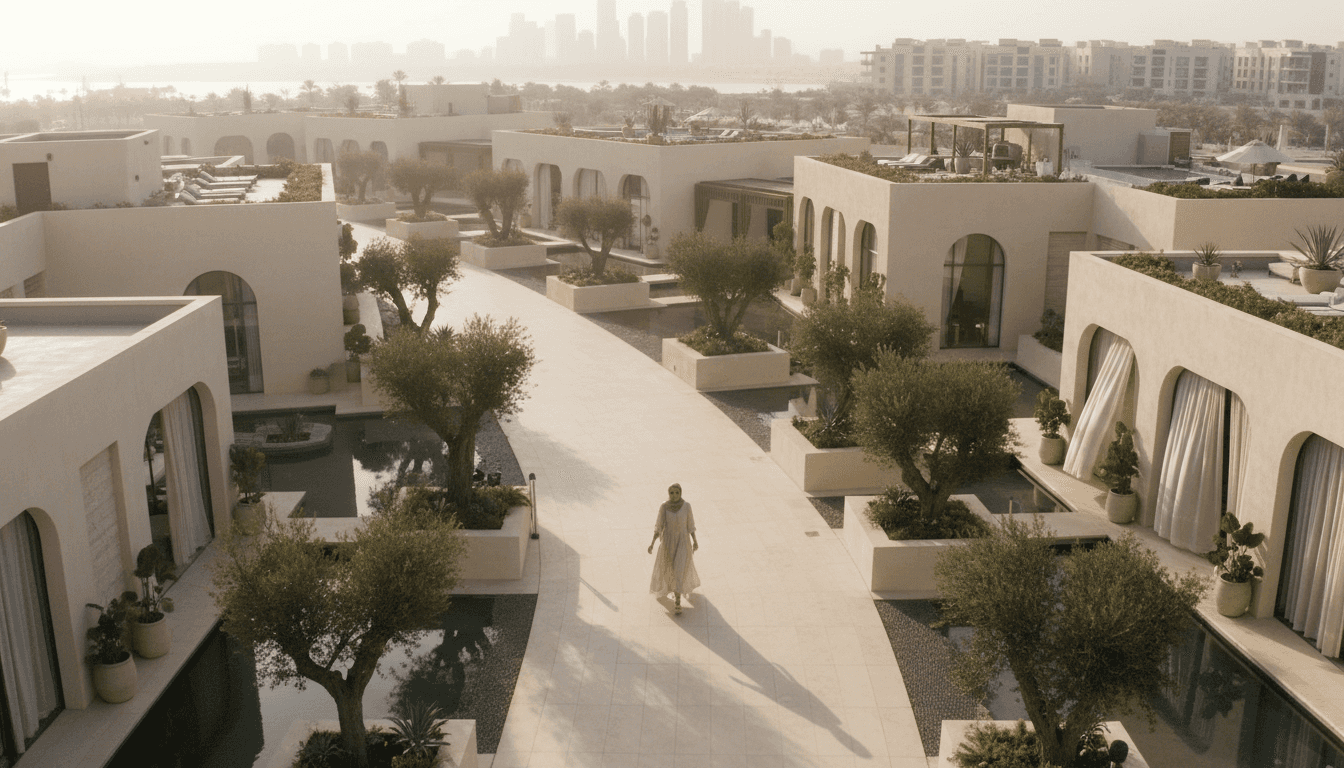
Dubai's Next Apartment Hotspots
I move beyond the established prime postcodes to identify the emerging Dubai communities offering the most significant growth potential for apartment investors and end-users.

Everyone knows the headline acts. Ask any investor about premium Dubai apartments and they'll rightly point you towards the glittering towers of Dubai Marina or the icon-adjacent living in Downtown. But focusing only on these mature, high-value markets means you might be missing the next chapter of Dubai's growth story. I believe the smartest money is now looking at the city's emerging districts, where infrastructure, vision, and value are converging to create the hotspots of tomorrow.
In this analysis, I'll lay out my framework for identifying high-potential apartment areas and apply it to specific communities I believe are poised for significant growth. We will explore:
- My criteria for what truly makes an 'emerging hotspot'.
- An in-depth look at the long-term vision for Dubai South and Expo City.
- Why Arjan is evolving from a forgotten pocket into a hub for affordable luxury.
- The quiet outperformer: How Al Furjan is using its strategic location.
- An 'on the radar' pick: The transformation happening in Liwan.
- A full, line-by-line breakdown of the real costs of buying in these zones.
My Framework for Identifying Future Hotspots
Before we can pinpoint the 'next big thing', we need a consistent way to evaluate potential. In my years analysing Dubai’s apartment market, I've seen countless projects announced with great fanfare only to fizzle out. True potential isn't about fancy renders or ambitious marketing slogans. It's grounded in tangible, verifiable fundamentals. My framework for spotting genuine high growth potential in Dubai real estate rests on four pillars: Government-led Infrastructure, Master Developer Vision, Tangible Connectivity, and Relative Value.
First, and most critically, is government-led infrastructure. Private developers can build beautiful towers, but only the government can build the city around them. I look for massive, state-level commitments. This means new metro lines, major highway interchanges, and economic anchor projects like airports or free zones. The expansion of Al Maktoum International Airport in Dubai South is a perfect example. A project of that scale isn't speculative; it's a statement of strategic intent that will create tens of thousands of jobs and drive organic housing demand for decades. When the RTA announces a new Metro line, as they have with the upcoming Blue Line, I immediately map its proposed route against developing communities. This is the single most powerful catalyst for long-term appreciation.
Second is the vision and track record of the master developer. A master-planned community is more than a collection of buildings; it's a cohesive environment with a unified design, shared amenities, and managed public spaces. I have far more confidence in areas where a single, top-tier developer like Emaar Properties, Nakheel, or Aldar is in control of the entire master plan. These developers have a vested interest in the long-term success of the community because their brand reputation is on the line. They plan for schools, parks, retail centres, and clinics from day one. Contrast this with fragmented areas with multiple small, private developers, which can lead to inconsistent quality, poor infrastructure, and a lack of a cohesive community feel. I always ask: who is the master planner, and have they delivered on their promises before?
Third, I assess tangible connectivity, today and tomorrow. How long does it *really* take to get to DIFC or Dubai Marina in rush hour? Is there a direct, traffic-free route to a major business hub? Proximity is not about straight-line distance on a map; it's about travel time in real-world conditions. I look at the existing road network and, more importantly, the planned upgrades. The ongoing development of the Hessa Street and Umm Suqeim Street corridors, for instance, is a game-changer for communities like JVC, Arjan, and Dubai Hills Estate. These off-the-beaten-path Dubai investment opportunities become far more viable once commute times are slashed. Public transport is a huge part of this; a community's value proposition transforms the day a Metro station opens at its doorstep.
Finally, it all comes down to relative value. The goal isn't just to find something cheap; it's to find quality and potential at a price point that makes sense. I compare the price per square foot for a new, high-quality apartment in an emerging area against a similar-quality, older apartment in an established area. If you can buy a brand-new, well-appointed two-bedroom apartment in Arjan for the price of a 15-year-old one-bedroom in Dubai Marina, that is a compelling value proposition. This is where the concept of 'affordable luxury' comes in. Buyers get the modern finishes, amenities, and efficiencies of a new build, without the hefty premium of a prime postcode. The key is to get in before this value gap closes, as infrastructure improvements and growing demand inevitably push prices up.
The Southern Star: Dubai South & Expo City
 Featured project
For years, the vast expanse of land south of Jebel Ali was seen as a distant prospect. Today, it stands as arguably one of the most significant future investment zones in Dubai. The transformation is anchored by two colossal, intertwined projects: the expansion of Al Maktoum International Airport (DWC) and the evolution of the Expo 2020 site into a permanent district, Expo City. This isn't a speculative play; it's a multi-decade strategic vision for Dubai's economic and urban future.
The scale of the DWC expansion is staggering. The plan to make it the world's largest airport, with a capacity for over 260 million passengers, creates an unparalleled economic engine. This isn't just about tourism; it's about logistics, commerce, and aviation services. The ecosystem of businesses and jobs that will surround this mega-hub will generate immense, sustained demand for housing. We're talking about pilots, cabin crew, logistics managers, engineers, and corporate staff all needing to live within a reasonable commute. This creates a foundational layer of rental demand that is less susceptible to market fluctuations than lifestyle-driven demand in other areas. The government's consolidation of all Emirates and flydubai operations to DWC in the coming years is the starting gun for this demographic shift.
The residential offerings are emerging to meet this future demand. Emaar South is a key development, offering a mix of tiered townhouses and low-rise apartments. More recently, we've seen developers launching new residential towers within Expo City itself, effectively creating a new urban core. Living here means being part of a 15-minute city, a sustainable, pedestrian-friendly environment with its own offices, exhibition centres, parks, and retail. Projects like the recently announced Hayat 1 - Dubai South are tapping into this, offering modern apartments directly within this growing ecosystem. The value proposition is clear: you are buying into a ground-up, meticulously planned city of the future. The Metro connection via the Route 2020 extension is already in place, providing a direct link back to the city's established coastline communities.
From an investment perspective, the entry points are still very attractive. A one-bedroom apartment in a new launch here can be secured for around AED 700,000 to AED 950,000, with two-bedrooms ranging from AED 1.1 million to AED 1.6 million. These are prices that are simply unattainable for new-builds in more central locations. The payment plans offered by developers like Emaar are also a significant draw, typically structured as 80/20 or 90/10, where the bulk of the payment is spread over the construction period with a final 10-20% due on handover. This allows investors to secure an asset with a relatively low initial capital outlay. The rental yields, once the area matures and the airport effect fully kicks in, are projected to be strong, driven by the captive audience of airport and Expo City employees. The risk, of course, is the timeline. This is a long-term vision, and investors must be prepared to hold the asset as the area develops around it. But for those with patience, buying into one of these new master communities in Dubai's southern corridor is, in my opinion, one of the most compelling long-term growth stories in the market today.
Arjan: The Rise of Affordable Luxury
For a long time, Arjan was one of those areas people drove past on Umm Suqeim Street without a second thought. It was a pocket of undeveloped plots and a handful of isolated buildings, overshadowed by its more established neighbours like Motor City and Dubai Hills Estate. But over the last few years, a quiet but dramatic transformation has been underway. Arjan is rapidly becoming a hotspot for some of the best-value, high-quality new apartments in Dubai, mastering the art of affordable luxury.
What changed? A convergence of factors. First, the infrastructure around it matured. The expansion and improvement of Hessa Street and Umm Suqeim Street have drastically improved connectivity. Suddenly, a commute from Arjan to Dubai Marina or Mall of the Emirates became a 15-20 minute drive, not the 30-40 minute crawl it once was. Second, land prices in Arjan remained relatively low compared to more central districts. This gave developers the financial room to focus on quality and amenities without having to pass on an exorbitant land cost to the end buyer. The result has been a wave of design-led projects from reputable private developers who are competing on quality, not just price.
This is where Arjan stands out from other 'affordable' areas. The new stock coming to market is of a surprisingly high standard. We are seeing projects with features you'd typically associate with prime developments: resort-style swimming pools, state-of-the-art gyms, elegant lobbies, and high-quality European fixtures and fittings in the apartments themselves. Developers like Binghatti and a host of other quality-focused private builders have recognised a gap in the market for young professionals and families who want a premium living experience without the prime price tag. They want the 'Dubai dream' — a beautiful, modern home with great facilities, and Arjan is delivering it.
Let’s look at the numbers. A brand-new, premium one-bedroom apartment in Arjan can be found in the range of AED 850,000 to AED 1.2 million. A spacious two-bedroom often lists between AED 1.4 million and AED 1.9 million. Compare that to a new project in Business Bay or Downtown, where a one-bedroom would start at well over AED 1.8 million. The value is self-evident. On top of that, Arjan already has established community anchors like Dubai Miracle Garden and Dubai Butterfly Garden, providing green spaces and leisure options right on the doorstep. With several new schools and clinics having opened recently, it's rounding out its offering to become a fully-fledged community. For end-users, it's a chance to get more space and better quality for their budget. For investors, the rental yields are compelling. Tenants are drawn to the new, high-quality buildings and amenities, and rents are highly competitive, leading to gross yields that can often exceed 6-7%, a strong performance in today's market. Arjan's journey from a sandy afterthought to a genuine residential destination is a case study in how infrastructure and quality-conscious development can create one of the city's next apartment hotspots.
Al Furjan: Connectivity and Community Come of Age
Al Furjan is a neighbourhood I’ve been watching with great interest. Developed by master developer Nakheel, it has been around longer than some of the other areas on this list, but it's only in the last few years that its true potential has been unlocked. For a long time, it was primarily known for its villas and townhouses, but the recent addition of high-quality apartment buildings, coupled with a major infrastructure upgrade, has put it firmly on my map as a future hotspot.
The game-changer for Al Furjan was the opening of the Route 2020 Metro extension. The Al Furjan station, along with the nearby Discovery Gardens station, suddenly connected this entire corridor to the rest of the city with world-class public transport. This was a catalyst of immense significance. It instantly made the area a viable and highly attractive option for professionals working in Jebel Ali Free Zone, Dubai Marina, JLT, and even further up Sheikh Zayed Road. The reliance on a car was lessened, and the community's appeal broadened dramatically.
Nakheel's master plan for Al Furjan has always been focused on creating a genuine community feel. The name itself translates to 'a collection of homes' or 'a small village'. The area is designed with two community centres, Al Furjan Pavilion and Al Furjan West Pavilion, which feature supermarkets, restaurants, gyms, and pools. This ready-made social infrastructure means residents don't need to leave the area for daily necessities, a crucial factor in liveability. The landscaping is mature, the road network is logical, and there’s a sense of established order that many newer, more fragmented communities lack. The new apartment buildings being launched here, both by Nakheel and select third-party developers, are building upon this solid foundation. They are typically low to mid-rise, which contributes to a less congested, more human-scale environment compared to the dense high-rise clusters elsewhere.
“The single biggest predictor of an area's future success is not a glossy brochure; it's the yellow-and-grey pylons of a new RTA Metro line going up.”
In terms of pricing, Al Furjan offers a sweet spot between the ultra-affordable and the prime. New one-bedroom apartments generally trade in the AED 750,000 to AED 1 million range, while two-bedrooms can be acquired for between AED 1.2 million and AED 1.7 million. Because the area is already established, the rental market is robust and predictable. You're not speculating on future demand; you're tapping into an existing tenant pool that is now being bolstered by the Metro effect. For an investor looking for a balanced risk profile — not quite the long-term play of Dubai South, but with more upside potential than a mature area like the Marina, Al Furjan presents a very compelling case. It has the backing of a master developer, proven infrastructure, existing amenities, and now, the transport connectivity that completes the puzzle. It's a quiet outperformer that has come of age.
On the Radar: Liwan's Transformation
Now for a true off-the-beaten-path Dubai investment pick: Liwan. Located in the Dubailand corridor, just off Sheikh Mohammed Bin Zayed Road and adjacent to Academic City, Liwan has been on the drawing board for over a decade. For much of that time, it was a collection of half-finished projects from the 2008 downturn. But a major shift is happening. Under the stewardship of master developer Dubai Properties, and with an influx of new, dynamic developers, Liwan is being reborn.
The investment thesis for Liwan is built on its exceptional location and its proximity to a massive, underserved tenant base. It sits at the intersection of Dubai's two most important arterial roads, Sheikh Mohammed Bin Zayed Road (E311) and Al Ain Road (E66). This provides fantastic city-wide access. More importantly, it is right next to Dubai International Academic City and Dubai Silicon Oasis, which together house tens of thousands of students and technology professionals. This is a huge, built-in pool of potential tenants who are looking for modern, affordable accommodation close to their work or university. Until now, their options were limited. Liwan is perfectly positioned to fill this gap.
New projects launching in Liwan are setting a new standard for the area. We are seeing a new wave of well-designed, mid-rise buildings offering quality amenities at an extremely competitive price point. Developers are capitalising on the relatively low land cost to deliver great value. For example, projects like Avenue Park Towers II are offering studios and one-bedroom apartments with finishes and facilities that are attracting both first-time homebuyers and savvy investors. The focus is on efficient layouts, smart home technology, and communal spaces that foster a sense of community, like co-working lounges and rooftop pools.
The pricing is what makes Liwan a truly exciting prospect for those looking for high growth potential. Entry-level studios in new launches can be found for as little as AED 450,000 to AED 600,000, with one-bedroom apartments typically priced between AED 650,000 and AED 850,000. These are some of the most accessible price points for new-build properties anywhere in Dubai. For an investor, the potential for high rental yields is obvious. Given the captive demand from Academic City next door, achieving gross yields north of 8% is, in my professional opinion, highly realistic once these new buildings are handed over. The risk factor in Liwan is execution. The area is still very much under construction. However, with reputable developers now leading the charge and a clear, underserved rental market to cater to, I believe Liwan is at the very beginning of its growth curve. It's an area to watch very, very closely.
The Numbers: A Realistic Cost Breakdown
Identifying a hotspot is one thing; understanding the true cost of entry is another. Too many first-time buyers focus solely on the sticker price of the apartment, only to be surprised by the additional fees and costs involved. At Gaia Living, we believe in full transparency, so let's break down the real, all-in cost of purchasing a ready-to-move-in apartment in one of these emerging areas. This is a critical step for any serious investor or end-user.
Let's take a hypothetical example of buying a two-bedroom apartment in Arjan with a purchase price of AED 1,500,000. Here is a line-by-line breakdown of the upfront costs you must budget for:
- Purchase Price: AED 1,500,000
- Down Payment (for mortgage): Typically 20% for residents, so AED 300,000. For non-residents, this might be 25% or more.
- Dubai Land Department (DLD) Transfer Fee: 4% of the purchase price. In this case, that's AED 60,000. You can find the latest fee structures on the official Dubai Land Department (DLD) website.
- DLD Registration Trustee Fee: This is a fixed administrative fee for handling the title deed transfer. It's approximately AED 4,200 (including VAT).
- Real Estate Agency Fee: Standard practice is 2% of the purchase price, plus 5% VAT on the fee itself. That comes to AED 30,000 + AED 1,500 VAT = AED 31,500.
- No Objection Certificate (NOC) Fee: This is paid to the developer to certify that the seller has no outstanding service charges. The fee varies but typically ranges from AED 525 to AED 5,250. Let's budget a conservative AED 1,500.
- Mortgage Arrangement & Valuation Fees: If you're financing, your bank will charge arrangement fees (often 1% of the loan amount) and a valuation fee (around AED 3,000). Let's estimate this at AED 15,000.
Total Upfront Cash Required (with mortgage): Down Payment (AED 300,000) + DLD Fees (AED 64,200) + Agency Fee (AED 31,500) + NOC (AED 1,500) + Bank Fees (AED 15,000) = AED 412,200.
As you can see, on a AED 1.5 million property, you need over AED 400,000 in cash, even when taking a mortgage. It's a substantial sum that must be factored into your budget from day one. For off-plan purchases, the structure is different. You pay a booking fee (e.g., 10%), a 4% DLD fee for Oqood registration, and then follow the developer's payment plan. The total upfront cost is lower, but you are committed to a schedule of payments over several years. Understanding these real-world numbers is the foundation of a sound investment strategy.
Final Verdict: Where Would I Invest?
After analysing these emerging Dubai apartment areas, the question remains: which one offers the most compelling opportunity today? Each has a distinct risk and reward profile, catering to different investor appetites and timelines. There is no single 'best' choice, but there is a 'best fit' for your personal strategy.
For the patient, long-term investor focused on macro-economic fundamentals, my verdict leans towards [Dubai South](/property-launches/hayat1-dubai-south). The sheer scale of the government's commitment to Al Maktoum International Airport and the surrounding logistics and commercial hubs creates an undeniable, long-term demand driver for housing. Buying here is a bet on the future trajectory of Dubai itself. It requires patience, as the full ecosystem will take a decade or more to mature, but the potential for capital appreciation as this city-within-a-city takes shape is, in my view, unparalleled. It is the definition of getting in on the ground floor.
For the value-focused buyer — whether an end-user or an investor seeking strong rental yields in the medium term, my choice would be Arjan. The area has reached a tipping point. The infrastructure is now largely in place, and a critical mass of high-quality, design-led residential projects has been delivered or is underway. It offers the best of both worlds: prices that are still significantly lower than in prime central locations, but a product quality that rivals them. The 'affordable luxury' proposition here is real and tangible. The rental market is already proving to be robust, driven by tenants seeking new buildings and better amenities. The growth story here is not a decade away; it's happening now.
Finally, for the more conservative investor who prioritises stability and proven infrastructure, Al Furjan stands out. It represents a lower-risk entry into an emerging hotspot. The Metro connectivity is a massive, de-risking factor, and the community is already mature and well-managed by a tier-one master developer. While the explosive capital growth might be less dramatic than in Dubai South, it offers the prospect of solid, steady appreciation and a reliable rental income from day one. It's a smart, balanced choice for those who want growth without the pioneering risk.
The greatest opportunities in Dubai's property market are no longer in the obvious prime locations. True value and high growth potential are found in the next wave of master-planned communities like Dubai South, Arjan, and Al Furjan, where infrastructure, connectivity, and quality are converging at an accessible price point. The key is to look beyond the present and invest in the vision for tomorrow.
Sources
- Dubai Land Department (DLD): dubailand.gov.ae
- Roads & Transport Authority (RTA): rta.ae
- UAE Government Portal (Golden Visa information): u.ae
- Central Bank of the UAE (Mortgage Regulations): centralbank.ae
Questions, answered
- Which emerging areas in Dubai have the best potential for apartment investment?
- In my view, areas with strong master plans and upcoming infrastructure offer the best potential. Key areas to watch include Dubai South due to its airport and Expo City proximity, Arjan for its strategic location and value, and Al Furjan for its connectivity and community feel.
- Are there affordable luxury apartments in these new Dubai hotspots?
- Yes, a key appeal of these emerging areas is access to what I call 'affordable luxury'. Developers are launching projects with high-end finishes and amenities in places like Arjan and Liwan at price points significantly lower than in prime central districts like Downtown Dubai or Dubai Marina.
- What are the total upfront costs to buy an apartment in Dubai?
- Beyond the property price, you must budget for a Dubai Land Department (DLD) transfer fee of 4% of the purchase price, a DLD registration trustee fee of around AED 4,200, your real estate agency fee (typically 2% + VAT), and a No Objection Certificate (NOC) fee to the developer, which can range from AED 500 to AED 5,000.
- How does off-plan investment work in these emerging Dubai areas?
- Investing off-plan involves purchasing a property directly from a developer before it's built. You'll pay an initial booking deposit, register the purchase with the DLD through a process called Oqood, and then follow a developer-set payment plan. This often allows you to secure a property at a lower price than a completed unit.
- Is financing available for properties in areas like Dubai South or Arjan?
- Yes, UAE banks offer mortgages for completed properties in these freehold zones, provided the building and developer are on their approved lists. For non-residents, the maximum loan-to-value is typically 75-80%, meaning you need a 20-25% cash down payment plus purchasing costs. Off-plan properties usually require you to follow the developer's payment plan until handover, at which point you can secure a mortgage to finance the final balloon payment.
- What is a key risk when investing in off-the-beaten-path Dubai real estate?
- The primary risk is project or infrastructure delays. The investment thesis for many emerging areas relies on the timely delivery of new metro lines, malls, and community facilities. Delays can impact rental demand and capital appreciation in the short to medium term, so it's crucial to assess the developer's track record and the master plan's progress.

Ravi lives and breathes apartment living — from studio yields in JVC to branded residences on the Palm. Floor plans, service charges, and view lines are his love language.
Related stories
Dubai's Big Squeeze: Smaller Plots, Denser Living
Dubai real estate is undergoing a fundamental shift towards smaller plot sizes and higher density. We analyse the economic drivers, the impact on property values, and what this new era of compact urban living means for both homebuyers and investors.
Resort Living as Your Dubai Reality
Explore how to trade temporary staycations for a permanent home with five-star amenities in Dubai. I'll break down the real costs, best communities, and lifestyle trade-offs of embracing high-end resort living every day.
Finding Your Tribe in Dubai's Villa Communities
I explore which of Dubai's renowned villa communities attract specific expat nationalities and lifestyle groups, offering insights to help you find a place that feels like home.
Echoes, in your inbox
One thoughtful email a month. Market insight, new launches, no spam.