

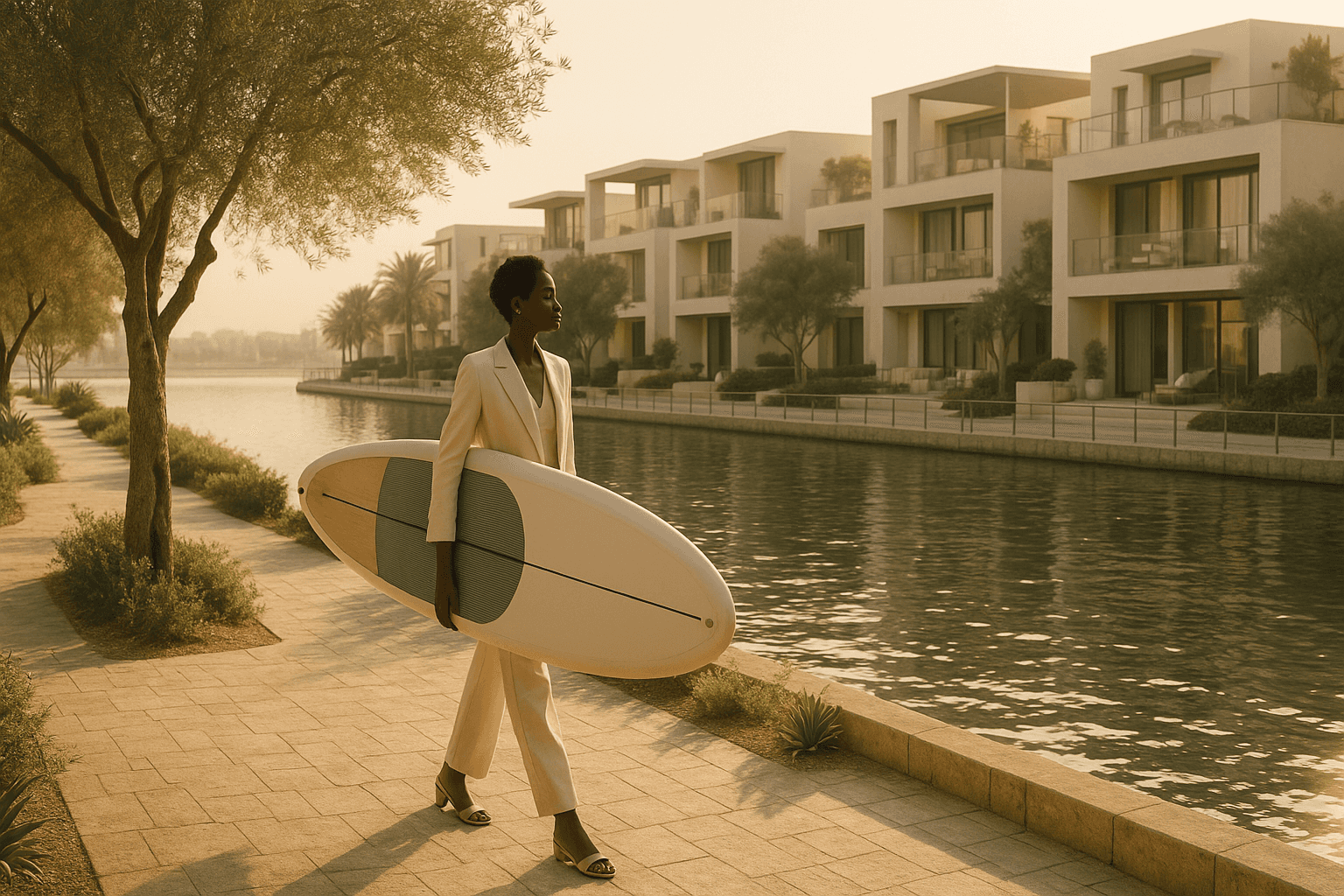
Dubai's Active Waterfront: Homes for Kayak & Paddleboard
For those who dream of a life on the water that's more about paddling at dawn than docking a yacht, Dubai offers a growing number of homes with direct access for kayakers and paddleboarders. This is a guide to finding them.

When clients tell me they want a waterfront home in Dubai, my first question is always the same: what does 'on the water' actually mean to you? For many, it's the classic Dubai dream: a superyacht moored at a private berth. But a different vision is quietly taking hold, one that speaks to a more personal, active connection with the water itself. It’s the dream of waking up, walking a few steps from your garden, and launching a kayak into the calm water as the sun rises.
Here’s what we’ll explore:
- The shift from passive views to an active water lifestyle.
- The original pioneers: Where this lifestyle began in Dubai.
- The new wave: Master-planned communities built for paddlers.
- The reality check: Direct access vs. 'waterfront' living.
- The cost of the current: A detailed breakdown of the premium.
- The fine print: Navigating community rules and hidden costs.
- My verdict: Is the paddleboard-access property a worthy investment?
From Views to Participation: Redefining Waterfront Living
For years, the pinnacle of waterfront property in Dubai was defined by two things: a breathtaking view and, for the ultra-wealthy, a place to park a very large boat. The apartment towers of Dubai Marina and the villas of Palm Jumeirah set the standard. The water was a backdrop, a stunning piece of scenery to be admired from a balcony or through floor-to-ceiling windows. It was a visual amenity, and a very valuable one at that. The proximity to yacht clubs and marinas was key, but direct, personal interaction with the water was often secondary to the spectacle.
Now, a significant evolution is underway. I see it in the briefs from a growing number of our clients at Gaia Living. They’re younger, more focused on wellness and experiences. They ask about `non-motorized water sports homes`. They want to know which communities are `kayak friendly homes Dubai`. The focus is shifting from passive ownership to active participation. The water is no longer just a view; it's a playground, a gym, a space for quiet contemplation at dawn. This is the rise of the `active water lifestyle residences`, where the home’s greatest feature isn’t its proximity to a marina, but its smooth connection to the water for personal use.
This new demand is reshaping development. It's not enough to build by the sea; developers must now design *for* the sea. This means creating calm, protected waterways, swimmable lagoons, and properties with private, gradual entry points into the water. The ideal is a home where you can store your paddleboard in the garage next to your car, and launch it from your own backyard. It’s a fundamental change in philosophy, moving from the grandiose statement of a yacht to the simple, daily pleasure of a paddle. It speaks to a desire for a healthier, more grounded lifestyle, even within a bustling global city.
The Pioneers: Palm Jumeirah and the Original Vision
 Featured project
To understand where this is going, we have to look at where it started. The undisputed pioneer of this lifestyle in Dubai is the Palm Jumeirah. When Nakheel conceived this audacious project, they created something that hadn't existed before: kilometres of sheltered, private coastline. The villas on the fronds, particularly the Signature and Garden Homes, are the original `paddleboard access property` type in the city. Their design, with a private beach backing directly onto the calm, protected waters between the fronds, was revolutionary. It created a safe, exclusive environment perfect for swimming, paddleboarding, and kayaking, away from the open sea's chop and boat traffic.
For residents of these villas, the water is a true extension of their garden. There are no promenades, no barriers. You simply walk across your sand and into the sea. This is the gold standard for an active water lifestyle. It’s why, decades after its launch, the Palm’s frond villas continue to command some of the highest premiums in the city. The experience is unparalleled. I've had clients who specifically bought there so their children could learn to swim and paddle in a safe, private setting, literally under their watchful eye from the living room. This direct, unfettered access is the ultimate luxury for this buyer profile.
However, this idyllic setup comes with its own set of considerations. The water quality between the fronds requires constant management, and the privacy that makes it so appealing can also feel a bit isolating for some. While you can paddle for hours within the crescent, accessing the open sea or other areas requires a bit more effort. Beyond that, this lifestyle is almost exclusively the domain of villa owners. Apartment residents on the Palm's trunk or crescent may have stunning views and beach club access, but the spontaneous, direct-from-home launch experience is reserved for the few. This created a clear gap in the market for a similar lifestyle at different price points and in different locations.
The New Wave: Sobha Hartland II and Dubai Islands
The most exciting developments in active waterfront living are happening now, in the city's new master communities. Developers have seen the success of the Palm Jumeirah model and are innovating on the concept, building entire neighbourhoods around man-made lagoons and canals. Two projects stand out as the flagships of this new wave: Sobha Hartland II and Dubai Islands. These aren't just communities with a water feature; the water is the central, organizing principle of the entire development. They are purpose-built for the active water enthusiast.
Sobha Realty is taking the concept to another level in Meydan with Sobha Hartland II. The plan features vast, crystal-clear swimmable lagoons that wind through the community, with villas and mansions built along their sandy shores. This design directly addresses the desire for `canal front living Dubai` but elevates it with beach-like aesthetics and guaranteed water quality. The key innovation here is scale and accessibility. A huge portion of the community will have this direct water access, not just a handful of elite properties. It democratizes the private beach lifestyle, creating a resort-like feel for everyday living. The focus is squarely on family-friendly, non-motorized activities. The calm, filtered waters are perfect for a morning paddle or an afternoon swim, creating a truly unique urban environment.
Simultaneously, Nakheel is applying the lessons learned from the Palm Jumeirah to its ambitious Dubai Islands project. Comprising five islands, this development is set to become a city within a city, with a significant focus on waterfront living and tourism. What's crucial here for our discussion is the design of the residential areas, which incorporate extensive canal networks and private beaches. Unlike the open sea, these inland waterways will offer protected conditions ideal for kayaking and paddleboarding. This is Nakheel’s answer to the demand for a new generation of waterfront homes, expanding the model beyond the ultra-luxury segment of the Palm. It promises to deliver a diverse range of properties, from apartments to villas, all benefiting from this active water lifestyle.
“The conversation has shifted from 'How big is the marina?' to 'Can I launch my paddleboard from the garden?'. It's a fundamental change in what 'waterfront' means to a new generation of Dubai residents.”
Reality Check: Direct Access vs. 'Waterfront'
It's crucial for buyers to understand the difference between a property that is merely 'waterfront' and one that offers genuine, direct water access for activities. The term is used broadly in marketing, and the reality on the ground can vary dramatically. A high-floor apartment in Business Bay overlooking the canal has a water view, but you are not stepping out of your building and into a kayak. This distinction is the single most important factor for anyone seeking an active water lifestyle.
True direct access is rare and carries a major premium. This is the Palm Jumeirah frond villa model, where your private property line meets the water. The new lagoon communities like Sobha Hartland II are replicating this at scale. The key features to look for are:
- Private Beachfront: Your garden has a sandy edge leading into a swimmable lagoon or canal.
- Private Pontoon/Jetty: A small, private dock for launching non-motorized craft.
- Gradual Water Entry: No sea walls or sharp drops, allowing for easy launch and recovery.
More common is 'community access'. This is a good compromise and is found in many master-planned areas. In this scenario, you may not be able to launch from your personal garden, but there are designated community launch points, slipways, or beaches just a short walk away. Areas like the eastern crescent of the Palm, parts of Jumeirah Islands, or even certain clusters in Damac Lagoons offer this. It's still highly convenient, but it lacks the ultimate luxury of stepping directly from your home into the water. When viewing properties, you must ask your agent to show you the exact access point and clarify the community rules for its use.
Finally, there is 'promenade-level' access. This is typical for apartment buildings in areas like Dubai Marina, Creek Harbour, or Business Bay. While you are next to the water, a public or semi-private walkway separates the buildings from the canal or marina. Launching a personal kayak here is often impractical or forbidden. Instead, you'll be relying on nearby rental stations or clubs. While these areas offer a vibrant waterside atmosphere, they don't provide the personal, on-demand access that defines the true active water lifestyle. Understanding these tiers is essential to avoid disappointment and ensure you're investing in the experience you actually want.
The Cost of the Current: Analyzing the Premium
An active water lifestyle is an incredible amenity, and it comes at a price. Properties with direct, private water access command a significant premium over their inland counterparts, even within the same community. Based on my analysis of market data and transactions we've handled at Gaia Living, a buyer can expect to pay anywhere from 15% to 30% more for a villa with a private beach or lagoon frontage compared to an identical villa on a park or internal road. The closer and more private the access, the higher the premium.
Let’s run a practical example. Consider a hypothetical five-bedroom villa in a new lagoon community. An inland-facing villa might be priced at AED 10 million. The exact same villa, with the same floor plan and build quality, but located on the lagoon with a private sandy beach, would likely be listed between AED 12 million and AED 13 million. This AED 2-3 million difference is the price of that direct water access. It's a pure lifestyle premium. For buyers who will use it daily, it represents immense value. For those who won't, it's a significant extra cost for a feature they don't need.
To make this tangible, let's break down the all-in cost of purchasing that AED 12 million lagoon-front villa, assuming a mortgage is involved. Understanding the full capital outlay is critical.
Line-by-Line Purchase Cost Breakdown (AED 12M Villa):
- Property Price: AED 12,000,000
- Down Payment (20% for residents): AED 2,400,000. Note: The Central Bank of the UAE mandates a minimum 20% down payment for expatriate residents on properties over AED 5 million.
- Dubai Land Department (DLD) Transfer Fee (4%): AED 480,000
- DLD Admin Fee: approx. AED 4,200
- Real Estate Agency Fee (2% + VAT): AED 252,000 (AED 240,000 + 5% VAT)
- Mortgage Registration Fee (0.25% of loan amount): AED 24,000 (on a loan of AED 9.6M)
- Bank Processing & Valuation Fees: approx. AED 10,000 - AED 15,000
- Trustee Registration Fee: approx. AED 4,200
- Total Upfront Cash Required: Approximately AED 3,172,400
This breakdown shows that nearly AED 3.2 million in cash is needed just to complete the transaction, before even considering furnishing or initial moving costs. This is why thorough financial planning is paramount. For off-plan launches, the payment structure is different, often with a smaller initial down payment (e.g., 10-20%) followed by instalments during construction and a larger payment on handover. However, the principle remains: the premium for water access is baked into the price from day one.
The Fine Print: Service Charges and Community Rules
Beyond the purchase price, owning a home in one of these active waterfront communities involves specific ongoing costs and rules that buyers must be aware of. The beautiful, crystal-clear lagoons and pristine private beaches don't maintain themselves. This upkeep is funded through community service charges, which are demonstrably higher in these specialized communities. While an inland villa community might have service charges around AED 3-5 per square foot of built-up area per year, a lagoon-front villa community will be significantly higher.
I would advise clients to budget for service charges in the range of AED 18 to AED 30+ per square foot on the plot area for villas with direct water access. This covers everything from landscaping and security to the complex filtration, cleaning, and staffing required for the water bodies. For a villa on a 7,000 sqft plot, this could mean an annual bill of AED 126,000 to AED 210,000. It's a substantial recurring cost that must be factored into your annual budget. Before signing any contract, you must request the detailed service charge statement and understand what is included. These fees are regulated by the Real Estate Regulatory Agency (RERA), but they reflect the real cost of the amenities provided.
Equally important are the community rules governing the use of the water. These are not open public waterways; they are private amenities. Every community will have a set of bylaws that you agree to upon purchase. These rules typically cover:
- Permitted Craft: Almost all will restrict usage to non-motorized craft only — kayaks, paddleboards, small sailing dinghies. Jet skis and motorized boats are universally banned from these inland lagoons for safety and noise reasons.
- Hours of Operation: There may be restrictions on using the water at night.
- Guest Access: Rules on whether your guests can use the water facilities and if they need to be accompanied.
- Storage: Regulations on where you can store your equipment. While a villa owner can use their garage, apartment dwellers may need to use designated storage areas, which could come at an extra cost.
Before you fall in love with the lifestyle, it is essential to do your due diligence. Ask for the community management rules and read them thoroughly. I have seen cases where a buyer assumed they could use a small electric tender, only to find it was forbidden. Clarity on these points is vital to ensure the reality of living there matches your dream. A good agent will procure these documents for you as a standard part of the buying process.
For those who will genuinely integrate paddling, swimming, or kayaking into their daily routine, the premium for a direct water-access home can be a worthwhile investment in health and happiness. For others, it's an expensive feature that may go unused.
My Verdict: An Investment in Lifestyle
So, after weighing the significant costs and navigating the rules, are these active waterfront homes a good investment? As with any property, the answer depends on your priorities. From a purely financial perspective, the premium for water access tends to hold its value well, especially in prime, well-managed communities. The scarcity of true, direct-access homes creates a strong value proposition. In a competitive market, these are the properties that stand out and often achieve higher rental yields and faster capital appreciation compared to their inland neighbours. They have a unique selling proposition that is difficult to replicate.
However, in my view, the real return on investment here isn't measured in dirhams alone. It's measured in quality of life. For the right person, the ability to de-stress with a sunset paddle after a long day at work, or to watch your kids play safely in the water from your own terrace, is priceless. This is a home that encourages a healthier, more outdoor-oriented lifestyle. It's an antidote to the high-rise, fast-paced nature of modern city life. It's an investment in your well-being, your family's happiness, and creating lasting memories.
My advice to clients is always to be honest with themselves. Are you truly the type of person who will get out on the water three or four times a week? Or do you just like the idea of it? If you are the former, then yes, I believe the premium is justified. You are buying more than a home; you are buying a lifestyle. The market in Dubai is mature enough now to offer these specialised choices. From the established prestige of the Palm Jumeirah to the exciting new vision of Sobha Hartland II, the options are there for those who hear the call of the water — not for their yacht, but for themselves.
At Gaia Living, we pride ourselves on understanding these nuances. We can guide you through the different tiers of waterfront living, from a simple view to full paddleboard access, ensuring you find a home that truly fits the life you want to live. It’s a wonderful niche in our market, and one I am personally very excited to watch grow.
Sources
- Dubai Land Department (DLD): dubailand.gov.ae
- Real Estate Regulatory Agency (RERA): Part of DLD website
- Central Bank of the UAE: centralbank.ae
Questions, answered
- Which Dubai communities offer direct water access for kayaking?
- Communities like Palm Jumeirah (frond villas), Dubai Islands, and Sobha Hartland II offer direct access from properties to the water for kayaking. Other areas like Dubai Marina and Creek Harbour have nearby launch points and rental facilities.
- Is living in a canal-front property in Dubai expensive?
- Yes, properties with direct water access command a significant premium. Expect to pay at least 15-30% more for a villa with a private water frontage compared to a similar-sized inland property in the same community.
- Can I launch a kayak from any waterfront apartment in Dubai?
- No, this is rarely possible. Most apartment buildings have promenades, private pools, or sea walls separating them from the water. You'll typically need to use a designated community slipway, a nearby public beach, or a rental station.
- What are the typical service charges for waterfront properties in Dubai?
- Service charges for waterfront properties, especially those with private beaches or lagoons, are higher due to maintenance costs. Expect figures ranging from AED 18 to AED 30+ per square foot annually, depending on the community and level of amenities.
- Are there new projects in Dubai focusing on active water lifestyles?
- Yes, several new master communities are designed around this concept. Sobha Hartland II and Dubai Islands by Nakheel are prime examples, featuring extensive swimmable lagoons and canal networks as a central part of their master plans.
- Do I need a license for a kayak or paddleboard in Dubai?
- For personal, non-motorized craft like kayaks and paddleboards used for recreation, you do not typically need a specific license. However, you must adhere to the rules set by your community management and maritime authorities regarding designated usage areas.

Yusuf writes about how Dubai actually lives — waterfront mornings, community dining, walkability, and the lifestyle premium built into an address.
Related stories

Dubai's Big Squeeze: Smaller Plots, Denser Living
Dubai real estate is undergoing a fundamental shift towards smaller plot sizes and higher density. We analyse the economic drivers, the impact on property values, and what this new era of compact urban living means for both homebuyers and investors.
Resort Living as Your Dubai Reality
Explore how to trade temporary staycations for a permanent home with five-star amenities in Dubai. I'll break down the real costs, best communities, and lifestyle trade-offs of embracing high-end resort living every day.
Finding Your Tribe in Dubai's Villa Communities
I explore which of Dubai's renowned villa communities attract specific expat nationalities and lifestyle groups, offering insights to help you find a place that feels like home.
Echoes, in your inbox
One thoughtful email a month. Market insight, new launches, no spam.