

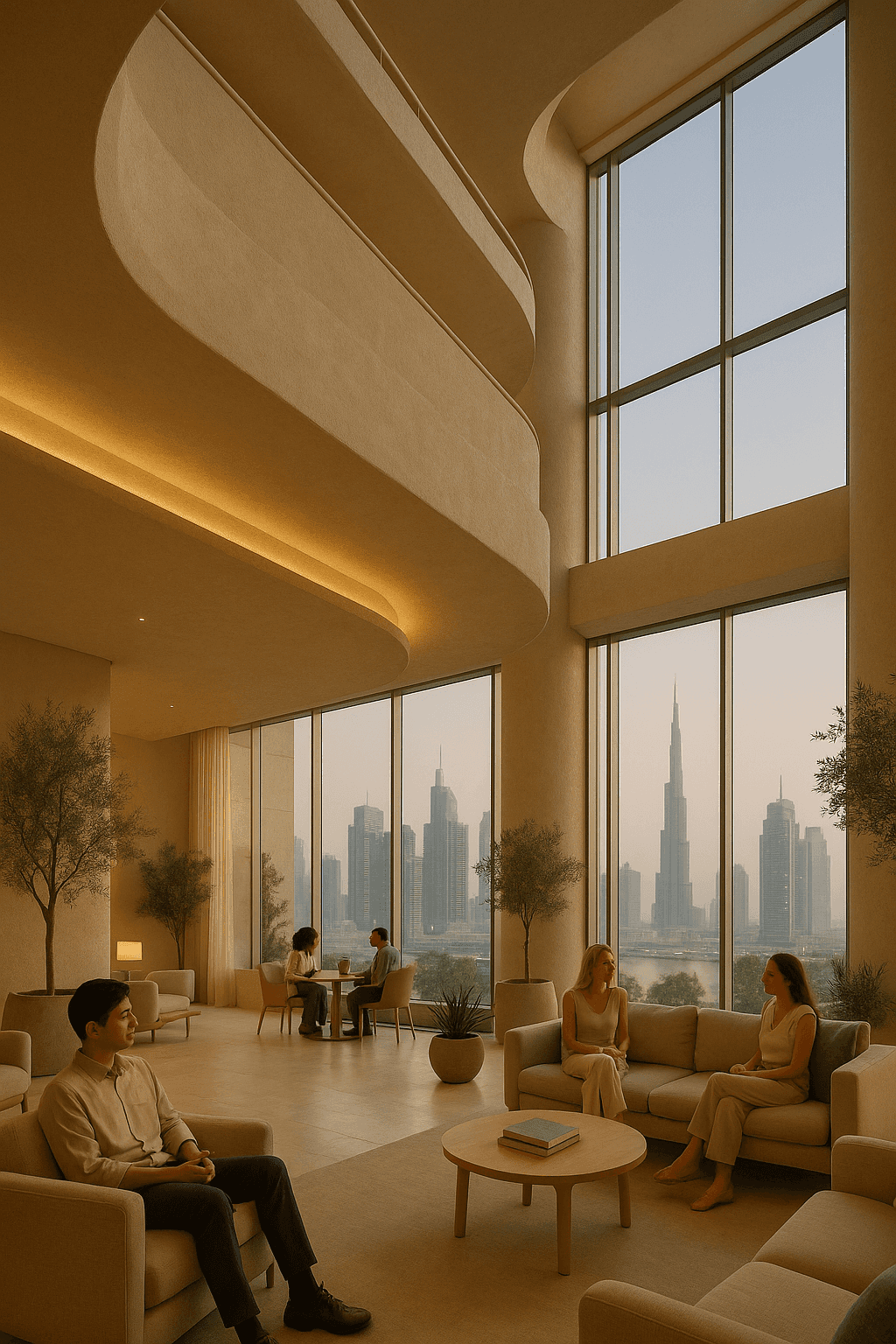
Dubai Co-Living: Beyond the Hype
A deep dive into the evolving market for co-living and hybrid real estate in Dubai, assessing the real demand drivers, investment models, and future potential beyond the buzzwords.

The narrative around co-living in Dubai often gets muddled with simple apartment sharing, but the professionalised, purpose-built model is a distinct asset class with its own set of rules. I believe its true potential lies not in replacing traditional rentals, but in serving specific, underserved niches of the market with a hospitality-led approach.
Here’s what my analysis will cover:
- Defining what 'co-living' truly means in the Dubai market.
- Unpacking the demographic and economic trends driving demand.
- Examining the different investment models available to individuals.
- A detailed look at the operational realities and cost structures.
- Comparing yields and risks against traditional buy-to-let investments.
- Regulatory considerations and the role of management companies.
- Identifying the most promising locations for future co-living projects.
- My final verdict on the long-term viability of this asset class.
The Real Definition of Dubai Co-Living
First, we need to establish a precise definition. In my experience, the term 'co-living' is frequently misused in Dubai. It is not, as some believe, simply a group of friends renting a villa together or an informal flat-share arranged on a classifieds site. True, institutional co-living is a professionalised real estate model where residents lease a private room (often with an en-suite bathroom) and gain access to extensive, shared communal facilities. These are not just basic living rooms; we are talking about professionally designed co-working spaces, gyms, cinemas, communal kitchens, and event spaces. The key differentiator is the service layer. The rent is typically all-inclusive, covering utilities, high-speed internet, regular cleaning, and maintenance. Crucially, there is a dedicated management team responsible for fostering a sense of community through organised events, workshops, and social gatherings. This is a hospitality product as much as it is a housing product.
The target demographic is not the budget-conscious labourer; it is the young professional, the digital nomad, the creative freelancer, or the person newly relocated to Dubai. These individuals are often single, aged between 25 and 40, and prioritise flexibility, convenience, and social connection over square footage. They are asset-light and experience-heavy. They value the ability to sign a flexible lease (often as short as one month), arrive with just a suitcase to a fully-furnished and equipped space, and instantly plug into a social network. This shared economy property Dubai model addresses the significant friction and high upfront costs associated with a traditional one-year lease, which requires a security deposit, agent fees, and setting up DEWA and internet accounts. Co-living removes these barriers, offering a smooth, turnkey solution.
From a development perspective, we're seeing two main streams of Dubai co-living spaces emerge. The first is the purpose-built tower, designed from the ground up for this specific use. Projects from developers like The Collective by Emaar Properties in Dubai Hills Estate were early pioneers, integrating private apartments with extensive shared amenities. The second model is the conversion of existing hotel apartments or residential buildings. This can be a faster route to market but may lack the smooth integration of purpose-built designs. The private spaces are typically smaller than a standard studio apartment, but the trade-off is access to a far greater range of high-quality, shared amenities. This efficient use of space is central to the co-living financial model, allowing operators to maximise revenue per square foot while offering a compelling lifestyle proposition to tenants.
Unpacking the Demand Drivers
 Featured project
The rise of flexible living Dubai is not a fleeting trend; it’s a structural shift underpinned by powerful economic and demographic forces. The primary driver is the changing nature of Dubai's workforce. The government's strategic focus on attracting talent in technology, creative industries, and entrepreneurship through initiatives like the Golden Visa and various freelance permits is reshaping the city's demographic profile. These new residents are often globally mobile, highly skilled, and may not initially commit to a long-term future in the city. For them, a one-year, unfurnished apartment lease is a significant and inflexible commitment. Co-living provides the perfect interim solution, offering high-quality accommodation without the long-term tie-down.
Another major factor is the global rise of remote and hybrid work. Dubai has actively courted this demographic with its virtual working programme. Digital nomads and remote workers are, by definition, transient. They seek flexibility and community above all else. A co-living space that combines a private living area with a built-in co-working facility and a network of like-minded professionals is an incredibly attractive proposition. It solves two problems at once: where to live and where to work. This is a fundamental aspect of hybrid real estate concepts Dubai is well-positioned to capitalise on. The ability to network and collaborate with other residents is a significant value-add that a traditional apartment cannot offer.
Finally, there's a powerful social driver. For all its glamour, Dubai can be a challenging city in which to build a social circle from scratch, especially for single newcomers. The loneliness epidemic is a real global phenomenon, and co-living directly addresses the human need for connection. The curated community aspect — the social events, shared meals, and interest-based clubs, is a core part of the product. Tenants are not just buying a room; they are buying access to a ready-made community. This social infrastructure is particularly appealing to those who have relocated without their existing network of family and friends. It accelerates the process of integration and makes the city feel more like home, faster. This focus on well-being and social connection is a powerful differentiator that, in my view, gives the model its long-term resilience.
Investment Models: From Whole Buildings to Single Units
For investors looking at investment in co-living UAE, the entry points are becoming more diverse. The most straightforward but capital-intensive model is the acquisition of an entire building — either a purpose-built co-living project or a hotel apartment tower suitable for conversion. This approach offers complete control over branding, operations, and tenant mix. It's the domain of institutional investors, private equity funds, and high-net-worth family offices. They can partner with an experienced operator (like The Vonder, HIVE, or Scon Prive) or build their own management platform. This model provides economies of scale but also concentrates risk. A successful operator can optimise revenue and manage costs effectively across hundreds of units, but a poorly managed building can become a significant liability.
More recently, a fractional model has begun to emerge, making the asset class accessible to individual investors. Some developers are now selling individual units (typically studios or one-bedroom apartments) within a larger co-living development. In this scenario, the investor buys the freehold title to the physical apartment. However, the purchase usually comes with a mandatory requirement to place the unit into a rental pool managed by the building's designated operator. The investor receives a share of the net rental income generated by the entire pool, proportionate to their unit's size or value. This model offers a hands-off investment, diversification of vacancy risk across the pool, and access to professional management. The downside is a lack of control; the investor cannot occupy the unit themselves or choose their own tenant, and they are entirely dependent on the operator's performance. Yields are pooled and distributed after the operator deducts significant management, marketing, and operational fees.
“The crucial question for any co-living investment is not 'what is the gross yield?', but 'who is the operator and what is their track record?'.”
The third, and most hands-on, approach is what I call 'DIY co-living'. This involves an investor purchasing a large standard apartment (e.g., a three or four-bedroom unit) in a well-located community like Dubai Marina or JVC and renting out the individual rooms on separate contracts. While this can generate very high gross rental income, I must caution that it is fraught with operational and legal complexities. It requires compliance with Dubai Land Department (DLD) regulations, which may have restrictions on partitioning and subletting. The investor becomes a full-time landlord, responsible for marketing, tenant screening, collecting rent from multiple individuals, managing disputes, and covering all utilities and maintenance. The time and effort involved are substantial, and it blurs the line between a passive investment and running a small business. While potentially lucrative, this model is only suitable for experienced investors with the time and expertise to manage it intensively.
The Operational Reality: A Cost Breakdown
The promise of higher yields from co-living is compelling, but it must be weighed against significantly higher operational costs compared to a traditional buy-to-let. The 'all-inclusive' rent model means the owner, not the tenant, is responsible for all expenses. Profitability hinges on managing these costs meticulously. An investor going into this asset class must have a clear-eyed view of the full expense stack, which goes far beyond a simple service charge.
Let’s break down the potential monthly operational costs for a hypothetical three-bedroom apartment operated as a DIY co-living unit. Assuming the unit is in a mid-range community like Jumeirah Village Circle, the numbers could look something like this:
- DEWA (Electricity & Water): With three or more individuals in the unit, consumption will be high. Expect AED 1,500 - AED 2,500 per month, especially during summer.
- Chiller (AC): If not included in the service charge (which is common in many newer buildings), this can add another AED 500 - AED 800 per month.
- High-Speed Internet & TV Package: A business-grade package is essential for this demographic. Budget for AED 400 - AED 600 per month.
- Weekly Cleaning Service: To maintain standards, professional cleaning of common areas is non-negotiable. This could cost AED 800 - AED 1,200 per month.
- Maintenance Fund: A sinking fund for repairs (appliances, plumbing, AC servicing) is crucial. A prudent allocation would be 5% of gross rent, perhaps AED 500 per month.
- Furnishing & Replenishment: Furniture, kitchenware, and linens suffer wear and tear. Amortising the initial fit-out and accounting for regular replacement might add another AED 400 - AED 700 per month to the cost base.
- Vacancy & Marketing Void: You must account for the 'void' period between tenants. A conservative estimate is to budget for one month of vacancy per room per year. If a room rents for AED 5,000/month, this is a loss of AED 417 per month on an annualised basis.
Adding these up, the total monthly operational overhead for a three-bedroom unit could easily be in the range of AED 4,100 to AED 6,300, *before* accounting for building service charges or any management fees. If the building service charge is, say, AED 18 per square foot on a 1,500 sq ft apartment, that's another AED 2,250 per month (AED 27,000 annually). This brings the total monthly running cost to between AED 6,350 and AED 8,550. If you generate AED 15,000 in gross rent (AED 5,000 per room), your net operating income before financing costs is between AED 6,450 and AED 8,650. The margins are much thinner than the gross rent figure suggests.
For investors in a managed rental pool, these costs are deducted by the operator before profits are distributed. The operator will also charge a significant management fee, often ranging from 20% to 35% of the gross rental income. This fee covers their staffing, marketing, community management, and profit margin. Therefore, an investor should scrutinise the management agreement and ask for a detailed breakdown of all potential fees and deductions. The headline yield figure is often quoted on a gross basis, and the net return to the investor will be substantially lower. It is essential to model the numbers based on realistic occupancy rates (typically 80-90%, not 100%) and a full accounting of all costs.
Yields vs. Traditional Rentals: A Sober Comparison
One of the main draws for investors considering Dubai co-living spaces is the potential for enhanced rental yields. By leasing a single property to multiple tenants, the gross rental income can indeed surpass that of a traditional single-tenancy lease for an equivalent unit. For example, a standard two-bedroom apartment in Business Bay might rent for AED 160,000 per year to a family. The same apartment, furnished and operated as a co-living space, could potentially generate AED 9,000 per month for each room, totalling AED 216,000 per year — a 35% uplift in gross revenue.
However, as we've established, gross yield is a vanity metric. Net yield is sanity. The higher operational costs associated with the co-living model — utilities, cleaning, management, and higher tenant turnover, eat directly into this premium. Once you subtract the comprehensive running costs I outlined earlier, the net yield can often converge with, or in some poorly managed cases even fall below, that of a traditional buy-to-let property. A traditional rental might achieve a gross yield of 6% and a net yield of around 5% after service charges. A co-living property might boast a 9% gross yield, but after deducting 2-3% for operational costs and another 1-2% for management and voids, the net yield could also land in the 4-6% range. The premium is not guaranteed and is highly dependent on operational efficiency.
The risk profile is also fundamentally different. A traditional rental is binary: it's either occupied or vacant. With a one-year lease, an investor has income security for a defined period. Co-living, with its flexible, shorter-term contracts, has a much higher churn rate. Vacancy is not a binary state but a constant variable. A 10% vacancy rate in a 10-room co-living setup means one room is empty at all times, on average. This model is more akin to hotel management and is far more sensitive to seasonal demand fluctuations and economic downturns. During a market contraction, tenants on flexible leases are the first to leave, whereas those on annual contracts are locked in. This makes income streams from co-living potentially more volatile than traditional residential assets.
On the other hand, the diversification of income across multiple tenants can also be seen as a form of risk mitigation. If one tenant leaves a three-room co-living unit, you still have income from the other two. If the single tenant in a traditional three-bedroom apartment defaults or breaks their lease, the income drops to zero instantly. Beyond that, co-living rents can be adjusted more dynamically to reflect market conditions, allowing owners to capture upside potential during periods of high demand more quickly than with a fixed annual lease. Ultimately, the choice between the two models is a choice between the stability of long-term leases and the higher-management, higher-potential-volatility of a hospitality-based model.
The Regulatory Landscape
Navigating the regulatory framework is perhaps the most critical aspect of investing in hybrid real estate concepts in Dubai. The legal environment is evolving to catch up with this new market segment. As of my writing, there isn't a single, bespoke 'co-living license'. Instead, operators and investors must navigate a combination of rules from the Dubai Land Department (DLD), the Real Estate Regulatory Agency (RERA), and the Department of Economy and Tourism (DET), especially where hospitality services are involved.
For investors setting up their own multi-let property, the key is to ensure compliance with DLD rules regarding partitioning and subletting, which are enforced to maintain building safety and quality standards. Any physical alterations to a property to create more rooms require a No Objection Certificate (NOC) from the developer and relevant authorities. Unauthorised partitioning is illegal and can result in significant fines. Beyond that, all tenancy agreements, even for single rooms, should be registered on the DLD's Ejari system to be legally enforceable. Managing multiple Ejari contracts for a single property can be administratively complex.
For larger, purpose-built projects, the licensing is more akin to that of a hotel or hotel apartment building. Operators need to secure the appropriate trade license from the DET, which comes with its own set of requirements regarding health, safety, and service standards. This is a more robust but also more expensive and complex regulatory pathway. For individual investors buying into a managed co-living building, the regulatory burden is largely borne by the operator. However, it is vital for the investor to conduct due diligence to ensure the operator holds all the correct licenses. An investment in an illegally operated building is an investment with enormous risk. You should request to see the operator's trade license and confirm the building is approved for this type of short-term or flexible leasing activity.
Co-living is not a passive investment. It is an active, operationally intensive business that requires professional management. For individual investors, the most viable path is likely through purchasing a unit in a professionally managed, fully licensed development. The DIY approach carries significant legal and operational risks that should not be underestimated.
The market is clearly moving towards greater clarity. As more institutional players enter the market, we can expect RERA and other government bodies to introduce more specific regulations and licensing categories for co-living. This will be a positive development, as it will provide a clearer framework for investors, raise standards across the board, and give tenants greater protection. A well-regulated market is a stable market, which is in everyone's long-term interest.
Prime Locations and Future Hotspots
Location is paramount to the success of any co-living venture. The ideal location is a function of the target demographic's needs: proximity to work, access to transport, and a vibrant local environment. For the young professionals and creatives that form the core market, this means being close to key business and innovation hubs. Areas like Dubai Science Park, Dubai Media City, Dubai Internet City, and Dubai Design District are natural epicentres of demand. Developments in or adjacent to these zones have a built-in pool of potential tenants.
Communities that offer a blend of affordability, amenities, and connectivity are also prime candidates. Jumeirah Village Circle (JVC) has become a popular spot for smaller-scale co-living operations due to its relatively modern building stock and central location. Similarly, areas like Dubai Studio City and Dubai Production City are attracting co-living operators due to their proximity to creative industries and more accessible rental prices. The presence of a metro station is a massive advantage. As the tenant base is less likely to own a car, easy access to public transport significantly widens a project's appeal. Any location along the Route 2020 metro line, for example, has strong underlying potential.
Looking forward, I see significant potential in areas being developed with a clear focus on knowledge economy workers and students. The area around Expo City, for instance, is being reimagined as a major commercial and residential hub. As companies move their headquarters there, the demand for flexible, convenient housing for their employees will surge. Similarly, the growth of academic institutions in Dubai Academic City creates a consistent demand stream from students and faculty, a classic demographic for co-living. Developers who can secure land and build purpose-built co-living projects in these growth zones will be well-positioned for success. A project like The Collective by Emaar in Dubai Hills is a good template; it’s integrated into a larger master community, giving residents access to parks, a mall, and a golf course while being a short drive from the city's main business districts.
My Verdict
So, what is the final verdict on the investment potential of co-living in Dubai? In my view, co-living is a durable and necessary niche in Dubai's maturing real estate market. It is not a speculative bubble, nor is it a magic bullet for generating outsized returns without risk. It is a sophisticated asset class that addresses the real needs of a growing and important segment of the population. The demand for flexible, community-oriented, and convenient housing is structural, not cyclical. As Dubai continues to attract global talent and cement its status as a hub for innovation, this demand will only grow.
However, success in this space is not guaranteed. Investment in co-living UAE requires a fundamental shift in mindset from being a traditional landlord to becoming a hospitality provider. The value is created not just in the brick-and-mortar asset but in the service, community, and brand. For this reason, the operator is the single most important variable in the equation. A skilled operator can create a desirable brand, manage costs efficiently, and foster a vibrant community that commands premium rents and high occupancy. A poor operator will fail, regardless of how good the physical building is.
For individual investors, I believe the most prudent approach is to invest via developers and operators with a proven track record. Buying a unit within a large, professionally managed rental pool de-risks the investment by providing access to economies of scale and operational expertise. The DIY model of renting rooms in a standard apartment is, in my opinion, too fraught with legal and operational headaches for the average investor. While the headline yields may seem attractive, the hidden costs and time commitment are substantial. The future of co-living investment in Dubai belongs to professional, scaled players who understand that they are in the business of selling a lifestyle, not just leasing a room.
Sources
- Dubai Land Department (DLD): dubailand.gov.ae
- Real Estate Regulatory Agency (RERA): Part of DLD's portal
- Central Bank of the UAE (CBUAE): centralbank.ae
- UAE Government Portal: u.ae
Questions, answered
- What exactly is co-living in the Dubai context?
- In Dubai, co-living involves renting a private bedroom within a larger, fully furnished apartment or building that offers shared communal areas like kitchens, living rooms, and co-working spaces. It's an all-inclusive model, with rent typically covering utilities, Wi-Fi, and cleaning, targeting young professionals, digital nomads, and newcomers seeking community and convenience.
- Is investing in a co-living property in Dubai a good idea?
- It can be, but it requires careful due diligence. Co-living can offer higher gross yields than traditional rentals due to multiple tenancies per unit. However, operational costs are higher, and success depends heavily on location, management quality, and alignment with demand from specific tenant profiles like tech professionals or students.
- What are the main risks with co-living investments in Dubai?
- The primary risks are regulatory ambiguity, as explicit co-living licenses are still evolving, and high operational intensity. Management is far more hands-on than a standard buy-to-let, and profitability is sensitive to vacancy rates and the costs of maintenance, marketing, and community management.
- Can I buy a single unit in a co-living building in Dubai?
- Yes, some developers are beginning to offer individual studios or apartments within purpose-built co-living projects for sale. In these cases, you would likely enter a mandatory rental pool agreement where the building's operator manages the unit for you in exchange for a share of the rental income.
- How do co-living rental yields compare to traditional rentals in Dubai?
- Gross yields for co-living can appear higher, often projected at 8-12%, compared to 5-7% for traditional long-term rentals in similar areas. However, after deducting higher operational costs (management, utilities, marketing, higher churn), the net yield may be closer to, or sometimes even below, that of a well-managed traditional property. The premium is not guaranteed.
- Which areas in Dubai are best for a co-living investment?
- Areas with a high concentration of young professionals, students, and proximity to business or creative hubs are prime. Consider locations like Dubai Science Park, Dubai Studio City, JVC, and areas near hubs like DIFC or Dubai Internet City. Proximity to public transport is a critical factor for this tenant demographic.

Amara translates DLD transaction data, supply pipelines, and macro signals into clear calls on where Dubai's market is heading. She writes the numbers most brokers only feel.
Related stories

Dubai's Big Squeeze: Smaller Plots, Denser Living
Dubai real estate is undergoing a fundamental shift towards smaller plot sizes and higher density. We analyse the economic drivers, the impact on property values, and what this new era of compact urban living means for both homebuyers and investors.
Resort Living as Your Dubai Reality
Explore how to trade temporary staycations for a permanent home with five-star amenities in Dubai. I'll break down the real costs, best communities, and lifestyle trade-offs of embracing high-end resort living every day.

Finding Your Tribe in Dubai's Villa Communities
I explore which of Dubai's renowned villa communities attract specific expat nationalities and lifestyle groups, offering insights to help you find a place that feels like home.
Echoes, in your inbox
One thoughtful email a month. Market insight, new launches, no spam.