

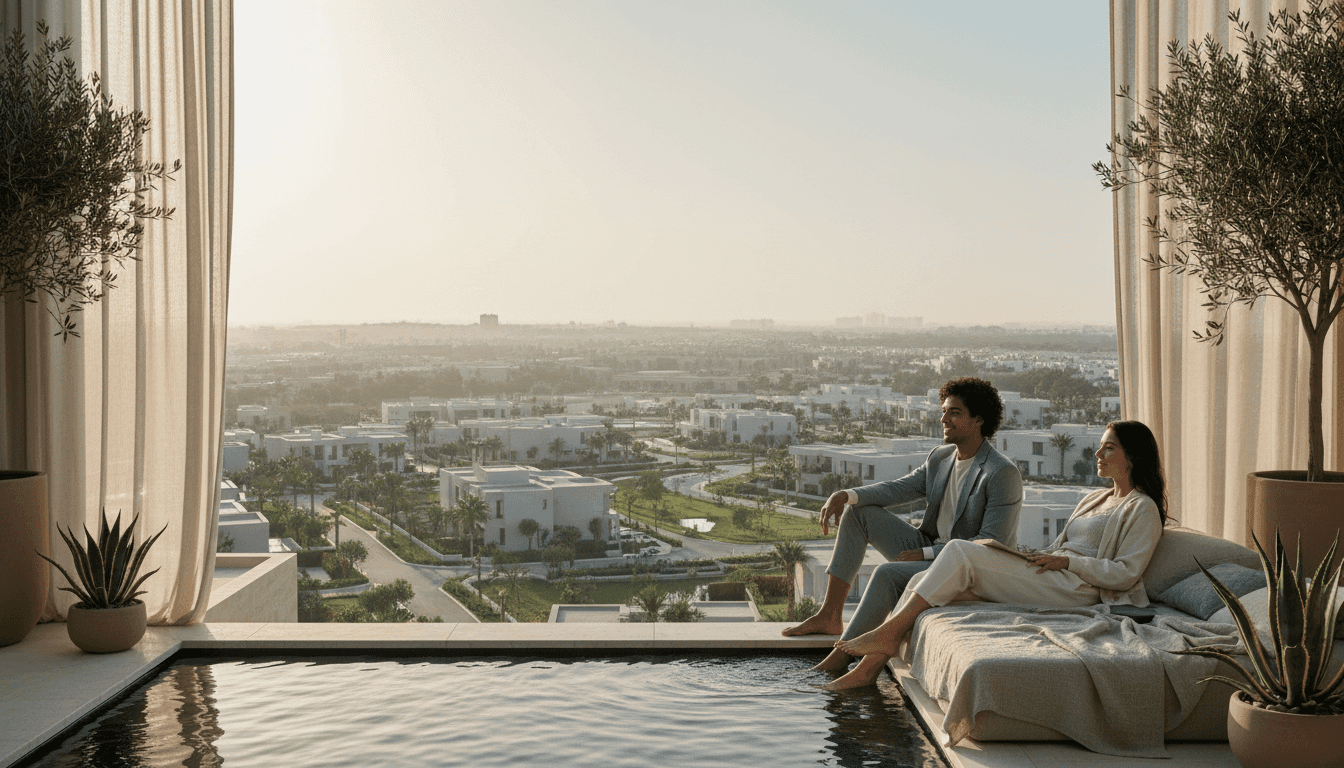
Beyond the Gym: Dubai’s Active Villa Havens
I explore the Dubai villa communities that have made an active outdoor lifestyle a core part of their identity, from dedicated cycle tracks to private lagoons.

For years, the definition of a 'premium' Dubai villa was tied to its size, its finishes, and perhaps a private pool. The community gym was often an afterthought. That model feels outdated now. Today, the most sought-after properties aren't just homes; they are gateways to a healthier, more connected, and more active way of life.
Here’s what we'll explore:
- The new developer mindset: from buildings to biophilia.
- For the cyclists: communities built around the track.
- For the runners and walkers: where trails are king.
- Making a splash: the rise of watersports communities.
- The 'everything' communities: where all sports converge.
- Understanding the true cost of this lifestyle.
- My verdict on the future of active living in Dubai.
The New Developer Mindset: From Buildings to Biophilia
When I first started in Dubai real estate, the sales pitch for a new villa community was straightforward. It was all about the square footage, the marble selection, and the proximity to a major highway. The 'community amenities' section of the brochure usually featured a single render of a generic swimming pool and a small, functional gym. This approach treated an active life as something you did indoors, separate from your home and your neighbourhood. The outdoors was for manicured, ornamental gardens you looked at, not lived in. This philosophy has undergone a radical transformation, driven by a profound shift in what discerning buyers, particularly families, expect from their environment.
The pandemic was a powerful accelerator, but the trend was already in motion. We all realised, with sudden clarity, the value of having usable, high-quality open space right on our doorstep. The demand for homes with proper gardens, and for communities with parks, trails, and safe places for children to play, skyrocketed. Developers who had already invested in this vision found their projects massively oversubscribed. Those who hadn’t, scrambled to redesign their master plans. It’s no longer enough to offer a token green space. The new benchmark for luxury is a community that is fundamentally integrated with nature and designed to promote an active, outdoor lifestyle. This is what we call building for 'biophilia' — our innate human need to connect with the natural world.
This change is most evident in the work of top-tier developers. Look at Majid Al Futtaim's Tilal Al Ghaf. They didn't just add a park; they centred the entire community around a 150,000 square metre recreational lagoon with sandy beaches. The network of walking trails and cycling paths isn't an afterthought; it’s the connective tissue of the entire master plan. Similarly, Aldar, in their first solo Dubai launch, Athlon, have explicitly branded their community as being built around 'active wellness'. They’ve partnered with wellness experts to design a community where every walk, run, and cycle is part of a holistic experience. This represents a fundamental shift from product-centric (selling a villa) to experience-centric (selling a lifestyle) development. It’s smart business, because it creates a much stickier, more desirable environment that commands a premium and fosters a genuine sense of community.
For the Cyclists: Communities Built Around the Track
 Featured project
As a keen amateur cyclist myself, nothing excites me more than the way Dubai has embraced cycling. The city's investment in world-class infrastructure like the Al Qudra Cycle Track is phenomenal. For many of our clients, proximity and safe access to these tracks have become non-negotiable requirements. Developers have responded, creating communities where a cycling lifestyle isn't just possible, but actively encouraged. These are the places where you can roll out of your garage and be on a dedicated track within minutes, without having to navigate dangerous junctions or strap your bike to a car.
My top recommendation for serious road cyclists has long been the communities clustered around Al Qudra Road. Arabian Ranches II and III, by Emaar Properties, are prime examples. Ranches III, in particular, was designed with this in mind, with multiple entry points to the vast network of paths that feed into the main Al Qudra track. You can easily get in a 50km loop before work. It creates a powerful social fabric; you see the same faces out on the track every morning. The community becomes a club. The villas themselves, from three-bedroom townhouses to larger standalone units, are perfect for families who share this passion.
Another outstanding option is Damac Hills and Damac Hills II. DAMAC Hills has its own internal cycling lanes, but its real advantage is its strategic location. It offers direct access to the Al Qudra track via a dedicated bridge, completely separating cyclists from traffic. This is a game-changer for safety and convenience. Just a short ride away, you have the Trek Bicycle Store and the last-exit food truck park, the social heart of Dubai’s cycling scene. For those looking at something newer, Aldar's Athlon near Arabian Ranches is explicitly designed around this. Their master plan features over 37 kilometres of paths, trails and tracks, with a dedicated cycling loop at its core. It’s clear they are targeting the exact same buyer profile: the family that wants their fitness integrated into their daily life, not confined to a weekend drive to a specific location.
Beyond these, even communities not directly on Al Qudra are improving their offerings. Tilal Al Ghaf offers an 18-kilometre network of walking and cycling trails that wind through the community, connecting the residential clusters to the lagoon and parks. While perhaps not for the hardcore peloton, it’s perfect for family bike rides and safe for children. This focus on internal networks is a key differentiator for the best cycling communities Dubai has to offer. It moves the bike from being purely a piece of sports equipment to a genuine mode of transport within the neighbourhood, which is a much more sustainable and enjoyable way to live.
For the Runners and Walkers: Where Trails Are King
While cycling grabs headlines with its impressive infrastructure, the simple, democratic act of running or walking is the daily ritual for most residents. For me, a great community is one where I can put on my trainers and go for a run without having to think about traffic, pavement quality, or personal safety. The best master plans understand this and prioritise pedestrian-friendly design, creating dedicated running trails villas that are both beautiful and functional. It’s about more than just a strip of pavement; it's about shade, lighting, scenery, and a layout that makes you want to get outside.
Emaar Properties has been a master of this for decades. Look at older, more established communities like The Meadows or the original Arabian Ranches. Their enduring appeal lies in the mature landscaping and the network of interconnected parks and lakeside paths. You can string together a 5k or 10k run through these communities without ever feeling bored or unsafe. The paths are wide, well-lit, and meander through genuine greenery, not just along a noisy road. This is a stark contrast to many standalone villa developments where the only place to run is on the street itself, competing with cars.
More recent developments have taken this concept and amplified it. The gold standard, in my opinion, is Al Barari. This community is less a housing development and more a botanical garden that happens to have homes in it. With over 60% of the master plan dedicated to green space, landscaped gardens, and waterways, the running experience here is unparalleled in Dubai. The trails are truly stunning, taking you through dense foliage and past beautiful water features. It is a genuinely therapeutic place to exercise. Of course, this comes at a premium; Al Barari is one of Dubai's most exclusive addresses. But it demonstrates what is possible when the landscape is the hero of the story, not the buildings.
A more accessible but equally impressive example is Nshama's Town Square. Nshama’s philosophy is built around creating affordable, family-friendly communities with exceptional amenities. The central Town Square Park is the heart, but radiating from it is an extensive green trail system for jogging and cycling. These trails connect the various apartment and townhouse clusters, encouraging residents to walk to the central plaza, the shops, or the cinema. It’s a very clever design that fosters a walkable, village-like atmosphere, making it one of the best healthy living communities for young families on a budget. The new Athlon community by Aldar also promises to be exceptional for runners, with its 37km of paths specifically designed for walking, jogging and cycling, making it a truly integrated outdoor fitness villas hub.
Making a Splash: The Rise of Watersports Communities
For a coastal desert city, it’s surprising how long it took for inland water features to become a central part of villa community design. For many years, your options were either a sea-fronting villa on the Palm Jumeirah or a standard community pool. That has changed dramatically with the advent of Crystal Lagoons technology, which allows for the creation of vast, swimmable, and sustainable bodies of water anywhere. This innovation has unlocked a whole new category of watersports communities Dubai and redefined what a premium lifestyle can be, far from the natural coastline.
Mohammed Bin Rashid City, specifically District One, was the pioneer. When the seven-kilometre Crystal Lagoon was first announced, it was a game-changer. Here was a development in the heart of Meydan, just minutes from Downtown, offering residents a private beachfront lifestyle. You can kayak, paddleboard, and swim in pristine, turquoise water right outside your home. It’s an incredible amenity that completely transformed the value proposition of the entire area. The success of District One proved the immense demand for this kind of lifestyle and set a new benchmark that other developers are now racing to meet.
Majid Al Futtaim’s Tilal Al Ghaf is arguably the most refined execution of this concept to date. Their 'Lagoon Al Ghaf' is the soul of the community. It’s not just a body of water; it’s a fully programmed recreational hub with sandy beaches, cabanas, and a host of non-motorised watersports. You can go from your front door to a paddleboard in under five minutes. This is an amenity that the whole family can use every day, which is why properties here have seen such strong appreciation. It’s a lifestyle you simply cannot replicate in older communities. The value is self-evident, and we see intense demand for both rentals and sales in Tilal Al Ghaf whenever a property becomes available.
This trend is now becoming a standard feature in many new high-end master plans. We see it in the Elysian Mansions and Lagoon Al Ghaf phases of Tilal Al Ghaf, and it’s a core component of DAMAC Lagoons, where each cluster is themed around a different Mediterranean destination, all connected by swimmable water. For residents, this means that an active water-based lifestyle is no longer a special occasion that requires a trip to Kite Beach or La Mer. It's an integral part of daily life. This has fundamentally expanded the options for families seeking an active lifestyle, well beyond the traditional confines of the established coastal neighbourhoods.
“The best new communities don't just sell you a home; they sell you a healthier daily routine. The design itself — the trails, the lagoons, the parks, is the most powerful amenity of all.”
The 'Everything' Communities: Where All Sports Converge
While some communities excel in one specific area — be it cycling, running, or watersports, the holy grail for many families is the 'everything' community. These are the large-scale master plans that manage to offer a comprehensive suite of world-class facilities for almost any interest. They are cities within a city, designed so that you rarely need to leave for your recreational pursuits. These are typically developed by the biggest names in the business, like Emaar and Majid Al Futtaim, who have the scale, capital, and experience to execute such an ambitious vision.
Dubai Hills Estate is perhaps the quintessential example. At its heart is the magnificent 18-hole championship golf course, but the active lifestyle offering goes so much further. There is a 54-kilometre bicycle route, a dedicated skate park, a splash park, and countless basketball and tennis courts. The Dubai Hills Park is a vast green lung with jogging tracks, outdoor fitness stations, and plenty of space for impromptu games of football or cricket. You have the stunning Dubai Hills Mall for indoor recreation, and the community is dotted with high-quality gyms and fitness studios. It’s this multi-faceted approach that makes it so popular. A family can live here, and every member can pursue their own passion without compromise. The father can be a golfer, the mother a runner, and the kids can cycle and skate in a safe, controlled environment.
Tilal Al Ghaf is another strong contender for the 'everything' title. I've already mentioned its incredible lagoon for watersports and its extensive network of running and cycling trails. But it also features a host of other facilities woven into the community fabric. There are tennis and basketball courts, outdoor 'fitness rooms' with permanently installed equipment, and skate parks. The entire master plan is designed around walkable 'Sikkat' trails that connect these amenities to the residential areas. The presence of the Royal Grammar School Guildford on-site also means that school sports facilities are integrated into the community. This holistic approach, where health, education, and recreation are all part of one smooth experience, is incredibly powerful.
This is the future direction of all major master-planned communities in Dubai. The new Palm Jebel Ali by Nakheel and The Oasis by Emaar are being designed on this very principle, but at an even grander scale. They understand that modern luxury isn't about isolation; it's about connection and activity. They are creating ecosystems where residents can live, work, and play, with a focus on wellness and an active outdoor life. These communities represent a significant investment from the developer, but they also create incredible long-term value for the homeowners who are lucky enough to live there.
Understanding the True Cost of This Lifestyle
This incredible lifestyle comes with a price tag, and it's important for buyers to understand the full financial commitment. The costs go beyond the initial purchase price of the villa. When we at Gaia Living advise our clients, we make sure they have a clear picture of all the associated expenses, particularly the annual service charges which fund these amazing amenities.
Service charges in these highly amenitised communities are, naturally, higher than in a basic villa sub-division. These fees cover the maintenance of the lagoons, the landscaping of the parks and trails, the lighting, the 24/7 security, and the upkeep of all the sports courts and facilities. They are calculated on a per-square-foot basis on your villa's built-up area (BUA) and are regulated and approved by Dubai's Real Estate Regulatory Agency (RERA). In my experience, for a premium villa community with extensive active amenities, you should budget for service charges in the range of AED 4.00 to AED 6.50 per square foot per year.
Let’s work through a concrete example for a 4,000 sq. Ft. villa in a community like Tilal Al Ghaf or Dubai Hills Estate:
- Annual Service Charge Calculation:
- Villa BUA: 4,000 sq. Ft.
- Assumed Service Charge Rate: AED 5.50 per sq. Ft.
- Total Annual Service Charge: 4,000 x 5.50 = AED 22,000
While this might seem like a significant annual cost, it’s crucial to contextualise it. What are you getting for that money? You're getting unlimited access to pristine parks, professionally maintained cycle tracks, safe running trails, and in some cases, a private beach and lagoon. If you were to pay for individual family memberships at a high-end beach club and a separate sports club, the annual cost could easily exceed this amount. Here, it’s integrated into your home environment. In my view, when you factor in the quality of life, the convenience, and the positive impact on property value, these service charges represent excellent value for money.
Beyond service charges, buyers must also account for the standard upfront costs associated with a property transaction in Dubai. These are set by the Dubai Land Department (DLD) and are non-negotiable. It's essential to have these funds ready in addition to your property down payment.
- Typical Upfront Purchase Costs (Example on a AED 5,000,000 Villa):
- DLD Transfer Fee: 4% of purchase price = AED 200,000
- DLD Registration Trustee Fee: AED 4,200 (for properties over AED 500k)
- Agency Fee: 2% of purchase price + 5% VAT = AED 105,000
- No Objection Certificate (NOC) Fee: Typically AED 500 - AED 5,000 (paid to developer)
- Mortgage Registration Fee (if applicable): 0.25% of loan amount (paid to DLD)
- Total Estimated Upfront Costs (excluding property price): ~AED 310,000
Understanding these figures is the first step to making an informed decision. While the investment is significant, the enduring popularity and strong capital appreciation in these active lifestyle communities suggest that the market overwhelmingly agrees on their value.
The premium paid for villas in communities like Tilal Al Ghaf or Dubai Hills Estate is not just for the property itself, but for the daily access to a curated, active, and healthy lifestyle. This 'lifestyle equity' is a powerful driver of both long-term rental demand and capital appreciation.
My Verdict: Investing in a Healthier Future
Having watched Dubai’s property landscape evolve over the years, I can say with confidence that this focus on integrated, active lifestyles is not a fleeting trend. It is the new standard for premium family living in the emirate. The developers who are leading this charge are the ones who will define the most desirable addresses for the next decade. For families moving to Dubai, or for existing residents looking to upgrade their quality of life, choosing a community based on its lifestyle offering is, in my opinion, the smartest move you can make.
The value proposition is multifaceted. Firstly, there is the undeniable benefit to your own health and wellbeing. Having world-class facilities on your doorstep removes the friction from staying active. It encourages you and your children to spend more time outdoors, to connect with neighbours, and to build healthy habits that last a lifetime. This is a return on investment that you can't measure in dirhams but is priceless.
Secondly, there is the financial aspect. Our experience at Gaia Living shows that properties in these well-designed, active communities consistently outperform the wider market. They command higher rental yields because tenants are willing to pay a premium for the lifestyle. They also demonstrate stronger capital appreciation because the demand from end-users — families who want to live there, is so deep and resilient. These communities are less susceptible to market fluctuations because their appeal is based on fundamental quality-of-life factors, not just speculation. When it comes time to sell, a villa in a community with a swimmable lagoon and a beloved cycle track will always have a competitive edge.
My advice to any client looking for a family villa in Dubai is to look beyond the floor plan. Visit these communities at the weekend. See the families out on their bikes, the runners on the trails, the kids playing in the parks. This is the living, breathing reality of the lifestyle you are buying into. While the initial investment may be higher, you are not just purchasing a property; you are investing in a healthier, more connected, and more enjoyable future for your family. And in a city as dynamic as Dubai, that is the most valuable asset of all.
Sources
- Dubai Land Department (DLD): https://dubailand.gov.ae/
- Real Estate Regulatory Agency (RERA): Part of the DLD website.
- Central Bank of the UAE (CBUAE): https://www.centralbank.ae/
- UAE Government Portal: https://u.ae/
Questions, answered
- Which Dubai community is best for serious cyclists?
- For dedicated road cyclists, communities with direct, safe access to the Al Qudra Cycle Track, like Arabian Ranches 2 & 3 or DAMAC Hills, are my top recommendations. The infrastructure provides a smooth and safe long-distance cycling experience.
- Are there villa communities in Dubai with private beaches or lagoons?
- Yes, several. District One at MBR City pioneered the private crystal lagoon concept. Now, developers like Majid Al Futtaim at Tilal Al Ghaf and Aldar with Athlon are integrating swimmable lagoons and extensive water features directly into their master plans.
- What are the typical service charges for a villa in a community with extensive amenities?
- Service charges vary by developer and the extent of the facilities. Expect to pay between AED 4.00 and AED 6.50 per square foot on your villa's built-up area annually. These fees are regulated by the Dubai Land Department and cover maintenance of parks, pools, security, and all shared amenities.
- Can I get a mortgage for a villa in these active communities?
- Yes, both ready and off-plan properties in these freehold communities are eligible for mortgages, subject to bank approval. For a ready villa, UAE residents typically need a 20% down payment, while non-residents need 25-30%. The Central Bank of the UAE sets these loan-to-value limits.
- Are running trails in these communities safe and well-lit?
- Absolutely. A key feature of master-planned communities like those from Emaar, Majid Al Futtaim, and Aldar is the provision of safe, well-lit, and landscaped jogging and walking trails, separate from road traffic, making them ideal for early morning or evening exercise.
- Do these active communities have good access to schools?
- Yes, a major draw for these family-oriented communities is their proximity to, or inclusion of, top-tier international schools. For example, Tilal Al Ghaf has the Royal Grammar School Guildford, and Arabian Ranches has the Jumeirah English Speaking School (JESS).

Sophia profiles Dubai's villa communities — schools, commute times, green space, and the intangible feel of a neighbourhood. She writes for families putting down roots.
Related stories
Dubai's Big Squeeze: Smaller Plots, Denser Living
Dubai real estate is undergoing a fundamental shift towards smaller plot sizes and higher density. We analyse the economic drivers, the impact on property values, and what this new era of compact urban living means for both homebuyers and investors.
Resort Living as Your Dubai Reality
Explore how to trade temporary staycations for a permanent home with five-star amenities in Dubai. I'll break down the real costs, best communities, and lifestyle trade-offs of embracing high-end resort living every day.
Finding Your Tribe in Dubai's Villa Communities
I explore which of Dubai's renowned villa communities attract specific expat nationalities and lifestyle groups, offering insights to help you find a place that feels like home.
Echoes, in your inbox
One thoughtful email a month. Market insight, new launches, no spam.