

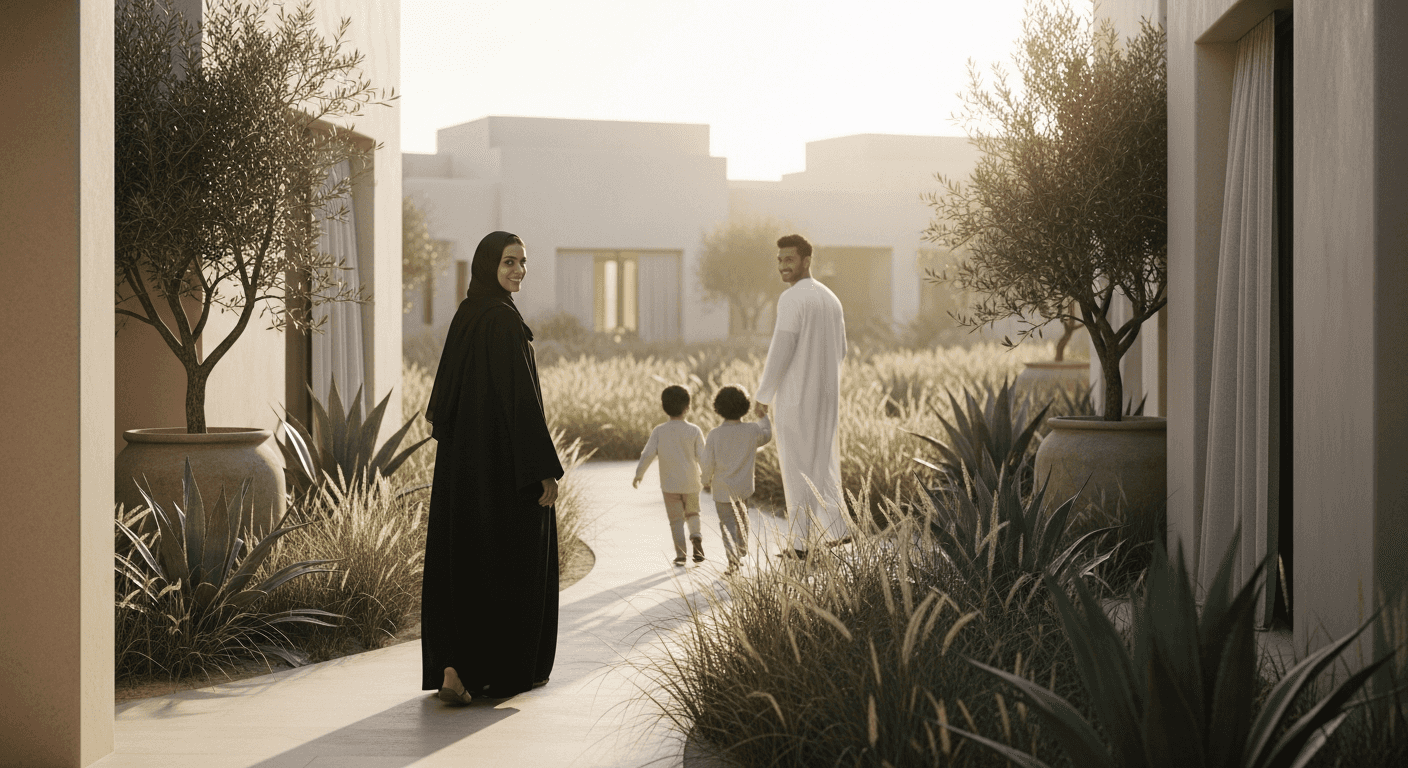
Beyond the Green: Dubai's Social Villa Communities
It's no longer enough for a family villa to just have a garden. I explore the Dubai communities that are master-planned for active lifestyles and genuine social connection.

For years, the dream for many families moving to Dubai was simple: a spacious villa with a private garden. A patch of green to call your own was the ultimate prize. But I’ve watched that dream evolve. Today, as I walk clients through properties, the conversation has shifted. The garden is still important, but the questions I hear most often are about what lies beyond the garden wall. What is there to do? Where can the kids play safely? Can we walk to a café? Will we meet our neighbours?
This is a search for something more than just space; it’s a search for connection, for activity, and for a lifestyle that feels vibrant and engaged. The most forward-thinking developers have understood this shift. They are no longer just building houses; they are building habitats. These are the `active family communities Dubai` is becoming famous for, places designed from the ground up to foster health, wellness, and that most elusive of modern commodities: a genuine sense of community.
Here's what we'll explore:
- The new definition of 'family-friendly' in Dubai's property market.
- The essential features that create a truly active and social community.
- A deep dive into Emaar's model, focusing on Dubai Hills Estate and Arabian Ranches.
- How challenger developers like Damac and Nshama are creating value and variety.
- The vital role of community centres and programmed events in `social villa living Dubai`.
- A transparent look at the true cost of these amenities through service charges.
- Niche communities that cater to specific active lifestyles, like golf or wellness.
- My final verdict on how to choose the right community for your family's unique needs.
Redefining 'Family-Friendly' in Dubai
When I first started in Dubai real estate, the term 'family-friendly' was a simple checklist. Did it have three or more bedrooms? Was there a garden? Was a school within a 15-minute drive? If yes, it was marketed to families. The communities themselves were often quiet, sleepy collections of villas, beautiful in their own right, but designed for privacy above all else. Social life happened by formal invitation, and the main community amenity was often a solitary, underused swimming pool and perhaps a sad-looking playground.
That model is becoming obsolete. The new definition of 'family-friendly' is dynamic. It’s about creating an environment where family life can spill out of the home and into shared public spaces that are safe, engaging, and beautiful. It's about giving children the freedom to cycle over to a friend’s house without crossing a major road, or for parents to bump into neighbours while grabbing a morning coffee. It’s a more integrated, almost village-like approach to suburban living, and it’s a direct response to the changing priorities of modern buyers, particularly expatriates who are building their lives here far from their extended family networks.
In my experience, this desire for connection is a powerful driver. Clients are willing to trade a few hundred square feet of indoor space for a location with a bustling park, a walkable retail strip, or world-class `community sports facilities Dubai` is known for. This isn't just a trend; it's a fundamental re-evaluation of what 'home' means. It’s an ecosystem, not just an asset. The developers who master this concept are the ones setting the benchmark for quality of life in the city. They understand that the value of a property is intrinsically linked to the vibrancy and health of its surrounding community.
This shift also has a practical, financial dimension. A well-managed, active community tends to hold its value better over time. The amenities and the social fabric create a stickiness; people want to live there, and once they do, they are reluctant to leave. This sustained demand provides a buffer against market fluctuations. When we at Gaia Living advise our clients, we always encourage them to look at the master plan, not just the floor plan. We ask them to consider the long-term livability and the developer’s commitment to maintaining the community's soul long after the last unit is sold. That is where the real, enduring value is found.
The Blueprint for a Vibrant Community
So, what are the tangible ingredients that make up one of these `vibrant villa communities`? It’s a design philosophy that prioritises people over cars and shared experiences over isolated living. When I assess a new community, I look for a specific set of features that work together to create a cohesive, active environment. It's a blueprint that the best developers have refined over years of observation and feedback.
First and foremost is walkability and connectivity. This means shaded pathways, dedicated jogging and cycling tracks that are separate from roads, and a layout where key amenities are clustered together to form natural hubs. A community where you must get in your car to buy a carton of milk or visit the park is a community that will struggle to feel connected. In contrast, places like Town Square or the park-side villas in Dubai Hills are designed so that daily life can be conducted on foot. This simple design choice is transformative, creating countless opportunities for casual, spontaneous social interactions.
Next on my list are the amenities themselves. The quality and variety of `family-friendly amenities villas` offer are critical. A single pool is no longer enough. I look for:
- Multi-use sports facilities: Tennis courts are standard, but the best communities offer basketball, volleyball, and football pitches.
- Tiered swimming pools: This includes a proper lap pool for adults, a family pool, and a separate, shaded toddler pool or splash pad.
- Expansive green spaces: Not just decorative landscaping, but functional parks with picnic areas, barbecue pits, and open lawns for informal games.
- Modern fitness centres: Well-equipped gyms that rival commercial offerings, saving residents a separate membership fee.
- Skate parks and pump tracks: These are increasingly popular and show a developer is thinking about teenagers and young adults, not just toddlers.
Beyond the physical hardware, the 'software' of the community is just as important. This is driven by an active and well-funded community management team. Do they organise events? Are there farmers' markets, outdoor movie nights, holiday celebrations, and community-wide garage sales? These programmed activities are the lifeblood of a social community. They provide a structure for neighbours to meet and form bonds. A well-run `Dubai community centres` becomes the heart of the neighbourhood, a place for classes, local clubs, and social gatherings. When I see a packed notice board at a community centre, I know the developer and the management are getting it right.
Emaar’s Signature: The Integrated Lifestyle Model
When you talk about master-planned communities in Dubai, one name stands above the rest: Emaar Properties. They didn't just pioneer the concept here; they have perfected it into a replicable, highly successful model. Their philosophy is to build entire ecosystems, not just residential developments. This integrated approach is the gold standard for `social villa living Dubai`, and nowhere is it more evident than in their flagship villa communities.
Let’s start with the original: Arabian Ranches. When it launched, it was a game-changer. It offered a slice of suburban paradise with a central community centre, a golf course, and a school. What makes the original Ranches so special, and why it remains so beloved, is its maturity. The landscaping has grown in, creating a lush, green canopy that feels established and serene. The community has a soul, forged over nearly two decades of family life. The retail centre and Jess school are true community hubs, and the various parks and pools are always in use. It set the template for everything that followed.
Then came Dubai Hills Estate, and it was as if Emaar took every lesson from Arabian Ranches and amplified it. Dubai Hills is, in my opinion, the pinnacle of the integrated lifestyle model in Dubai today. It is a city within a city, executed with incredible foresight. The community is anchored by the magnificent Dubai Hills Park, a vast green lung with wadis, a skate park, a splash park, and sports courts. It’s connected by a smooth network of jogging and cycling paths. But the integration goes further. You have the Dubai Hills Mall for retail and entertainment, the Dubai Hills Golf Club for recreation, a business park for work, and multiple high-quality schools and a major hospital right within the community. You could, in theory, live, work, and play without ever needing to leave the area. This level of comprehensive planning creates a lifestyle of unparalleled convenience and fosters an incredibly strong community identity.
What Emaar does so well is scale and quality. The `community sports facilities Dubai` sees in Emaar projects are top-tier. The parks are not afterthoughts; they are central, defining features. The community management, while not inexpensive, is professional and consistent in its event programming. From National Day fireworks to festive markets, they understand how to activate the public spaces they build. The result is a predictable but extremely high-quality living experience. When a client buys into an Emaar villa community, they are buying a promise of a certain lifestyle, and it's a promise that, in my long experience, is consistently delivered.
The Challenger Brands: Variety and Value
While Emaar may have written the playbook on integrated communities, they are by no means the only players in the game. A healthy market thrives on competition, and several other developers have brought their own unique visions to the table, often offering compelling value propositions and distinct lifestyle flavours. For buyers, this means more choice and the ability to find a community that perfectly matches their budget and personality.
One of the most prominent challengers is Damac Properties, with its ambitious Damac Hills and Damac Hills II projects. Damac's approach is different from Emaar's; it's bolder, often built around high-profile brand partnerships. Damac Hills is anchored by the Trump International Golf Club Dubai, while Damac Hills 2 features themed areas like a water town and a sports town. This creates a resort-like feel. Their signature amenity, Malibu Bay, a large wave pool, is a perfect example of this — it's a spectacular feature that provides a major draw for families. In my view, the community feel can be less organic than in an Emaar project, but the sheer volume and novelty of the amenities on offer provide incredible value, especially for families with active children who will make full use of such facilities.
At a different end of the spectrum is Nshama's Town Square. I have a real soft spot for this project. It has been intelligently designed from the ground up to appeal to a younger, dynamic demographic by focusing on affordability without sacrificing lifestyle. The entire development revolves around Town Square Park, a huge central space that is a hive of activity. It features a carousel, a kids' train, a massive splash pad, and is surrounded by an array of trendy cafes and restaurants. The emphasis is on an active, outdoor lifestyle, with extensive cycling and jogging trails, sports courts, and a skate park. Nshama has proven that you don't need a luxury price tag to create one of the most `vibrant villa communities` in the city. It feels energetic and youthful, and the 'cost-per-amenity' ratio is arguably one of the best in Dubai.
Other developers like Nakheel are also evolving. Known for the iconic Palm Jumeirah, their newer villa projects are increasingly incorporating the principles of integrated community living. They are focusing more on creating walkable neighbourhoods with robust community retail and extensive green spaces. This competition is fantastic for the market. It forces every developer to up their game, to think more deeply about livability, and to offer more to residents. Whether you're drawn to the established quality of Emaar, the flashy fun of Damac, or the smart value of Nshama, there's a master-planned community that fits the bill.
The Social Fabric: Beyond Bricks and Mortar
Having incredible facilities is one thing; seeing them used and enjoyed is another entirely. The transition from a mere housing development to a living, breathing community happens in the shared spaces, and it's powered by what I call the 'social fabric'. This intangible quality is the magic ingredient that turns neighbours into friends and a collection of houses into a home. It’s something that can't be rushed; it has to be cultivated, both by the residents themselves and, crucially, by proactive community management.
The true value of a master-planned community isn't just in the amenities you can see; it's in the spontaneous conversations and friendships those amenities make possible.
This is where the role of the `Dubai community centres` becomes so vital. In the best communities, these are not just administrative offices. They are the heart of the neighbourhood. A great community centre will host a variety of classes — yoga, martial arts, language courses, for all ages. It will have a coffee shop that serves as a natural meeting point for parents after the school run. It will have a multi-purpose hall that can be booked for birthday parties or community gatherings. The team that runs it is the key; they are the community animators, the organisers, and the facilitators who listen to residents and help bring their ideas to life. In Arabian Ranches, for instance, the community centre is a bustling hub from morning until night, a sign of a well-understood and well-served population.
Equally important is the calendar of programmed events. A community that celebrates together, stays together. I always advise my clients to look at the community's social media pages or notice boards to get a feel for its personality. Do they have a weekly food truck night? Do they organise outdoor movie screenings in the cooler months? Are there special events for major holidays like Eid, Diwali, Christmas, and Halloween? These organised touchpoints are incredibly important, especially in an expatriate city like Dubai. They provide a ready-made social life and an easy way for new residents to integrate and feel like they belong. It’s this consistent, thoughtful programming that fosters `social villa living Dubai` residents now actively seek.
Ultimately, the physical design of the community must support this social ambition. Cul-de-sacs that open onto shared gardens, front porches that are close to the sidewalk, and low walls all encourage casual interaction. It's a subtle but powerful form of social engineering. When a developer gets this right, the community takes on a life of its own. Residents start their own book clubs, organise street parties, and set up sports leagues. The community management provides the spark, but the residents themselves become the flame. This is the ultimate sign of a successful community — one where the social fabric is so strong that it becomes self-sustaining.
The True Cost of Community: Understanding Service Charges
All these beautiful parks, sparkling pools, state-of-the-art gyms, and 24-hour security teams come at a cost. This is a topic I always discuss in frank detail with our clients at Gaia Living, as it's a crucial part of budgeting for a villa purchase. The cost is covered by annual service charges, a fee levied on homeowners to pay for the upkeep, management, and operation of all the shared areas and amenities. While no one loves paying fees, it's essential to see them not as a tax, but as an investment in the lifestyle you're buying into and the long-term value of your property.
Service charges are calculated on a per-square-foot basis, typically on the plot area of your villa, not just the built-up area. The rates are proposed by the developer's management company and must be approved by Dubai's Real Estate Regulatory Agency (RERA), which ensures they are fair and accurately reflect the costs of maintaining the community. You can verify the approved charges for any community using the Dubai REST app from the Dubai Land Department, which provides excellent transparency. Rates can vary significantly. An older community with basic amenities might have charges as low as AED 2-3 per square foot. However, for the premium, `active family communities Dubai` is known for, you should budget for more. A community like Dubai Hills Estate or the newer phases of Arabian Ranches might be in the range of AED 4-6 per square foot.
Let’s run through a realistic example of the upfront costs and the first-year running cost for a four-bedroom villa in a premium community. This transparency is vital for proper financial planning.
Sample Cost Breakdown: AED 5,000,000 Villa
- Purchase Price: AED 5,000,000
- Dubai Land Department (DLD) Fee (4%): AED 200,000
- DLD Registration Trustee Fee: approx. AED 4,200
- Agency Fee (2% + 5% VAT): AED 105,000
- Mortgage Registration Fee (0.25% of loan amount): approx. AED 10,000 (on an 80% LTV mortgage)
- Bank Processing/Valuation Fees: approx. AED 5,000 - 10,000
- Total Upfront Purchase Costs: ~ AED 324,200
Now, let's add the recurring cost. If the villa has a plot of 6,000 sq ft and the service charge is AED 5/sqft:
- Annual Service Charge: 6,000 sq ft x AED 5/sqft = AED 30,000
While AED 30,000 a year may seem substantial, consider the value. That fee likely covers a family gym membership (which could easily cost AED 10,000-15,000 a year elsewhere), access to multiple pools, tennis and basketball courts, pristine parks, and robust security. When you itemise what you're getting, the fee often represents excellent value for money. My advice is to always see the service charge as part of the overall value equation. A low service charge in a poorly maintained community with no amenities is no bargain at all. A fair service charge in a vibrant, well-run community is an investment in your family's quality of life.
Niche and Boutique Communities: Beyond the Mega-Projects
While the large, integrated communities from developers like Emaar and Damac represent the mainstream ideal for many families, Dubai's property market is mature enough to offer fantastic alternatives for those with more specific passions. These niche or boutique communities cater to a particular lifestyle, building a strong social fabric around a shared interest. For the right buyer, these can be even more fulfilling places to live.
Jumeirah Golf Estates: (/areas/jumeirah-golf-estates) is a prime example. As the name suggests, life here revolves around the two world-class championship golf courses, Fire and Earth. But it’s more than just a place for golfers. The community has become a highly sought-after destination for families who appreciate the stunning, verdant landscape and the high-end, resort-like atmosphere. The European Tour Performance Institute and the clubhouse, with its restaurants and leisure facilities, act as the central social hub. The community is tight-knit, bound by a shared appreciation for the sport and the beautiful, tranquil environment it creates. It’s an active lifestyle, but one with a very specific, sophisticated flavour.
For those whose idea of activity leans more towards wellness and nature, there is nowhere in Dubai quite like Al Barari. This is one of my personal favourite communities. It's an ecological masterpiece, a low-density development with over 60% of its area dedicated to landscaped gardens, freshwater streams, and leafy walkways. It doesn't have rows of tennis courts or football pitches; its version of an active lifestyle is about forest bathing, using the Body Language health club, and dining at the iconic farm-to-table restaurant, The Farm. The sense of community here is palpable, built around a shared ethos of quiet luxury, health, and environmentalism. It attracts a specific type of resident, and the result is a uniquely serene and harmonious living experience.
These communities demonstrate that 'active' and 'social' are not monolithic concepts. They can be interpreted in many ways. You also have equestrian-focused communities like the Polo Homes in Arabian Ranches or beach-focused living on Palm Jumeirah. The key is that the master plan is built with a clear identity and a central, unifying passion point. This creates a powerful filter, attracting like-minded individuals and fostering a deep sense of belonging that can sometimes be harder to achieve in the larger, more diverse mega-projects. When we consult with clients, we always start by asking about their hobbies and passions — sometimes the perfect community for them isn't the biggest, but the one that speaks most directly to their heart.
My Verdict: Finding Your Family's Perfect Fit
After years of walking through every type of villa community in this city, from the sprawling mega-projects to the exclusive boutique enclaves, my main conclusion is this: there is no single 'best' active community in Dubai. The very idea is a fallacy. The 'best' community is the one that aligns most perfectly with your family's unique personality, priorities, and definition of a life well-lived.
Finding that fit requires a bit of introspection. Before you even start browsing our properties for sale, I encourage you to sit down with your family and create a lifestyle profile. Be honest about how you see yourselves living. I suggest a simple checklist to guide the conversation:
- What is your 'activity DNA'? Are you a family that needs team sports like football and basketball? Or do you prefer individual pursuits like cycling, running, and swimming? Or perhaps your idea of activity is a quiet walk in a beautiful garden?
- What does 'community' mean to you? Do you thrive on big, organised events and a bustling social calendar? Or do you prefer a quieter, more intimate setting where you know a smaller circle of neighbours well?
- What's your budget for living? Look beyond the purchase price. Be realistic about your tolerance for annual service charges. A higher fee might be worth it if you use every facility, but it's a waste if you don't.
- How important are practicalities? Map out the commute to work and the distance to your preferred schools. A dream community can quickly become a burden if it adds an hour to your daily drive.
- Do you prefer the new and shiny or the mature and established? Are you excited by the latest amenities and a brand-new home, or do you value the charm of mature landscaping and a settled community feel?
In my personal view, the communities that succeed best are those that master the art of 'soft' infrastructure — the walkability, the chance encounters, the well-programmed spaces. For this reason, I often find myself drawn to the balance offered by places like Dubai Hills Estate, which combines grand scale with thoughtful, human-centric design. The mature parts of Arabian Ranches offer a similar magic, built up over time. But for a young family on a different budget, the sheer energy and value of Town Square might be an unbeatable proposition.
Key takeaway: Your home is the backdrop to your life's story. Choosing a community is about more than an address; it's about choosing the stage where your family's story will unfold. Look for the place that doesn't just give you a beautiful house, but also offers the lifestyle, the connections, and the opportunities for joy that will fill it with life.
## Sources
- Dubai Land Department: https://dubailand.gov.ae/
- Real Estate Regulatory Agency (RERA): Part of the DLD website.
- The UAE Government Portal: https://u.ae/
Questions, answered
- Which Dubai communities are best for active families?
- Communities like Dubai Hills Estate, Arabian Ranches (I, II, and III), and Town Square are excellent choices. They are master-planned with extensive parks, cycle tracks, sports facilities, and community events that encourage an active, social lifestyle.
- What are typical service charges for a villa in an active community?
- Service charges in amenity-rich villa communities typically range from AED 3 to AED 6 per square foot on the plot area, annually. This fee covers the maintenance of parks, pools, security, and sports facilities, and is regulated by Dubai's Real Estate Regulatory Agency (RERA).
- What makes a villa community 'social'?
- A truly social community goes beyond shared amenities. It involves thoughtful urban planning like walkable pathways and central hubs, plus consistent programming by the community management, such as farmers' markets, outdoor cinemas, and holiday events that bring residents together.
- Are newer villa communities better than established ones?
- Not necessarily. Newer communities often have the latest amenities planned from the start, but established communities like Arabian Ranches I have mature landscaping and a deeply rooted community spirit that can be very appealing. The choice depends on your family's preference for modern facilities versus a more settled atmosphere.
- Can I check the official service charges for a community before buying?
- Yes, you can. Service charge details for all projects are registered with the Dubai Land Department (DLD) and can be verified through the Dubai REST mobile application. This allows for complete transparency on annual costs before you commit to a purchase.

Sophia profiles Dubai's villa communities — schools, commute times, green space, and the intangible feel of a neighbourhood. She writes for families putting down roots.
Related stories
Dubai's Big Squeeze: Smaller Plots, Denser Living
Dubai real estate is undergoing a fundamental shift towards smaller plot sizes and higher density. We analyse the economic drivers, the impact on property values, and what this new era of compact urban living means for both homebuyers and investors.
Resort Living as Your Dubai Reality
Explore how to trade temporary staycations for a permanent home with five-star amenities in Dubai. I'll break down the real costs, best communities, and lifestyle trade-offs of embracing high-end resort living every day.
Finding Your Tribe in Dubai's Villa Communities
I explore which of Dubai's renowned villa communities attract specific expat nationalities and lifestyle groups, offering insights to help you find a place that feels like home.
Echoes, in your inbox
One thoughtful email a month. Market insight, new launches, no spam.