

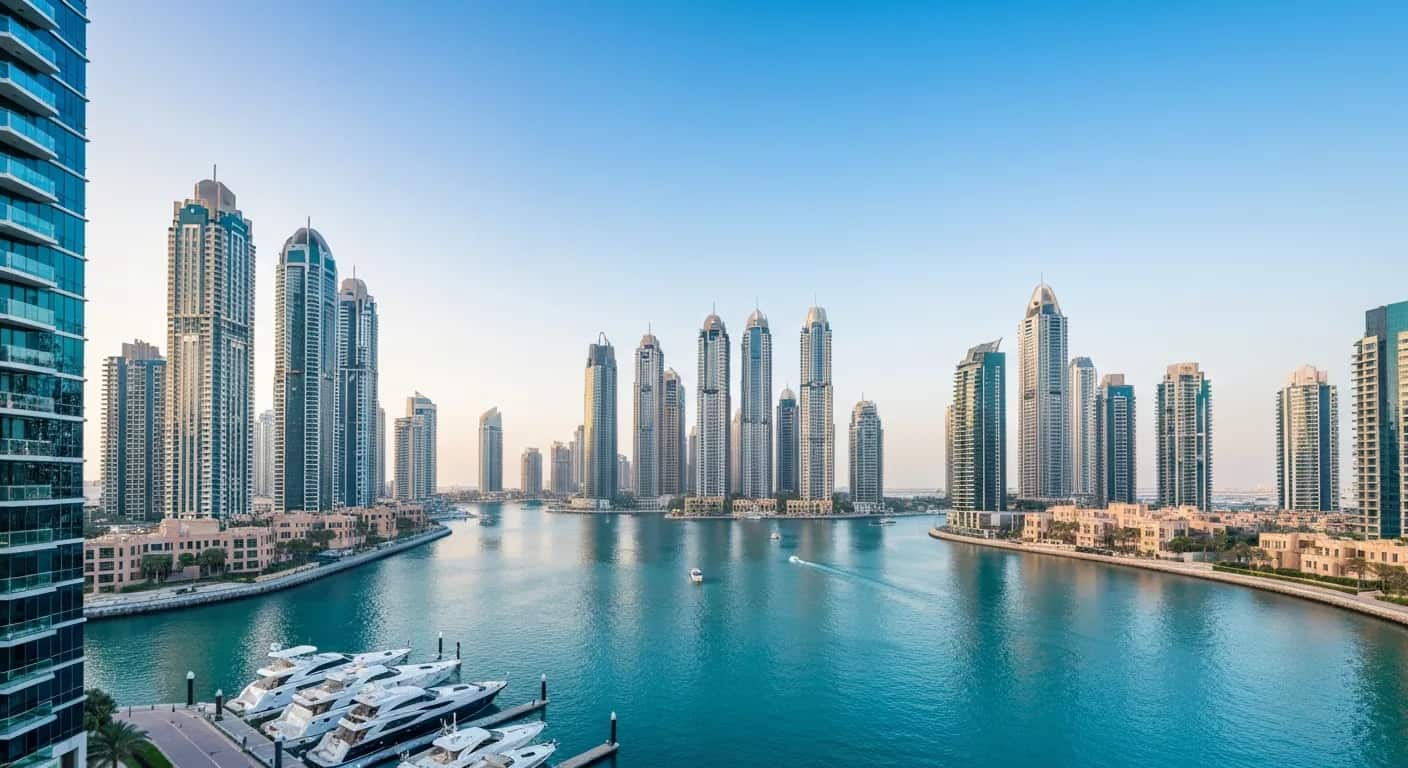
Waterfront living in Dubai: which address is worth the premium
Waterfront living in Dubai rewards different priorities: Dubai Marina often delivers the best balance of lifestyle and value, while Palm Jumeirah buys iconic beachfront prestige. Choose by routine—how you live your days matters more than the view alone.

Waterfront living in Dubai is no monolith: a marina apartment, an island villa, a creekside townhouse and a canal-facing condo all sell under the same banner but deliver different lives. The question a buyer should ask is not just "Can I afford the premium?" but "Which daily rituals am I paying to preserve or buy?"
Waterfront living in Dubai — thesis and how to judge the premium
Waterfront living in Dubai is both a lifestyle choice and a line item on a balance sheet. If you begin with the primary keyword — Waterfront living in Dubai — you immediately see why this topic matters: the city layers water into value in multiple ways, from private beachfront and yacht berths to promenades, views and microclimates. The premium attached to those qualities is not a single percentage; it is a bundle of tangible and intangible returns: quieter mornings, walkability to cafes, better tenant appeal, or simple social status. My thesis is straightforward: only some premiums are worth paying. The trick is to separate emotional ROI — the joy of waking to waves — from measurable, repeatable benefits that fit your goals as owner-occupier or investor.
Start by defining your horizon. If you seek capital growth and can tolerate volatility, ultra-prime beachfront has symbolic value and may hold capital during cycles, but it often compresses rental yields because purchase prices are high. If steady rental income and broader tenant demand are priorities, then marina-front or creekside mid-rise stock tends to provide a more reliable yield profile and easier liquidity. There is no universal 'best' waterfront address in Dubai: the best address is the one that aligns the everyday lifestyle you want with a cost structure you can sustain — mortgage servicing, service charges, strata headaches and transfer costs are as real as the view.
Finally, judge supply and governance. Dubai's waterfront inventory is shaped by a handful of master developers — Nakheel, Emaar, Meraas and Dubai Holding among them — each with different reputations for build quality, handover disciplines and long-term community management. Freehold zones, strata governance, and municipal services (DLD/RERA, NOCs, developer warranties) change how the premium plays out after you sign on the dotted line. In short: waterfront is desirable, but the premium is only 'worth it' when it aligns with use-case, governance, and the ongoing cost-of-ownership.
What 'waterfront' really means in Dubai — types, governance and practical trade-offs
 Featured project
‘Waterfront’ in Dubai is a broad category that umbrellas several distinct typologies: private sandy beachfront (Palm Jumeirah, Jumeirah), linear promenades and marinas (Dubai Marina, JBR, Dubai Harbour), island developments (Bluewaters, the Palm), canal-front and creekside communities (Dubai Canal, Dubai Creek Harbour), and soft-waterfronts along lagoons, inlets and artificial lakes within masterplans (Jumeirah Islands, Arabian Ranches’ lakes). Each typology creates different living patterns. A beachfront villa buys private sand and direct sea noise; a marina apartment buys mooring culture, promenades and evening energy. Knowing which you want is more useful than chasing the most expensive zip code.
Legally and administratively, the ‘waterfront’ premium is mediated by Dubai institutions. The Dubai Land Department (DLD) and RERA set transfer fees, service charge disclosure rules and strata regulations that affect cost predictability. For example, property transfers attract DLD fees and registration requirements that add to transaction costs; service charges are set by community management and can materially affect annual carrying costs. Developers use escrow accounts for off-plan projects to protect buyers’ payments — a critical safeguard — but secondary-market deals and resales move under different mechanics: confirm whether a vendor has paid community dues and whether there are outstanding NOC obligations.
Practical trade-offs come down to use-case. If you want year-round private beach access without public crowds, island villas on Palm Jumeirah or Jumeirah private estates are rare and command a different market dynamic — lower liquidity and higher ongoing maintenance. If you prize social convenience — restaurants, fitness, daily groceries within a 10–15 minute walk — marina-front apartments deliver that more efficiently. Canal and creekfront developments often combine larger floorplates and quieter, family-oriented public spaces with planned infrastructure (schools, parks), but they may still be at the mercy of future phases and developer delivery timelines. In every case, ask for the strata statement, recent service-charge bills and any pending litigation; those pieces determine whether the visible premium will be eroded by invisible costs.
The iconic premium: Palm Jumeirah — who should pay, and why
Palm Jumeirah is the face of Dubai’s ultra-iconic waterfront: a sculpted island, private beaches, yacht culture and a global brand. Its premium is about exclusivity and privacy more than convenience. Villas and high-end apartments on the trunk and fronds deliver the sensation of living on holiday — private driveways, beach access literally a few steps away, and a social scene that skews status-conscious. That premium is justified for buyers who treat the property as a primary lifestyle asset: people who value private outdoor space, family-friendly sandy beaches and a sense of separation from the city’s bustle.
From a cost-structure perspective, Palm properties carry higher entry prices and higher ongoing charges: service charges for waterfront complexes and private landscaping can be significant, and villa maintenance (pool, facade, seawall repairs over time) requires a dedicated budget. Liquidity can be slower, especially at the very top end — estate-type villas change hands less frequently than apartments in mass-market towers. Rental yields historically tend to be compressed because capital values are so high; short-term rental demand exists for signature properties but is seasonal. Buyers who can tolerate lower yields in exchange for a unique asset and personal lifestyle wins will find the premium rational.
Operationally, there are a few practical points to weigh. Private villas and some apartment buildings on the Palm require specific NOCs for transfers and modifications, and some plots are subject to communal rules around external works. Yacht berths are a separate market and often sold or leased independently; if a berth is critical to your lifestyle, check marina management and berth availability. Finally, consider resale audience: the ultra-prime buyer pool is smaller and often overseas, so political and travel disruptions can affect demand. If prestige and private beachfront are your priorities and you plan to live there for many years, Palm’s premium is defensible. If you prefer a more liquid asset or higher rental yield, the premium may not be worth it.
Urban convenience premium: Dubai Marina and JBR — the case for practical waterfront living
Dubai Marina and Jumeirah Beach Residence (JBR) represent a different strand of waterfront living: high-energy, highly walkable, and intensely amenity-focused. The premium here buys immediate access to nightlife, a dense restaurant scene, the tram and metro interchanges, marinas and the long, usable promenade. For many buyers — especially younger professionals, expat families and rental investors — Marina/JBR strikes the best balance between lifestyle and cashflow. The buildings are typically mid- to high-rise, with a large supply of one- and two-bedroom units that are easier to rent and resell than beachfront villas.
On the economic side, marina apartments are priced at a premium compared with inland towers because of the view and location, but the delta is often smaller than island beachfront premiums. Rental demand remains robust thanks to proximity to business districts (DMCC, JLT) and leisure corridors. Service charges can be high in premium towers with concierge, pools and marinas, so run the numbers: service charge per square foot and annual utilities matter for net yield. Short-term rental rules and licensing in Dubai are strict and evolving — holiday-home registration with DLD is necessary where relevant — but marina properties have historically been strong performers in the long-stay rental market.
From a lifestyle lens, Marina/JBR delivers the simplest daily pleasures: morning coffee overlooking yachts, an evening run on the promenade, easy dinner options and regular public events along the water. The trade-off is that these areas can be noisy and crowded at peak times, and some towers suffer from higher churn in owners and tenants. For an owner who values convenience, social life and predictable tenant demand, the urban waterfront premium of Marina and JBR often represents the most pragmatic purchase among Dubai waterfronts: not the cheapest, but giving a steady, usable value premium that pays back in everyday living.
Compact prestige: Bluewaters, Dubai Harbour and boutique island projects — premium for curated community
Beyond the Palm and the Marina, Dubai’s recent waterfront narrative has included more compact, curated projects: Bluewaters island, Dubai Harbour and select canal-front developments. These projects sell a tightly controlled neighbourhood experience: limited units, targeted retail and hospitality components, and a deliberate architectural identity. Bluewaters, for example, offers walkable streets, a tightly curated F&B scene, and views across to the Palm — all of which command a premium simply because scarcity is engineered into the plan. These developments attract buyers who want a less manicured but more exclusive alternative to the sprawling Palm.
The premium here behaves differently. Unit sizes are often smaller but with higher-quality finishes; owners pay more per square foot for a sense of community control, stronger architectural curation and boutique services. Developers such as Meraas have placed an emphasis on placemaking — retail that complements the residential fabric rather than overwhelms it — and that earns a lifestyle premium among buyers who value design and calm. Because supply is intrinsically limited, resale values can be resilient, but buyer pools are narrower: people want that specific brief and are usually local or international buyers who know the product.
Operational considerations include developer reputation for handover and post-handover management, and whether you can secure services like private parking, berths or guest suites. Service charges in these curated communities might be higher per square foot because of higher standards of finish and additional amenities, yet the margin can be justified by the higher satisfaction and lower turnover. If your priority is a boutique, design-driven waterfront experience — curated evenings, a specific community feel and a limited set of neighbours — these compact waterfront addresses merit the premium for many buyers.
Waterfront for families and long-term residents: Dubai Creek Harbour, Jumeirah and canal-side living
Family-oriented waterfront living follows a different logic. Places like Dubai Creek Harbour and canal-side communities prioritise green space, schools, and a calmer rhythm compared with high-energy marinas. Dubai Creek Harbour, masterplanned by Emaar, aims to stitch waterfront promenades with parks, cultural nodes and family amenities; canal-side neighbourhoods within the city provide linear open spaces that are easier to navigate with children and pets. The premium in these areas is not only for the view but for urban design that supports daily routines: walking to school, stroller-friendly promenades, and safe cycling paths.
From a financial perspective, family-focused waterfront locations often offer larger units or townhouses at price points that can be competitive versus beachfront villas, especially when you compare usable internal space and outdoor amenity. Service charges for townhouse communities can be more predictable than for high-rise towers, and the community management model tends to be long-term oriented. For families, proximity to schools (British, American and IB curricula are widely available across Dubai) and healthcare matters more than whether a property sits on the most famous island. These considerations can make a family-oriented waterfront a better use of the premium than an iconic—but less practical—villa.
There are governance and timing considerations: some family-oriented waterfronts are masterplan projects delivered in phases, which means infrastructure and retail may take time to mature. Check completion records, phase delivery timelines and the developer’s track record for community build-out. Also factor in commute time: certain creekside and canal locations provide easy access to downtown while preserving calm; others are further afield. For families planning to settle long-term, the premium is worth it when it buys daily ease, space and a low-stress environment.
How to calculate whether the premium is worth it — costs, yields, hidden fees and lifestyle math
When you evaluate a waterfront premium, run a three-part test: lifestyle fit, cost transparency, and liquidity. Lifestyle fit is simple: does the new life match your routines — morning swims, walking to restaurants, quick airport access, school runs? Cost transparency means you have line-by-line clarity on transfer fees (DLD registration), developer NOCs, service charges, and foreseeable maintenance (pool, facade, private quay or seawall works). Liquidity asks whether the market you are buying into is broad enough to resell promptly if your life changes.
On costs: Dubai’s purchase ecosystem includes well-known line items — DLD transfer fees, agency commissions, mortgage registration and possibly an NOC fee for certain communities. Service charges can vary dramatically; ask for the past three years of service charge accounts and any planned capital expenditures. Developers sometimes pass on special assessments for works; confirm with the owner or management company. On mortgages, central bank and UAE bank lending standards set different loan-to-value ratios for residents and non-residents, and banks also cap lending by borrower profile. If you plan to finance, get pre-approval and understand the servicing cost at variable or fixed rates.
On yields and capital behaviour, be candid: ultra-prime beachside often produces lower rental yields because buyers pay heavily for land-side attributes; however, it may protect capital better in certain cycles due to scarcity. Marina and creekside apartments typically generate higher yield-to-price ratios because of broader tenant demand. Short-term rental strategies require compliance with DLD holiday-home regulations and local community rules. The final arithmetic should combine the direct cashflow picture (rent net of service charges and financing) with softer benefits — quality of life, time saved, reputational gain. If the qualitative benefits are central to why you buy, the premium is easier to justify. If you are an investor focused on quantifiable returns, target the parts of the waterfront market where yield and liquidity align.
“The smartest waterfront purchase is the one that pays you back in saved time and daily satisfaction, not just a bigger view.”
Practical checklist and verdict: who should pay extra and where to look first
If you are an owner-occupier who wants a daily life of sand underfoot and private mornings, pay the premium on Palm Jumeirah or Jumeirah villas — accept higher maintenance and lower yield. If your priority is an active social life, quick commutes and easier liquidity, Dubai Marina or JBR is the pragmatic waterfront premium: you get social infrastructure and steady rental appeal. If you want curated, boutique waterfront living and are prepared for a narrower buyer pool, Bluewaters or Dubai Harbour offer scarcity and placemaking that justify a higher per-square-foot cost.
For families seeking long-term stability and space, creekside and canal-front developments are often the best use of a waterfront premium: you buy more usable space and community infrastructure without paying top-tier beachfront prices. Investors who prioritise yield and ease of re-letting should look at marina-front mid-rise stock and select Creek Harbour phases where tenant demand is strong and the supply pipeline is manageable. In every case, run the numbers carefully: scrutinise service charges, check for special assessments, confirm NOC and community rules and verify the developer’s post-handover management plan.
The premium for Waterfront living in Dubai is worth paying when it matches your everyday life and you understand the ongoing economics: Palm buys private prestige, Marina buys practical vibrancy, and creek/canal locations often buy family-friendly space and predictability. Choose by routine, not by headline view.

Yusuf writes about how Dubai actually lives — waterfront mornings, community dining, walkability, and the lifestyle premium built into an address.
Related stories

Dubai's Big Squeeze: Smaller Plots, Denser Living
Dubai real estate is undergoing a fundamental shift towards smaller plot sizes and higher density. We analyse the economic drivers, the impact on property values, and what this new era of compact urban living means for both homebuyers and investors.
Resort Living as Your Dubai Reality
Explore how to trade temporary staycations for a permanent home with five-star amenities in Dubai. I'll break down the real costs, best communities, and lifestyle trade-offs of embracing high-end resort living every day.
Finding Your Tribe in Dubai's Villa Communities
I explore which of Dubai's renowned villa communities attract specific expat nationalities and lifestyle groups, offering insights to help you find a place that feels like home.
Echoes, in your inbox
One thoughtful email a month. Market insight, new launches, no spam.