

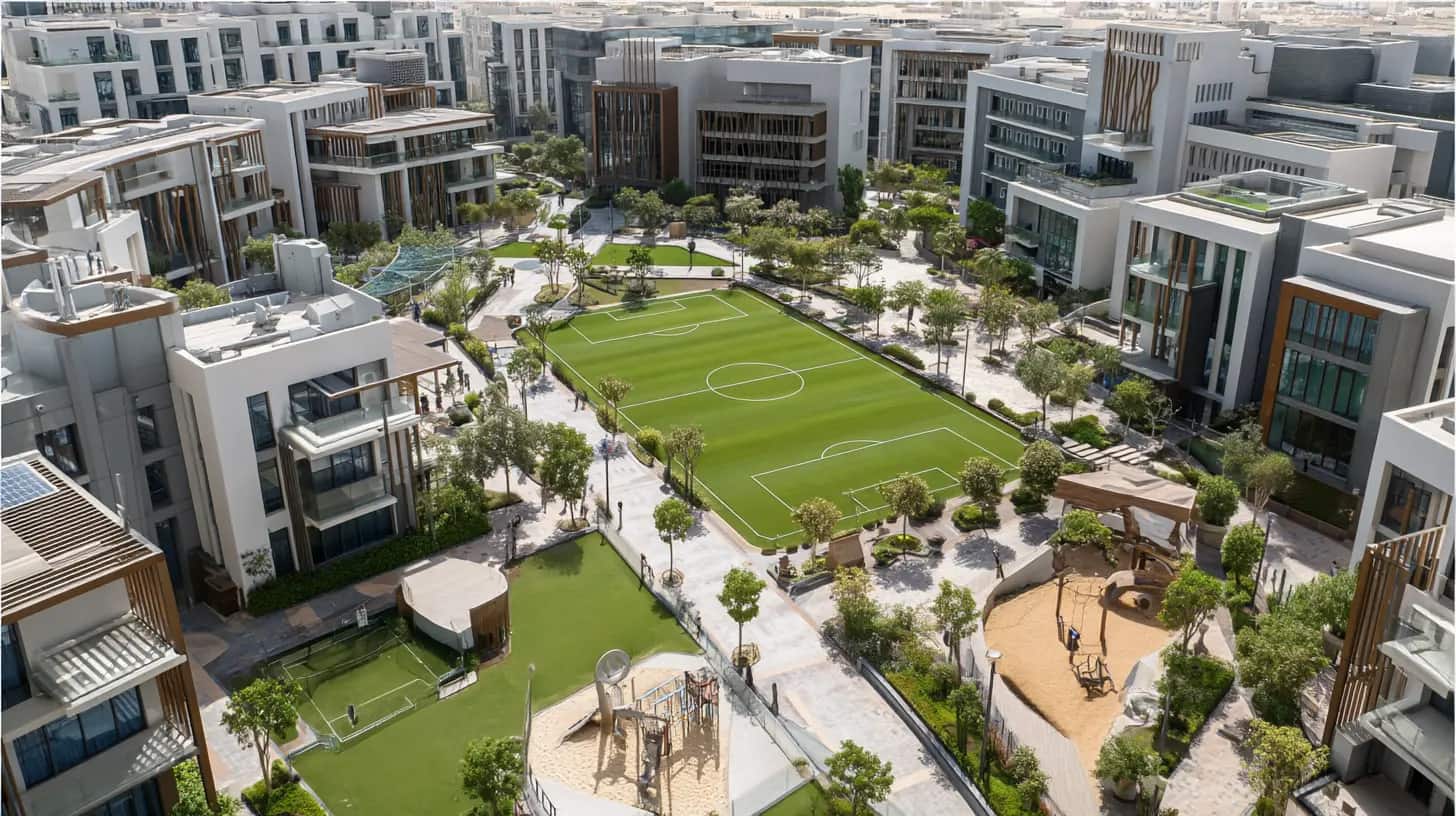
Family-Friendly Areas Near Dubai's Best Schools
Dubai Hills, Arabian Ranches, Jumeirah, Mirdif, Nad Al Sheba. The communities where school access, family infrastructure, and housing costs align best in 2026.
In Dubai, Where You Live and Where Your Kids Go to School Are the Same Decision.
Most cities offer a separation of these two concerns. You pick a neighborhood you like, then find the schools available. It is sometimes successful, sometimes not. At least the decisions are independent of one another.
Dubai does not work like this. At least, not without a great deal of peril. The schools are fragmented by curriculum, cost, school ratings, and waiting lists that have time scales so long that decisions made at the last moment are extremely costly. A family arrives in Dubai. They rent a community they like. Then they discover that every school within commuting distance is either full, unaffordable, or rated too low. Do they have a forty-five-minute commute to school every day? Do they move? Do they do both? In short, yes. The families that succeed in the complex decisions of Dubai's schools and communities are the ones that approach the problem as a unified concern. What schools are important to us? At what cost? What curriculum? Where are the schools? What communities are within commuting distance? What are the costs of those communities? Do they align with our budget? Schools first, community second, housing third. Always.
It's not a simple optimization problem because the landscape of schools in Dubai is genuinely complex. More than 200 schools exist in Dubai, including British, American, Indian (CBSE and ICSE), IB, French, German, and many more curricula. KHDA rates all of these schools on a scale from Outstanding to Inadequate every year. The fees vary from less than 10,000 AED annually in the affordable segment to more than 90,000 AED annually in the top international schools. Waiting lists exist in the top schools that are in demand, which range from one to three years. To top it all off, the geography is spread out in a city where, without a metro system in place, school locations are a practical concern rather than an abstract one.
The article seeks to identify which communities consistently work well for families—i.e., where access to schools, community resources, safety, access to green space, and housing costs all fit together in a coherent way. In addition to that, we will look at five areas in depth, examine the school landscape in these areas, reveal the true costs of housing in these areas, and highlight the trade-offs that are often ignored in the typical list of family-friendly communities.
How Dubai's School System Works
A brief orientation is necessary before the community analysis because the school system structure shapes everything that follows.
Dubai's schools are almost entirely private. There is a small number of government schools, but they are primarily for Emirati students. The private school market ranges from budget international schools with fees below AED 20,000 per year to elite British and American schools charging AED 70,000 to AED 95,000 per year. Most families from professional backgrounds are looking at the AED 40,000 to AED 75,000 range per child per year for a well-rated school.
KHDA ratings are the primary quality signal available to parents. Outstanding and Very Good schools are the target tier for most families making a primary school decision. The ratings are updated annually and are publicly searchable on the KHDA website — checking current ratings before assuming a school's historical reputation is still accurate is essential, as schools move up and down the rating scale.
Curriculum matters for families with international mobility. British curriculum schools (GCSE and A-Level) are the most common and provide the widest global portability. American curriculum (AP and SAT pathway) is the second most common. IB (International Baccalaureate) is offered by a smaller number of schools and is highly portable internationally. Indian curriculum schools serve a large segment of Dubai's population but are primarily relevant for families planning to return to India. French, German, and other European curriculum schools exist for those nationality communities.
Waiting lists are real. The most in-demand schools — GEMS Wellington International, Jumeirah English Speaking School, Dubai College, Repton Dubai — regularly have waiting lists of one to three years for the most popular year groups. Families who have flexibility on curriculum sometimes have more luck approaching schools with shorter lists rather than chasing the most popular names.
According to KHDA's 2024 Annual Report on Dubai Schools, 69% of Dubai's private schools were rated Good, Very Good, or Outstanding in 2024 — a figure that has improved consistently over the past five years as competitive pressure and regulatory oversight have driven quality upward. The full report is worth reviewing for families doing deep school research: KHDA Annual Report 2024.
Dubai Hills Estate: The Strongest In-Community School Offer
Dubai Hills Estate is the community that most cleanly solves the school-proximity problem for families. The masterplan was designed with school infrastructure built in — not as an afterthought but as a founding element of the community proposition.
GEMS Wellington Academy — Al Khail, the Dubai Hills campus of one of Dubai's most respected school brands, sits within the masterplan. It offers British curriculum from Foundation Stage through to A-Level and has been rated Very Good to Outstanding by KHDA in multiple recent inspection cycles. For families who specifically want a British curriculum school that is walkable or a short drive from home, Dubai Hills is one of very few communities in Dubai where that combination is available.
GEMS Metropole School — also within the Dubai Hills masterplan — offers British curriculum at a slightly lower fee point than Wellington, making it accessible to families who want the British system without the top-tier pricing. Both schools have waiting lists for the most popular year groups, but families who are renting or buying in Dubai Hills are prioritised in the admissions process by some schools, which is a genuine practical advantage over families applying from elsewhere.
Beyond the in-community schools, Dubai Hills' central location — roughly equidistant between Downtown Dubai and Dubai Marina — puts several other well-regarded schools within fifteen to twenty minutes by road. GEMS World Academy, which offers IB curriculum and is consistently rated Outstanding, is accessible from Dubai Hills without the worst of Dubai's traffic patterns.
Housing costs in Dubai Hills reflect the premium of the school catchment and community infrastructure. Two-bedroom apartments in well-located buildings run AED 1.6 million to AED 2.8 million. Three-bedroom townhouses sit at AED 3.5 million to AED 5.5 million. Four-bedroom standalone villas start around AED 9 million. Rental equivalents are AED 120,000 to AED 180,000 per year for a two-bedroom apartment, AED 180,000 to AED 280,000 for a three-bedroom townhouse.
Families who buy in Dubai Hills and place children in the community schools report some of the highest residential satisfaction scores in Dubai. The combination of schools, green space, the golf course environment, King's College Hospital within the community, and Circle Mall for daily retail needs has produced a community where families settle for five to ten years rather than moving every two to three. That stability benefits investors through high renewal rates and benefits families through the continuity it creates for children's schooling and social networks.
Browse current Dubai Hills listings across apartments, townhouses, and villas to see what the community offers at different budget levels.
Jumeirah and Umm Suqeim: The Legacy Family Address
Jumeirah — the stretch of residential villas and low-rise apartments running along Dubai's original coast from the Creek to Umm Suqeim — is where Dubai's expat family community has been anchored for thirty years. The schools that define this area's reputation were established here decades before most of Dubai's current communities existed, and they remain among the most respected in the city.
Jumeirah English Speaking School (JESS) — operating on two campuses, Jumeirah and Arabian Ranches — is one of Dubai's most consistently well-regarded British curriculum schools. The Jumeirah campus, on Beach Road, has been educating expat children for over fifty years and maintains a waiting list that reflects its reputation. Very Good to Outstanding KHDA ratings, strong university placement record, a community of alumni families who return their own children — JESS has the kind of institutional depth that newer schools are still building.
Dubai College, rated Outstanding by KHDA, serves secondary students (Year 7 to Year 13) on a selective basis. It is one of Dubai's most academically focused schools and produces consistently strong A-Level results and university placements. Location on Al Sufouh Road puts it within practical reach of families in Jumeirah, Umm Suqeim, and parts of Al Barsha.
Safa British School, on Al Wasl Road, has grown rapidly since opening and is rated Very Good by KHDA. It serves a wide age range and has a more accessible fee point than some of the longer-established schools in the area.
Housing in Jumeirah and Umm Suqeim skews toward villas and low-rise apartments — the area's low-rise residential character has been largely preserved, which is part of its appeal. Older villas in the Jumeirah 1 to Jumeirah 3 strips are available for AED 4 million to AED 10 million depending on size, age, and proximity to the beach. Newer villa developments in Umm Suqeim sit at AED 7 million to AED 20 million. Apartments in Al Wasl and the surrounding streets are available from AED 1.2 million to AED 2.5 million for two-bedrooms.
The area's primary limitation as a family investment is supply constraint — not the positive scarcity kind that supports appreciation, but a relative lack of new product, which can make finding the right home a slower process than in communities with active development pipelines.
Arabian Ranches: The Established Suburban Model
Arabian Ranches is the community that essentially defined Dubai's concept of the family villa suburb. Emaar launched it in 2004 as a golf course-anchored, gated villa community, and it has been one of the emirate's most consistently family-occupied communities ever since. Arabian Ranches I, Arabian Ranches II, and Arabian Ranches III represent three generations of the same concept at evolving price points.
The school anchoring Arabian Ranches is JESS Arabian Ranches — the second campus of the Jumeirah English Speaking School — which opened as the community developed and serves the family population in this part of Dubai. A second notable school in the area is Ranches Primary School (now South View School), a well-regarded option with a more accessible fee point than JESS.
Proximity to Jumeirah English Speaking School has made Arabian Ranches a destination for families who specifically want the JESS experience but can't access housing near the Jumeirah campus. The school's waiting list management has historically given some priority to families in the immediate catchment area, making the address-school connection practically meaningful rather than just geographically convenient.
Three-bedroom villas in Arabian Ranches I — the most established phase — currently transact at AED 4 million to AED 7 million. Arabian Ranches II product sits at AED 4.5 million to AED 8 million. Arabian Ranches III, the newest phase with newer infrastructure, runs AED 4 million to AED 9 million for three and four-bedroom product.
Rental prices in Arabian Ranches reflect the family demand — three-bedroom villa rents run AED 180,000 to AED 280,000 annually, with limited supply at any price point given the community's appeal and the low turnover of long-term family tenants. Investors in Arabian Ranches benefit from exactly the same stickiness that makes Dubai Hills attractive — families who settle stay, and families settle here because the school access and community environment are among the most dependable in Dubai.
Capital appreciation in Arabian Ranches has been strong. Phase I villas that transacted at AED 2.5 million to AED 3.5 million in 2015 to 2018 are now selling at AED 4.5 million to AED 7 million. The combination of supply scarcity on the original phases and ongoing demand from the family market has driven appreciation that outpaces many higher-profile Dubai communities on a total return basis when yield is included.
Mirdif: Family Value at the Most Accessible Price Point
Mirdif doesn't appear on most premium family area lists and that is partly why it deserves space here. It is one of the few communities in Dubai where a family with a combined income of AED 25,000 to AED 35,000 per month can access a three-bedroom villa within practical distance of well-rated schools without spending 60% of their income on rent.
The community sits near Dubai International Airport, which is its most cited drawback — flight noise affects some parts of Mirdif, and families who are noise-sensitive should check flight paths for specific streets before committing. The areas furthest from the flight path are largely unaffected, and the community's generally calm, low-rise residential character compensates for the airport proximity for many families.
The school landscape around Mirdif is solid if not exceptional. Uptown School, a well-regarded American curriculum school, has a strong presence in the area. GEMS Royal Dubai School offers British curriculum in the vicinity. Sharjah American International School is accessible for families who are specifically looking for that curriculum and are comfortable with the Sharjah border proximity.
Housing costs in Mirdif are among the most accessible for villa living in Dubai. Three-bedroom townhouses and semi-detached villas run AED 1.8 million to AED 3 million. Four-bedroom villas sit at AED 2.5 million to AED 4.5 million. Rents for three-bedroom villas run AED 110,000 to AED 160,000 annually — lower than Arabian Ranches or Dubai Hills equivalents by 30% to 50%.
For investors, the yield profile in Mirdif is among the strongest for villa product in Dubai — gross yields of 6% to 8% on villas are achievable where comparable Dubai Hills or Arabian Ranches villas sit at 4% to 6%. The trade-off is lower capital appreciation — Mirdif is not a scarcity market and the community hasn't repriced the way the premium family communities have. It is a yield play rather than a total-return play, and for investors specifically targeting family tenants at accessible price points, it delivers that consistently.
Nad Al Sheba: The New Family Destination
Nad Al Sheba is the community that has attracted the most attention in family-focused real estate conversations over the past two to three years, and the reasons are straightforward. It sits immediately adjacent to Meydan and Mohammed Bin Rashid City, with good road access to Business Bay and Downtown, and it has been developing a school infrastructure that is beginning to match its residential growth.
Hartland International School, rated Very Good by KHDA, is within the Sobha Hartland development that borders Nad Al Sheba and is accessible to families in the wider area. North London Collegiate School Dubai — a branch of the prestigious North London Collegiate School, consistently rated Outstanding — sits in Nad Al Sheba and has rapidly become one of the most sought-after school addresses in the community.
North London Collegiate School Dubai deserves specific mention because it has changed the family demand dynamic for the entire area. Since opening in 2018, the school has established a waiting list comparable to JESS and Dubai College. Families specifically relocating to access the school have bid up villa prices in the surrounding streets, and investor demand from families who want to lock in proximity to the school before the waiting list closes further has been significant.
Housing in Nad Al Sheba reflects this school-driven demand. Three-bedroom villas run AED 4 million to AED 7 million. Four-bedroom product sits at AED 6 million to AED 10 million. The area is still developing, which means both the infrastructure and the housing supply are less mature than Arabian Ranches or Dubai Hills — a risk for some buyers and an opportunity for investors who believe the community will continue to mature around its school anchors.
The community's proximity to the Meydan Racecourse and the Dubai Bling social scene is a secondary attraction for some residents and a matter of indifference to others. What matters most for families is the school access, the villa product, and the improving but still-maturing community infrastructure.
Explore what's available in Nad Al Sheba currently across villa and townhouse product.
Gaia Realty Original Research: Family Community Snapshot, Q1 2026
Based on KHDA school ratings, DLD transaction data, rental registration records, and family resident surveys across five profiled communities as of Q1 2026.
Housing costs and rental yields by community:
- Dubai Hills 2-bed apartment: AED 1.6M to AED 2.8M, gross yield 5.5% to 7%, tenant renewal rate 74%
- Dubai Hills 3-bed townhouse: AED 3.5M to AED 5.5M, gross yield 5% to 6.5%, tenant renewal rate 79%
- Arabian Ranches 3-bed villa: AED 4M to AED 7M, gross yield 4.5% to 6%, tenant renewal rate 81%
- Jumeirah 2-bed apartment: AED 1.2M to AED 2.5M, gross yield 5% to 6.5%, tenant renewal rate 69%
- Mirdif 3-bed villa: AED 1.8M to AED 3M, gross yield 6% to 8%, tenant renewal rate 77%
- Nad Al Sheba 3-bed villa: AED 4M to AED 7M, gross yield 5% to 6.5%, tenant renewal rate 72%
School access quality by community:
- Dubai Hills: Outstanding and Very Good schools within community — GEMS Wellington Academy, GEMS Metropole
- Arabian Ranches: Very Good school within community — JESS Arabian Ranches
- Jumeirah and Umm Suqeim: Outstanding and Very Good schools within 5 minutes — JESS Jumeirah, Dubai College, Safa British School
- Mirdif: Good and Very Good schools within 10 minutes — Uptown School, GEMS Royal Dubai School
- Nad Al Sheba: Outstanding school within community — North London Collegiate School Dubai
Capital appreciation since 2020 by community:
- Dubai Hills villas: 90% to 120%
- Arabian Ranches Phase I villas: 65% to 90%
- Jumeirah villas: 55% to 80%
- Nad Al Sheba villas: 45% to 70%
- Mirdif villas: 30% to 50%
Average family tenancy length by community:
- Arabian Ranches: 4.2 years average
- Dubai Hills: 3.8 years average
- Nad Al Sheba: 3.1 years average
- Jumeirah: 2.9 years average
- Mirdif: 3.5 years average
What the School-Proximity Premium Is Actually Worth
The data above tells a specific story about the relationship between school quality and property values that is worth spelling out explicitly.
Communities with Outstanding-rated schools within the masterplan or within a five-minute drive command meaningful premiums over comparable communities without that access. Dubai Hills and Arabian Ranches consistently achieve rental yields that are lower than their price would suggest in pure yield terms — but the yield compression is offset by dramatically higher tenant retention. A family tenant who has children in a school three minutes' walk from home and has invested two years on a waiting list to get there is not leaving at lease renewal unless something forces them to. That 4.2-year average tenancy in Arabian Ranches is the financial consequence of school stickiness — and it means that the real net yield, accounting for zero vacancy over four-plus years versus multiple vacancies in a high-turnover community, is higher than the gross yield comparison suggests.
For investors, the school-proximity premium is most valuable not as a capital appreciation driver — though it does support appreciation — but as a tenant retention mechanism. Every month of vacancy costs roughly 8% of annual rent income. A community with 81% tenant renewal rates and 4-year average tenancies has structurally lower vacancy costs than a community with 60% renewal rates and 2-year average tenancies, regardless of what the headline gross yields show.
Our property management services cover all of the communities profiled here if you want professional management for a family-tenant investment property.
Questions People Ask About Family-Friendly Areas Near Dubai Schools
Which Dubai community has the best schools overall?
Dubai Hills and Jumeirah are the strongest for school quality within or immediately adjacent to the community. Dubai Hills wins on in-community convenience. Jumeirah wins on the depth of school history and the range of options within a short drive.
How far in advance should I apply to Dubai's top schools?
For the most in-demand schools — JESS, Dubai College, GEMS Wellington, North London Collegiate — apply the moment you know you're moving to Dubai, ideally a year or more in advance. Some families register children at birth for the most competitive year groups.
Does living near a school guarantee admission?
No. Proximity is a factor in some schools' admissions processes but it's not a guarantee. Siblings of current students and children of alumni often take priority. Nationality quotas exist at some schools. Always confirm the admissions policy directly with the school rather than assuming proximity equals access.
Is the British curriculum the best choice for Dubai?
It depends on your family's likely future destinations. British curriculum is the most portable across the Commonwealth and Europe. American curriculum works well for families likely to return to the US or move to American-curriculum countries. IB is the most universally portable but offered by fewer schools. Indian curriculum is most relevant if you're returning to India.
What's the most affordable family community near good schools?
Mirdif offers the best combination of accessible housing costs and reasonable school access for families on tighter budgets. Three-bedroom villas at AED 1.8 million to AED 3 million with decent nearby schools make it the most accessible family community in this analysis.
Are Dubai schools expensive compared to other cities?
Mid-range by international private school standards. Well-rated British curriculum schools in Dubai charge AED 40,000 to AED 65,000 per child per year — broadly comparable to a mid-tier UK independent school but with no boarding fees. Top-tier Dubai schools at AED 75,000 to AED 95,000 are expensive by any standard.
Can I get my child into a good Dubai school without being on the waiting list?
Sometimes. Mid-year vacancies occur and schools fill them quickly. Less popular year groups — Year 10, Year 11, Year 12 — often have more availability than primary years. Curriculum flexibility helps — a family that can consider both British and American curriculum schools has twice the options. And schools rated Good rather than Outstanding often have availability that Outstanding schools don't.
Do school ratings change often in Dubai?
Yes. KHDA inspects every school and publishes updated ratings annually. A school rated Outstanding three years ago may now be Very Good. Always check the current rating, not the historical one. The KHDA website has the most current data.
Is traffic to school a serious daily problem in Dubai?
Yes, in some communities more than others. Jumeirah to school on Al Wasl Road between 7am and 8am is genuinely congested. Arabian Ranches to JESS Arabian Ranches is mostly internal roads and manageable. Dubai Hills to GEMS Wellington is a five-minute internal community drive. Factor commute realism into school and housing choices — a thirty-minute school run twice daily is sixty minutes and two trips worth of fuel and stress.
Does the Golden Visa affect school eligibility in Dubai?
No. All legally resident children in Dubai can access private schools regardless of visa type. The Golden Visa provides residency stability for families buying on the Palm or in higher-value communities, but it doesn't create any school access advantages beyond those available to standard employment visa holders.
Are international schools in Dubai good enough for university entry?
Yes. Dubai's top schools produce graduates who enter top universities globally — Oxbridge, Russell Group, Ivy League, European universities. The university placement records of Dubai College, JESS, Repton Dubai, and GEMS Wellington International are directly comparable to well-regarded UK and US independent schools. The quality is real, not just marketing.
What's the best age to move children to Dubai for schooling?
Before Year 7 is the most common advice. Secondary years — particularly Year 10 onward — are harder to navigate mid-stream, with GCSE and A-Level coursework already in progress. Younger children adapt more readily. Families moving with secondary-age children should specifically research schools that accept mid-GCSE joiners before committing to a move.
School Choice Sets the Rhythm of Family Life in Dubai. Get It Right Early.
The happiest families in Dubai, who stay the longest and have the strongest community ties and a more positive experience of their time in Dubai, are invariably those who made the right choice of school at an early stage of their stay. Not necessarily the best or most exclusive school, not necessarily the most expensive, but the right school for their specific children's needs, in a community where logistics are convenient and easy, and at a cost that does not put undue pressure on their finances.
While the communities mentioned in this article are not the only ones in Dubai where families thrive, they are the ones where the alignment of schools, community, and property is strongest. Dubai Hills has the strongest in-community solution, while Jumeirah has a long-standing history and a reputation for schools, Arabian Ranches has the strongest model of family suburbia, Mirdif has accessibility at its core without compromising on schools, and Nad Al Sheba has a contemporary model with an Outstanding School Catalyst.
All of these communities are successful, and all of them involve compromises on cost, commuting time, infrastructure development, and the long-term appreciation of capital cost. The right choice will depend on budget, curriculum requirements, ages of children, and duration of stay. It will be very different for a family staying for two years with a seven- and a nine-year-old child from a family staying for ten years with young children whose schooling will be finished in Dubai.
What is constant in all of these scenarios is the need for a family to get the schools right first, then the community, and then the property. If they get those three things in the right order, then the rest of the process is manageable, and our team has assisted many families through just that process.
If you want to talk through specific areas and what's available at your budget, reach out and we'll take it from there.
Related stories
Dubai's Established Charm: The Case for Older Homes
In a city focused on the future, I believe the smartest move for many buyers is to look back. Dubai's seasoned communities offer space, character, and surprising value that new builds often can't match.
The True Cost of Owning a Dubai Property
Beyond the purchase price, your annual budget for a Dubai home must account for service charges, utilities, and maintenance. I'll break down every ongoing expense you need to plan for.
Calculating ROI on Dubai Rental Upgrades
As a landlord in Dubai, you can't just follow trends. I'll show you how to calculate the precise ROI of minor property upgrades to genuinely increase your rental yield.
Echoes, in your inbox
One thoughtful email a month. Market insight, new launches, no spam.