

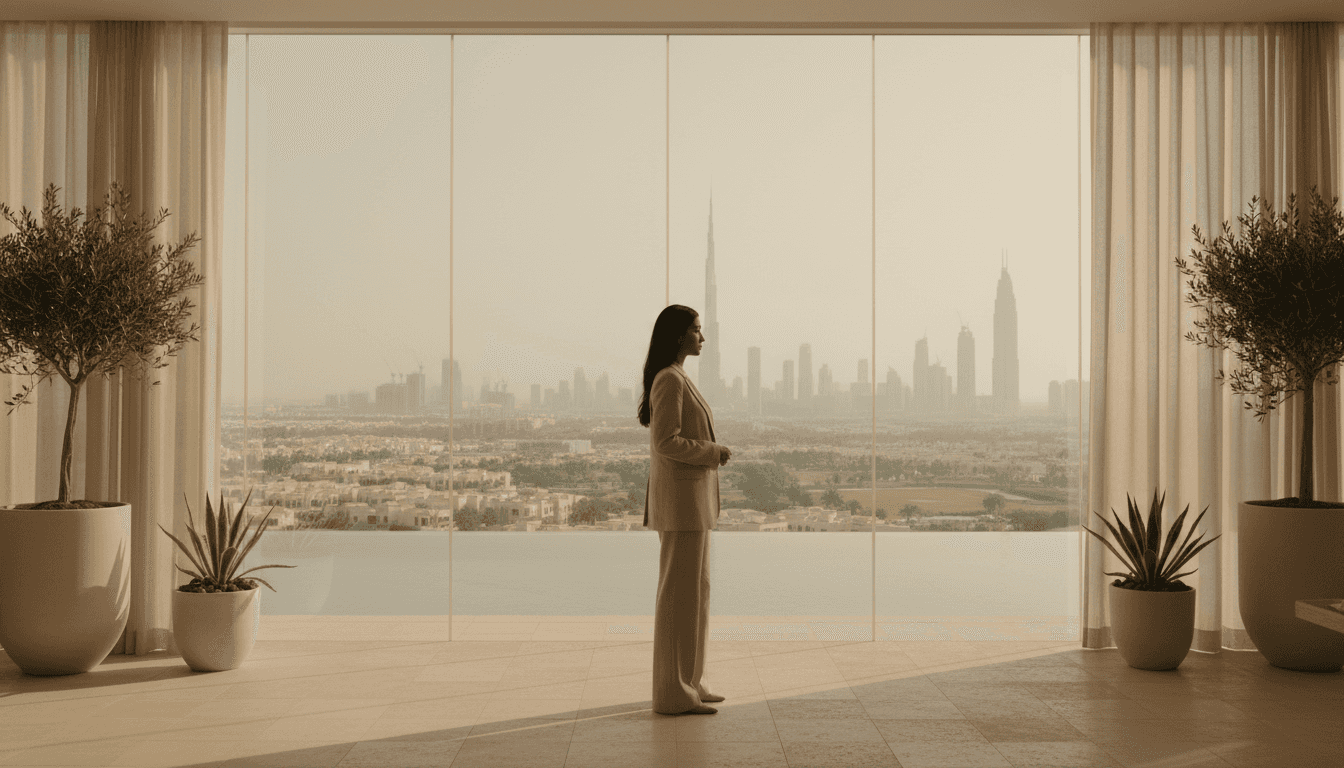
The Education Effect: How Schools Drive Dubai Property
A deep dive into how Dubai's educational zones and school clusters are no longer just a perk, but a primary driver shaping residential demand, rental yields, and property values in the city's key growth corridors.

For decades, the mantra for family homebuyers has been simple: find a good school, then find a house nearby. In Dubai, however, this straightforward formula is evolving into something far more complex and powerful, fundamentally reshaping the city’s residential landscape.
Here's what we'll explore in this analysis:
- The fundamental shift from single-school proximity to the strategic importance of 'Education Corridors'.
- A deep dive into the original academic anchor: Dubai International Academic City (DIAC) and its influence.
- Analysis of the new growth axes, particularly along Al Khail and Sheikh Mohammed Bin Zayed Roads.
- The financial calculus: quantifying the 'school premium' on sales prices and rental yields.
- How master developers like Emaar and Sobha are now hard-wiring education into their community DNA.
- An investor's guide to using these educational ecosystems for stable, long-term returns.
- The future outlook for education-led real estate development in Dubai.
The Old Model vs The New Reality
For many years, the discussion around `school proximity property` value in Dubai was localised. A family moving to the city would identify a desirable school — perhaps one of the established non-profits in Jumeirah or a GEMS flagship campus, and their property search would radiate outwards from that single point. This created intense, hyper-local demand pockets in areas like Umm Suqeim, Jumeirah, and the original Arabian Ranches. While effective, this model was limited. It tethered a family's largest asset to the fortunes and admissions policies of a single institution. If the school's rating slipped or the children couldn't get a place, the primary reason for living there evaporated.
Today, I see a much more sophisticated dynamic at play. The focus has shifted from proximity to a single school to being located within a broader 'Education Corridor'. These are geographic zones, often aligned with Dubai’s major arterial roads, that contain a critical mass of educational institutions. This includes a variety of curricula (British, American, IB, Indian), price points (from affordable to ultra-premium), and levels (from nurseries to universities). This cluster effect provides families with choice and resilience. They are no longer buying into a single school's catchment area, but into an ecosystem of educational opportunity. This is a profound change that significantly de-risks the location decision for long-term residents and homeowners.
This evolution is a direct result of Dubai's strategic urban planning. The development of specialised free zones like Dubai Knowledge Park and Dubai International City's Academic cluster (DIAC) laid the groundwork. Initially, these were seen as standalone commercial hubs. But as the city expanded outwards, these zones became gravitational anchors for new residential master communities. Developers understood that to attract the target demographic for their sprawling villa and townhouse projects — namely, families, they needed more than just a community pool. They needed schools. Not just one, but a portfolio of them. This transformed the role of education from a simple amenity to a core piece of infrastructure, as vital as a road network or a retail centre.
The DIAC Effect: Dubai's First Education Anchor
 Featured project
To understand the power of an academic hub, we only need to look at Dubai International Academic City (DIAC) and its surrounding areas. Launched in 2007, DIAC was a bold vision: a purpose-built free zone dedicated to higher education, attracting global university branch campuses to the heart of Dubai's new growth frontier. Today, it hosts dozens of institutions and over 27,000 students, forming a powerful economic and demographic engine. The immediate impact on the `academic zone real estate` market was clear. Communities like Dubai Silicon Oasis (DSO) and Liwan became the default residential options for thousands of students and faculty members.
This created a distinct rental sub-market. While much of Dubai's rental demand is driven by professional singles or families, the areas around DIAC developed a robust, recession-resistant demand for smaller, more affordable units. Studios and one-bedroom apartments became hot commodities, sought after by students whose families were either overseas or lived in other parts of the UAE. This provided a steady, predictable stream of tenants, which is music to an investor's ears. The `university district property value` in these areas is directly correlated with the academic calendar. At Gaia Living, we see a noticeable spike in rental enquiries for DSO and Liwan from July to September, just ahead of the new academic year. This predictable seasonality is a unique feature of these zones.
However, the DIAC effect extends beyond just the student rental market. It created a 'knowledge economy' ecosystem that attracted a wider demographic. The presence of universities and research centres drew in academics, administrative staff, and professionals in related industries. These are often families who value the intellectual environment and the convenience of a short commute. Consequently, demand grew for larger townhouses and villas in nearby communities. The lesson from DIAC is that a critical mass of educational institutions doesn't just serve its immediate population; it creates a ripple effect, lifting the demographic profile and residential demand in a wide radius. This was the blueprint that would later be replicated, albeit in a more integrated fashion, in Dubai's newer master communities.
The New Education Corridors: Al Khail and MBZ Road
The real story of the last decade has been the emergence of powerful new education corridors along Dubai's main transport arteries, particularly Al Khail Road (E44) and Sheikh Mohammed Bin Zayed Road (E311). This is where the world’s leading school operators have chosen to build their new flagship campuses, and where developers have responded by creating some of the city's most desirable `family-centric communities Dubai`. This symbiotic relationship between schools and developers has been a masterclass in urban planning and has fundamentally defined the character of areas like Al Barsha South, Dubai Hills Estate, and the entire Dubailand district.
Consider the stretch of Al Khail Road from Meydan down to Dubai Hills. Within a 15-minute drive, you have an incredible concentration of top-tier schools: North London Collegiate School, Hartland International, and the new Clarion School campus in Sobha Hartland and Sobha Hartland II; Kings' School Al Barsha and GEMS Dubai American Academy further south. This is not an accident. Developers like Emaar and Sobha Realty understood that to command premium prices for their villas and apartments, they needed to provide access to premium education. They didn't just wait for schools to show up; in many cases, they actively courted them, offering prime land parcels as part of the master plan. The result is a community like Sobha Hartland, which isn't just *near* schools — it is built *around* them.
This clustering has a powerful network effect. A family moving to Dubai Hills Estate isn't just buying proximity to GEMS Wellington Academy; they're buying choice. If their child doesn't get into one school, there are several other excellent options within a short drive. This drastically reduces the stress of school hunting and makes the community far more attractive for the long term. It also creates a distinct lifestyle. The school run becomes a 5-minute drive, not a 45-minute battle with traffic. After-school activities are local. Friends from school live in the same neighbourhood. This creates the 'sticky' community fabric that families crave and are willing to pay a premium for.
We see a similar pattern along the E311/E611 corridors, anchoring communities like Damac Hills and Damac Hills II, Arjan, and Arabian Ranches III. Here, developers have planned for and integrated schools like Jebel Ali School, Safa Community School, and the Royal Grammar School Guildford Dubai. These schools act as crucial anchors, drawing families deeper into Dubai's suburban landscape and underpinning property values in areas that were once considered 'the outskirts'. The presence of these reputable school brands provides a stamp of quality and assurance for buyers, signalling that these are not transient developments but established, long-term communities.
“The conversation has changed. Clients no longer ask 'Is there a good school nearby?'. They now ask, 'What are my school options within a 10-minute drive?'. This shift from a single point of interest to a portfolio of choices is the defining feature of Dubai's modern real estate market.”
Quantifying the 'School Premium': Price, Rent, and Yield
So, what is this proximity to a good education corridor actually worth in monetary terms? While it's difficult to isolate a single variable in a dynamic market, my experience and the data we analyse at Gaia Living point to a clear and quantifiable 'school premium'. This premium manifests in three key ways: higher capital values, stronger rental yields, and lower vacancy rates. For a `Dubai education city property`, the numbers are compelling and offer a clear investment thesis.
In terms of sales prices, properties within a 5-10 minute drive of a top-rated school cluster can command a premium of anywhere from 5% to as high as 15% compared to identical properties further away. Take, for example, a standard four-bedroom villa in a community like Dubai Hills Estate. Its value is significantly enhanced by its proximity to the educational hub within the community and in nearby Al Barsha South. A similar-sized villa in a community with fewer or lower-rated school options, even with comparable amenities, will almost always trade at a discount. This premium is not just a perception; it's a hard-nosed calculation made by buyers who are factoring in the financial and lifestyle costs of a long school run.
To illustrate the real-world costs, let's break down the purchase of a family home in an education-centric community versus a less-connected one. Assume a target property is a 4-bedroom townhouse.
Example Cost Breakdown: 4-Bed Townhouse
- Property in an Education Corridor (e.g., Sobha Hartland):
- Purchase Price: AED 4,500,000
- Dubai Land Department (DLD) Fee (4%): AED 180,000
- Registration Trustee Fee: AED 4,200
- Agency Fee (2% + VAT): AED 94,500
- Total Upfront Cost: AED 4,778,700
- Similar Property in a Less-Connected Area:
- Purchase Price (10% lower): AED 4,050,000
- Dubai Land Department (DLD) Fee (4%): AED 162,000
- Registration Trustee Fee: AED 4,200
- Agency Fee (2% + VAT): AED 85,050
- Total Upfront Cost: AED 4,201,250
The upfront premium is significant, but buyers are often willing to pay it because they see it as an investment in lifestyle and a hedge against the hidden costs of a poor location — fuel, time, and stress. The rental market tells an even clearer story. In these prime school zones, landlords have the upper hand. Demand from families is consistent and less price-sensitive, especially at the start of the academic year. A townhouse in Arabian Ranches that is a short walk from Ranches Primary School will rent faster and for a higher price than an identical unit on the other side of the community. This translates directly into better rental yields and, crucially, shorter void periods between tenants. For an investor, a property that is vacant for only two weeks a year instead of six can make a material difference to the net return.
Developer Strategy: Education as Critical Infrastructure
The most forward-thinking developers in Dubai no longer view schools as an afterthought or a box-ticking exercise. They see education as a fundamental piece of community infrastructure, as essential as roads, parks, and retail. Master planners like Emaar Properties, Nakheel, and Sobha Realty now embed educational facilities deep into the DNA of their projects from the earliest design stages. This represents a strategic pivot from simply building houses to curating entire lifestyles, with education at the core.
Sobha Hartland is perhaps the best example of this integrated approach. The developer, Sobha Realty, allocated prime land within the master plan specifically for two high-end schools, North London Collegiate and Hartland International. This wasn't a reactive move; it was a proactive strategy to define the character of the community and attract their target demographic of affluent families. By placing the schools at the heart of the community, they created a powerful unique selling proposition. Residents can genuinely live, work, and educate their children within a single, cohesive environment. This level of integration creates immense 'stickiness' — families who move there are less likely to leave, which leads to a stable community and protects long-term property values.
Emaar's approach in communities like Dubai Hills Estate and Arabian Ranches follows a similar logic. They partner with renowned education providers like GEMS Education to establish schools directly within their developments. This does two things. First, it provides residents with an immediate, tangible amenity that improves their quality of life. Second, it acts as a powerful marketing tool, giving the community a stamp of credibility and family-friendliness. When you browse properties for sale in these areas, the proximity to a 'Very Good' or 'Outstanding' KHDA-rated school is often the lead selling point. This developer-led integration is a win-win: schools get access to a ready-made population of students, and developers get a powerful anchor that drives sales and enhances the value of their entire project.
We are also seeing this strategy play out in the city's ambitious new mega-projects. For developments like The Oasis by Emaar or the redevelopment of areas like Mina Rashid Yachts, the inclusion of educational facilities is a non-negotiable part of the plan. It’s a clear signal that these projects are being designed for long-term residents, not just transient investors. This is a mature approach to city-building that recognises that sustainable communities are built on social infrastructure, not just physical structures. For buyers, this means that investing in a new launch within these master plans comes with a greater degree of confidence that the community will thrive and hold its value over the long run.
The Investor's Playbook for Education Zones
For property investors, these education-driven ecosystems present a clear and compelling opportunity, but success requires a nuanced strategy. It's not as simple as just buying any property near a school. The savvy investor looks at the specific dynamics of the educational hub to identify the most lucrative investment profile. I generally advise our clients at Gaia Living to consider two distinct strategies: the family rental market and the student rental market.
Strategy 1: The Family Rental Market This strategy focuses on larger properties — three-to-five-bedroom townhouses and villas, located in established master communities that are rich in schools. The target tenant is the classic Dubai expatriate family, often on a corporate housing allowance, for whom school choice is the number one priority.
- Target Locations: Dubai Hills Estate, Sobha Hartland, Arabian Ranches (I, II, and III), Damac Hills.
- Key Success Factors:
- Proximity to Multiple Schools: The property should be within a 10-15 minute drive of at least two or three reputable schools with different curricula.
- Community Amenities: Families look for more than just a house. Parks, playgrounds, community pools, and local retail are essential.
- Property Layout: A practical layout with a maid's room, a small garden, and good storage is highly valued.
- Long-Term Horizon: This is a capital appreciation play as much as a yield play. These communities are designed for stability, and values tend to grow steadily over time.
Strategy 2: The Student and Faculty Rental Market This is a yield-focused strategy centred on the `university district property value` proposition. The goal is to acquire smaller, more affordable units that cater to the transient but large population of students and university staff.
- Target Locations: Dubai Silicon Oasis, Liwan, Arjan, and specific buildings in Dubai Science Park.
- Key Success Factors:
- Unit Type: Studios and one-bedroom apartments are the most in-demand.
- Proximity to Campus: The closer to DIAC or Dubai Knowledge Park, the better. Walkability is a huge plus.
- Affordability: This is a budget-conscious market. Keeping the rental price competitive is key to high occupancy.
- Furnishing: Offering a furnished option can significantly increase rental income and appeal, as many students are international and don't want the hassle of buying furniture.
- Management: This market can have higher turnover. Using a professional property management service is crucial to handle contracts, maintenance, and finding new tenants efficiently.
Regardless of the strategy, the underlying principle is the same: you are investing in a property that is supported by a resilient, non-cyclical source of demand. While corporate relocations can fluctuate with economic cycles, the need for education is constant. This makes properties in well-planned education corridors some of the most defensive real estate assets you can own in Dubai.
The Future: Hyper-Integration and Niche Specialisations
Looking ahead, I believe the link between education and real estate in Dubai will only become stronger and more integrated. The model of building a community and then adding a school is already being superseded by a more holistic approach where the educational offering itself defines the community's identity. We're moving towards an era of hyper-integration and specialisation.
One major trend I anticipate is the rise of communities built around specialised educational philosophies. Imagine a master community anchored by a leading arts and design university, with residential offerings, galleries, and studio spaces tailored to a creative demographic. We see early signs of this around the Dubai Design District (d3). Similarly, a community could be built around a world-class sports academy, attracting families passionate about athletic development, or a technology-focused institution, creating a hub for STEM families. This creates powerful niche markets and allows developers to differentiate themselves in a competitive landscape.
The role of technology will also be transformative. With the growth of hybrid learning models, the definition of 'proximity' may evolve. However, the need for physical campuses for collaboration, socialisation, and specialised facilities remains. I foresee universities and schools becoming even more integrated into mixed-use developments, blurring the lines between campus and community. A university building might sit atop a retail podium, next to a co-working space and residential apartments, creating a truly vibrant, 24/7 environment. This is already happening in major global cities and is a logical next step for Dubai.
Finally, government initiatives like the Golden Visa will continue to fuel this trend. By providing a clear path to long-term residency for talented students and professionals, the UAE government is encouraging families to put down deeper roots. This long-term mindset makes the decision of where to live and educate children more critical than ever. Families are no longer just looking for a two-year rental; they are planning for a decade or more. This long-term outlook places an even greater premium on stable, well-serviced, education-rich communities, ensuring that the 'Education Effect' will remain a primary driver of the Dubai property market for years to come.
The most resilient and valuable residential properties in Dubai's future will be those embedded within comprehensive educational ecosystems. For both end-user families and long-term investors, the strategy is no longer about finding a home near a school, but about buying into a community where education is a foundational pillar of its value and lifestyle offering.
Sources
- Dubai Land Department (DLD): dubailand.gov.ae
- Knowledge and Human Development Authority (KHDA): Part of the Government of Dubai portal dubai.ae
- UAE Government Official Portal: u.ae
Questions, answered
- Does living near a school really increase property value in Dubai?
- Yes, properties located within a short drive of reputable schools and educational hubs consistently command higher prices and rental rates. This 'school premium' can range from 5% to over 15% compared to similar properties further away, reflecting strong demand from family-centric tenants and buyers.
- Which are the best residential areas in Dubai for families with school-going children?
- Family-centric communities like Sobha Hartland and Sobha Hartland II, Arabian Ranches, and the areas around Al Khail Road are highly sought after. They offer a mix of high-quality housing and proximity to multiple well-regarded British, American, and IB curriculum schools.
- What is Dubai International Academic City (DIAC)?
- DIAC, along with Dubai Knowledge Park, forms a major educational free zone hub hosting dozens of international university branch campuses and vocational institutes. It creates a significant rental market driven by students and faculty, influencing property demand in nearby communities like Liwan and Dubai Silicon Oasis.
- Are properties near universities a good investment in Dubai?
- Yes, investing in smaller units like studios and one-bedroom apartments near university hubs like DIAC can be a sound strategy. These properties attract consistent rental demand from a large student population, often leading to stable yields and high occupancy rates.
- How much are KHDA school fees in Dubai?
- School fees in Dubai vary widely, from as low as AED 2,500 per year in some Indian curriculum schools to over AED 100,000 per year in premium international (IB or British) schools. The Knowledge and Human Development Authority (KHDA) publishes official fee structures for all private schools on its website.
- What is the impact of the Golden Visa on Dubai's education sector?
- The Golden Visa programme has encouraged more families to establish long-term residency in Dubai, increasing the demand for high-quality schooling. This long-term commitment supports stable enrolment for schools and sustained demand for family homes in well-serviced communities, further solidifying the link between education and real estate value.
Omar tracks the announcements that move the market — new launches, regulation, mega-projects, and developer moves — and tells you what they actually mean for buyers.
Related stories
Beyond the Blueprint: The Retail Value Multiplier
It's a simple truth of Dubai real estate: proximity to quality retail and leisure isn't just a perk, it's a powerful driver of property value. I'll explain how operational hubs are creating measurable premiums for investors and residents.
Your Dubai Home Setup Guide
A step-by-step guide for new Dubai homeowners on connecting utilities, setting up essential services, and integrating into your new community.

The Productive Address in Dubai
The line between home and work has blurred for good. Discover the Dubai properties and communities designed for the focus, flexibility, and balance that modern professionals demand.
Echoes, in your inbox
One thoughtful email a month. Market insight, new launches, no spam.