

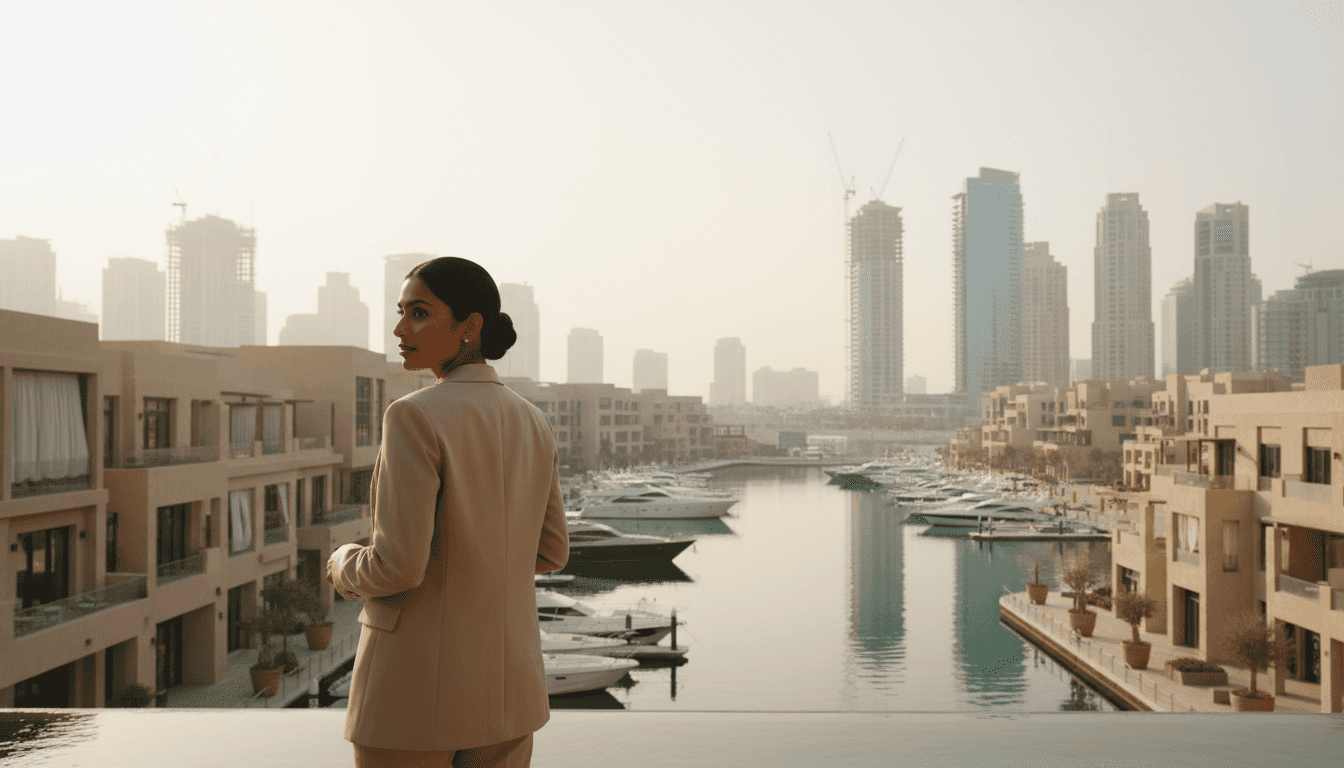
Beyond the Blueprint: The Retail Value Multiplier
It's a simple truth of Dubai real estate: proximity to quality retail and leisure isn't just a perk, it's a powerful driver of property value. I'll explain how operational hubs are creating measurable premiums for investors and residents.

In the early days of Dubai's freehold market, the mantra was simple: build it and they will come. A residential tower was an asset in itself. Today, the market has matured. A home is no longer just a collection of rooms; it's a node in a lifestyle network. And the most powerful force shaping that network — and the values within it, is the operational retail and leisure hub.
Here's what we will explore:
- The shift from 'proximity' to 'integration' as the key value driver.
- Case studies of master developers like Emaar and Nakheel who have perfected this model.
- The measurable 'ripple effect' on adjacent, more affordable communities.
- A cost breakdown of investing in these premium, amenity-rich areas.
- My verdict on where the next wave of opportunity lies for savvy investors.
The New Premium: From Proximity to Integration
For years, real estate professionals have talked about the 'proximity premium'. The logic was straightforward: a property near a major landmark, like the Mall of the Emirates, would naturally command a higher price. When the mall opened in 2005, it had a transformative effect on the surrounding areas, particularly Al Barsha. It provided a focal point, an amenity anchor that made the entire neighbourhood more desirable. This was the first-generation model of Dubai retail impact property — value by association. But it was a relatively passive relationship. You lived *near* the mall, but you still had to get in your car to go there. The residential and retail components were distinct entities.
Today, that model has been superseded by something far more powerful: integration. The most successful and value-accretive developments are no longer just *near* amenities; they are interwoven with them. The new premium isn't about a short drive; it's about a short walk. It’s about a smooth transition from your front door to a curated world of dining, shopping, and entertainment. This shift is fundamental to understanding modern Dubai property lifestyle growth. A developer's glossy brochure promising a future 'retail centre' is met with healthy scepticism. The market has seen enough empty retail strips and delayed projects to know that a blueprint is not a business. The value is only unlocked when the hub is operational, tenanted, and drawing footfall. It’s the difference between a promise and a tangible, daily-use asset.
Consider the evolution. We went from standalone communities near standalone malls (Al Barsha and Mall of the Emirates) to more connected concepts like Dubai Marina with its Marina Mall and waterfront promenade. This was a step forward, blending lifestyle and living more closely. But the true masters of the integrated model are now creating entire micro-cities. Think of Bluewaters Island by Meraas. The residential buildings are not just 'near' the retail and dining concepts; they are part of the same pedestrianised ecosystem. This creates a stickiness and a lifestyle quality that you simply cannot replicate in older, car-dependent neighbourhoods. Residents are not just buying an apartment; they are buying into a managed, walkable, and vibrant destination. This is where we see the most significant and sustainable value uplift.
Case Study: The Emaar Effect in Dubai Hills Estate
 Featured project
If you want to see the integrated model executed to perfection, look no further than Emaar Properties and their flagship master community, Dubai Hills Estate. When it was first launched, the central proposition was a golf course community with high-quality villas and apartments. The promise of a future mall was part of the master plan, but for early investors, it was a distant concept. For years, the community's primary appeal was its green space, its location, and the Emaar brand. Property values were solid, but they were benchmarked against other high-end villa communities like Arabian Ranches.
Then, in 2021, Dubai Hills Mall opened. It was not just another mall. It was a thoughtfully designed, bright, and family-friendly destination with a direct link to the central park. Its opening was the catalyst that transformed the perception and valuation of the entire community. Suddenly, Dubai Hills Estate was not just a quiet suburban enclave; it was a complete, self-sustaining town. Residents could walk from their homes in Park Heights or Collective to a world-class retail and entertainment hub. This had a direct, measurable impact on both sales prices and rental demand. Apartments that previously competed with those in more remote communities now commanded a premium. The mall became the gravitational centre of the community, cementing its status as one of Dubai's most desirable addresses for families.
The data, even observed anecdotally, is compelling. Before the mall's full operational impact was felt, a two-bedroom apartment in a mid-rise building might have traded for around AED 1.4 million. Today, that same apartment can easily command AED 2.2 million or more. Villas saw a similar, if not more pronounced, surge. The key takeaway for any investor is that Emaar didn't just build a mall; they delivered the final, critical piece of the lifestyle puzzle they had promised years earlier. This delivery on the master plan is what underpins long-term leisure district property value. The premium is not speculative; it's based on a tangible, daily enhancement to residents' lives. This is a crucial lesson for anyone evaluating off-plan launches that promise future retail amenities. The developer's track record of actually delivering these complex commercial assets is paramount.
Case Study: Nakheel's Palm Jumeirah Transformation
While Emaar was perfecting its suburban model, Nakheel was applying the same principles to its iconic urban island, Palm Jumeirah. For over a decade, the Palm was defined by its luxury villas, shoreline apartments, and the Atlantis resort. It was a world-famous address but, for its residents, it lacked a central, convenient retail and community core. Daily necessities often required a drive off the island. Nakheel recognised this gap and strategically began retrofitting the island with the very lifestyle infrastructure it needed to mature.
The first major move was the opening of Nakheel Mall at the heart of the Palm's trunk. Connected via a pedestrian walkway to The Pointe (a waterfront dining destination which is now being redeveloped), and served by the Palm Monorail, it instantly created a new focal point. Residents of the shoreline apartments, previously isolated in their respective buildings, could now walk to a supermarket, cinema, and dozens of shops and restaurants. This dramatically improved the 'livability' of the Palm. It was no longer just a beautiful place to live; it became a convenient one. This had a direct impact on the value of the trunk's apartments, firming up prices and making them far more attractive to both end-users and long-term tenants.
Following this, Nakheel continued to layer in amenities. The Palm West Beach development transformed a previously underused stretch of coastline into one of Dubai's most popular beachfront promenades, lined with chic beach clubs and restaurants. This provided another powerful anchor, particularly for the properties on the western side of the trunk. What Nakheel has demonstrated is that even a globally recognised, mature development can find another gear of value growth by strategically adding lifestyle hubs. For an investor, the lesson is clear: look for established areas where master developers are actively upgrading the community infrastructure. The value uplift in these retrofitting scenarios can be just as potent as in a brand-new master plan. It’s a sign of the idea that the work of creating a community is never truly finished.
The Ripple Effect: How Hubs Influence Adjacent Areas
One of the most fascinating dynamics in the Dubai property market is the 'ripple effect'. When a major lifestyle hub is successfully launched, its positive impact is not confined to the immediate master community. The gravitational pull of the new amenity extends outwards, lifting the appeal and, consequently, the values of adjacent, often more affordable, neighbourhoods. This creates a secondary wave of investment opportunities for those who can spot the trend early. It's a classic case of a rising tide lifting all boats, and it's a key strategy for investors looking for growth beyond the premium core.
The clearest example of this today is the impact of Dubai Hills Estate on its neighbours. As prices within Dubai Hills began to climb, driven by the success of the mall and the overall quality of the community, buyers and renters seeking a similar location but at a more accessible price point began looking at the areas immediately surrounding it. Communities like Arjan, Dubai Science Park, and even parts of Al Barsha South suddenly became much more attractive. They offered proximity to the coveted Dubai Hills lifestyle — the mall, the park, the hospital, without the premium price tag. Developers in these areas were quick to capitalise, launching new projects that marketed themselves based on their short drive to Dubai Hills.
This is not just a marketing gimmick; it's a real value driver. A few years ago, Arjan was a developing area with a handful of completed buildings and a lot of potential. Now, thanks in part to its proximity to the fully-realised ecosystem of Dubai Hills, it's a thriving community in its own right, with its own growing retail landscape. An investor who bought an apartment in Arjan five years ago has benefited significantly from the 'borrowed' amenity value of Dubai Hills. We see a similar pattern elsewhere. The established communities of The Springs and Meadows have long benefited from their proximity to the amenities along Sheikh Zayed Road, and newer communities are learning from this. This ripple effect is a crucial factor for investment near entertainment hubs. Sometimes the smartest play is not to buy at the epicentre, but in the immediate orbit where the growth trajectory is steepest.
Quantifying the Premium: A Cost Breakdown
It's all well and good to talk about a 'premium', but what does that look like in concrete financial terms? Let's analyse the real costs and potential returns of investing in a community with an integrated retail hub versus one without. While precise figures are always in flux, we can work with realistic, representative numbers to understand the mechanics.
Let's compare two hypothetical, yet typical, two-bedroom apartments of around 1,200 sqft:
- Apartment A: Located in a premium master community with a walkable, high-quality mall and leisure hub (e.g., Dubai Hills Estate or Creek Harbour).
- Apartment B: Located in a decent, standalone community with basic amenities but requiring a drive to any significant retail or entertainment (e.g., a well-maintained but isolated tower in JVC or Dubai Production City).
Here's how the initial investment might stack up:
- Purchase Price (Apartment A): AED 2,200,000
- Purchase Price (Apartment B): AED 1,500,000
The initial outlay for Apartment A is substantially higher. This is the 'lifestyle premium' in action. Now, let's look at the associated purchasing costs, which are a percentage of the purchase price. According to the Dubai Land Department (DLD), the transfer fee is a standard 4%.
Upfront Cost Breakdown (Apartment A): - Purchase Price: AED 2,200,000 - DLD Transfer Fee (4%): AED 88,000 - DLD Registration Trustee Fee: ~AED 4,200 (including VAT) - Agency Fee (2% + VAT): AED 46,200 - Total Upfront Cost: AED 2,338,400
Upfront Cost Breakdown (Apartment B): - Purchase Price: AED 1,500,000 - DLD Transfer Fee (4%): AED 60,000 - DLD Registration Trustee Fee: ~AED 4,200 (including VAT) - Agency Fee (2% + VAT): AED 31,500 - Total Upfront Cost: AED 1,595,700
Now, let's consider the operational side: service charges and rental income. Premium communities often have higher service charges due to superior landscaping, security, and maintenance. However, they also command significantly higher rents. Let's assume service charges for Apartment A are AED 20 per sqft and for Apartment B are AED 15 per sqft.
- Apartment A Annual Service Charge: 1,200 sqft * AED 20/sqft = AED 24,000
- Apartment B Annual Service Charge: 1,200 sqft * AED 15/sqft = AED 18,000
And the crucial rental income:
- Apartment A Expected Annual Rent: AED 150,000
- Apartment B Expected Annual Rent: AED 100,000
Let's calculate the gross and net rental yield. The net yield gives us a truer picture by accounting for service charges.
- Apartment A Net Rental Income: AED 150,000 - AED 24,000 = AED 126,000
- Apartment A Net Yield: (AED 126,000 / AED 2,338,400) * 100 = 5.39%
- Apartment B Net Rental Income: AED 100,000 - AED 18,000 = AED 82,000
- Apartment B Net Yield: (AED 82,000 / AED 1,595,700) * 100 = 5.14%
In this realistic scenario, the net yields are quite comparable. The higher rent in the premium community effectively compensates for the higher purchase price and service charges. However, this calculation omits the most important factor: capital appreciation. In a stable or rising market, properties like Apartment A, anchored by irreplaceable lifestyle infrastructure, tend to appreciate faster and hold their value better during downturns. The demand is stickier, the tenant profile is often stronger, and the supply of truly integrated communities is limited. This is the core of the investment thesis: you are paying a premium not just for yield, but for resilience and superior growth potential. The Dubai retail impact property thesis is proven not just in rental income, but in the long-term asset value.
“The conversation has shifted. Investors no longer ask 'Where is the nearest mall?'. They ask 'Can I walk to a great coffee shop? Is there a park for my kids? Can I have dinner without starting my car?'. The value is in the ecosystem, not just the unit.”
The Investor's Checklist: Identifying Future Hotspots
So, how does an investor apply these lessons to find the next area of opportunity? It's about looking beyond the current state and analysing the master plan through the lens of lifestyle delivery. It requires separating marketing promises from credible, funded development plans by proven players.
Here is a checklist I use when evaluating investment near entertainment hubs and retail developments:
- Developer Track Record: Is the master developer known for delivering high-quality, successful commercial and retail assets? A residential developer dabbling in retail is a much higher risk than a proven ecosystem-builder like Emaar, Nakheel, or Aldar.
- Integration, Not Just Proximity: Scrutinise the master plan. Are the residential areas connected to the retail hub via pleasant, shaded, pedestrianised pathways? Or is it separated by a six-lane road? True integration is the goal.
- Phasing and Delivery: When is the retail hub scheduled for completion relative to the residential handovers? A long delay between moving in and the amenities opening can suppress rental income and initial capital growth.
- Curation and Tenant Mix: What is the planned quality of the retail? Is it a generic community centre or a destination with flagship brands, unique F&B concepts, a cinema, and family entertainment? The quality of the offering dictates its pulling power.
- The Ripple Effect Potential: If the core community is already pricing at a premium, look at the adjacent areas. Is there a developing community next door that will benefit from the new infrastructure? Buying in this 'ripple zone' can offer a lower entry point with strong growth potential.
- Infrastructure and Connectivity: How does the community connect to the rest of Dubai? Is it close to a major highway? Is there metro or monorail access? A great internal community that is isolated from the wider city will always have a ceiling on its value.
Applying this checklist to the current market reveals several areas of interest. The obvious ones are the ongoing developments in places like Dubai Creek Harbour, which is set to have a monumental retail offering. But I'm also watching the evolution of areas like the Dubai Islands (formerly Deira Islands) by Nakheel. The scale of the ambition there is enormous, with plans for a huge mall and extensive waterfront retail. Early investors who get in before these hubs are fully operational could see significant upside, provided Nakheel delivers on its vision with the same quality as it did on the Palm.
My Verdict: Where to Look Now
In my view, the era of speculative, blueprint-based investing is drawing to a close in Dubai's mature market. Sustainable value is being created by developers who understand that they are not just building properties, but curating lifestyles. The operational retail and leisure hub is the engine of this new value creation model.
For investors today, this presents a two-tiered opportunity. The first is to buy into established, premium communities where this model is already proven. Places like Dubai Hills Estate, City Walk, and Bluewaters Island will continue to command a premium because their lifestyle offering is a known, high-quality commodity. These are resilient, blue-chip real estate investments that offer stable yields and solid, long-term capital preservation. The price of entry is high, but so is the quality of the asset.
The second, and perhaps more exciting, opportunity lies in identifying the next generation of these integrated communities. This requires more research and a greater appetite for risk, but the potential rewards are higher. This means looking at projects by developers with a proven track record of delivering not just the residential units, but the entire master plan ecosystem. It means focusing on projects where the retail and leisure components are not an afterthought, but a core part of the value proposition from day one.
The most reliable indicator of future residential value in Dubai is no longer just location, but the quality and accessibility of the surrounding lifestyle ecosystem. Investors should prioritise communities where a walkable, high-quality, and operational retail and leisure hub is a central, integrated feature. This is the defining characteristic of premium, resilient real estate in the city's next chapter.
At Gaia Living, we are constantly analysing these trends, guiding our clients to differentiate between a simple property and a genuine lifestyle investment. The blueprint is only the beginning; the real value is in what happens after the construction crews leave and the community comes to life.
Sources
- Dubai Land Department (DLD): https://dubailand.gov.ae/en/
- Real Estate Regulatory Agency (RERA): Part of the DLD website.
- UAE Government Portal: https://u.ae/en
Questions, answered
- Does being near a mall in Dubai always increase property value?
- Not automatically. The biggest value uplift comes from proximity to high-quality, operational and well-integrated retail and leisure hubs that offer a complete lifestyle experience, not just shopping. Walkability and the quality of the destination are key factors.
- Which communities in Dubai have seen the best value growth from new retail hubs?
- Communities like Dubai Hills Estate (with Dubai Hills Mall) and Palm Jumeirah (with Nakheel Mall and The Pointe, before its redevelopment) have seen significant, sustained value appreciation directly linked to these lifestyle destinations. Newer areas like Dubai Islands are poised for similar growth.
- What is the 'ripple effect' in real estate?
- This is when the value increase in a prime community, driven by a new amenity like a mall, 'ripples' outwards to adjacent, more affordable communities. For example, the success of Dubai Hills has positively impacted the value and appeal of nearby areas like Arjan and Dubai Science Park.
- How much can a new mall increase nearby property prices?
- While there's no fixed percentage, well-executed, integrated lifestyle hubs can create a value premium of 15-30% or more for the most connected properties compared to similar real estate further away. The effect is most pronounced in master communities where the developer controls the entire ecosystem.
- Is it a good investment to buy property near a planned mall in Dubai?
- It can be, but it carries more risk. The value uplift is only truly realised when the mall is operational and successful. Investing 'on the blueprint' requires strong faith in the developer's ability to deliver a high-quality, popular destination on schedule.
- How do service charges in communities with large retail hubs compare to others?
- Service charges are not directly inflated by the retail hub itself, as it's a commercial asset. However, these master communities often have higher-end landscaping, security, and amenities, which can lead to service charges in the range of AED 16-25 per sqft, reflecting the premium environment.
Omar tracks the announcements that move the market — new launches, regulation, mega-projects, and developer moves — and tells you what they actually mean for buyers.
Related stories
Your Dubai Home Setup Guide
A step-by-step guide for new Dubai homeowners on connecting utilities, setting up essential services, and integrating into your new community.

The Productive Address in Dubai
The line between home and work has blurred for good. Discover the Dubai properties and communities designed for the focus, flexibility, and balance that modern professionals demand.
The Mortgage Effect: Your Guide to Dubai Rental Yields
Financing is the engine of your property investment. As a yield analyst, I'll walk you through how different mortgage structures can either supercharge your net cash flow or quietly erode your returns in the Dubai market.
Echoes, in your inbox
One thoughtful email a month. Market insight, new launches, no spam.