

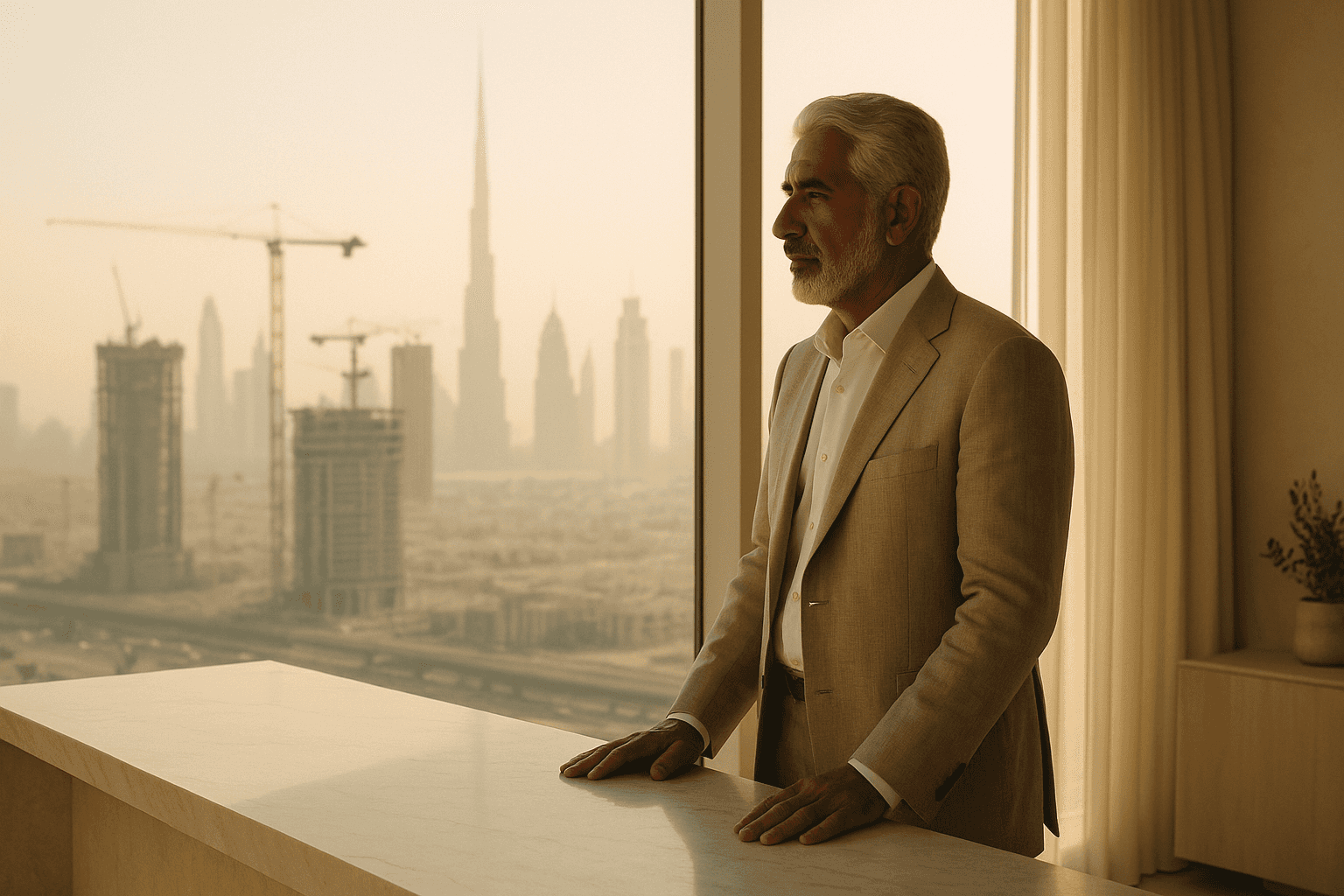
From Desk to Dwelling: Converting Dubai's Offices
As flexible work reshapes Dubai's commercial landscape, the glut of older office stock presents a complex but compelling case for residential conversion. I explore the real opportunities, costs, and challenges for investors.

The narrative around the future of the office is often oversimplified. In Dubai, it’s not a story of universal decline but one of profound divergence, where the rise of flexible work is creating both winners and losers in the commercial property sector. This bifurcation presents one of the most intriguing, if challenging, investment theses for the decade ahead: the large-scale **Dubai commercial property conversion** of underperforming office assets into much-needed homes.
Here is what I will explore in this analysis:
- The dual nature of Dubai's office market: a tale of two realities.
- Identifying the ideal candidates for residential conversion.
- The legal and regulatory maze: navigating zoning and permits.
- A deep dive into the real costs, with a line-by-line breakdown.
- Pinpointing the Dubai districts with the most conversion potential.
- Understanding the residential demand side of the equation.
- The significant risks and potential rewards for institutional investors.
- My final verdict on whether this is a viable strategy for Dubai's future.
The Great Office Market Bifurcation
To understand the conversion opportunity, you first have to grasp the current state of office demand shifts in Dubai. It’s a split market. On one side, you have premium, Grade A office towers in prime locations like the DIFC, Downtown Dubai, and certain parts of Business Bay. These buildings are experiencing record-low vacancy rates and climbing rents. The post-pandemic 'flight to quality' is real; large corporates, legal firms, and financial institutions are consolidating into high-spec, amenity-rich buildings that help them attract and retain top talent. These buildings offer large, efficient floor plates, advanced technology, high environmental standards (ESG), and a prestigious address. They are not candidates for conversion; they are the gold standard of Dubai's commercial real estate.
On the other side of the divide, you have a vast stock of older, Grade B and C office buildings. These are typically located in secondary business districts, might be 10-20 years old, and often suffer from smaller, less efficient floor plates, dated facilities, inadequate parking, and lower-quality management. Many of these buildings were developed speculatively during previous building booms and are now struggling to compete. The rise of hybrid work and the proliferation of co-working spaces Dubai has hit this segment hard. A small business that might have once rented a 1,500 sqft office in JLT or Barsha Heights can now opt for flexible desks or a private office in a modern co-working hub, avoiding a long lease and significant capital outlay. This has hollowed out demand for small to mid-sized units in older towers, leading to persistent vacancies and stagnant rents.
This is where the opportunity lies. We have a structural oversupply of a specific type of commercial asset (older, secondary offices) coexisting with a structural undersupply of mid-market residential property in central, well-connected locations. The logical conclusion is to bridge this gap through conversion. However, logic and financial viability are two different things. A building that is failing as an office is not automatically destined for success as an apartment block. The process is fraught with technical, financial, and regulatory challenges that can quickly derail an underprepared investor. At Gaia Living, we see the potential, but we also advise our institutional clients to approach this with extreme caution and rigorous due diligence. The rewards can be significant, but the path is anything but straightforward.
Anatomy of a Conversion Candidate
 Featured project
So, what separates a promising conversion project from a financial black hole? It’s not simply about finding the cheapest, most vacant office building. A specific set of characteristics must align. First and foremost is location. The old real estate adage holds truer here than anywhere: location, location, location. An office building in a desolate industrial park is unlikely to succeed as a residential tower, no matter how cheap the conversion. The ideal candidate is situated in a mixed-use community with existing residential infrastructure: nearby supermarkets, schools, parks, and public transport links. Districts like Jumeirah Lake Towers, parts of Barsha Heights (TECOM), and certain clusters within Business Bay are often cited for this reason. They are already established residential and commercial hubs.
Next comes the building's physical structure. This is a critical factor that requires deep technical analysis. The ideal building has a relatively shallow floor plate, meaning the distance from the central core (lifts, stairwells) to the external window line is not excessive. Deep office floor plates are difficult to convert because they result in apartments with windowless internal rooms, which are undesirable and often not permitted by building codes. The placement of structural columns is also vital; a regular, wide grid allows for more flexible apartment layouts. Conversely, an irregular column layout can make it nearly impossible to create sensible living spaces. The 'slab-to-slab' height is another key consideration, as it needs to accommodate residential services like plumbing, HVAC ducting, and electrical wiring, which are far more complex than in a typical office fit-out.
Finally, there's the 'envelope' and services. The condition of the building's facade, windows, and roof is crucial. A full re-cladding is an enormously expensive undertaking that can kill a project's budget. The building must have sufficient capacity for utilities. Residential buildings consume significantly more water and electricity per square foot than offices, and have far more complex waste and drainage requirements. Upgrading the building’s main MEP (Mechanical, Electrical, Plumbing) systems can be prohibitively expensive if the existing infrastructure is inadequate. A building with multiple small, strata-titled office units owned by dozens of different individuals is also a non-starter. A viable project almost always requires a single owner who controls the entire building, allowing for a clean acquisition and unified decision-making during the complex conversion process.
Navigating the Regulatory Labyrinth
The financial and technical hurdles are significant, but they are often dwarfed by the regulatory complexities. A Dubai commercial property conversion is not a simple renovation; it is a fundamental change of use that requires navigating a multi-layered approval process involving several government and private entities. The journey begins with zoning. The property must be in a zone where residential use is permitted, or the investor must successfully apply for the land to be rezoned. This process is at the discretion of the master developer (if in a free zone like JLT, which is governed by DMCC) or the Dubai Municipality and Dubai Land Department (DLD) for freehold areas.
Obtaining this initial 'in-principle' approval for the change of use is the most critical and uncertain step. Authorities will assess the impact on local infrastructure. Will the new residential population strain the local road network? Is there enough school capacity? Are the utility networks prepared for the increased load? A comprehensive Traffic Impact Study (TIS) and other environmental or infrastructure assessments are almost always required. This initial stage can take many months and comes with no guarantee of success. An investor could spend a considerable sum on preliminary studies only to have the application rejected.
Once the change of use is approved, the next stage involves securing building permits for the physical conversion, which falls under the purview of the relevant building authority (e.g., Trakhees, Dubai Municipality). This requires submitting detailed architectural and engineering plans that demonstrate full compliance with Dubai's building codes for residential properties. These codes are stringent and cover everything from fire safety and accessibility to minimum room sizes and ventilation standards. Key considerations include:
- Fire & Life Safety: Residential buildings have different, often stricter, requirements for fire separation, escape routes, and alarm systems than commercial ones.
- Parking: The required number of parking spaces per residential unit is typically higher than for office space. If the building's existing parking is insufficient, this can be a major stumbling block.
- Accessibility: Ensuring compliance with modern accessibility standards for people of determination may require structural changes to entrances, lifts, and common areas.
- Unit Mix: The proposed mix of studio, one, two, and three-bedroom apartments must be approved and often needs to align with the municipality's broader housing strategy for the area.
After construction, the final hurdle is registration with the DLD. The original commercial title deed must be cancelled and new residential title deeds (or Oqood for off-plan sales) must be issued for each individual apartment. This involves a final inspection and a further set of fees. The entire regulatory journey is long, expensive, and requires expert guidance from legal and planning consultants who specialize in Dubai's real estate laws. It is a process that favours large, well-capitalized developers with the patience and resources to see it through.
“The most significant barrier to office-to-residential conversions in Dubai isn't construction; it's the paper trail. Securing change-of-use approval is the real crucible where most projects will either succeed or fail.”
The Financials: A Sobering Look at the Costs
While the concept is appealing, the financial reality of converting an office building is sobering. This is a capital-intensive strategy that requires deep pockets and a long-term outlook. In my experience, investors often underestimate the 'soft costs' and focus too heavily on the hard construction numbers. A successful project requires a meticulously detailed feasibility study from day one. Let's break down a hypothetical, but realistic, cost structure for a mid-sized conversion project in a secondary district like JLT or Barsha Heights. Assume we are acquiring a 15-year-old, fully vacant office tower with a Gross Floor Area (GFA) of 150,000 sqft.
First, there's the acquisition cost. Even a struggling Grade C building has a significant land value. Let's assume an optimistic acquisition price of AED 400 per sqft on the GFA, which comes to AED 60 million. On top of this, you have the DLD transfer fee of 4%, plus a trustee fee, which adds another AED 2.4 million. Agency fees would be around 1-2%, adding another AED 600,000 to AED 1.2 million. So, before a single hammer is swung, we are already at approximately AED 63 million.
Next are the construction or 'hard' costs. This is highly variable, depending on the building's condition and the desired quality of the finished apartments. It involves gutting the entire interior, reconfiguring all MEP systems, building new walls, installing dozens of new kitchens and bathrooms, and potentially upgrading the facade and common areas. A realistic budget for a good quality conversion would range from AED 800 to AED 1,500 per sqft on the Net Saleable Area (NSA). Assuming an 85% GFA-to-NSA efficiency, our 150,000 sqft GFA becomes 127,500 sqft of saleable residential space. At a mid-range construction cost of AED 1,000 per sqft, this adds a staggering AED 127.5 million to the budget.
Then come the 'soft costs,' which are extensive. This category includes everything from architectural and engineering design fees to the costs of obtaining all the necessary permits and approvals. Here’s a sample breakdown of what a developer must account for:
- Consultancy Fees: (Architects, Engineers, Project Managers, Cost Consultants): 5-8% of construction cost. (Approx. AED 7.6 million)
- Permitting & Authority Fees: (Rezoning applications, building permits, utility connection charges): Can be highly variable, but budgeting 2-3% of construction cost is prudent. (Approx. AED 3.2 million)
- Financing Costs: If the project is leveraged, interest payments during the 2-3 year construction period can be substantial. (Highly variable, but could easily be AED 10-15 million+)
- Marketing & Sales Costs: (Agency commissions, advertising, show suite): 4-5% of total revenue. (Approx. AED 12 million)
- Contingency: An absolute must. Prudent developers hold a 10% contingency on construction costs. (Approx. AED 12.75 million)
Adding it all up — acquisition (AED 63M), construction (AED 127.5M), and soft costs (let's estimate AED 35M including financing), our total project cost is in the region of AED 225.5 million. To be profitable, the total sales revenue must comfortably exceed this figure. If we assume the 127,500 sqft of new apartments can be sold for an average of AED 2,000 per sqft, our total revenue would be AED 255 million. This leaves a gross profit of around AED 29.5 million, or a 13% profit on cost. While respectable, this margin carries immense risk given the project's complexity and duration. A 10% overrun in construction costs or a 6-month delay in approvals could wipe out the entire profit. This illustrates why these projects are not for the faint of heart.
Pinpointing Dubai's Conversion Hotspots
The opportunity for residential conversion opportunities is not evenly distributed across Dubai. The most fertile ground is found in established but maturing districts that possess a specific blend of ingredients: a critical mass of older office stock, strong underlying residential demand, and well-developed community infrastructure. Jumeirah Lake Towers (JLT) is perhaps the most frequently discussed candidate. It has a large inventory of strata-titled office towers from the 2005-2010 era, many of which struggle with high vacancies in their smaller units. JLT's appeal lies in its excellent connectivity via Sheikh Zayed Road and the Dubai Metro, its vibrant community feel with parks and lakes, and plenty of retail and dining options. A conversion project here could deliver much-needed modern apartments into a highly desirable rental market.
Business Bay presents a more complex but potentially more lucrative picture. While it is home to some of Dubai’s newest and most prestigious office towers, it also contains a significant number of mid-range commercial buildings from its first wave of development. The key advantage here is the central location, proximity to Downtown Dubai, and the canal-side lifestyle. A conversion could create premium residential units with water views. The challenge in Business Bay is often higher acquisition costs and the need to deliver a very high-end product to compete with new launches from master developers like Emaar Properties. It’s a high-stakes game, but the potential returns are proportionally higher.
Other areas worth considering include Barsha Heights (formerly TECOM) and Dubai Production City (IMPZ). These areas have a high concentration of office buildings catering to the TMT (Technology, Media, Telecoms) and production sectors. Like JLT, they feature a mix of building ages and benefit from good transport links and established surrounding communities like The Greens and JVC. The residential product created here would likely cater to the mid-market segment, providing homes for the thousands of professionals who work in these business hubs. The key to unlocking these areas is working closely with the respective master developers (TECOM Group, in this case) to align on a strategy that enhances the overall community mix without overburdening the infrastructure. The flexible office space impact is felt keenly in these zones, making the case for conversion particularly strong.
The Demand Side: What Kind of Homes?
Successfully converting an office building is not just about construction; it's about creating a product that the market actually wants. The demand in Dubai's residential market is nuanced. While the headlines are dominated by ultra-luxury villas and branded penthouses, the bedrock of the market is the demand for well-located, high-quality, but reasonably priced apartments for the city's professional population. This is precisely the segment that conversion projects are best placed to serve. The goal should not be to compete with a brand-new, off-plan tower from a major developer. Instead, the opportunity lies in creating a unique value proposition.
This could mean offering larger-than-average one and two-bedroom apartments, using the typically generous floor plates of older office buildings. Whereas new builds are often shrinking unit sizes to hit a specific price point, a conversion could offer spacious living areas, dedicated home office nooks, and ample storage — features that are highly valued in the post-pandemic era of hybrid work. The design should be modern, clean, and functional, with high-quality finishes in kitchens and bathrooms. This is not the place for gold taps and marble-clad lobbies; it's about delivering substance and quality where it matters most to the end-user.
Beyond that, developers should think creatively about amenities. Instead of just a standard gym and pool, they could repurpose part of the old office space into unique facilities that appeal to today's residents. This might include a resident-only co-working lounge, sound-proofed meeting pods, a library, a high-tech games room, or even a small cinema. By converting what was once commercial space into shared amenities, developers can create a powerful sense of community and a strong differentiator in a crowded rental and sales market. The target demographic is young professionals, couples, and small families who value convenience, community, and quality of life over the glitz of a five-star branded residence. Delivering a product tailored to their needs is the key to a successful sales or leasing campaign.
Risks vs. Rewards: The Investor's Calculus
For institutional investors and large private developers, the calculus of office-to-residential conversion is a classic high-risk, high-reward scenario. The potential rewards are compelling. A successful project can generate a significant development profit, as illustrated in the cost breakdown. Beyond the initial sale, if the developer chooses to retain and lease the building, they will have created a prime, income-generating residential asset in a central location, with a yield potentially higher than that of a new-build acquisition, given the lower all-in cost basis. It's a way to create 'new' residential stock in mature, built-out areas where land for new construction is scarce or non-existent.
However, the risks are manifold and must not be underestimated. The primary risk is regulatory. A project can be stalled for months or even years awaiting approvals, incurring massive holding costs and jeopardizing financing. There is always the ultimate risk that a change-of-use application is denied, leaving the investor with a vacant, underperforming office building they may have overpaid for. Construction risk is also significant. Unexpected structural issues, the need for complete MEP or facade replacement, and supply chain disruptions can lead to major cost overruns that decimate profitability. The discovery of unforeseen asbestos, for instance, can add millions to a demolition and rebuild budget.
Market risk is another major factor. These are not short projects; a full conversion can take 2-3 years from acquisition to handover. The residential market conditions at the project's completion could be very different from those at its inception. A downturn in sales prices or rental rates could turn a profitable project into a loss-making one. This is why thorough market analysis and conservative financial modeling are so critical. In my view, this investment class is suitable only for sophisticated, patient capital. It is not for individuals or syndicates seeking quick returns. It requires a dedicated team of experts in planning, law, construction, and finance, and the balance sheet to withstand delays and unforeseen costs. For those who can master its complexity, it offers a unique route to creating value in Dubai's evolving urban fabric.
My Verdict: A Niche Opportunity for the Bold
After weighing the evidence, my verdict is that the conversion of obsolete office buildings into residential apartments represents a genuine, but highly niche, opportunity in the Dubai real estate market. It is not the widespread, easy solution that some might imagine. The confluence of factors required for a project to be successful — the right building, in the right location, at the right price, with a clear regulatory path, is rare. The financial and technical barriers to entry are immense, and the risks are considerable. This will never be a mainstream investment strategy accessible to the average investor.
However, for a select group of well-capitalized and highly experienced developers, it offers a path to unlocking significant value. The structural shifts in how and where we work are not a temporary trend; the bifurcation of the office market is here to stay. This will continue to place pressure on older, secondary commercial assets, making their conversion a financially logical proposition. As Dubai continues to densify and mature, the creative reuse of existing buildings will become an increasingly important part of the city's development story, just as it has in global cities like New York and London.
At Gaia Living, we are watching this space with great interest. We believe that the first few successful, high-profile conversion projects could act as a catalyst, creating a clearer regulatory pathway and a proven financial model for others to follow. For now, it remains a frontier. It's a strategy that requires courage, deep expertise, and considerable patience. But for those who can successfully turn dated desks into desirable dwellings, the rewards will be substantial. The Dubai commercial property conversion story is just beginning, and it will be a fascinating one to watch unfold.
The conversion of older Dubai office buildings into homes is a viable but high-risk strategy, best suited for large, expert developers. Success hinges on navigating complex regulations and high costs to meet the strong demand for centrally located, mid-market apartments.
Sources
- Dubai Land Department (DLD): https://dubailand.gov.ae/en/
- Dubai's Official Government Portal: https://www.dubai.ae/
- Central Bank of the UAE (CBUAE): https://www.centralbank.ae/
Questions, answered
- Is it possible to convert a commercial property to residential in Dubai?
- Yes, it is possible, but it is a complex process. It requires obtaining approvals from multiple authorities, including the Dubai Land Department (DLD) and the relevant free zone or master developer, to rezone the property and secure the necessary permits for reconstruction.
- What is the main driver for office-to-residential conversions in Dubai?
- The primary driver is the shift in office demand. While new, Grade A office spaces are in high demand, older, less-equipped Grade B and C buildings are facing higher vacancy rates due to the rise of flexible work and a flight to quality, creating an opportunity for repurposing.
- Which areas in Dubai are best for commercial-to-residential conversions?
- Areas with a high concentration of older office stock and strong residential demand are prime candidates. Districts like parts of Business Bay, Jumeirah Lake Towers (JLT), and even some buildings in TECOM (Barsha Heights) could offer potential opportunities for conversion projects.
- How much does it cost to convert an office to an apartment in Dubai?
- The costs are substantial and variable. Beyond the acquisition price, you must budget for significant construction costs (AED 800-1,500+ per sqft), plus fees for consultants, permits, DLD charges, and financing. A full financial feasibility study is essential before proceeding.
- Is converting commercial property in Dubai a good investment?
- It can be, but it carries significant risk. Success depends on acquiring the right building at the right price, navigating the complex regulatory process efficiently, and delivering a residential product that meets current market demand. It is not a strategy for novice investors.
- How does the rise of co-working spaces affect this trend?
- Co-working and flexible office spaces absorb some of the demand that might have gone to traditional small offices, further reducing the appeal of older, smaller office units. This indirectly strengthens the argument for converting those less desirable commercial assets into residential apartments.
Omar tracks the announcements that move the market — new launches, regulation, mega-projects, and developer moves — and tells you what they actually mean for buyers.
Related stories
Decoding Your Dubai Off-Plan SPA
A property's glossy brochure is a promise, but the Sale and Purchase Agreement is the binding reality. As an investor, mastering these critical clauses is your single most important step for protection in Dubai's off-plan market.
Dubai Mortgages: Beyond Pre-Approval
You've got your mortgage pre-approval, but the race isn't over. Here’s how to navigate the final, critical steps to secure your full mortgage offer in Dubai.
Utilities: The Hidden Cost Killing Your Dubai Rental Yield
As a yield analyst, I see landlords consistently miscalculate their returns by ignoring the true operational costs of utility management. Here’s how DEWA, district cooling, and vacancy periods silently drain your rental income.
Echoes, in your inbox
One thoughtful email a month. Market insight, new launches, no spam.