

When Is the Best Time to Buy an Apartment in Dubai
The best time to buy a Dubai apartment is when your situation aligns with the right opportunity. Selection beats timing. Here's how to actually decide in 2026.
The question of when to buy an apartment in Dubai gets asked constantly by international buyers approaching the market. The implicit assumption is that there’s an optimal moment to enter, and that finding that moment will produce meaningfully better outcomes than entering at the wrong time. The honest answer is more nuanced than the question assumes.
Timing the Dubai apartment market involves several distinct considerations that get conflated in casual discussions. Market cycle timing (where in the broader cycle we are). Seasonal timing (what time of year produces best opportunities). Life-stage timing (when in your personal situation purchase makes most sense). Specific opportunity timing (when specific properties become available). Each consideration matters differently for different buyer profiles, and the optimal answer for any specific buyer depends on which timing considerations are most relevant to their situation.
We’ve worked with enough Dubai apartment buyers across enough market periods to understand what timing actually matters versus what gets oversold as timing-sensitive. This article walks through the different timing considerations, the data on whether each timing variable actually affects outcomes, the patterns that matter most for different buyer profiles, our research on actual timing outcomes, and the practical framework for thinking about your specific timing question.
A note up front. The framework here applies to typical residential apartment purchases rather than ultra-luxury or investment-only situations. Ultra-luxury and pure investment purchases have somewhat different timing dynamics. For most international buyers approaching mainstream Dubai apartment purchases, the framework here provides reasonable orientation.
Faisal Durrani, Knight Frank’s head of Middle East research, has consistently emphasised that most Dubai apartment buyers worry too much about market cycle timing and not enough about specific property selection. The variation in outcomes across specific properties within any given timing window typically exceeds the variation across different timing windows for similar properties.
Market Cycle Timing
The market cycle dimension of timing involves asking where we are in the broader Dubai market cycle and whether the current point favours buyers or sellers:
• Cycle peaks when prices have grown rapidly and supply expansion is catching up to demand. Late 2007-mid 2008 and mid-2014 represent historical peak periods
• Cycle corrections when prices decline meaningfully from peak levels. 2008-2010 (severe) and 2014-2016 (moderate) represent historical correction periods
• Cycle recoveries when prices begin growing again from trough levels. 2011-2013 and 2017-2019 represent historical recovery periods
• Cycle expansion when prices grow steadily with supply absorbing into rising demand. The 2021-2023 surge period represents recent strong expansion
• Cycle normalisation when growth moderates from peak rates while remaining positive. The current 2024-2026 period represents normalisation
The current Dubai market is in continued positive growth at moderated rates. Not a peak that’s about to correct. Not a trough that’s about to recover. The continued positive growth situation has been ongoing for several years.
Historical patterns suggest the strongest buyer-favourable timing has been late in correction periods or early in recovery periods, when pricing is at or near lows and the recovery trajectory is starting. Investors who entered Dubai property in 2011-2012 or 2016-2017 generally captured strong subsequent appreciation.
The current period offers neither the bargain pricing of correction lows nor the explosive growth potential of early recovery. It offers moderated positive growth from current levels with continued strong fundamentals supporting long-term holding.
For most apartment buyers, the practical implication of market cycle timing is straightforward. The market isn’t at extreme highs or lows that would create urgent timing imperatives. Buyers can purchase now with reasonable confidence in long-term outcomes, or they can wait without major risk of missing extreme opportunity. The cycle timing isn’t doing much work in the current period for typical residential buyers.
For investment-focused buyers with capital appreciation as primary objective, the cycle timing matters more. Investors who specifically want to capture cycle-recovery dynamics may benefit from patience until clearer signs of correction or trough emerge. But this strategy requires accurate market timing that even professionals struggle to execute, and the opportunity cost of waiting can exceed the benefits of better entry pricing.
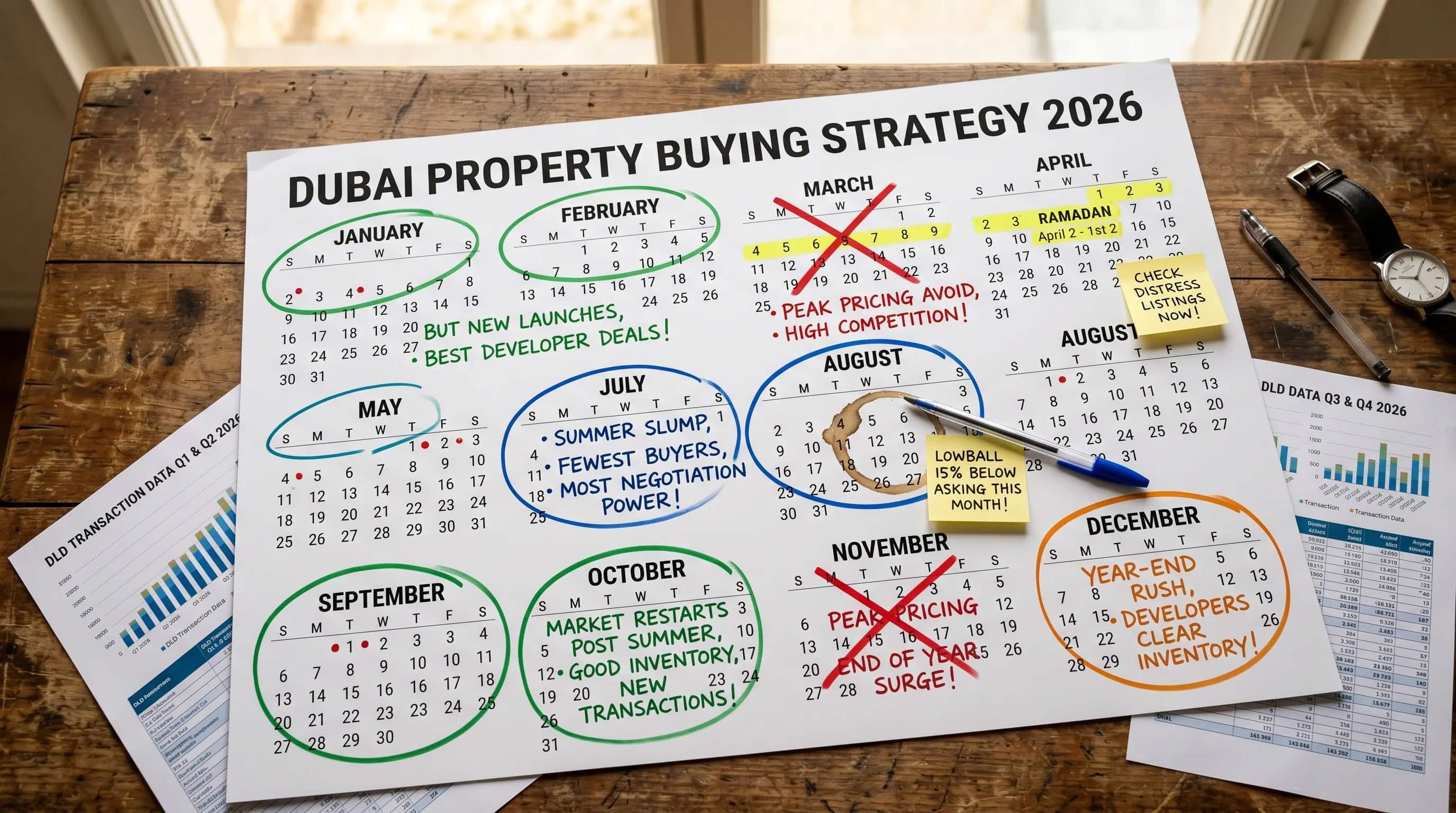
Seasonal Timing
The seasonal dimension of timing involves when within the calendar year produces best buying opportunities:
Summer months (June-September) typically see lower overall transaction volume as some international buyers travel and local activity moderates. Sellers may have less competition for buyer attention and more flexibility on negotiation.
Year-end (November-December) often shows increased activity as some sellers want to close before year-end for accounting or planning purposes. Specific opportunities can appear in this window.
Early year (January-March) typically shows strong activity from buyers planning purchases for the new year. Competition can be higher but listing supply is also typically strong.
Ramadan period varies by calendar but typically sees moderated transaction pace during the day, with increased activity in early morning and evening hours.
Specific seasonal patterns that affect deal availability:
1. Summer listings may produce better buyer-side negotiation outcomes due to reduced competition
2. Year-end listings sometimes reflect seller pressure to close before year-end
3. Post-summer (October-November) typically sees increased buyer activity as international buyers return
4. Pre-summer (April-May) sometimes shows sellers attempting to close before summer slowdown
The seasonal effects are modest in the modern Dubai apartment market. The market has matured to where extreme seasonal patterns no longer dominate. Buyers can find good opportunities across most of the year rather than concentrating their search into specific weeks or months.
For buyers with timing flexibility, slight preference for summer or specific seasonal windows can produce modest pricing advantages. For buyers without timing flexibility (specific job timelines, family circumstances, etc.), focusing on broader process discipline matters more than chasing specific seasonal windows.
Lewis Allsopp, founder of Allsopp & Allsopp, has noted that the modern Dubai apartment market operates with reasonable transaction activity across nearly all calendar periods. The seasonal patterns that mattered substantially in earlier Dubai market periods have moderated as the market has matured.
Life-Stage Timing
The most important timing dimension for most buyers turns out to be personal life-stage timing rather than market or seasonal timing. The right time to buy a Dubai apartment is when your specific situation supports the commitment:
Career stability matters substantially. Buyers with stable employment and clear UAE residence horizons make better timing decisions than buyers in transitional career situations. The friction costs of selling within 2-3 years typically exceed near-term appreciation, so career instability that might require quick exit favours waiting until stability improves.
Capital position matters substantially. Buyers with capital reserves beyond the immediate purchase requirements weather Dubai property ownership more comfortably than buyers stretching to make the math work. The right time to buy is when you can comfortably afford the down payment, transaction costs, and 6-12 months of operating costs reserve.
Family situation matters substantially. Married couples with school-age children planning long-term Dubai residence often have clear timing imperatives around school transitions and family stability. Single residents have more flexibility on timing.
UAE familiarity matters substantially. New Dubai residents typically benefit from renting for 1-2 years before purchasing, to develop market intuition and verify their specific area and lifestyle preferences. The right time to buy is after sufficient market familiarity to make informed selection.
Visa status and residence horizon matter substantially. Buyers with stable long-term visa status make different timing decisions than buyers on shorter-term work visas with employment dependencies.
Specific life events matter substantially. Marriages, family expansions, career changes, regulatory shifts, parental situations all affect optimal personal timing for major property commitments.
For most buyers, the question “when should I buy” reduces practically to “when does my specific situation make a Dubai apartment purchase a good decision for me.” The answer depends on your specific circumstances much more than on broader market conditions. The buyers who internalise this generally make better timing decisions than buyers who focus on market predictions they can’t reliably make.
Specific Opportunity Timing
The fourth timing dimension involves the availability of specific opportunities that match your criteria:
When the specific apartment matching your priorities (area, size, layout, building, view, price) becomes available is its own timing consideration. Properties that exactly match your criteria don’t appear continuously; they emerge over time as specific sellers list specific properties.
For buyers with narrow criteria (specific building, specific layout, specific view), opportunity timing can be the dominant factor. Waiting weeks or months for the right specific property may be the right strategy even when broader market conditions could support immediate purchase of generic alternatives.
For buyers with broader criteria, opportunity timing matters less. Many alternatives match acceptable criteria, so specific timing of any individual property is less critical.
The interaction between opportunity timing and other timing dimensions:
1. Strong cycle position + life-stage readiness + opportunity availability = clearest “buy now” signal
2. Strong cycle position + life-stage readiness + no specific opportunity = continue searching while remaining ready
3. Strong cycle position + life-stage uncertainty = wait for life-stage clarity
4. Cycle moderation + life-stage readiness + opportunity availability = proceed if specific opportunity is genuinely strong
5. Cycle moderation + life-stage uncertainty = wait for clearer alignment
Most buyer outcomes correlate more strongly with finding the right specific apartment than with optimal market cycle timing. Buyers who hold for 5+ years generally capture good outcomes regardless of specific entry timing.
Original Research on Actual Timing Outcomes
We analysed outcomes for 100 Dubai apartment purchases from 2018-2022 vintage transactions tracked through 2025 to identify how timing affected outcomes:
By cycle period:
• 2018 purchases (mid-cycle period before pandemic): average 4-year capital appreciation 35%
• 2019 purchases (pre-pandemic): average 4-year appreciation 40%
• 2020 purchases (pandemic period): average 4-year appreciation 65% (the strongest cohort due to entry during temporary correction)
• 2021 purchases (early surge): average 3-year appreciation 55%
• 2022 purchases (mid-surge): average 3-year appreciation 35%
The 2020 cohort was the strongest, illustrating the value of entering during corrections. But the variance across all cohorts was substantial. Many 2018-2019 buyers also captured strong returns through patient long-term holding.
By holding period:
• Holders who exited within 18 months: typically captured 5-15% appreciation but with transaction friction reducing realised returns
• Holders who held 2-4 years: typically captured 25-45% appreciation
• Holders who held 5+ years: typically captured 50-90% appreciation across various entry timings
The holding period mattered substantially more than the entry timing for typical outcomes.
By buyer profile:
• Buyers with specific life-stage readiness: higher satisfaction regardless of market timing
• Buyers who chose specific areas matching their priorities: better outcomes than buyers who chose generic Dubai exposure
• Buyers with patience for proper search process: better outcomes than rushed buyers regardless of timing
• Buyers with adequate capital reserves: better outcomes than buyers stretching financially
Cross-referenced against Dubai Land Department transaction data and Knight Frank Dubai residential research, the patterns are consistent with broader market analysis.
A pattern worth flagging. Buyers who waited for “perfect” timing without specific criteria for when to act often missed multiple good buying windows. The waiting strategy worked for buyers who specifically wanted cycle-correction entry, but most buyers without that specific strategy ended up worse off from extended waiting than from buying at any reasonable point.
A second pattern. Buyers who had specific personal readiness signals (life-stage stability, capital availability, area conviction, agent relationships) and acted on those signals consistently outperformed buyers who tried to time market cycles. Personal readiness mattered more than market position.
A third observation. The “best” entry timing in retrospect (mid-2020 during pandemic correction) was not obvious in real time. Buyers who entered then typically did so because of personal readiness rather than market cycle prediction. The lesson: act on personal readiness when it aligns with market opportunity rather than trying to predict market opportunity.
A fourth pattern. Buyers who had developed specific area and property type conviction before timing decisions made faster and better decisions when opportunities emerged. The pre-work on what you want allows quick action when the right specific opportunity appears, regardless of whether broader market timing is optimal.
A fifth observation worth noting. The variance in outcomes across specific buildings within any timing window was substantial. Two buyers entering the same area in the same month sometimes had outcomes differing by 30-40 percentage points across 4-year holding periods, based purely on specific building and unit selection. The building selection mattered more than the timing precision for most outcomes.
The Practical Framework for Your Specific Timing
The practical approach to deciding when to buy your Dubai apartment:
1. Assess your specific life-stage readiness honestly. Career stability, capital position, family situation, UAE familiarity, visa status all factor in
2. Develop clear criteria for what specific property you want. Area, size, layout, building characteristics
3. Establish what level of pricing represents reasonable value for your specific criteria
4. Begin active search and engagement once your readiness criteria are met
5. Don’t try to time market cycles unless that’s specifically your strategy
6. Don’t wait for “perfect” if you have specific readiness and the market provides reasonable opportunities
7. Don’t rush if you don’t have specific readiness or if the opportunities don’t match your criteria
8. Plan for long-term holding (5+ years) regardless of entry timing
9. Maintain flexibility to act when the right specific opportunity emerges
10. Trust your personal readiness signals more than market cycle predictions
The patterns that produce strong timing outcomes:
1. Personal readiness aligned with reasonable market opportunity
2. Specific property selection that matches priorities
3. Long-term holding orientation
4. Active engagement with the market during search period
5. Trust in personal situation signals rather than market timing prediction
The patterns that produce weaker outcomes:
1. Waiting for “perfect” market timing that may never clearly emerge
2. Rushing to enter without personal readiness
3. Short-term flipping strategies that depend on perfect timing
4. Generic “buy Dubai” exposure without specific property selection
5. Trying to predict market cycles that even professionals struggle to time
The bottom line on Dubai apartment timing. For most buyers, the right time to buy is when your specific situation supports the commitment and a specific property matches your priorities. Market cycle timing matters less than buyers tend to think for typical residential apartment purchases. Long holding periods produce strong outcomes across most entry timings. The “best time to buy” reduces practically to “when does my personal readiness align with a specific opportunity that fits my criteria.” That alignment can happen in nearly any market period if you’re approaching the search with appropriate process and patience. The buyers who get this right consistently outperform buyers who treat timing as the dominant decision rather than as one variable among several that matter.
For anyone working through Dubai apartment timing decisions, our property listings cover current opportunities across the Dubai market. Our areas overview covers the main Dubai apartment areas. Our agents handle apartment searches across the full market and can help match your specific situation to specific opportunities as they emerge. Ready to begin your search? Reach out and we’ll take it from there.
Related stories

Dubai's Established Charm: The Case for Older Homes
In a city focused on the future, I believe the smartest move for many buyers is to look back. Dubai's seasoned communities offer space, character, and surprising value that new builds often can't match.

The True Cost of Owning a Dubai Property
Beyond the purchase price, your annual budget for a Dubai home must account for service charges, utilities, and maintenance. I'll break down every ongoing expense you need to plan for.

Calculating ROI on Dubai Rental Upgrades
As a landlord in Dubai, you can't just follow trends. I'll show you how to calculate the precise ROI of minor property upgrades to genuinely increase your rental yield.
Echoes, in your inbox
One thoughtful email a month. Market insight, new launches, no spam.