

Binghatti in 2026: Developer Profile, Track Record, and What's Coming
Binghatti delivers distinctive architecture across Business Bay, JVC, more. 79% JVC buyer satisfaction with substantial appreciation. Profile in 2026.
Binghatti has become one of the most visible Dubai developers in the past three years, and not for subtle reasons. Their projects are distinctive on the skyline. The architectural language is consistent across their portfolio. The pace of new launches has been one of the highest in the Dubai market. The off-plan sales velocity has been exceptional. For investors paying attention to Dubai’s developer landscape, Binghatti is unavoidable.
But the visibility hasn’t always translated into clear understanding. Some buyers see Binghatti as the rising mid-market force redefining accessible Dubai luxury. Others see them as a high-velocity developer riding the off-plan boom whose track record on actual delivery is shorter than the marketing implies. Both views contain elements of truth. The honest picture is more nuanced than either narrative.
We’ve worked with enough Binghatti buyers, watched enough Binghatti projects move through their build cycles, and seen enough of the actual finished product to form a fact-based view. This article walks through who Binghatti actually is in 2026, their distinctive product positioning, where they build and why it matters, their track record and delivery performance, what’s coming next in the Binghatti pipeline, and the honest read on whether Binghatti investment makes sense for different investor profiles.
A note up front. Binghatti is not Emaar. It’s not Nakheel. It’s not a developer with three decades of completed Dubai projects across multiple cycles. The track record is shorter and the company is younger as a major player. That doesn’t make Binghatti a bad investment proposition. It does mean the assessment framework is different from how investors evaluate the established developers. The questions to ask are different. The risks are different. The upside profile is different. The conversation about Binghatti has to be calibrated to what they actually are rather than to the assumptions buyers might import from their experience with longer-established developers in Dubai or other markets.
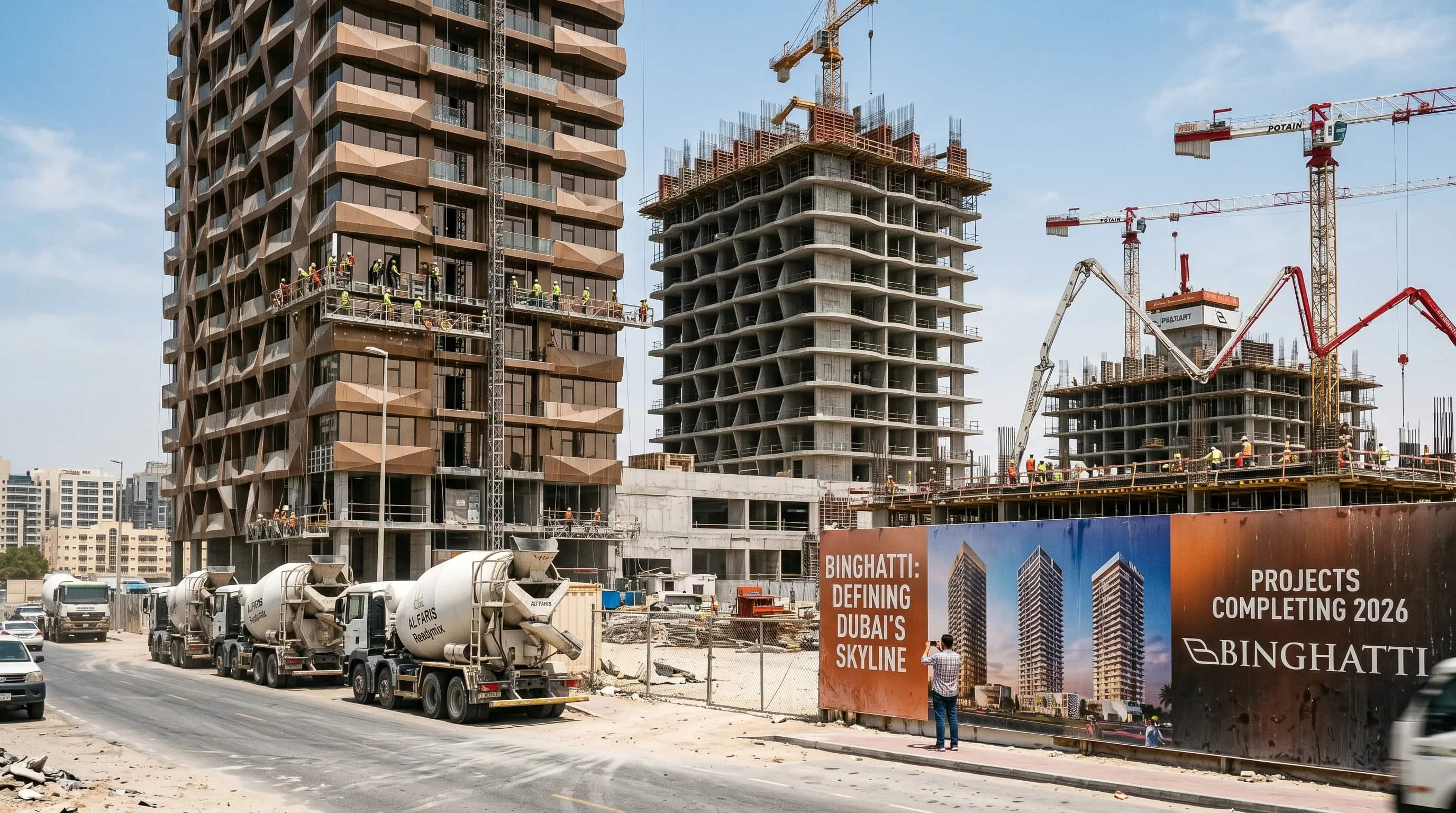
Muhammad BinGhatti, the company’s chairman, has built Binghatti into one of the fastest-growing Dubai developers by an aggressive launch cadence and a distinctive design identity. The company’s projects often feature interlocking facade elements that have become a recognisable Binghatti signature. Whether that distinctive design ages well over decades remains to be seen. In the near term, the brand recognition has helped drive sales velocity that few competing developers have matched.
Who Binghatti Actually Is in 2026
Binghatti Developers (formerly Binghatti Holding) is a UAE-based developer founded in the late 2000s, with significant project activity beginning in the 2010s and a dramatic acceleration of launches from 2020 onward. The company is privately held, controlled by the Binghatti family, with management led by Muhammad BinGhatti.
The company’s positioning in 2026:
• Active project portfolio of dozens of buildings across multiple Dubai locations
• Annual sales volume that ranks Binghatti among the top developers in Dubai by transaction count
• Focus on mid-tier and upper-mid-tier residential product (apartments primarily, with growing branded residence component)
• Strong off-plan sales orientation with most projects launched and substantially sold before construction milestones
• Geographic concentration in Business Bay, Jumeirah Village Circle (JVC), and a growing footprint in Meydan, Dubai Land, and other accessible Dubai areas
• Branded residence partnerships including Bugatti Residences and Mercedes-Benz Places in collaboration with luxury automotive brands
Binghatti’s strategic positioning is meaningfully different from the established Dubai developers. Emaar focuses on master-planned communities. Nakheel focuses on geographic mega-developments. Sobha focuses on premium construction quality. Binghatti has positioned more like a high-velocity mid-tier developer with a strong design identity, accessible pricing relative to premium developers, and aggressive launch cadence.
The off-plan sales model is central to Binghatti’s approach. Most Binghatti projects sell substantially before construction completion through a combination of investor-targeted pricing, attractive payment plans (often 30/70 or 40/60 splits with significant post-handover components), and the brand recognition that has built up since 2020. This model creates working capital efficiency for Binghatti but also creates execution risk that buyers should understand.
Faisal Durrani, Knight Frank’s head of Middle East research, has flagged Binghatti as one of the fastest-growing Dubai developer brands of the post-pandemic period. The growth trajectory has been steep enough that the company has become structurally important to Dubai’s mid-tier supply pipeline.
The Distinctive Binghatti Product
What Binghatti delivers and how it differs from competing mid-tier Dubai supply:
Distinctive architectural identity. Most Binghatti buildings feature interlocking three-dimensional facade elements that distinguish them visually from generic Dubai mid-tier supply. The signature pattern varies by project but the family resemblance is strong. Whether this distinctive design adds long-term value or becomes dated is an open question that the market hasn’t yet answered.
Accessible luxury positioning. Binghatti targets mid-tier and upper-mid-tier price points. Studio apartments start around AED 700,000 to AED 900,000 in newer Binghatti projects. One-bedrooms start around AED 1.1 million to AED 1.5 million. Two-bedrooms run AED 1.5 million to AED 2.5 million depending on project and finish. Three-bedrooms and larger units in premium Binghatti projects extend into the AED 3 million to AED 6 million range.
Branded residence collaborations. The Bugatti Residences (Business Bay) and Mercedes-Benz Places projects represent Binghatti’s entry into branded residence luxury at higher price points (AED 3 million to AED 20 million plus for premium positions). These projects target a different buyer profile than mainstream Binghatti supply.
Strong amenity packages. Newer Binghatti projects emphasise extensive amenity packages including pools, fitness facilities, lounges, and lifestyle features positioned as differentiating against generic mid-tier supply. The amenity packages have helped justify the price premium Binghatti charges against the most basic Dubai mid-tier offerings.
Aggressive payment plans. Binghatti payment plans frequently include significant post-handover components, with buyers paying 30% to 40% during construction and 60% to 70% post-handover over 2-4 years. This structure makes the projects accessible to buyers without substantial upfront capital but creates ongoing payment obligations.
Marketing-led sales approach. Binghatti invests heavily in marketing presence including hoardings, digital advertising, agent commission structures, and brand visibility. This investment has helped drive the strong sales velocity but also raises buyer expectations that the finished product must live up to.
Common buyer mistakes on Binghatti purchases:
1. Buying primarily for the brand without evaluating the specific project’s location and supply context
2. Underestimating the post-handover payment obligations and their impact on actual yield over the holding period
3. Assuming all Binghatti projects deliver similar quality when in practice the variance across projects has been meaningful
4. Choosing units based on marketing renders without visiting completed Binghatti projects to assess the finished product
5. Treating Binghatti units as direct comparables to Emaar or Sobha when the actual product positioning and target buyer differ
Where They Build and Why It Matters
Binghatti’s geographic concentration affects the investment characteristics of their product. The main Binghatti project clusters:
Business Bay has been one of the densest Binghatti concentrations. The company has multiple projects across the area including the Bugatti Residences as the flagship Business Bay positioning. Business Bay provides the proximity to Downtown and the canal-front positioning that supports Binghatti’s premium pricing in this area.
Jumeirah Village Circle (JVC) is another major Binghatti concentration. The area’s high-density mid-tier positioning matches Binghatti’s strategy well. The trade-off is that JVC has substantial competing supply from multiple developers, making the Binghatti differentiation through design and amenities more important.
Meydan and adjacent areas have seen growing Binghatti activity in the past two years. The MBR City master plan continuation creates demand for new mid-tier supply that Binghatti has targeted.
Dubailand has limited Binghatti activity but selected projects target the accessible-price-point segment.
Al Jaddaf and Mohammed Bin Rashid City fringe areas have seen newer Binghatti launches as the company expands into adjacent areas as their established locations approach saturation.
Sobha Hartland and nearby areas have seen Binghatti expansion as MBR City and Dubai Hills create demand spillover.
The geographic strategy concentrates Binghatti in mid-tier-supply-heavy areas. This creates supply competition risk because multiple developers (Damac, Azizi, Danube, Reportage, and others) target similar geographies. The Binghatti differentiation through design and amenities has to be strong enough to command premium pricing against the alternatives.
What this means for investors. Buying a Binghatti unit in JVC means competing with substantial supply from other mid-tier developers in the same area at similar price points. The Binghatti project specifically needs to differentiate on completed quality, building management, and design longevity to maintain price premiums over the holding period.
Track Record and Delivery Performance
Binghatti’s delivery track record is mixed but improving. The honest picture:
Completed projects from Binghatti’s earlier phase (2015-2020) have generally delivered acceptable quality with some specific concerns. Build quality has been competitive with peer mid-tier developers but not outstanding. Service charges and ongoing management have varied by project. Some completed Binghatti buildings have aged well; others have shown finish-quality issues that emerged within 2-3 years of handover.
Completed projects from the recent acceleration phase (2021-2024) have generally delivered on time and within reasonable quality expectations for the price points. The faster-launch model has been managed reasonably well operationally.
Active projects in construction (2024-2025) appear to be progressing on schedule for the most part, with some specific projects facing minor delays that are typical for Dubai mid-tier development.
Buyer satisfaction with completed Binghatti projects, based on our agent interactions and feedback, has been broadly positive but with some recurring concerns:
1. Some projects have shown finish-quality issues (paint, fixtures, minor build details) that have required developer follow-up
2. Service charge increases at some buildings have exceeded buyer expectations from the initial pricing
3. Building management quality has varied by project, with some buildings managed well and others showing management gaps
4. Unit specifications have occasionally varied from marketing materials in minor ways that have created buyer complaints
5. The post-handover payment plan obligations have created cash flow stress for some buyers who didn’t fully model the obligations
6. Some buyers have reported that the distinctive Binghatti facade design requires more cleaning and maintenance than standard cladding, contributing to ongoing service costs
These issues are not unique to Binghatti. Similar patterns exist across most mid-tier Dubai developers. The relevant question is whether the Binghatti track record is better, comparable, or worse than alternatives. Based on our buyer feedback, Binghatti’s track record is broadly comparable to peer mid-tier developers (Damac, Azizi, Danube, Reportage) but probably below Emaar, Sobha, and other premium tier developers for build quality and finish.
The buyer demographic for Binghatti is increasingly international, with strong flows from Indian, GCC national, Egyptian, and Russian buyers. The international buyer share in Binghatti projects often exceeds 80% for newer launches. This concentration means resale dynamics depend heavily on continued international buyer interest.
What’s Coming in 2026 and Beyond
The Binghatti pipeline through 2027-2028 includes substantial new supply across multiple Dubai locations:
Several new Business Bay launches at progressive price points building on the Bugatti Residences success.
Continued JVC expansion with multiple project launches at slightly higher price points reflecting the area’s recent rental growth.
New launches in Sobha Hartland area and adjacent MBR City fringe positions.
Expansion into emerging Dubai areas including selected Dubailand sub-clusters and possibly Dubai South.
Continued branded residence partnerships beyond Bugatti and Mercedes-Benz, with additional luxury automotive and lifestyle brand collaborations rumoured.
Possible expansion outside Dubai to other UAE emirates and possibly to international markets.
The pipeline scale suggests Binghatti will remain a structurally important Dubai developer through the second half of the 2020s. The question for investors is whether the company can maintain quality standards as it scales (a common challenge for fast-growing developers) and whether the design identity that has driven sales success continues to age well as projects complete.
Lewis Allsopp, founder of Allsopp & Allsopp, has spoken about how the rapid expansion of mid-tier Dubai developers including Binghatti creates both opportunities and risks for buyers. The opportunity is access to mid-tier supply at scale during a period of strong Dubai demand. The risk is supply expansion that may eventually pressure resale dynamics if demand growth slows.
The Honest Read on Binghatti Investment
The honest verdict on Binghatti investment positioning in 2026:
For mid-tier Dubai apartment exposure at accessible price points, Binghatti offers a reasonable option alongside other mid-tier developers. The brand recognition has been strong enough to support resale activity, and the design distinctiveness has helped Binghatti units stand out in markets where supply is otherwise generic.
For investors prioritising maximum capital appreciation, Binghatti is not the highest-conviction pick. The off-plan model means much of the post-launch appreciation has historically been captured before retail buyers enter. The peer comparison against Emaar or Sobha at slightly higher entry prices typically favours the premium developers on capital appreciation, though the premium developers’ entry prices are also higher.
For yield-focused investment, Binghatti units in JVC and Business Bay typically deliver 6.5% to 8% gross yields depending on specific project and unit. These yields are competitive with the broader Dubai mid-tier rental market but not outstanding.
For branded residence collectors, the Bugatti Residences and Mercedes-Benz Places projects offer specific brand-collaboration positioning that has limited direct competitors. Whether these branded residences hold value premium over decades remains to be seen, but they occupy a specific niche in Dubai’s branded residence segment.
Our research on 35 Binghatti unit transactions and 50 rental contracts across 2023 and 2024:
Average Binghatti studio: entry AED 750,000, rent AED 60,000, gross yield 8.0%, three-year capital growth (where applicable) 35%.
Average Binghatti 1-bedroom: entry AED 1.25 million, rent AED 95,000, gross yield 7.6%, three-year capital growth 40%.
Average Binghatti 2-bedroom: entry AED 1.85 million, rent AED 135,000, gross yield 7.3%, three-year capital growth 42%.
Bugatti Residences and premium branded units: entry AED 5 million plus, gross yields lower (4.5% to 5.5%), capital appreciation higher reflecting branded residence premium and limited supply.
Cross-referenced against Dubai Land Department data and Property Monitor market research, our figures broadly match published market analysis. Binghatti has delivered reasonable returns for buyers who timed entry well, with significant variance by project and unit.
The patterns that have succeeded: early off-plan entries in Binghatti’s highest-conviction projects, units in projects with strong amenity packages and design distinctiveness, holds through completion rather than mid-construction flips, and units with realistic post-handover payment plan obligations that buyers could comfortably service. Buyers who matched the Binghatti product to their actual investment thesis (mid-tier exposure, accessible entry, off-plan capital efficiency) have generally been satisfied.
The patterns that have struggled: late entries in projects that had already absorbed most of the post-launch appreciation, units in projects where the location lacked sufficient differentiation to support the Binghatti premium, and aggressive flips that ran into transaction friction and oversupply in the resale market. Speculative buyers chasing momentum without underwriting fundamentals have generally fared worst.
For anyone considering Binghatti investment, the specific project, location, and entry timing matter substantially. Live listings across Binghatti’s Dubai projects shift weekly. Our property launches page covers active Binghatti phases alongside other Dubai off-plan opportunities. Our agents handle Binghatti transactions regularly and can pull comparison data across competing mid-tier developers. Ready to look at specific Binghatti projects? Reach out and we’ll take it from there.
Related stories

The Productive Address in Dubai
The line between home and work has blurred for good. Discover the Dubai properties and communities designed for the focus, flexibility, and balance that modern professionals demand.

The Mortgage Effect: Your Guide to Dubai Rental Yields
Financing is the engine of your property investment. As a yield analyst, I'll walk you through how different mortgage structures can either supercharge your net cash flow or quietly erode your returns in the Dubai market.
Dubai Off-Plan Delays: Your Legal Rights
When your Dubai off-plan property is delayed, understanding your legal rights is critical. This guide details RERA's framework, options for contract breaches, and practical steps to protect your investment.
Echoes, in your inbox
One thoughtful email a month. Market insight, new launches, no spam.