

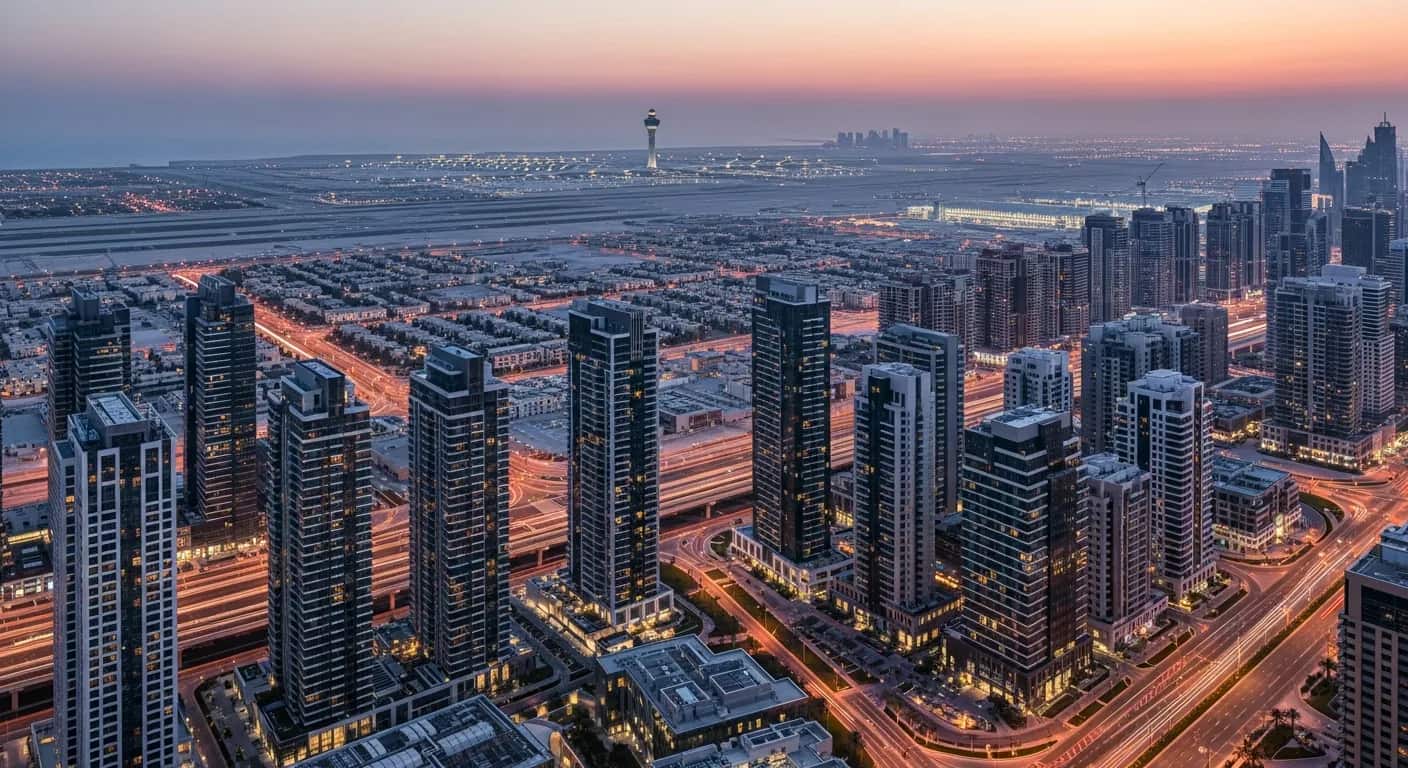
DWC Expansion: A New Gravity for Dubai Property
The AED 128 billion expansion of Al Maktoum International Airport is set to create a new urban core in Dubai's southern corridor. This report analyzes the phased impact on property values and outlines strategies for investors.

The recent confirmation of the AED 128 billion master plan to expand Al Maktoum International (DWC) is the most significant catalyst for Dubai's real estate market I have seen in a decade. In my analysis, this is not merely an infrastructure upgrade; it is the deliberate creation of a new center of gravity, an event that will fundamentally recalibrate the city's economic and demographic map over the next two decades and cement the rise of the southern Dubai growth corridor.
Here's what we will explore in this report:
- The thesis that DWC's expansion creates a new, self-sustaining urban nucleus.
- How the 'Aerotropolis' concept applies specifically to Dubai's development model.
- The immediate and secondary ripple effects on different property sectors.
- A granular forecast for key communities like Dubai South and Expo City.
- A detailed, line-by-line breakdown of the real costs of acquiring property in the area.
- The critical risks investors must navigate, from oversupply to infrastructure pacing.
- A verdict on investment strategies for different risk profiles.
Thesis: More Than an Airport, a New Urban Nucleus
When we analyze mega-projects at Gaia Living, we look beyond the headline numbers to understand the underlying mechanisms. The plan for DWC—to create a hub capable of handling 260 million passengers annually, five times the capacity of Dubai International (DXB)—is a statement of intent that transcends aviation. My thesis is that this project is the anchor for a new, fully integrated city, a southern capital for Dubai that will pull the entire urban framework southwards. The airport itself is simply the heart, around which a new anatomy of residential, commercial, logistics, and lifestyle districts will be built and populated over the next twenty years. This isn't speculation; it is the explicit strategy outlined in the Dubai 2040 Urban Master Plan, which designates this vast southern expanse as a primary engine of future growth.
The sheer scale dictates this outcome. An airport serving a quarter of a billion people cannot exist in a vacuum. It requires a workforce of hundreds of thousands, from pilots and engineers to logistics managers and hospitality staff. These individuals and their families will need places to live, schools for their children, clinics for their health, and parks for their leisure. The project's announcement that an entire city will be built around the airport in Dubai South, with housing for a million people, confirms this vision. This triggers a chain reaction of development that moves far beyond the airport's perimeter fence, creating concentric circles of influence that will ripple across the entire southern corridor.
In my view, investors who see this merely as an 'airport-adjacent' opportunity are missing the bigger picture. This is akin to the early development of Dubai Marina or Downtown Dubai, projects that created entirely new destinations and value propositions from scratch. The difference here is the scale and the economic driver. While those earlier projects were driven by lifestyle and tourism, the DWC hub is driven by global trade, logistics, and connectivity. This provides a powerful and resilient economic base that makes the long-term residential and commercial property story exceptionally compelling. The key for investors is to understand the timeline and the phased nature of this transformation, as the full impact will not be felt overnight.
Deconstructing the 'Aerotropolis' Model in Dubai's Context
 Featured project
The term 'aerotropolis' describes a metropolitan subregion whose infrastructure, land use, and economy are centered on an airport. While the concept has been implemented with varying success globally, I believe Dubai is uniquely equipped to execute a true, fully-realized version. The Emirate's proven ability to deliver integrated mega-projects, driven by a singular government vision and executed by world-class master developers like Emaar Properties and Nakheel, removes many of the political and logistical hurdles that have hindered similar ambitions elsewhere. The availability of vast, unencumbered land parcels in the southern corridor is a crucial enabling factor, allowing for true master planning from a blank canvas.
The DWC aerotropolis is already taking shape within the 145-square-kilometer master plan of Dubai South. This is not a future dream; it is an existing, zoned city with dedicated districts that form the core components of the airport-centric ecosystem. The Logistics District and Aviation District are already operational and thriving, acting as the industrial engine. They leverage the unparalleled strategic advantage of the site's proximity to Jebel Ali Port, creating a seamless sea-air logistics corridor that is unmatched globally. This synergy is the economic foundation upon which the entire aerotropolis is built. Global e-commerce giants and logistics firms are already concentrated here, and the airport's expansion will only intensify this clustering effect.
Crucially, the master plan includes a vast Residential District, designed to provide a complete lifestyle offering. It's not just about building apartment blocks; the vision encompasses schools, clinics, retail centers, parks, and the 'green belt' promised in the 2040 plan. This is where the opportunity for most property investors lies. Unlike organic urban growth, which can be messy and unpredictable, the aerotropolis model allows for the deliberate creation of balanced communities where work, life, and leisure are integrated. The success of this model in Dubai's context will depend on the government and its development partners' ability to phase the delivery of this social infrastructure in lockstep with both the airport's construction and the delivery of residential supply. The existence of Expo City as a ready-made town center provides a massive head start in this regard.
The First Ripple: Immediate Impact on Logistics and Industrial Real Estate
While the long-term vision is one of thriving residential communities, my analysis indicates that the first and most powerful wave of real estate demand will be in the industrial and logistics sector. This is the immediate, direct consequence of both the construction phase and the airport's core function. The ten-year construction timeline for the new passenger terminals will, in itself, require a colossal logistical operation. This means immediate demand for warehousing, material storage facilities, temporary offices, and specialized industrial yards within and around Dubai South's Logistics District. This demand is not speculative; it is a certainty, tied directly to the project's execution.
Looking beyond construction, the airport's ultimate purpose as a global cargo and passenger hub will permanently anchor logistics and e-commerce as the region's primary economic activity. The planned cargo capacity of 12 million tonnes per year is a clear signal to the world's largest freight forwarders, retailers, and manufacturers. We anticipate that firms will increasingly seek to build major consolidation and distribution centers within the Dubai South ecosystem to leverage the DWC-Jebel Ali corridor. This translates into sustained, long-term demand for high-grade warehouses, cold-storage facilities, and light-industrial units. For sophisticated institutional investors and private funds, this sector represents a lower-risk, high-demand entry point into the DWC growth story.
This industrial boom has a direct, albeit less glamorous, knock-on effect on a specific niche of residential real estate: staff and labour accommodation. The sheer number of workers required for both the construction and the subsequent operation of the airport and its logistics ecosystem will create immense demand for well-managed, purpose-built accommodation. While this is a specialized asset class, it is one of the most direct and predictable beneficiaries of the airport expansion. The growth in this sector is a leading indicator of the broader economic activity that will eventually fuel the demand for mid-market apartments and family homes in the surrounding areas. It is the first, foundational layer of the residential market to be established.
The Second Ripple: EXPO City and the Residential Tipping Point
If the logistics sector is the engine of the DWC aerotropolis, then Expo City is its pre-built heart. In my assessment, the maturation of Expo City is the single most important factor that will bridge the gap between the industrial gravity of the airport and widespread residential appeal. It solves the classic 'chicken-and-egg' problem that plagues most new developments. New residents are hesitant to move to an area without amenities, and amenities won't open without a critical mass of residents. Expo City breaks this cycle by providing a ready-made, vibrant, and world-class destination from day one.
Think of what Expo City already offers: the iconic Al Wasl Plaza, the stunning Surreal water feature, museums, performance venues, and vast public parks. It has its own dedicated Metro station, providing vital connectivity. It is already a hub for major corporate tenants, with firms like DP World and Siemens having established their headquarters there. This creates an immediate white-collar employment base within the district itself. Now, with the launch of its first residential developments—projects like Expo Valley and Mangrove Residences—it is transitioning from a visitor attraction and commercial hub into a living, breathing community. These are not just apartments and villas; they are homes integrated into a unique, pedestrian-friendly, and sustainable urban environment.
This is the tipping point. The presence of Expo City provides an immediate 'sense of place' that would otherwise take a decade to develop organically. It gives future residents of the wider Dubai South area a destination for dining, entertainment, and recreation right on their doorstep. This significantly de-risks the investment proposition for the surrounding residential districts. I anticipate that properties with good connectivity to Expo City will command a premium over those further afield. As Expo City's own residential population grows, it will catalyze the development of further social infrastructure—more schools, more retail, more clinics—creating a virtuous cycle of growth that will radiate outwards and benefit the entire southern corridor. It is the spark that will ignite the broader residential market.
“The DWC expansion is not a speculative bet on future growth; it's a calculated investment in infrastructure that forces a predictable sequence of real estate development. The 'when' is a matter of phasing, but the 'what' is a certainty.”
Dubai South & Surrounds: A Granular Property Forecast
Understanding the macro trend is one thing; identifying the specific sub-markets and asset types that will benefit is where value is created. My team at Gaia Living has analyzed the communities in and around the DWC corridor to forecast how this growth will likely manifest. The impact will not be uniform; it will be a story of concentric circles, with the most direct and explosive growth nearest the epicenter, and a more gradual appreciation in adjacent, established areas.
The Epicenter: Dubai South Residential District This is the most direct beneficiary. Developed by the master planner, this area, which includes sub-communities like Emaar South, is purpose-built to house the airport's workforce and their families. Currently, it offers a mix of apartments, townhouses, and villas at what I consider to be a very attractive entry point. For instance, two-bedroom apartments can be found in the range of AED 1 million to AED 1.6 million, while three-bedroom townhouses typically trade between AED 1.8 million and AED 2.5 million. These prices, in my opinion, do not yet fully factor in the long-term impact of the DWC expansion. The key here will be the quality of the developer. Projects by top-tier names like Emaar Properties within Emaar South, with its golf course and premium amenities, offer a greater degree of security and are likely to lead the market in terms of value appreciation.
The Inner Circle: Adjacent Communities The spillover effect will quickly reach well-connected, nearby communities. Al Furjan, a mature and popular villa and townhouse community by Nakheel, is a prime example. Its direct access to the Metro's Red Line extension makes it an obvious choice for professionals who want a larger home but need easy access to both the new airport and the rest of the city. We are already seeing strong demand here, and I expect its value proposition to strengthen considerably. Similarly, Dubai Investment Park (DIP) will see renewed interest. As a long-established, mixed-use community with its own industrial park and residential zones, DIP is well-positioned to benefit. It offers a more mature environment with existing schools and retail, which will appeal to families moving to the area.
The Outer Ring: The Premium Periphery Even premium, established communities further north will feel the positive effects. A prime example is Jumeirah Golf Estates. While it is a luxury destination in its own right, its relative distance from the city's traditional center has been a consideration for some buyers. As Dubai's center of gravity shifts south, JGE effectively becomes more central. The journey to the world's largest airport will be a mere 15-20 minutes, a major selling point for the highly mobile, affluent executives who form its resident base. We will also see increased interest in affordable, family-focused communities like Town Square by Nshama. Located along Al Qudra Road, it offers excellent amenities at a competitive price point. As the southern corridor develops, Town Square's location becomes increasingly strategic, offering a compelling balance of lifestyle, affordability, and accessibility to the new economic hub.
A Worked Example: Cost of Acquiring a Townhouse in Dubai South
To make this tangible, it's essential to understand the real, all-in costs of acquiring a property in this emerging corridor. Vague promises of future growth are meaningless without a clear-eyed view of the upfront capital required. Let us model the purchase of a three-bedroom townhouse in a community like Emaar South, assuming a purchase price of AED 2,200,000 on the secondary market.
This exercise is critical for any serious investor. As you can see, the initial cash outlay is significantly more than just the down payment. Factoring in these costs is the first step in conducting proper due diligence. Below is a realistic, line-by-line breakdown of the upfront costs for a resident financing the purchase with a mortgage:
- Property Purchase Price: AED 2,200,000
- Mortgage Down Payment (20% of Price): AED 440,000
- As per Central Bank of the UAE regulations, for a first property under AED 5M, expatriate residents must provide at least a 20% down payment.
- Dubai Land Department (DLD) Transfer Fee (4% of Price): AED 88,000
- This is a mandatory government fee for registering the property transfer.
- Real Estate Agency Fee (2% of Price + 5% VAT): AED 46,200
- (AED 44,000 Fee + AED 2,200 VAT)
- Mortgage Registration Fee (0.25% of Loan Amount): AED 4,400
- The loan amount is AED 1,760,000 (80% of purchase price). This fee is paid to the DLD.
- Bank Processing/Arrangement Fee (approx. 1% of Loan): AED 17,600
- This can sometimes be waived or negotiated, but it's crucial to budget for it.
- Property Valuation Fee: AED 3,150 (including VAT)
- The bank requires an independent valuation before approving the loan.
- Trustee Office Fee for Transfer: AED 4,200 (including VAT)
- This is a fixed fee paid to the DLD-approved office that facilitates the transfer process.
Total Estimated Upfront Cash Required: AED 603,550
This total represents approximately 27.4% of the property's purchase price. It is a substantial figure that must be planned for. Beyond these initial costs, an owner must also budget for ongoing expenses. The primary one is service charges, which cover the maintenance of common areas, security, and amenities. For a townhouse in Dubai South, a reasonable estimate would be between AED 3.00 and AED 4.50 per square foot on the plot area annually. For a property with a 2,500 sq.ft. plot, this would translate to an annual charge of AED 7,500 to AED 11,250. Understanding both the upfront and recurring costs is fundamental to accurately calculating potential net yield and overall return on investment.
Navigating the Risks: Oversupply, Phasing, and Infrastructure Lag
As an analyst, it is my responsibility to present a balanced view. While the long-term outlook for Dubai's southern corridor is incredibly positive, investors must be clear-eyed about the potential risks. This is not a market for short-term speculation, and navigating it successfully requires patience and a deep understanding of its unique challenges. The most significant risk, in my opinion, is the potential for a phased oversupply of residential units. The sheer amount of land available for development is staggering. If multiple developers launch and deliver projects simultaneously, ahead of the demand curve generated by the airport's phased completion, the market could experience a period of suppressed prices and rental yields. The key mitigating factor here is the strong, centralized control of the master developer, Dubai South, which should, in theory, manage the release of land and pace of development more effectively than in fragmented, freehold areas.
A closely related risk is the timeline itself. The vision for DWC is a multi-decade project. The first new passenger terminal is not expected to be operational for approximately ten years. While we will see population growth before then, driven by construction and logistics, the major influx of aviation professionals and their families is still some way off. Early investors, therefore, need a long-term horizon. Those who buy an off-plan property today must be prepared to hold it for at least 7-10 years to ride through the initial development phases and into the period of mature, sustained demand. During this initial phase, rental yields might be lower than in established communities like Dubai Marina, potentially in the 4-6% range, before rising as the population density increases.
Finally, there is the risk of infrastructure lag. While the Dubai 2040 plan mandates integrated development, the practical reality of building cities is complex. The timely delivery of essential social infrastructure—high-quality schools, comprehensive healthcare facilities, and sufficient retail and entertainment options—is paramount. Without these, the area will struggle to attract the family demographic it targets. The Roads and Transport Authority (RTA) has a proven track record, and the Metro connection is a huge asset, but the delivery of 'soft' infrastructure by private and public providers must keep pace with the delivery of homes. We will be monitoring the announcements and progress of new schools and hospitals in the area very closely, as these are critical leading indicators of the corridor's evolution into a mature, desirable place to live.
Investor Strategy: A Phased Approach for Different Risk Appetites
Given the long-term timeline and varying risk factors, there is no single 'best' strategy for investing in the DWC corridor. The right approach depends entirely on an investor's capital base, risk tolerance, and investment horizon. At Gaia Living, we advise our clients to consider a stratified approach, matching the opportunity to their specific profile.
Here are three distinct strategies I see emerging:
1. The Pioneer (High Risk / High Reward): This strategy involves investing directly into the core of the action: buying off-plan launches or newly completed properties within the Dubai South Residential District itself. This approach offers the highest potential for long-term capital appreciation, as these investors are entering the market at the lowest price point, before the full impact of the DWC expansion is priced in. However, this path also carries the highest risk, including potential construction delays, infrastructure lag, and lower initial rental yields. It is best suited for cash-rich investors with a 10-15 year holding period who can withstand market volatility and do not depend on immediate rental income.
2. The Adjacency Play (Medium Risk / Balanced Reward): This is a more conservative, yet still highly promising, strategy. It involves acquiring property in established, adjacent communities that are set to benefit from the spillover effect. Areas like Al Furjan, with its Metro link and existing community feel, or the mature ecosystem of Dubai Investment Park, fall into this category. These communities already have proven rental demand and established infrastructure, which significantly de-risks the investment. While they may not experience the same explosive percentage growth as a brand-new launch in Dubai South, they offer a blend of stable rental income from day one and strong potential for steady capital appreciation as the entire southern corridor becomes more desirable. This is a suitable strategy for mortgage-buyers and investors seeking a balance of income and growth.
3. The Premium Bet (Lower Risk / Steady Growth): This strategy focuses on established, high-end communities located on the periphery of the southern corridor, such as Jumeirah Golf Estates or even certain parts of Arabian Ranches. The investment thesis here is not about exponential growth, but about enhanced value and desirability. As the DWC hub matures, the location of these premium communities becomes more central and convenient for a wealthy demographic of executives, pilots, and business owners. This will solidify their status, protect their value, and drive consistent, stable appreciation. This is the safest play, ideal for risk-averse investors and end-users who want to buy a high-quality lifestyle asset whose long-term value will be strongly underpinned by the new economic hub.
The Al Maktoum Airport expansion is a foundational economic event that will reshape Dubai. The question for investors is not *if* prices in the southern corridor will rise, but *which* assets to acquire and *when* to enter the market. A successful strategy requires patience, a long-term perspective, and a clear understanding of the phased nature of this multi-decade transformation.
My Verdict: The Inevitable Shift South
Having analyzed the plans, the economic drivers, and the existing market landscape, my professional verdict is clear: the southward shift of Dubai's demographic and economic center of gravity is now an inevitability. The AED 128 billion commitment to the Al Maktoum International Airport project is the point of no return. It acts as an anchor, pulling development, employment, and ultimately, residents, towards it. This is not a forecast based on sentiment, but an analytical conclusion based on a chain of cause and effect. A mega-airport requires a massive workforce, that workforce requires housing, and that housing requires a complete community infrastructure. This is the sequence that will play out over the next 10 to 20 years.
The real estate opportunities this creates are generational. However, I must caution that this is a market for the strategic and the patient. The immense profits will not be made by those looking to 'flip' a property in 12 months. They will be realized by those who understand the phasing of the project—recognizing the initial demand in logistics, the pivotal role of Expo City in creating a lifestyle core, and the eventual, massive wave of residential demand. Success will lie in choosing the right location within the corridor, the right type of property for the target demographic, and having the financial fortitude to hold the asset through the initial growth pangs as the area matures.
At Gaia Living, we are positioning ourselves and our clients for this long-term shift. We are not just selling properties; we are providing strategic counsel on how to navigate this evolving landscape. The rise of Dubai's southern corridor will be one of the defining real estate stories of the next quarter-century. For those with a clear vision and a steady hand, the rewards will be commensurate with the scale of the ambition that is driving this incredible transformation. The journey south has begun, and it is irreversible.
Sources
- Dubai 2040 Urban Master Plan: UAE Government Portal
- Property Transaction & Registration Data: Dubai Land Department
- Mortgage Regulations: Central Bank of the UAE
- Public Transport & Infrastructure Plans: Roads & Transport Authority (RTA)
Questions, answered
- How long will it take for property prices in Dubai South to increase due to the airport?
- Significant, broad-based price appreciation is a long-term play, likely unfolding over 5 to 15 years. While some early speculative growth is expected, the most substantial value shifts will occur as the airport's phases complete and the surrounding residential and commercial ecosystems mature.
- Is Dubai South a good place for rental investment right now?
- It can be, but with caveats. Investors should anticipate initially moderate rental yields (around 5-6%) due to the current level of supply. As the airport workforce and surrounding businesses grow, rental demand is projected to increase substantially, which should in turn improve yields and occupancy rates.
- What is the difference between investing in Dubai South and Expo City?
- Dubai South is a vast 145 sq km master development with distinct districts, including a large, developing residential zone. Expo City is a more curated, mature community within that southern corridor, benefiting from ready infrastructure and a unique lifestyle proposition left over from the World Expo. Expo City offers a more immediate sense of place, while Dubai South represents a broader, longer-term growth story.
- What are the main costs when buying property in Dubai South?
- Beyond the property price, key costs include a 4% DLD Transfer Fee (or Oqood fee for off-plan), a 2% real estate agency fee (plus VAT) for secondary market purchases, and various administrative and mortgage registration fees. For a secondary property, upfront costs can total 7-8% of the purchase price.
- Which property types are likely to see the most growth near Al Maktoum Airport?
- Initially, logistics and industrial real estate will see the most direct demand. For residential property, I anticipate strong long-term demand for mid-market townhouses and family-oriented villas, as well as apartments catering to the vast workforce the airport and its associated industries will employ.
- How will the DWC expansion affect infrastructure in southern Dubai?
- The expansion is a core component of the Dubai 2040 Urban Master Plan, which mandates integrated infrastructure development. We expect to see continued expansion of road networks, public transport including the Metro's Green Line, and the planned development of schools, healthcare facilities, and retail to support the growing population.

Amara translates DLD transaction data, supply pipelines, and macro signals into clear calls on where Dubai's market is heading. She writes the numbers most brokers only feel.
Related stories
Dubai's Big Squeeze: Smaller Plots, Denser Living
Dubai real estate is undergoing a fundamental shift towards smaller plot sizes and higher density. We analyse the economic drivers, the impact on property values, and what this new era of compact urban living means for both homebuyers and investors.
Resort Living as Your Dubai Reality
Explore how to trade temporary staycations for a permanent home with five-star amenities in Dubai. I'll break down the real costs, best communities, and lifestyle trade-offs of embracing high-end resort living every day.
Finding Your Tribe in Dubai's Villa Communities
I explore which of Dubai's renowned villa communities attract specific expat nationalities and lifestyle groups, offering insights to help you find a place that feels like home.
Echoes, in your inbox
One thoughtful email a month. Market insight, new launches, no spam.