

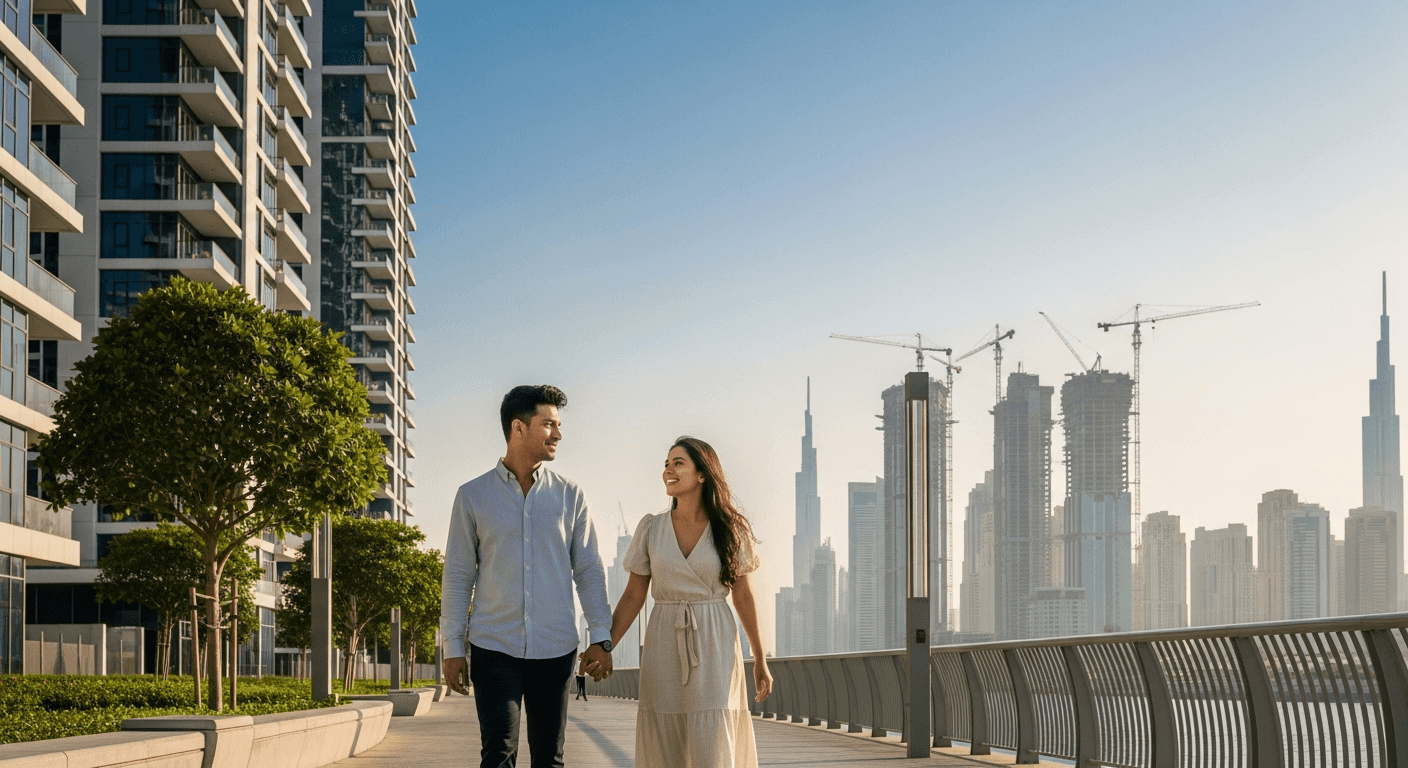
Dubai's Next Growth Zones: Beyond the Usual Suspects
Veteran investors know the returns from Dubai Marina and Downtown. But the next wave of capital growth lies elsewhere. We identify the emerging zones poised for significant appreciation.

Every seasoned investor I speak with has a story about the ‘one that got away’ — the chance to buy into [Dubai Marina](/areas/dubai-marina) in the early 2000s, or a plot in [Emirates Hills](/areas/emirates-hills) before it became the byword for luxury. Hindsight is a wonderful, if frustrating, thing. The more practical question for today’s investor is simple: where is the *next* wave of growth?
Here’s what I'll explore in this analysis:
- The key indicators I use to identify a genuine emerging zone, not just a speculative pocket.
- A deep dive into the southern city-within-a-city: Dubai South and Expo City.
- The powerful ripple effect from Ras Al Khaimah and the opportunity on Al Marjan Island.
- Inland value plays that are quietly maturing, specifically Arjan and Liwan.
- The strategy of backing world-class master developers in their new flagship communities.
- A complete, line-by-line cost breakdown for an off-plan investment in one of these areas.
- A clear-eyed look at the risks involved and how to mitigate them.
The Anatomy of an Emerging Zone
Identifying future growth hubs is less about crystal balls and more about reading the blueprints. In my experience, spotting the next high-growth corridor isn’t about chasing rumors; it’s about applying a consistent framework. You are looking for a confluence of factors that create unstoppable momentum. The first and most critical ingredient is clear, unwavering government commitment. This is visible through strategic documents like the Dubai 2040 Urban Master Plan. This plan explicitly outlines the city's growth vectors, focusing on sustainability, efficiency, and improving quality of life. When the government designates an area for significant population growth or as a new economic centre, it’s the loudest signal an investor can get. This isn't just rhetoric; it unlocks state-level funding for infrastructure.
That leads to the second ingredient: transformative infrastructure. I’m not talking about a new roundabout. I mean metro line extensions, major highway interchanges, and, in the case of Dubai, entirely new airports and seaports. These projects are the arteries that pump economic life into a new district. They solve the fundamental problem of accessibility and connect the new area to the established heart of the city. A neighbourhood is just a collection of buildings until people can get to and from it easily. Follow the path of the Roads & Transport Authority (RTA)'s five-year plans, and you’ll find a reliable map to future value. The extension of the Metro's Red Line to the Expo 2020 site was a textbook example of infrastructure preceding and enabling a real estate boom.
Finally, you need developer conviction. When you see master developers with proven track records — names like Emaar Properties, Nakheel, and now increasingly Aldar from Abu Dhabi, acquiring huge land banks and committing billions of Dirhams to create self-contained communities, it’s a massive vote of confidence. These companies do extensive market research before deploying capital on such a scale. They are not just building apartments; they are building destinations, complete with schools, clinics, retail centres, and parks. Their investment validates the government's vision and provides the housing stock and lifestyle amenities that will attract the first wave of residents. An area with all three, government vision, infrastructure investment, and master developer buy-in, is a potential growth zone. One or two is interesting. All three is a powerful investment thesis.
The Southern Star: Dubai South & Expo City
 Featured project
The sheer scale of ambition in Dubai’s southern corridor is hard to overstate. This isn’t just another suburb; it’s a foundational piece of Dubai's future economic and demographic map. The primary engine of this transformation is the government’s confirmed plan to expand Al Maktoum International Airport (DWC) into the world’s largest, with a capacity for 260 million passengers. This project is the definition of a game-changer. An airport of this size is an 'aerotropolis' — a city in its own right, built around aviation, logistics, tourism, and commerce. The influx of professionals required to build, manage, and operate this hub will generate enormous and sustained demand for housing nearby. We are talking about pilots, engineers, logistics managers, hospitality staff, and their families, all needing a place to live, and they will want to be close to work.
Complementing the airport is the ready-made city of Expo City. The legacy of Expo 2020 is not a collection of abandoned pavilions; it’s a fully-functional, technologically advanced urban environment with world-class infrastructure already in place. It has its own Metro station, a dedicated road network, and a commitment to sustainability that is baked into its design. Companies are increasingly choosing Expo City for their headquarters, attracted by its 15-minute city model, where residents can walk or cycle to offices, shops, and parks. This creates a captive and growing tenant base for properties within the immediate vicinity. The area is becoming a hub for technology, education, and wellness-focused businesses, diversifying its economic base beyond the airport.
From an investment perspective, Dubai South offers a diverse range of entry points. You can find everything from relatively affordable apartments aimed at the mid-market to spacious townhouses and villas in gated communities. Developers are actively launching projects with attractive payment plans designed to appeal to both end-users and investors. A two-bedroom apartment in a new launch here might be priced from AED 1.4 million to AED 1.8 million, a figure that would be unthinkable for a similar new property in a more central location like Business Bay. The investment thesis here is straightforward but requires patience. Capital appreciation will be directly correlated with the phased construction of the airport and the continued growth of Expo City's commercial and residential population. This is a 10-to-15-year story, not a quick flip, but the potential for significant long-term growth is, in my view, unparalleled in Dubai today.
The 'New North': The Ras Al Khaimah Ripple Effect
For years, the investment conversation in the UAE has been overwhelmingly Dubai-centric, with some attention on Abu Dhabi. That is changing, and one of the most compelling new investment narratives is unfolding just a 45-minute drive from Dubai International Airport, in Ras Al Khaimah. The catalyst is the multi-billion dollar Wynn Resort, slated to open on the man-made Al Marjan Island. To dismiss this as just another hotel would be a profound miscalculation. This is the first integrated gaming resort in the region, an economic anchor of such magnitude that its impact will be felt across the entire UAE real estate market. It will create thousands of jobs, attract a new segment of high-spending tourists, and put RAK firmly on the global luxury tourism map.
This single project has triggered a 'developer land rush' of a scale I haven't seen in years. The most respected names in Dubai and Abu Dhabi real estate are piling in, a clear sign they believe in the RAK growth story. Emaar Properties has announced significant beachfront projects. Aldar has acquired a huge presence. Developers like Select Group are launching luxury towers. This is market validation on a massive scale. These developers don’t make billion-dirham bets on a whim; they see the same potential for explosive growth that transformed Dubai’s coastline two decades ago. They are building not just holiday homes, but residential communities designed for the people who will service and benefit from this new economic hub.
“The value proposition is startlingly clear: you can acquire a beachfront apartment on Al Marjan Island, with a direct sea view, for a price per square foot that is a fraction of what you would pay for a similar property on the Palm Jumeirah or Emaar Beachfront. We're talking about a potential 40-60% price difference for a comparable product category. For Dubai-based investors, this presents a powerful diversification opportunity. It offers exposure to the high-growth tourism and hospitality sector, with a waterfront asset, at an accessible entry price. The infrastructure is already there, the government backing is solid, and the primary economic driver is a globally recognized brand. The 'ripple effect' means that as RAK property values rise, the relative value of Dubai properties will also be re-evaluated, creating a rising tide that lifts all boats in the northern Emirates.”
Inland Value: Arjan and Liwan
While headline-grabbing mega-projects in the south and north capture the imagination, some of the most consistent and reliable growth is happening quietly in the city's inland corridors. These are the areas that represent the classic 'path of progress' investment strategy: identifying communities located between established hubs and benefiting from spillover demand and maturing infrastructure. Two of the best examples of this today are Arjan and Liwan. They may lack the glamour of a beachfront address, but they offer something many investors and tenants crave: value, space, and convenience. They are the engine rooms of Dubai's affordable luxury market.
Arjan, once a collection of disparate buildings, is rapidly coalescing into a proper community. Its strategic location is key — sandwiched between Sheikh Mohammed bin Zayed Road and Umm Suqeim Street, it offers excellent connectivity. Residents can reach Mall of the Emirates, Dubai Hills Estate, or the city's main business districts in 15-20 minutes. The area has moved beyond its early reputation and is now seeing an influx of reputable developers launching well-designed, amenity-rich projects. The presence of landmarks like the Dubai Miracle Garden and Butterfly Garden adds to its appeal. For investors, Arjan hits a sweet spot. A brand new one-bedroom apartment can be acquired for between AED 900,000 and AED 1.3 million, and it can generate a strong rental yield, often in the 6.5% to 7.5% gross range, because it attracts a wide tenant pool of young professionals and small families priced out of more central areas.
Liwan, located within the vast Dubailand master plan, presents a slightly earlier-stage opportunity. Situated on the Dubai-Al Ain Road and close to Sheikh Mohammed bin Zayed Road, its locational fundamentals are strong. It's often compared to how Jumeirah Village Circle (JVC) looked 7-8 years ago, but with the benefit of learning from JVC's growing pains. Newer master plans in Liwan show better-integrated community spaces, more green areas, and improved traffic flow. The investment thesis is to get in as the community infrastructure — the schools, clinics, and retail centres, catches up with the residential development. As these amenities come online, the area's appeal will broaden, driving both rental demand and capital values. Developers are offering very competitive pricing, with one-bedroom units sometimes available for under AED 800,000 on attractive post-handover payment plans. It’s a bet on the continued eastward expansion of Dubai's urban core.
The Next Wave of Master Communities
Beyond identifying broad geographical zones, another powerful strategy is to invest in the creation of a new destination itself. This means backing a master developer with a world-class reputation as they launch a new, large-scale, fully-integrated community. This is less about buying a property and more about buying into a vision. When Emaar launched Dubai Hills Estate, it wasn't just selling villas and apartments; it was selling a lifestyle built around a championship golf course, a massive central park, a premium mall, schools, and hospitals. Early investors in Dubai Hills have seen phenomenal capital appreciation because Emaar delivered on that vision, creating one of Dubai's most desirable addresses from scratch. The same can be said for communities like Jumeirah Golf Estates or Town Square.
The key to this strategy is to focus on the developer's track record. A master developer's ability to execute a complex, multi-decade project is the single most important factor. Look for developers who have a history of delivering on their promises, managing infrastructure, and maintaining high standards of community upkeep. New launches from these established players are often the most sought-after off-plan launches in the market. They are creating their own ecosystems, often with a unique theme or focus — be it wellness, sustainability, or family-centric living. These self-contained communities are increasingly popular as they offer a high-quality, hassle-free lifestyle without the need to travel into the congested city centre for daily needs.
When evaluating such an opportunity, look beyond the individual property and assess the entire master plan. What are the anchor amenities? Is there a clear and funded plan for schools, retail, and public transport? How is the project being phased? Investing in an early phase of a large master plan often offers the highest potential for growth, but also requires a longer investment horizon. As the community develops and matures, the initial perceived 'remoteness' disappears, and the property is re-valued based on its prime position within a now-thriving destination. The success of Damac Hills is a sign of this, evolving from a remote area on the edge of town to a bustling community with its own distinct identity and market gravity.
The Numbers: A Worked Off-Plan Example
Theory and strategy are essential, but real estate investment ultimately comes down to the numbers. To make this tangible, let's walk through a realistic cost breakdown for purchasing an off-plan, one-bedroom apartment in a promising emerging area like Arjan or Dubai South. We'll assume a purchase price of AED 1,200,000, which is a typical price point for a quality new-build in these districts. Understanding the full, upfront cash requirement is the first step to any sound investment.
Here are the upfront costs you must budget for, based on current regulations from the Dubai Land Department (DLD):
- Purchase Price: AED 1,200,000
- Down Payment (20% on booking): AED 240,000
- DLD Transfer Fee (4% of Purchase Price): AED 48,000
- DLD Admin Fee (Fixed): approximately AED 4,200
- Oqood Registration Fee (For off-plan): AED 5,250
- Total Initial Cash Outlay: AED 297,450
This total represents the cash you need on day one to secure the property. It's crucial to note that the DLD fees are almost always payable upfront along with the initial down payment. After this, you will follow the developer's payment plan. A common structure is a 60/40 plan, where 60% of the property value is paid in installments during the construction period (typically 3-4 years), and the remaining 40% is due upon handover. This structure allows investors to spread their capital outlay over time. Some developers even offer post-handover payment plans, which can further improve cash flow, but may come at a slightly higher purchase price.
Once you take handover, you become responsible for the property's running costs. The main one to consider is the annual service charge, which is levied to maintain the building's common areas and amenities. In a new building in Arjan, a realistic rate is AED 16-20 per sq. Ft. For a 700 sq. Ft. apartment, this translates to an annual cost of AED 11,200 to AED 14,000. On the income side, a brand new one-bedroom unit of this type in a well-located project could realistically rent for AED 75,000 to AED 85,000 per year in the current market. This would give you a gross rental yield of approximately 6.25% to 7.08% (calculated as Annual Rent / Purchase Price). This is a strong return that provides healthy cash flow while you wait for the area's long-term capital appreciation to materialize.
Risks, Caveats, and Due Diligence
No honest discussion about high-growth investments is complete without a sober assessment of the risks. The potential for higher rewards in emerging zones comes with a corresponding increase in uncertainty compared to investing in a mature, established area. The most common risk in the off-plan market is construction and handover delays. While Dubai's robust regulatory framework, overseen by the Real Estate Regulatory Agency (RERA), mandates the use of escrow accounts for buyer payments — a system that protects funds, delays can still happen. This can impact your financial planning, especially if you were counting on rental income starting from a specific date.
Another significant risk is what I call 'infrastructure lag'. Sometimes, the residential towers are completed long before the promised metro station, community mall, or central park. This can lead to a period of suppressed rental demand and lower-than-expected yields until the area's amenities fully mature. It tests an investor's patience. Similarly, the spectre of oversupply is a perennial concern in any rapidly developing market. If too many developers launch too many similar projects in the same area at the same time, it can lead to intense competition for tenants and put downward pressure on both rental rates and sales prices. This is why it’s critical to choose a project with a unique selling proposition in a well-planned master community, rather than just another anonymous tower.
Mitigating these risks comes down to rigorous due diligence. Blind faith is not an investment strategy. Before committing any capital, there is a non-negotiable checklist you must go through. At Gaia Living, we guide our clients through this process meticulously.
- Project & Developer Verification: Use the official Dubai REST app or the DLD website to verify the project's official registration and its escrow account details. Research the developer extensively. What is their track record for quality and timely delivery?
- Understand All Costs: Scrutinize the payment plan. Are there hidden fees? What are the projected service charges? Ensure you have a full picture of your financial obligations, both upfront and ongoing.
- Legal Review: Never sign a Sales and Purchase Agreement (SPA) without reading it thoroughly. Ideally, have it reviewed by a qualified property lawyer who can explain all the clauses and commitments.
- Visit the Site: Don't just rely on glossy brochures. Visit the location of your proposed investment. Get a feel for the access roads, the surrounding area, and the current state of infrastructure development. See the progress with your own eyes.
The most substantial gains in Dubai property are made by identifying the path of progress and investing just ahead of the crowd. This requires more than just capital; it demands research, patience, and a clear-eyed assessment of both the opportunities and the risks. The next wave of growth will be driven by government-backed mega-projects, infrastructure expansion, and the proven ability of master developers to create new, desirable destinations. The key is to look at the city's official blueprints, follow the infrastructure, and bet on proven execution.
Sources
- Dubai 2040 Urban Master Plan: UAE Government Portal
- Real Estate Regulations and Data: Dubai Land Department (DLD)
- Transport and Infrastructure Projects: Roads & Transport Authority (RTA)
Questions, answered
- What are the most promising up-and-coming areas for property investment in Dubai?
- Based on infrastructure development and strategic government plans, Dubai South (surrounding the expanding Al Maktoum Airport), and inland communities like Arjan and Liwan show significant promise. For a high-growth coastal play, Al Marjan Island in nearby Ras Al Khaimah is also attracting major Dubai-based investors and developers.
- Is it better to invest in a new emerging area or an established one like Dubai Marina?
- It depends on your risk appetite and investment horizon. Established areas offer stability and proven rental demand but lower capital growth potential. Emerging areas present a higher potential for capital appreciation as they mature, but may carry risks like construction delays or slower initial rental uptake.
- How does the Dubai 2040 Urban Master Plan influence property investment?
- The Dubai 2040 Urban Master Plan is a government blueprint for the city's sustainable growth. It signals where new infrastructure, green spaces, and economic hubs will be developed. Investing in areas prioritized by this plan can align your investment with the city's long-term strategic direction, potentially leading to stronger capital growth.
- What is an 'Oqood' fee when buying off-plan property in Dubai?
- Oqood, which means 'contracts' in Arabic, is a registration process for off-plan properties in Dubai. When you buy from a developer, the Oqood registration with the Dubai Land Department (DLD) secures your ownership rights before the property is built and a final Title Deed is issued. The associated fee is currently set at AED 5,250.
- What are typical service charges in Dubai's emerging communities?
- In new and emerging communities like Arjan or Dubai South, you can expect service charges for apartments to be in the range of AED 15 to AED 22 per square foot, per year. These fees cover the maintenance of common areas, security, and amenities, and are a key running cost to factor into your investment calculations.
Omar tracks the announcements that move the market — new launches, regulation, mega-projects, and developer moves — and tells you what they actually mean for buyers.
Related stories
Dubai 2040: A Land Use and Investment Blueprint
A deep dive into the Dubai 2040 Urban Master Plan, analysing specific zoning changes and land use designations to reveal the next generation of property investment hotspots.
Beyond the Blueprint: The Retail Value Multiplier
It's a simple truth of Dubai real estate: proximity to quality retail and leisure isn't just a perk, it's a powerful driver of property value. I'll explain how operational hubs are creating measurable premiums for investors and residents.
Your Dubai Home Setup Guide
A step-by-step guide for new Dubai homeowners on connecting utilities, setting up essential services, and integrating into your new community.
Echoes, in your inbox
One thoughtful email a month. Market insight, new launches, no spam.