

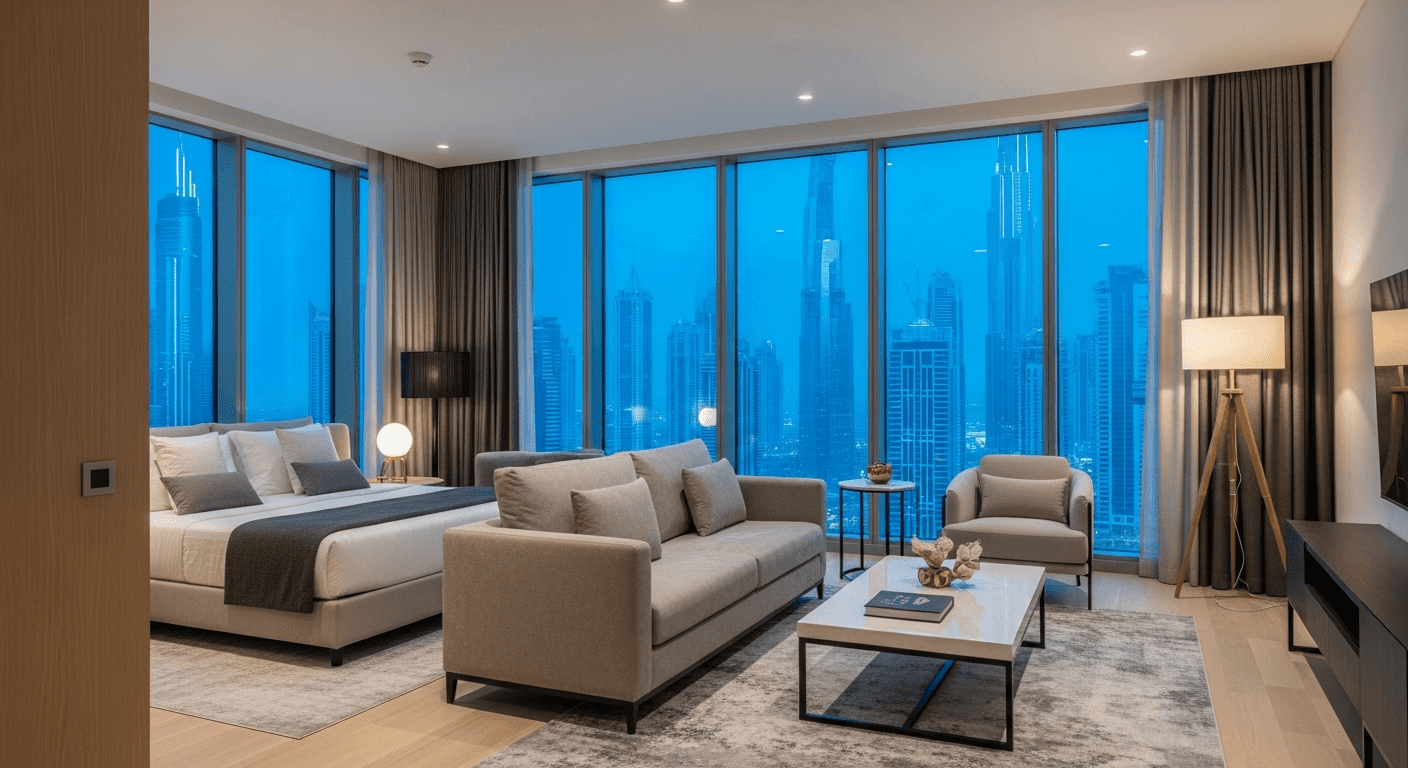
Branded Residences: The Real Dubai Premium
Branded residences command a significant price premium in Dubai, but their true value proposition extends far beyond a luxury label. My analysis shows the real return lies in asset quality, service delivery, and lower-volatility performance over time.

The rise of branded residences in Dubai is one of the market's defining stories. These properties, aligning real estate with globally recognized luxury brands, consistently command headlines and top-tier pricing. The central question for any discerning buyer or investor, however, goes beyond the glossy marketing: what are you actually paying for with the significant premium, and is it a price worth paying? In my view, the answer is nuanced. The value is not merely in the name on the door, but in a specific, measurable bundle of services, management quality, and risk mitigation that can justify the cost — if you choose the right project.
Here’s a look at how we will deconstruct the premium:
- What truly defines a 'branded residence' in Dubai's market context.
- A data-driven look at quantifying the price premium.
- The tangible benefits: service, amenities, and management.
- The intangible value: brand association and resale liquidity.
- An analysis of rental performance and yield potential.
- A line-by-line breakdown of the true cost of ownership.
- My final verdict on whether the premium is justified.
Defining the Category: More Than Just a Name
The term 'branded residence' is applied liberally in Dubai's dynamic property market, yet not all branded projects are created equal. As an analyst, I see the market segmenting into distinct tiers, and it's critical for buyers to understand the differences. The quality of the brand association directly correlates with the tangible benefits an owner receives. At the top of the pyramid are the hotel-managed residences. These are projects integrated with five-star hotel operations from brands like Four Seasons, St. Regis, Ritz-Carlton, or homegrown champions like Address Hotels by Emaar Properties. Here, residents have access to the full suite of hotel amenities and a la carte services, from in-residence dining and housekeeping to a world-class concierge. The management and maintenance are handled by the hotel operator, ensuring the property is kept to a consistent, institutional standard.
One step removed are residences affiliated with a hotel brand but managed separately. While they share the name and often some amenities, the integration is less complete. Below this, a rapidly growing category is that of fashion, jewelry, and automotive brands licensing their names to a development. Think of projects by Bvlgari, Armani, Cavalli, Bugatti, or Mercedes-Benz. While these bring a powerful design aesthetic and a built-in marketing narrative, the value proposition rests heavily on the quality of the underlying developer and the appointed property management company. The services offered can be excellent, but they lack the proven, globally consistent operational model of a major hotelier. The risk is that you are paying a premium for a design concept rather than a service infrastructure.
My primary concern is when the brand is merely a skin-deep marketing tool. An investor must ask: who is managing the building in ten years? A hotel like The Ritz-Carlton has a century of experience and a global reputation to protect with every property it manages. This provides a powerful incentive to maintain standards long after the developer has sold the last unit. For fashion or automotive brands, real estate is not their core business. Therefore, the long-term value of such a project is intrinsically tied to the developer's commitment and the third-party operator's quality. At Gaia Living, when we advise clients on the Dubai branded residences investment case, we compel them to look past the logo and scrutinize the Service Level Agreement (SLA) and the operator's track record. The real value is in the execution, not just the name.
Quantifying the Premium: What Do the Numbers Say?
 Featured project
Discussions about the premium for branded residences are often vague. Let's ground this in the directional data we observe in the market. Across global real estate hubs, the premium for a branded residence over a comparable non-branded luxury property is well-established. In Dubai, this figure typically sits in a range of 25% to 40%. This is not a fixed rule; it's a market average. For an ultra-prime trophy asset, such as an apartment in Atlantis The Royal on Palm Jumeirah or a waterfront villa by a top-tier hotelier, the premium can easily exceed 100% over a generic luxury building nearby. The market is clearly willing to price these assets in a different category altogether.
To make this concrete, consider a hypothetical scenario in a prime central location like Downtown Dubai. A high-quality, non-branded 2,000-square-foot, two-bedroom apartment with premium finishes and good amenities might trade for AED 5 million, or AED 2,500 per square foot. An equivalent apartment in a neighbouring hotel-branded tower — like The Address or a St. Regis, could realistically be listed for AED 6.5 million to AED 7 million, which is AED 3,250 to AED 3,500 per square foot. This represents a 30-40% premium. What is the market pricing in? It's a combination of factors: the superior quality and range of amenities, the service provision, the prime location often secured by these brands, and the intangible value of the brand itself.
This premium is not static; it evolves with market cycles. My analysis of past downturns suggests that while branded residences are not immune to price corrections, their value tends to be more resilient. They often experience smaller declines and faster recoveries compared to the broader luxury market. This 'defensive' characteristic is part of what an investor is buying. The global recognition of the brand provides a floor on the price that a non-branded, locally-known building might not have. The buyer pool for a Four Seasons residence is global and mobile; the buyer pool for 'Al Dana Tower' is, by comparison, much more localized. This broader demand base is a crucial factor that underpins the *branded residences premium Dubai* and justifies a portion of the higher initial outlay.
The Tangible Value: Service, Amenities, and Hassle-Free Management
Beyond price metrics, the tangible benefits are where the value proposition of a true hotel-branded residence becomes clear. This is what you physically see, touch, and experience, and it's what separates this asset class from standard luxury. The core of this is the integration of hotel-level services into daily life. This is not simply a better-than-average concierge; it's a fully staffed operation designed to provide smooth convenience. For an owner, this translates into a quantifiable improvement in quality of life and a significant reduction in the administrative burden of property ownership.
Let’s itemize what this typically includes: - 24/7 Concierge and Valet: A professionally trained team to handle everything from reservations and transport to deliveries and guest assistance. - A La Carte Services: The ability to order housekeeping, in-residence dining from the hotel's restaurants, laundry, and maintenance services on a pay-as-you-go basis. - Security: Enhanced security protocols, managed by the hotel's professional team, providing a higher level of safety and privacy. - Centralized Billing: All services are often billed to a single owner account, simplifying management.
Second, the amenities are on a different scale. A standard luxury building might have a nice gym and a pool. A branded residence is more likely to feature a state-of-the-art wellness center with spa treatment rooms, multiple swimming pools (including residents-only pools), private cinemas, residents' lounges for work or entertainment, and high-end F&B outlets right in the building. Projects like the Four Seasons Private Residences in DIFC or those along the Dubai Water Canal exemplify this, offering an ecosystem of luxury facilities that become an extension of one's home. This is a powerful draw for end-users seeking a lifestyle of ultimate convenience.
Finally, and perhaps most importantly for investors, is the hassle-free management. The hotel operator takes responsibility for the maintenance of not just the common areas but often the technical aspects within the apartments themselves. This ensures the entire building is kept in pristine condition, which protects the long-term value of the asset. For an overseas investor, this is a turnkey solution. There are no calls about a leaking pipe or a faulty AC unit. The brand's reputation is on the line, so they are incentivized to maintain the property to the highest standard. This peace of mind has a real, monetary value, particularly for those who own property as a pure investment rather than a primary home.
The Intangible Value: Brand Trust and Resale Liquidity
While services and amenities are tangible, a significant portion of the premium is tied to intangible factors that are harder to quantify but no less real. Chief among these is brand trust. In a global city like Dubai, which attracts buyers from over 200 nationalities, a well-known international brand acts as a powerful quality assurance signal. A buyer from London, Hong Kong, or Moscow may not know the track record of a local developer, but they know what to expect from a St. Regis or a Mandarin Oriental. This de-risks the purchase decision, lowers the barrier to entry for international capital, and creates a baseline of trust that a standalone building cannot easily replicate.
This brand association also confers a 'trophy asset' status onto the property. Owning a piece of an iconic brand is a powerful statement. This emotional and status-driven component of demand should not be underestimated, particularly at the ultra-high-net-worth level. For these buyers, the property is not just a home or an investment; it is part of their personal portfolio of luxury goods. This demand, driven by factors beyond simple square footage and location, helps to insulate the asset class from the purely functional considerations that drive the mainstream market.
“The most crucial intangible benefit, in my professional opinion, is enhanced resale liquidity. In a stable or rising market, everything sells. The true test of an asset's quality is its performance in a slow or correcting market. Branded residences tend to perform better in these conditions for one simple reason: their target market is wider and deeper. When you list a branded property for sale, you are not just marketing to local buyers. You are marketing to a global network of brand loyalists and HNWIs who actively seek out these properties. This global marketing reach, often amplified by the brand's own channels, means there are more potential buyers at any given time, which leads to faster sales and less price erosion. An owner is paying a premium upfront for the benefit of a more orderly and predictable exit in the future.”
Analyzing Rental Performance and Investment Yields
The ultimate test for any investment is its performance. When analyzing the *luxury branded apartments performance*, we must look beyond gross rental figures and focus on the net return. It's true that branded residences typically command a significant rental premium, often fetching 20-35% higher rents than comparable non-branded units in the same vicinity. This is driven by demand from high-level executives, diplomats, and affluent individuals on extended stays who are willing to pay for the services, security, and prestige that come with a branded address. The property appeals to a corporate tenant base that is less price-sensitive and more focused on quality and convenience.
A key feature for investors in many hotel-branded projects is the option to place their unit into a managed rental pool. The hotel operator markets and rents out the apartment as part of its inventory, handling all guest interactions, billing, and maintenance. This offers a path to truly passive income. The upside is access to the hotel's powerful marketing engine and global distribution systems, which can lead to higher-than-average occupancy rates. However, this convenience comes at a cost. The management fee for a rental pool is substantial, often taking 40-50% of the gross rental revenue, which covers all operational, marketing, and management expenses. This is a stark contrast to the 5-8% fee a standard real estate agent might charge for a simple tenant-finding service.
Therefore, calculating the net yield is essential. While the gross rent is higher, so are the outgoings. Service charges are significantly higher, and if you're in a rental pool, the management fee is a major deduction. Let's compare a simplified example. A non-branded apartment might generate a 5% net yield with active management from the owner. A branded residence, after accounting for its much higher service charges and potential rental pool fees, might also generate a 5% net yield. So where is the advantage? The argument is that the branded residence achieves a similar yield but with far less volatility, zero owner effort (in a rental pool), and superior long-term asset value preservation. The return is not just financial; it's a return on time and a reduction in risk.
The True Cost of Ownership: A Line-by-Line Breakdown
To make an informed decision, a potential buyer must understand the full financial picture. The sticker price is just the beginning. The higher recurring costs associated with branded residences are a critical part of the equation. Let's walk through a realistic cost breakdown for acquiring a hypothetical two-bedroom branded residence in a prime area like Business Bay. This analysis is crucial for anyone considering a *Dubai branded residences investment*.
Case Study: Acquiring a AED 5,000,000 Branded Residence
First, let's look at the one-time upfront costs required to take ownership:
- Purchase Price: AED 5,000,000
- Dubai Land Department (DLD) Transfer Fee: 4% of purchase price = AED 200,000. This is a mandatory government fee, as stipulated by the Dubai Land Department (DLD).
- DLD Registration Fees (Title Deed Issuance): Approximately AED 4,200 (this includes an AED 4,000 fee + AED 20 admin fee).
- Real Estate Agency Fee: Typically 2% of the purchase price + 5% VAT. (0.02 * 5,000,000) * 1.05 = AED 105,000.
- Developer's No Objection Certificate (NOC) Fee: This fee varies but is typically between AED 1,000 and AED 5,250 (including VAT). Let's use an estimate of AED 5,250.
- Total Upfront Cost (Cash Purchase): Approximately AED 5,314,450
If you are using a mortgage, you would also need to account for bank arrangement fees (up to 1% of the loan amount) and a property valuation fee (approx. AED 3,000). Remember, under Central Bank of the UAE regulations, expatriate buyers typically need a minimum down payment of 20% for a first property, so for this purchase, you would need at least AED 1,000,000 in cash for the down payment, plus the transaction costs.
Now for the recurring annual costs, which is where the difference truly lies: * Annual Service Charges: This is the most significant differentiator. A standard luxury building in Business Bay might have service charges of AED 20-25 per sq. Ft. A branded residence could easily be AED 40-60 per sq. Ft. Assuming our 1,500 sq. Ft. apartment has a branded service charge of AED 45 per sq. Ft.: 1,500 sq. Ft. * AED 45/sq. Ft. = AED 67,500 per year. * Compare this to a non-branded equivalent at AED 22 per sq. Ft.: 1,500 sq. Ft. * AED 22/sq. Ft. = AED 33,000 per year. That's a difference of over AED 34,500 every single year, money that goes directly toward funding the superior service and amenities. This cost must be factored into any rental yield calculation.
This breakdown demonstrates that the premium for a branded residence is not a one-time event at purchase. It is an ongoing financial commitment. Buyers must be comfortable with these higher recurring costs and see them as a fee for the lifestyle, convenience, and asset preservation they are receiving.
Market Trends: Where is the Sector Headed?
The Dubai market for branded residences is not just growing; it's accelerating and diversifying. The pipeline of new projects is robust, solidifying Dubai's position as a global leader in this segment, rivaling and in some cases surpassing markets like Miami and New York. The key *branded residence market trends* I see shaping the coming years are diversification, geographic expansion, and a deepening focus on holistic lifestyle offerings. We are moving beyond the initial wave of hotel-branded towers and into a more mature and varied market landscape.
One major trend is the proliferation of brands from outside the traditional hospitality sector. We have seen a surge in collaborations with high-fashion, jewelry, and automotive giants. Projects from developers like Binghatti with Jacob & Co. or Damac with Cavalli are prime examples. The Bugatti Residences by Binghatti and the forthcoming Mercedes-Benz Places represent a new frontier. From an analyst's perspective, these are more speculative plays. The value is tied to the novelty and the design language. My caution to buyers is to assess whether the brand brings genuine operational value or if it is purely an exercise in marketing. The long-term success of these projects will depend entirely on the quality of the underlying developer and the appointed management company.
Geographically, the concept is also breaking new ground. While prime hubs like Downtown Dubai, Palm Jumeirah, and the Marina remain the epicenters, we are seeing branded residences launch in emerging destinations. Ambitious projects in Ras Al Khaimah's Al Marjan Island and new developments along Dubai's coastline are attracting top-tier hotel brands, signaling confidence in these areas' long-term potential. This expansion provides new entry points for investors, but it also requires careful due diligence. The success of a branded residence is still fundamentally tied to its location. A great brand cannot salvage a poor location. Finally, the nature of the 'brand' itself is evolving. The next wave of luxury is focused on wellness and sustainability. We are beginning to see projects that brand themselves around a wellness concept, offering not just a spa but a fully integrated healthy-living ecosystem. This aligns with a global shift in consumer preferences among the wealthy and is a trend I expect to see gain significant momentum.
My Verdict: Is the Premium Justified?
After dissecting the costs, benefits, and market dynamics, my conclusion is that the premium for a branded residence in Dubai can be justified, but only for the right asset and the right buyer profile. It is not a universally superior investment, but a distinct one with a specific set of advantages and disadvantages. The decision hinges entirely on an individual's financial goals, lifestyle preferences, and tolerance for the associated costs.
For the end-user — the individual or family who plans to live in the property, the calculation is often more straightforward. If you highly value time, convenience, and access to five-star services and amenities, then the premium is often a price worth paying. You are not just buying square footage; you are buying into a managed lifestyle. The higher annual service charges are, in effect, a subscription fee for an effortless, luxury living experience. For this buyer, who intends to use the concierge, the in-residence dining, and the exclusive facilities, the value is experienced daily. The key is to ensure the brand's promise is backed by a reputable operator, particularly a world-class hotelier.
For the pure investor, the math is colder and more complex. The high entry price can be a drag on capital appreciation, and the higher running costs can compress net yields. I would argue that a branded residence is not the vehicle for maximizing speculative gains or achieving the highest possible rental yield. Instead, its primary investment virtues are defensive. You are buying lower volatility, superior asset quality preservation, and enhanced resale liquidity. It is a lower-hassle, more institutional-grade residential investment. In a portfolio context, it can play the role of a stable, blue-chip holding. My advice to investors is to focus relentlessly on hotel-branded projects in prime locations, as this combination has the most proven track record of value retention and performance.
The premium for a branded residence is not a fee for a logo; it is a payment for a bundle of tangible and intangible benefits: operational excellence from a hotelier, a higher standard of amenities, hassle-free ownership, and superior market liquidity. The value is real, but buyers must be clear-eyed about the significant and ongoing costs, and choose projects where a world-class operator underpins the brand's promise.
## Sources - Dubai Land Department (DLD): https://dubailand.gov.ae/ - Central Bank of the UAE (CBUAE): https://www.centralbank.ae/
Questions, answered
- Are service charges in Dubai's branded residences negotiable?
- No, service charges are non-negotiable. They are set by the operator and approved by the Dubai Land Department (DLD) based on the actual cost of maintaining the property and providing the contracted services. Owners are legally obligated to pay them.
- Do branded residences guarantee higher rental income?
- While they typically achieve higher gross rental income than comparable non-branded units, this is not guaranteed. The higher income is often offset by significantly higher service charges and, if used, rental pool management fees. The primary benefit is often rental stability and professional management rather than a dramatically higher net yield.
- Can I live in my branded residence full-time?
- Yes, in most cases. The majority of branded residences in Dubai are sold on a freehold basis for full-time occupation. However, if you opt to place your unit in a hotel rental pool, your personal usage may be restricted to a certain number of days per year as per your agreement with the operator.
- What is the average price premium for a branded residence in Dubai?
- The premium varies widely but generally falls between 25% and 40% compared to a non-branded luxury property of similar size, quality, and location. For ultra-exclusive projects by top-tier hotel brands in prime locations like Palm Jumeirah, the premium can exceed 100%.
- Is the 'brand' the most important factor when investing in a branded residence?
- While the brand is important for recognition and trust, the operator's quality and the service level agreement are more critical. A well-managed property by a reputable hotel operator provides more tangible value than a property that simply licenses a famous fashion or automotive name without the operational expertise to back it up.

Amara translates DLD transaction data, supply pipelines, and macro signals into clear calls on where Dubai's market is heading. She writes the numbers most brokers only feel.
Related stories

Dubai's Big Squeeze: Smaller Plots, Denser Living
Dubai real estate is undergoing a fundamental shift towards smaller plot sizes and higher density. We analyse the economic drivers, the impact on property values, and what this new era of compact urban living means for both homebuyers and investors.
Resort Living as Your Dubai Reality
Explore how to trade temporary staycations for a permanent home with five-star amenities in Dubai. I'll break down the real costs, best communities, and lifestyle trade-offs of embracing high-end resort living every day.
Finding Your Tribe in Dubai's Villa Communities
I explore which of Dubai's renowned villa communities attract specific expat nationalities and lifestyle groups, offering insights to help you find a place that feels like home.
Echoes, in your inbox
One thoughtful email a month. Market insight, new launches, no spam.